
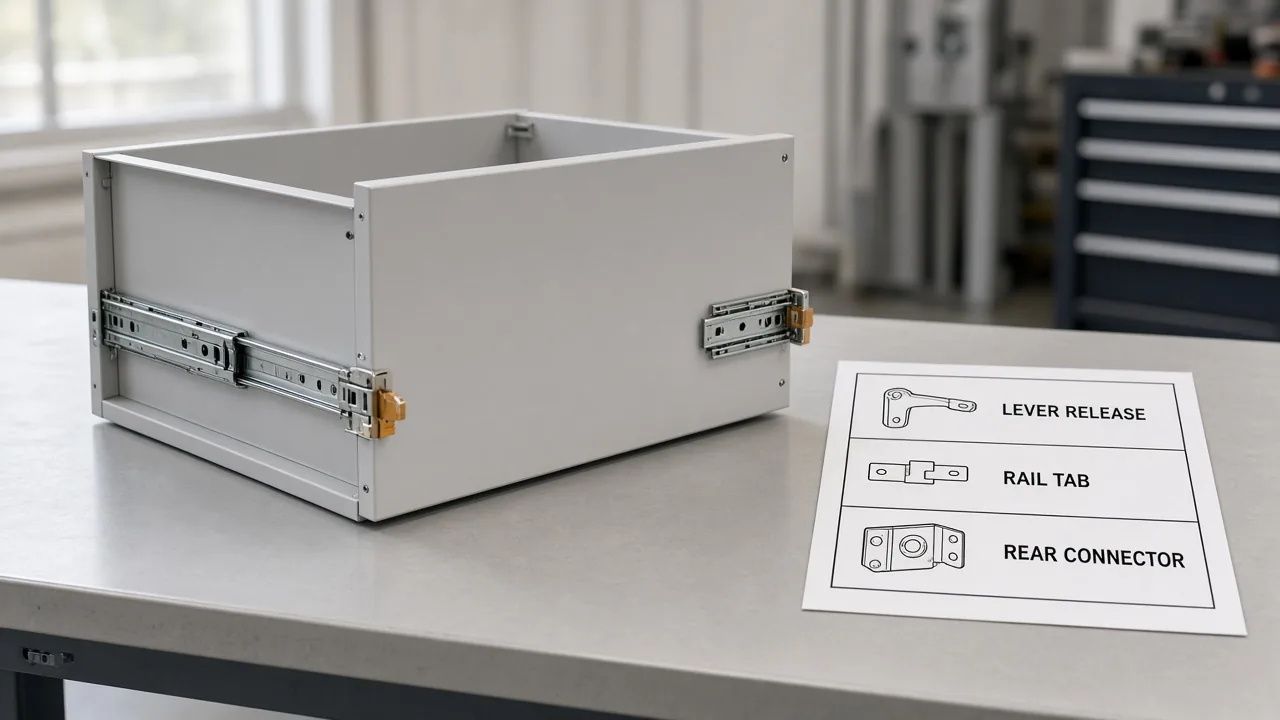
A service sheet can tell a buyer how to remove a drawer from a cabinet only after the packed disconnect family is named from the slide’s install or service sheet. The family is a lever, a rail tab, a rear connector, or a documented no-lever release. The map is the official release path that belongs to that packed family, not a generic lift-and-pull guess.
First-hang of the slides belongs on the companion install file in this batch. Disconnect-latch procurement, including release access, intended removal, travel stop, and retention as a buying decision, belongs on the live latch RFQ. Uninstalling the slide members themselves is a different job. None of those decisions is this drawer-box release map, and none should be rewritten as one.
This guide is for importers, distributors, and private-label teams approving service-sheet wording for drawer-box removal on slides already in the live OEM library. Koitor Hardware is a family-owned China OEM manufacturer of custom metal bathroom and home storage hardware. Adjacent drawer-slide OEM pages already sit in that published library.
That published-library fact is not a claim that Koitor currently manufactures a named slide SKU or a complete drawer box. Send the slide drawing or service sheet, the disconnect family, and the intended cabinet use. We can review the wording and the map scope. We will not issue a universal lift-and-pull method, a force chart, or an interchange claim.
What does a how to remove a drawer from a cabinet file actually freeze?
It freezes the packed disconnect family and the official release map that family can support. It does not freeze first-hang of the slides, a latch-procurement RFQ, uninstall of the slide members, or a dresser, desk, or file-cabinet tutorial.
Searchers often ask how to remove a drawer from a cabinet because a lever is hidden, because there appears to be no lever, or because a vanity drawer will not come free. That demand is real. For an importer, the usable decision is whether a listing or a service sheet may say the drawer is easy to remove, and which packed disconnect family is being promised.
A lever, a rail tab, a rear connector, and a documented no-lever release do not share a map, even when the slide finish matches. If the sheet does not say which family shipped, an easy-to-remove line will be applied to the wrong slide. This file is not a consumer furniture tutorial, and it is not a product listing.
Related phrases such as how to remove a drawer with no lever, how to remove a drawer from a vanity, and how to remove a drawer with full-extension or ball-bearing slides are coverage of the same cabinet drawer-box decision when the packed family is named. They are not a license to borrow the parent “how to remove a drawer” volume, which failed a noData SERP and is not this target.
Ein OEM home storage hardware manufacturer can review whether a service sentence and a packed disconnect family stay together. Matching a slide finish or a drawer box to a collection is not the same as inventing a default release motion or a timed removal method. If you are screening this line, bring the intended disconnect family and the official leaflet with the drawing.
A published “easy to remove” claim is only as complete as the named family and the official map. If the photograph shows a lever and the packed slide uses a rear connector, the sheet has already failed, even if the members look familiar.
This file can precede a service-program RFQ. It should not be turned into a catalog page, a first-hang manual, a latch-procurement essay, or a furniture-drawer tutorial. Those jobs already have, or should keep, their own files.
Which packed disconnect family must be named first?
Name the packed family first: lever, rail tab, rear connector, or a documented no-lever release. Then pack or cite the official map that belongs to that family, or mark the map as documented only on the supplier’s current service sheet. Do not start with a generic lift-and-pull, and do not start with an undocumented bypass.
A lever family uses a packed lever or paddle on the slide or the drawer member. The sheet should say so, and it should say where that lever is reached if that access is part of the official leaflet. “Push the lever” is not a complete family line if the packed slide does not use a lever, and this page will not invent the motion as a factory default.
A rail-tab family is a different release, even when the slide looks similar. The official map must name the tab or rail release the SKU actually ships. A lever leaflet copied onto a rail-tab carton is already the wrong map, regardless of extension length.
A rear-connector family releases at the back of the drawer or slide, not at a side lever. Name that family in plain language and pack or cite the official map that belongs to it. Do not hide a rear connector under a generic “just pull the drawer” photograph.
A no-lever release may be printed only when the supplier’s current official sheet documents that release. “No lever” in a search query is demand evidence, not a license to invent a motion or a destructive workaround. If the official sheet does not document a no-lever path, the service sheet must not invent one.
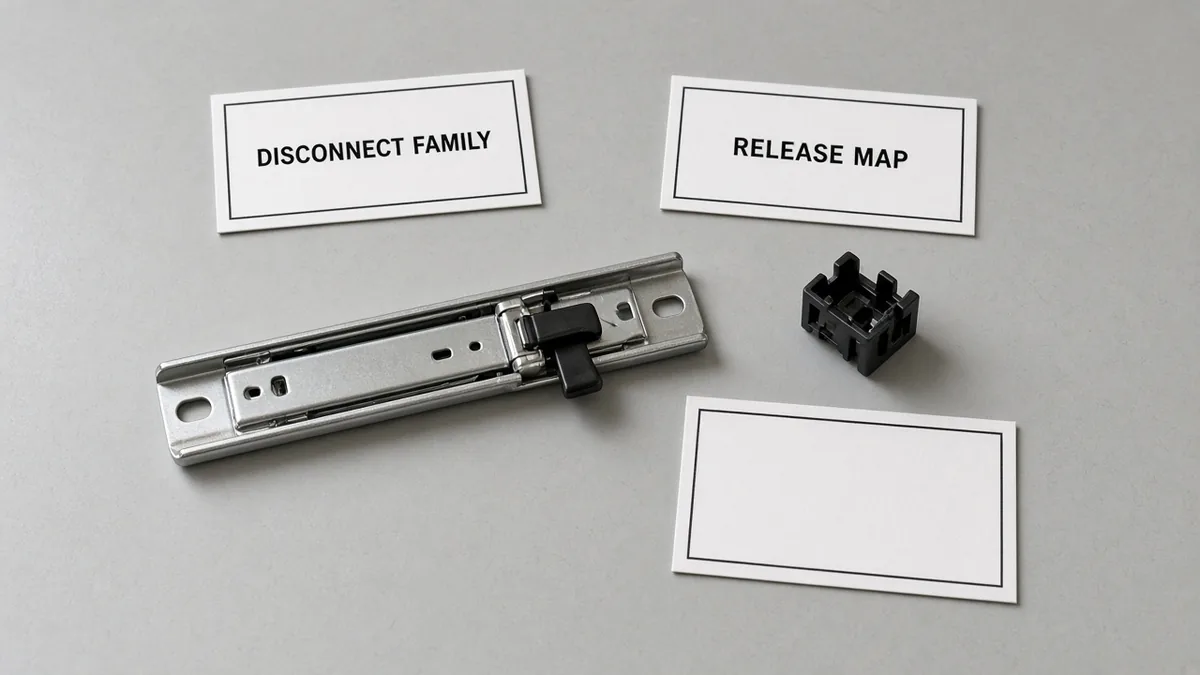
Full-extension or ball-bearing phrasing does not, by itself, name the disconnect family. Those are motion or construction features. Name the family first, then use those phrases only as coverage if they help identify the packed slide.
How to remove a drawer slide is slide-member uninstall, not this box-release file. How to remove a drawer front is a front-fixing decision, not box release. Keep those jobs off this sentence, even when they appear in the same search mix.
What belongs in the service-sheet map, and what must stay out?
The map should include the packed disconnect family, the official release path or a pointer to the supplier’s current official sheet, and a clear exclusion of undocumented motions and furniture-drawer instructions. It should not include a first-hang screw sequence, a latch-procurement table, or a dresser tutorial.
A hardware kit packing inspection checklist is a useful neighbor when you are comparing a service pack or a spare-lever bag to the sheet. That checklist does not invent a release motion. It only asks whether the named parts were packed. Use it as a completeness check, not as a substitute for the family line.
| Family or claim | What must be named | What the official map may print | What this row is not |
|---|---|---|---|
| Lever | That the packed slide uses a lever or paddle, and how that lever is reached if the official leaflet says so | The official lever path, or a pointer to the supplier’s current official sheet | A rail-tab or rear-connector leaflet, or a factory-universal motion invented from a forum thread |
| Rail tab | Rail-tab family, in plain language | The official tab path that belongs to this SKU | A lever sentence copied onto a tab slide |
| Rear connector | That release happens at a rear connector, not at a side lever | The official rear-connector path, or a pointer to the official sheet | A “just pull” photograph used as the map |
| Documented no-lever release | That the supplier’s current official sheet documents a no-lever path | Only that documented path, clearly cited | An undocumented bypass, a destructive method, or a borrowed no-lever internet trick |
| Easy to remove | The packed family and official map the sentence is allowed to assume | Nothing beyond that official map | A dresser, desk, or file-cabinet tutorial, or a first-hang of the slides |
Keep first-hang architecture and kit on the companion how to install drawer slides file. This release map may name the disconnect hardware that is already on the installed slide. It should not become a first-hang screw sequence.
Do not fill a blank motion or force field with a plant default. If a later buyer file names a required official path and cites a source, the sheet may repeat that path and cite the source. Until such a source exists, keep the family named and leave unsourced motions off the carton.
Why are dresser and file-cabinet tutorials not this service map?
They are different products and unvalidated volumes. How to remove a drawer from a dresser, a file cabinet, or a desk appeared in the research mix as furniture or file-cabinet leaks. They were not officialed as this page’s target, and their volume must not be borrowed. A cabinet drawer on a packed slide family is the job this file can freeze.
Third-party videos and forum threads are demand evidence. Quote them only as proof that the packed family must be named. Do not copy a lift-and-pull trick, a “wiggle until it comes free” method, or a furniture-drawer sequence as a Koitor standard. This page will not teach an undocumented no-lever bypass, even as a warning list of steps.
Brand-navigational phrases, including phrases built around another company’s slide model, are not this page’s target. Describe the hardware in disconnect-family and official-map terms. Do not borrow a competitor’s removal video, or that video’s search volume, as a Koitor standard.
A force number, a travel measurement, or an interchange claim is also out of scope unless a cited buyer file already supplies it. This pack does not authorize inventing those figures.
Which neighboring drawer-slide files should stay out of this sentence?
First-hang architecture and kit stay on the companion article in this batch, how to install drawer slides. Point new-install questions there by name. Do not merge box release with first hang because both mention disconnect hardware.
Type classification stays on the Drawer Slide Types: Separate Mounting, Extension and Motion Features file. This service file may use a type name to help identify the packed slide. It should not reprint the classification argument.
The live disconnect-latch RFQ, hold-out or lock-out files, and undermount locking-device compatibility files are neighbors, named in prose only when they are missing from the lock copy. Do not invent addresses for them. This box-release map should not become those procurement or detent files.
A fixing-arrangement neighbor that is in the lock copy is the Drawer Slide Breathing Tabs: Check What the Fixing Arrangement Preserves file. That page is not a drawer-box release sequence. Leave it as a neighbor, not as this thesis.
Nominal length, parallelism, and soft-close files also stay off this sentence. Slide-member uninstall stays off this sentence. Front-fixing, “how to remove a drawer front,” stays off this sentence.
What should be checked before a listing says the drawer is easy to remove?
Check the packed disconnect family, the official map or official-sheet pointer, the furniture exclusion, and the bypass exclusion before any easy-to-remove sentence is printed. If any of those is missing, the sentence is not ready, even if the drawer box photographs well.
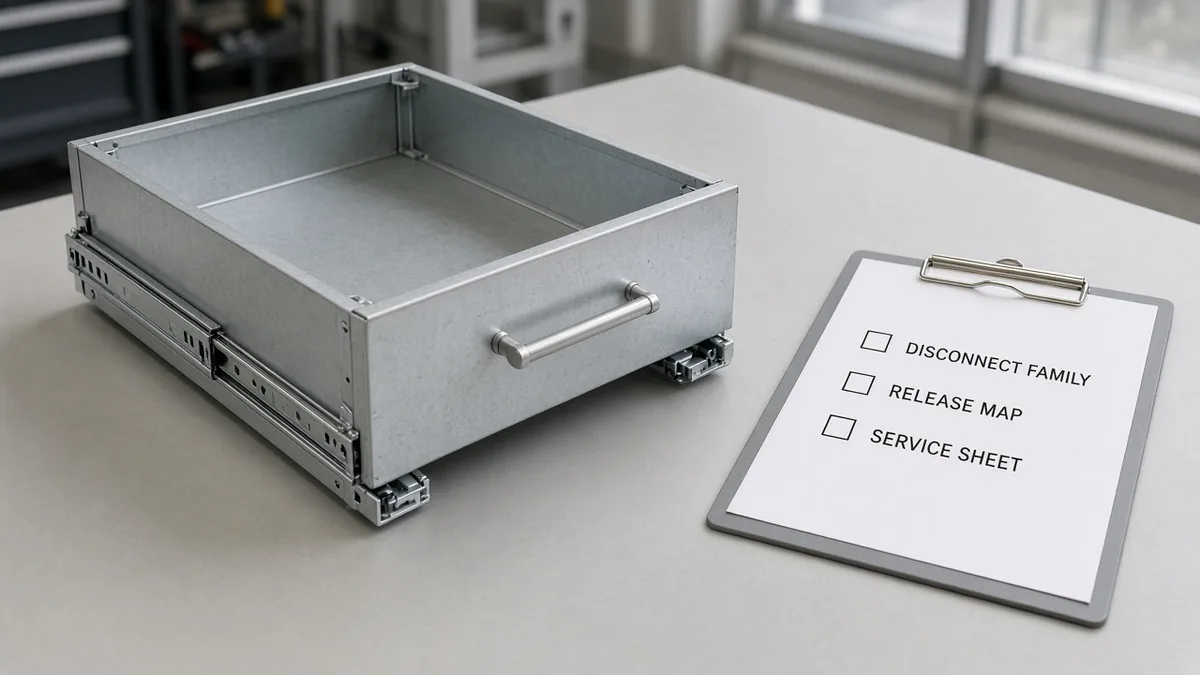
- Name the packed disconnect family in plain language: lever, rail tab, rear connector, or a documented no-lever release, before any removal sentence is printed.
- Pack or cite the official release map that belongs to that family, or mark the map as documented only on the supplier’s current official sheet.
- Print a no-lever path only when the official sheet documents it; do not invent a motion or a destructive workaround.
- Keep first-hang of the slides on the companion install file in this batch; do not print a screw sequence on a service carton.
- Keep latch-procurement, hold-out, and locking-device questions on their neighboring files, named in prose when the lock copy omits those hrefs.
- Keep slide-member uninstall and drawer-front removal off this box-release map.
- Exclude dresser, desk, and file-cabinet instructions, and do not borrow those volumes or the unusable parent “how to remove a drawer” head.
- Do not print a universal lift-and-pull method, a force chart, or an interchange claim as a Koitor standard.
- Do not print a brand or forum trick as a factory sequence, and do not invent a current named slide SKU.
- Revise the easy-to-remove line whenever the packed family or the official leaflet changes.
Translations on a bilingual carton should follow the same named fields. A no-lever exclusion that appears only in one language is not an exclusion in the other market. Review both languages against the same official family before the easy-to-remove line is translated.
Incoming sample checks can use a simple slide-to-sheet comparison: identify the packed disconnect family on the sample and tick it against the official map. That check is not a force study, and it is not a furniture-drawer trial. It only asks whether the service sheet can be believed.
If a later order adds a rear-connector SKU beside a lever SKU in the same finish, treat that as a new map, not as a sticker change on the same bag. The official path and the instructions may all change. A lever easy-to-remove sentence left on a rear-connector carton will be believed, and it will be wrong.
The same discipline applies when a first-hang carton later gains a service leaflet, or the reverse. The slide may look familiar. The packed decision is a new decision. Reprint the disconnect family before the carton reuses an old easy-to-remove line or an old first-hang line in the wrong place.
How to remove a drawer from a cabinet is not completed by pointing at a types page or a first-hang kit list. Those neighbors remain neighbors. The service sheet is ready only when the packed family and the official map can be believed on their own terms.
Vanity use remains coverage of this same cabinet drawer-box file, not a second furniture page. Name the packed family the same way. A vanity location does not invent a new release motion, and it does not authorize borrowing dresser volume.
Finish and extension length can change without changing the disconnect family, and the disconnect family can change without changing the finish. Treat those as separate fields. A new powder color or a new full-extension member is not, by itself, a license to reuse an old release sentence, and a new rear connector is not a license to keep last year’s lever leaflet just because the drawer box looks familiar.
How to remove a drawer from a cabinet on full-extension or ball-bearing slides remains this same official-map file, not a second service sheet and not a force table. If the carton serves that construction, name the packed family and cite the official path. A longer travel does not authorize a Koitor motion or interchange claim that the official sheet has not supplied.
Sample photographs should not show a lever next to a rear connector in one easy-to-remove frame unless the program truly packs both families and the difference is unmistakable. Incoming inspection can tick the packed family against the official map without turning the bench into a yank test. The check is still a completeness check, not a travel study and not a furniture-drawer rehearsal.
If a project later names a required official path and cites a source, the service sheet may repeat that path and cite the same source. Until such a source exists, keep the family named and leave unsourced motions off the carton. A blank official-path field, pointed to the supplier’s current sheet, is safer than a borrowed lift-and-pull line.
Hold-out or lock-out detents, if they are present on the packed slide, may be named as packed features that are not this release family. Their procurement and in-service meaning stay on the neighboring detent file. This box-release map should not invent a detent bypass in order to get the drawer out, and it should not treat a detent as a fourth undocumented family.
Translations of “no lever” need the same discipline as the official path. In one language the phrase may sound like a documented official release. In another it may sound like an invitation to improvise. Review both languages against the supplier’s current official sheet, and keep unofficial motions off every language on the carton.
If a service program later adds a spare lever or a spare rear connector as a loose bag, treat that bag as a new packed list, not as a sticker on the original slide carton. The official family and the official map still have to match the slide that is already in the cabinet. A spare part does not authorize a universal motion for every slide in the collection.
Häufig gestellte Fragen
Can the listing say the drawer is easy to remove from the cabinet?
Only after the packed disconnect family and the official map are named, and only if the sentence does not go beyond that map. An easy-to-remove line is not a substitute for an unnamed family or an undocumented no-lever trick. This article does not supply a universal lift-and-pull method or a force chart.
What if the slide seems to have no lever?
Name whether the packed family is a rail tab, a rear connector, or a no-lever release that the supplier’s current official sheet actually documents. If the official sheet does not document a no-lever path, do not invent one on this carton. Lost or hidden-lever demand is evidence that the family must be named, not a license to teach a bypass.
Is this the same file as how to install drawer slides?
No. The companion first-hang file freezes architecture and the cabinet-interface kit. This file freezes drawer-box release on an already installed slide. Do not merge the two sentences.
Can dresser, desk, or file-cabinet instructions be added for extra search coverage?
No. Those were furniture or file-cabinet leaks and were not validated as this target. Their volume must not be borrowed, and their sequences must not be printed here.
Should this sheet also tell buyers how to take the slide members out of the cabinet?
No. That is slide uninstall, not box release. Keep it off this map, and do not treat “how to remove a drawer slide” as this page’s question.
Does Koitor currently offer a named drawer-slide catalog SKU?
This article does not assert a current named production SKU, and it does not claim that Koitor supplies a complete drawer box. Adjacent drawer-slide OEM pages already sit in the published library. If you are screening this line, send the intended disconnect family and service-sheet wording for review of wording and map scope.
Arbeiten Sie mit Koitor Hardware zusammen
Need a drawer-box release map reviewed?
Send Koitor the slide drawing or service sheet, the disconnect family, and the intended cabinet use. Our team can review the wording and the map scope, without offering a universal lift-and-pull method. MOQ can start from about 100 pcs depending on the product; samples usually take 5-7 working days after details are confirmed; bulk production usually takes 4-6 weeks depending on the project.
OEM / EIGENE MARKE
Verwandeln Sie diesen Beschaffungsleitfaden in ein Produktdossier
Teilen Sie uns Ihr Zielprodukt, die Größe, die Oberflächenausführung, die Bestellmenge und Ihre Verpackungsanforderungen mit. Ihr Team erhält vor der Angebotserstellung eine praxisorientierte Prüfung der Herstellbarkeit.

 English
 Español
 Português
 Français
 Deutsch
 العربية