
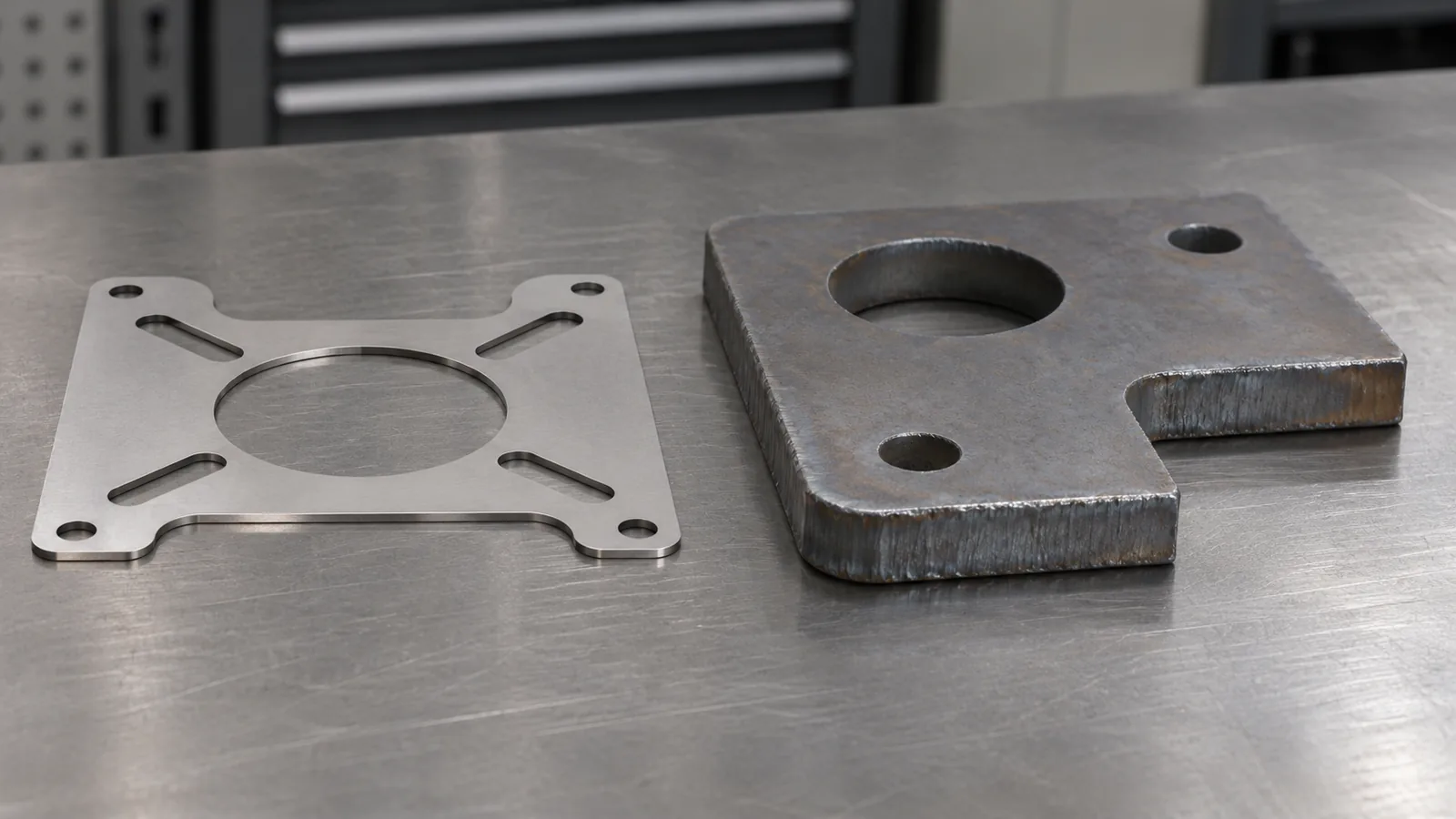
Laser cutting vs plasma cutting is a process comparison, not a universal ranking: the better route depends on the material, thickness, geometry, edge and hole requirements, production setup, and the actual supplier’s equipment and process controls. Plasma cutting creates an arc and ionized gas to cut electrically conductive material; fiber laser cutting uses a focused beam of light. Both can produce metal parts, but their capabilities and results vary by system, consumables, settings, material, and job. For a buyer, compare a representative part and the required acceptance criteria rather than choosing from a broad claim about speed, cost or precision.
What problem does this comparison solve?
A product drawing may specify a cut profile without identifying whether the supplier plans to laser cut or plasma cut it. A buyer may also receive two quotes with different process assumptions and wonder whether they are equivalent. The route can affect edge condition, kerf, feature size, subsequent bending or welding, finishing, nesting, cost and lead-time assumptions. Those effects need to be checked for the specific part and supplier.
This article helps an importer or product developer ask a more useful question: what does the part require, and what evidence shows that the proposed route can meet it? “Laser” and “plasma” identify broad cutting technologies. They do not specify a machine model, power, material grade, thickness range, tolerance, edge quality, hole capability, production volume or acceptance result. One supplier’s comparison is not an independent guarantee for another supplier’s equipment or work. A laser cutting vs plasma cutting review should therefore begin with a controlled part definition and shared acceptance criteria.
The measured search query is broad and may include readers outside B2B manufacturing. The buyer-focused scope here is limited to comparing thermal cutting routes for metal components used in product development and sourcing. It does not provide machine-buying advice, production parameters, a universal price chart or a claim about Koitor’s cutting equipment. Koitor’s approved profile supports custom metal hardware fabrication and drawing/sample communication, not a specific laser or plasma machine inventory.
How the two processes differ in principle
Plasma cutting uses an electrical arc and ionized gas to melt and remove material. The process is associated with electrically conductive materials, and system configurations vary. Fiber laser cutting uses a concentrated beam of light and assist gas to cut a material along a programmed path. “Laser cutting” is itself a broad family; this comparison is specifically about metal cutting with fiber laser systems as discussed in the current technical source.
The mechanism helps explain why material compatibility and part requirements matter, but a mechanism is not a full process specification. The supplier’s actual system, material, thickness, cutting head or torch, consumables, programming, operator setup, maintenance and downstream finishing all affect the result. A label on a quotation cannot establish performance by itself.
| Buyer dimension | Laser route | Plasma route | What to ask for the actual part |
|---|---|---|---|
| Basic mechanism | Focused beam of light; fiber laser is the relevant metal-cutting system here | Electrical arc and ionized gas remove material | Which exact system and setup is proposed? |
| Material | Depends on the laser system and material response | Intended for electrically conductive materials | Exact grade, coating and thickness? |
| Cut geometry | Fine features may be possible on systems suited to the geometry | Contour capability depends on system and part conditions | Smallest holes, slots and internal radii required? |
| Edge acceptance | Must be defined for the material, thickness and finish | Must be defined for the material, thickness and finish | Which burr, taper, dross or heat-related conditions are acceptable? |
| Economics | Depends on utilization, setup, energy, gas and finishing | Depends on utilization, consumables, setup and finishing | Is the quote based on a comparable process and lot size? |
The comparison table deliberately avoids universal thresholds. A supplier may have equipment or process conditions that change the result. Ask for the actual machine/process capability and an agreed sample or inspection method rather than transferring a general web comparison into the purchase specification. In a laser cutting vs plasma cutting quotation review, the same material, thickness, quantity and finishing scope need to be held constant before comparing the proposed routes.
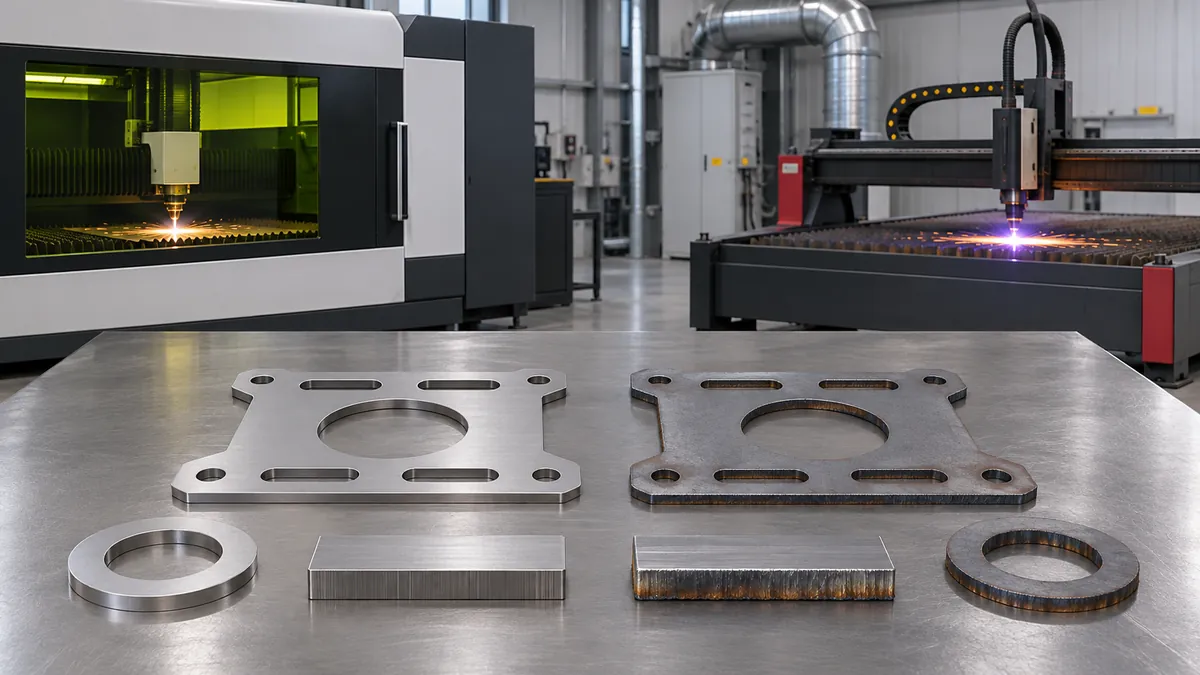
What should buyers compare on a real component?
Material and thickness
Start with the material designation and actual supplied form. Different grades, surface layers and thicknesses can affect the cutting setup and edge result. Plasma requires electrically conductive material; laser system capability depends on the actual machine and material combination. Do not assume a vendor’s general range covers a particular material, coating or part geometry.
If the drawing leaves the material open, state that the quote is preliminary and ask the supplier to list assumptions. If the material is specified, keep it fixed while comparing cutting routes so the evaluation does not accidentally compare two different part definitions. A process change should not silently change the substrate, thickness or surface finish.
Features and tolerances
List the critical features: holes, slots, narrow bridges, tight corners, fine contours, tabs, notches, edge distance and any alignment surface. Identify which dimensions are functional and which are reference only. The process family alone cannot promise that a given hole or contour will meet a tolerance. The supplier’s machine, programming, material movement, fixturing and inspection method all matter.
For a hardware component that will be bent or assembled later, compare the cut profile and the downstream fit. A small change in a hole, notch or edge can affect a bend line, fastener, bracket or cosmetic seam. If the feature is critical, identify it on the drawing and agree the measurement or sample check before release.
Cut edge and downstream finishing
Describe the edge condition needed after cutting. Buyers may care about dross or burr, edge taper, heat tint, roughness, sharp edges, appearance, or the amount of grinding or polishing allowed. The term “clean cut” is too general unless the buyer and supplier connect it to visible criteria or a measurement method.
For a visible bathroom or home-storage hardware part, the cut edge may later be bent, welded, ground, polished or coated. The route should therefore be evaluated with the intended finishing sequence. Ask what additional deburring or preparation is included in the quote and what edge condition is delivered before the next operation. Do not assume a supplier’s process brochure covers the exact finished-part requirement.
Quote and production assumptions
Ask the supplier to identify the proposed route, material, thickness, lot size, nesting or setup assumptions, edge finishing, inspection and any excluded operations. A unit price can differ because the quotation includes different cutting, post-processing, packaging or inspection—not only because one technology is inherently cheaper.
For a fair comparison, hold the drawing revision, material, quantity, finish and acceptance criteria constant. Ask each supplier to separate the cutting process from subsequent grinding, bending, welding or coating where those costs matter. State whether the sample price is for a first article, a design iteration, or a representative production sample. Avoid converting a laser cutting vs plasma cutting comparison into a cost claim without comparable quotes.
A route-selection decision framework
Use the following sequence to narrow the decision without treating a process name as a shortcut:
- Freeze the part definition. Confirm the material, thickness, drawing revision, quantity and finish.
- Mark critical features. Identify the holes, narrow slots, edges, corners and alignment surfaces that matter to fit or assembly.
- Define edge acceptance. State visible and functional edge requirements, including any planned deburring, grinding or polishing.
- Ask for the actual route. Have the supplier name the proposed process and relevant machine setup or capability evidence for the part.
- Review process interactions. Consider how cutting affects later bending, welding, assembly, coating and packaging.
- Request a representative sample if needed. Use the sample to assess the defined features, not to infer untested performance.
- Compare equivalent offers. Ensure that price and delivery assumptions include the same operations and acceptance requirements.
- Control changes. Require written approval before a process, material, thickness or finishing change that can affect the part.
This framework keeps the decision grounded in the product, not a general ranking. If neither process can demonstrate the needed feature at the agreed acceptance level, the buyer may need a different cutting method, geometry, tolerance or product design review. That conclusion should be based on actual supplier capability and engineering needs, not a slogan about one process always being more precise.
Hypothetical hardware example
Imagine a flat mounting plate for a bathroom storage product with a set of holes, narrow slots and an exposed outer contour. The buyer should mark which holes control assembly, which edge is visible after coating, and whether the plate will be bent or welded later. Then the supplier can propose a cutting route and state how it will verify those features. If a laser and plasma quote differ, the buyer should compare the actual sample and included finishing rather than assuming the lower price or more familiar process is automatically acceptable.
This example is hypothetical. It is not a Koitor customer order, production result, equipment claim or tested part. It demonstrates how to connect a process choice to a drawing and an acceptance plan.
Build an acceptance plan around the part
A useful process comparison starts by separating the features that matter from those that are merely visible in a drawing. Buyers often send a profile and ask for “laser or plasma” without identifying which dimensions control assembly, whether a cut edge remains exposed, or how much cleanup is allowed. The supplier then has to make assumptions, and two technically plausible quotations may represent different deliverables. Before comparing routes, mark functional features, cosmetic surfaces and secondary operations on the same controlled drawing revision.
Identify critical features before requesting samples
For a mounting plate or bracket, critical features might include hole centers, slot width, a datum edge, a tab that enters a mating component, or a contour that must clear an adjacent part. The buyer should state the nominal dimension and tolerance for each feature that actually controls fit. Avoid applying a tight tolerance to every dimension without a functional reason: that can create cost and inspection burden without improving the assembly. Conversely, an apparently simple cutout may deserve a tolerance if it controls a screw, insert or locating feature.
Ask the supplier how it will measure those characteristics and what sample evidence it can provide. A visual review can reveal obvious burrs, edge damage or distortion, but it cannot establish dimensional conformance for a critical slot. A measurement report must identify the drawing revision, feature, method and sample part; a number without that context is hard to compare. If a feature is not measurable with the buyer’s available tools, agree in advance whether the supplier will provide records or whether a suitable gauge is needed.
Describe edge condition in observable terms
“Good edge quality” can mean different things to different teams. A buyer can make the requirement clearer by stating whether the edge is hidden, touched during installation, visible after assembly, or exposed to a later finish. Identify unacceptable sharpness, loose dross, burrs, notches or visible heat discoloration only where those conditions matter. If the part will be deburred or polished later, say which operation is included and whether the post-process edge is the acceptance point.
Do not turn a single photograph into an undocumented acceptance standard. A photo may help locate a cosmetic area, but scale, lighting, image processing and viewing angle can hide or exaggerate details. If visual appearance is important, provide a controlled reference sample or an agreed inspection description and specify the viewing conditions when appropriate. A sample is most useful when both parties know which features it is intended to demonstrate and what it does not prove.
Follow the effect into downstream operations
Cutting is often only the first operation. A cut profile may be bent, welded, ground, polished, coated, assembled or packed. A route that leaves a different edge or thermal condition can change the amount of preparation required; the practical consequence depends on the geometry, material, supplier setup and subsequent work. Ask the supplier to explain how the proposed cut edge will be handled before bending or joining, especially when the edge is near a bend line, weld location or visible face.
This is a coordination question, not a claim that one cutting method always causes a specific defect. If a plate is bent after cutting, the buyer should confirm that the finished bend and hole position meet the drawing. If an edge will be welded, clarify whether burr removal, fit-up preparation or cleaning is included. If the component is coated, identify the required finished appearance and the surface preparation responsibility. Do not assume that a cutting quote includes these later operations merely because the supplier offers a complete manufacturing service elsewhere.
Compare like-for-like quotations
The supplier quotation should identify the part revision, material and thickness, quantity, proposed route, included edge treatment and inspection basis. It should also state meaningful exclusions, such as deburring, dimensional reports, protective film, finishing, tooling or packaging when relevant. Buyers should compare the scope line by line instead of treating the unit price as a direct measure of cutting technology. A low quote may omit a downstream step; a higher quote may include more inspection or finishing. Neither interpretation should be assumed without clarification.
For repeat orders, capture the approved route or the allowed substitution process in the purchasing record. If a supplier proposes changing equipment, material source or finishing sequence, determine whether the change affects a critical feature and whether a new sample or approval is needed. The control can be proportionate to risk: an unchanged noncritical operation may require a record, while a change affecting fit, exposed appearance or assembly may need buyer review. The goal is traceability to the agreed part requirements, not paperwork for its own sake.
| Comparison field | Buyer should provide or confirm | Supplier response to request |
|---|---|---|
| Part identity | Drawing number, revision and quantity | Confirm the version priced and any assumptions |
| Material | Grade or approved material description, thickness and finish | Identify the proposed stock and any substitution |
| Functional features | Critical holes, slots, datums and fit dimensions | State how the features will be produced and checked |
| Edge acceptance | Visible/touch areas, permitted burr or cleanup and next operation | Describe included deburring or preparation |
| Route | Whether the process is fixed or supplier-proposed | Name the actual route and relevant capability evidence |
| Quote scope | Sample or production lot and required records | List included operations, inspection and exclusions |
This table is a request-for-quotation aid, not a universal technical specification. The buyer should adapt it to the actual component and applicable contract requirements. It deliberately avoids prescribing machine settings, cut speeds or a process crossover threshold; those details require the actual equipment, workpiece and supplier’s validated operating information.
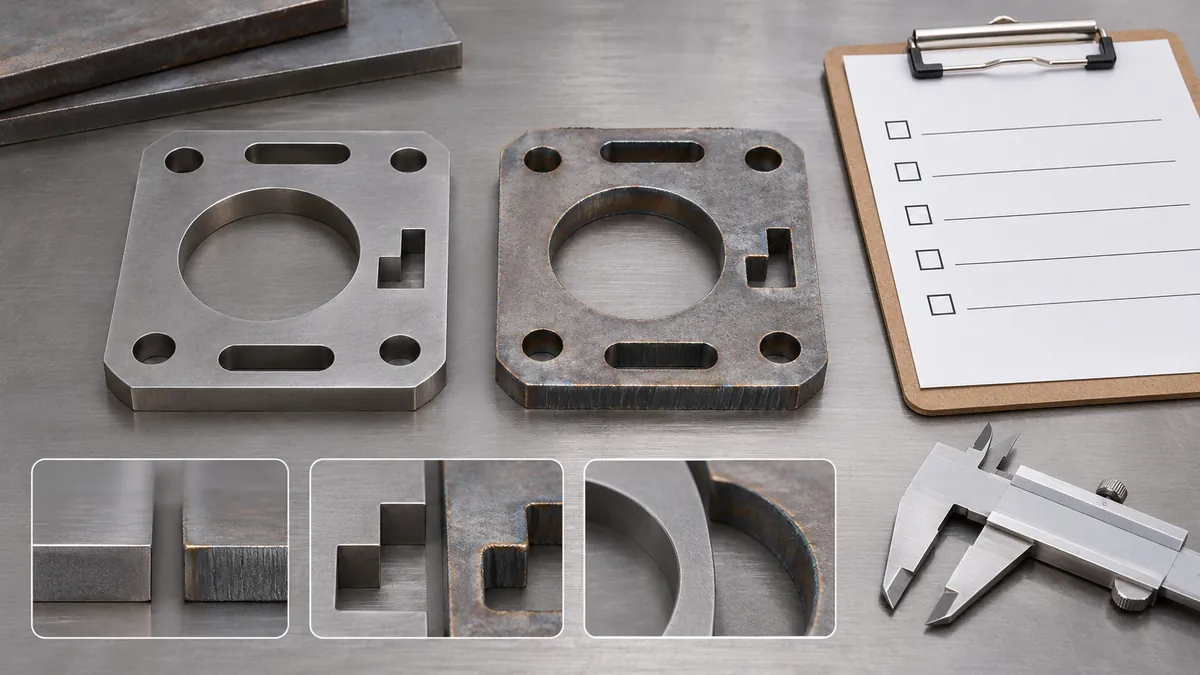
When the buyer should specify the route
Some buyers prefer to specify an approved process because the route is part of a validated product definition, a regulated contract, a qualified supplier arrangement or an established production control. In that case, the drawing or purchasing specification should name the process clearly and define how proposed changes are approved. A supplier cannot reliably comply with an unstated preference, and a casual email may not be enough to keep the requirement attached to later revisions or repeat orders.
Other buyers are open to a supplier-proposed route. That can be practical when the buyer is purchasing a finished component and is focused on dimensions, material, finish, edge condition and cost rather than the equipment used. The supplier still needs to disclose the route if it affects a requirement or a buyer approval. “Supplier’s choice” should not mean that the acceptance criteria are also left open. Agree the result first, then allow a qualified supplier to explain how it can deliver that result.
Consider requiring a route review when a design changes thickness, material, a narrow feature, a visible edge, or the quantity profile. Those changes can alter the supplier’s assumptions even if the outside contour looks familiar. A short revision note that lists affected features can help both sides decide whether the previous sample remains representative. If the design changes after a sample is approved, record whether the old sample is still an acceptable reference or has been superseded.
Finally, keep process capability evidence proportional to the purchase. A buyer may request a representative sample, feature measurements, or an explanation of the process route for a custom part. This does not automatically require an audit, a machine certificate or proprietary parameters. Ask for evidence that answers the actual risk: can this supplier make this part to this drawing and acceptance plan? Avoid requesting records that neither party will use, while retaining enough information to identify the approved version and investigate a mismatch.
Common sourcing mistakes
- Choosing by technology name alone. Compare the supplier’s actual setup and representative part result.
- Assuming laser is always more precise. Precision depends on the system, material, thickness, geometry and tolerance requirement.
- Assuming plasma can cut any material. The described process is for electrically conductive materials; verify the exact material and system.
- Using a generic thickness threshold. Capability varies by machine and operating conditions; request current supplier data for the part.
- Comparing quotes with different material assumptions. Hold grade, thickness, finish and quantity constant.
- Leaving edge quality undefined. Specify visible and functional edge criteria and downstream finishing.
- Ignoring downstream operations. Cutting changes may affect bends, welds, fit, coating or packaging.
- Treating a sample as a certification. A sample can check agreed features but does not establish every property or production outcome.
- Using broad speed or cost claims. Evaluate total quoted operations and batch assumptions.
- Changing process without revision control. Reassess critical features and approvals when the proposed route changes.
Häufig gestellte Fragen
What is the main difference between laser cutting and plasma cutting?
Plasma uses an electrical arc and ionized gas to melt and remove conductive material. Fiber laser cutting uses a focused beam of light to cut material. The suitable route depends on the actual material, thickness, features, supplier equipment and required acceptance.
Is laser cutting always more accurate than plasma?
No universal conclusion applies to every system and part. The relevant comparison is whether the specific supplier can meet the drawing’s critical dimensions and edge criteria on the specified material and thickness.
Can plasma cut aluminum or stainless steel?
Plasma cutting is used on electrically conductive metals, including steel, stainless steel and aluminum, but the actual system and requirements must be checked. This general fact does not establish suitability for a particular part or supplier.
Which process is cheaper?
There is no universal answer. Equipment utilization, setup, material, part geometry, quantity, consumables, gas, electricity, and finishing all affect the quote. Compare equivalent proposals and included operations.
Which process should I specify in my drawing?
Specify a process only when the project has a reason to control it. Otherwise, you may define the part, material, critical features and acceptance criteria and ask the supplier to propose a route. Agree on who approves any process substitution.
What should I inspect on a cut sample?
Check the critical dimensions, hole and slot fit, edge condition, visible surface, burr or dross criteria, and compatibility with planned bends or assembly. Use the agreed drawing and acceptance method; do not infer hidden capability from appearance alone.
Does cut quality determine the finished product quality?
No. Cutting is one operation in a sequence. Forming, welding, finishing, assembly, inspection and packaging can also affect the delivered product. Evaluate the complete part against the approved requirements.
How can Koitor support a cutting-route discussion?
Koitor Hardware is a family-owned custom metal hardware factory. Buyers can share a drawing or sample, material and finish requirements, and critical cut features for project-specific discussion. This does not imply a particular in-house laser or plasma system or a guaranteed process capability.
Sources and scope
Scope note: This article explains comparison questions for sourcing metal parts. It does not specify machine settings, guarantee tolerance or cut quality, claim a cost advantage, or establish Koitor’s equipment. Confirm the actual route and evidence with the supplier for the exact part.
Review a metal part drawing and cutting requirement
Share the controlled drawing, material and thickness, critical features, edge criteria, and downstream forming or finishing needs. Koitor can discuss the surrounding custom hardware project within its confirmed scope.
OEM / EIGENE MARKE
Verwandeln Sie diesen Beschaffungsleitfaden in ein Produktdossier
Teilen Sie uns Ihr Zielprodukt, die Größe, die Oberflächenausführung, die Bestellmenge und Ihre Verpackungsanforderungen mit. Ihr Team erhält vor der Angebotserstellung eine praxisorientierte Prüfung der Herstellbarkeit.


 English
 Español
 Português
 Français
 Deutsch
 العربية