
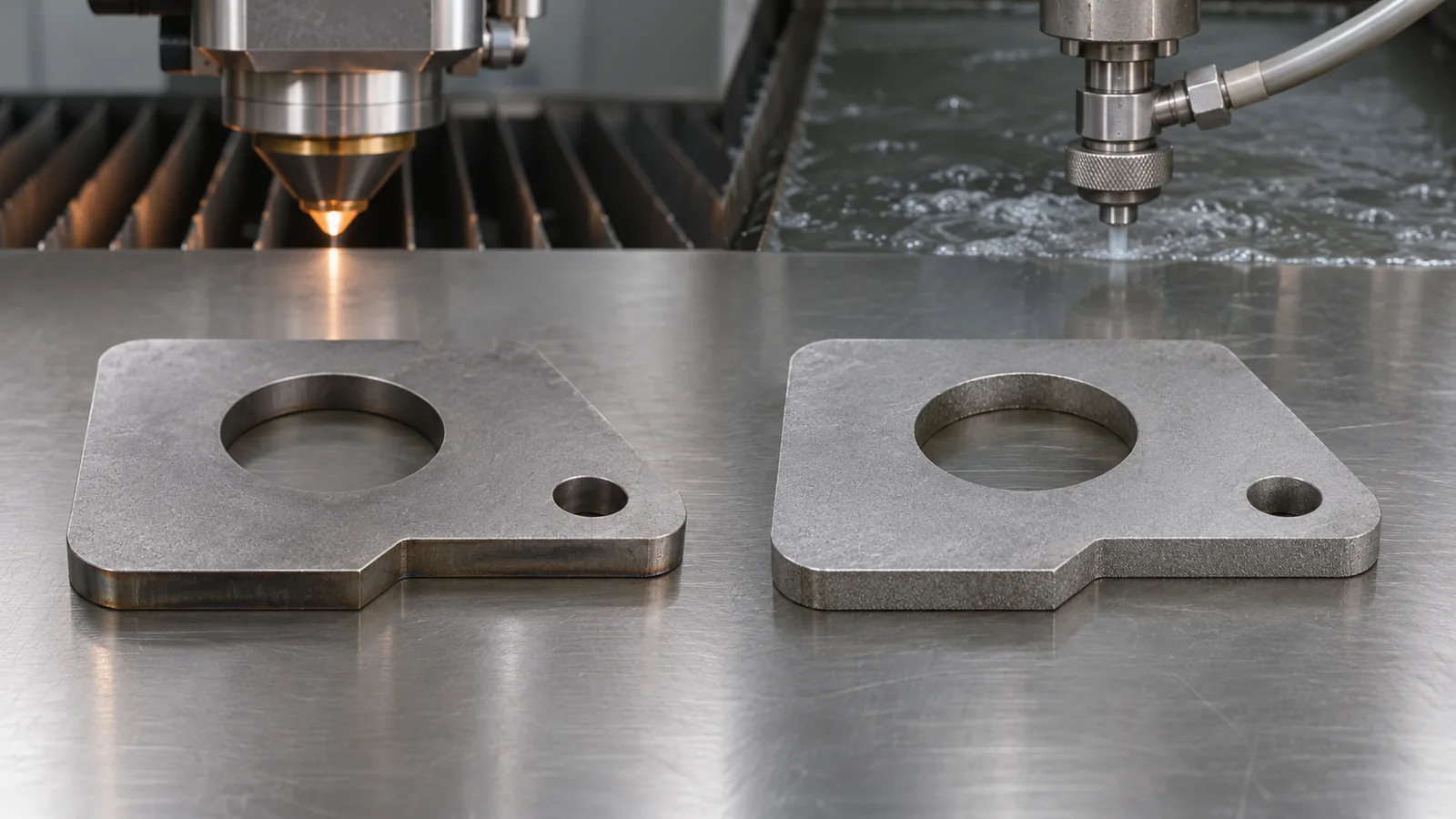
Laser cutting vs waterjet is a comparison between a thermal cutting route and an erosive cutting route. A laser concentrates light to heat and separate material; a waterjet uses a high-pressure water stream, with abrasive added in many metal-cutting applications. Neither method is universally better. Material, thickness, geometry, edge acceptance, production conditions and downstream operations determine the useful choice. For a buyer sourcing a finished metal component, the practical question is whether the supplier can make the actual drawing to agreed requirements and explain the proposed route.
What the process names tell you
The terms identify broad energy and material-removal mechanisms. Laser cutting is thermal: focused light creates a localized interaction that separates material. Waterjet cutting is erosive: a high-pressure stream removes material, and abrasive may be introduced when cutting metals or other hard materials. The exact configuration matters. “Waterjet” alone does not tell you whether a particular operation uses pure water or abrasive, what equipment is used, what material is being cut, or what edge condition will result.
A process name does not specify the machine, material grade, thickness, tolerance, feature capability, surface condition, cut quality or inspection method. It does not prove that the finished part will fit an assembly or survive its intended environment. This distinction is useful when two supplier quotations use different technology names: the buyer should compare the resulting part and included operations, not infer equivalence from a label.
This guide focuses on metal blanks and components relevant to bathroom and home-storage hardware sourcing. It is not a machine-purchasing guide, cutting-parameter manual or claim that Koitor owns laser or waterjet equipment. The approved company scope supports custom metal hardware fabrication and drawing/sample communication; the specific specialist cutting route must be confirmed with the supplier handling the part.
How the mechanisms differ
A laser system directs a concentrated beam along a programmed path. In thermal cutting, the workpiece experiences localized heat. The result depends on the source and configuration, material, thickness, assist gas, programming, setup and maintenance. A thermal mechanism makes heat-related effects a question to evaluate for a specific part, but it does not mean that every laser-cut edge has the same heat-affected zone or that every material suffers a meaningful property change.
A waterjet directs water at high pressure through a small orifice. For many metal-cutting applications, abrasive particles are carried in the stream to erode material. The cutting action is not based on adding the same thermal cutting energy as a laser. That distinction can matter when a buyer is concerned about thermal exposure, but “no thermal cutting heat” is not the same as “no possible damage.” Taper, striation, edge texture, dimensional variation, contamination, handling marks and later finishing remain part-specific considerations.
Abrasive waterjet and pure-water cutting should not be treated as interchangeable labels. Pure water is associated with softer materials; abrasive is commonly used to cut hard materials such as metal. Buyers should confirm the actual process proposed for their material rather than assume that a supplier’s waterjet capability covers every product. Similarly, “laser” can refer to different system families. Ask what technology and setup the quote assumes if the distinction affects the purchase.
| Buyer question | Laser route | Waterjet route | Anzufordernde Nachweise |
|---|---|---|---|
| How is material separated? | Focused light creates a thermal cut | High-pressure water, often with abrasive for metal, erodes material | Supplier’s named route for the actual material |
| What material scope applies? | Depends on laser system and workpiece | Pure-water or abrasive configuration changes scope | Exact grade, coating and thickness confirmation |
| What happens at the edge? | Thermal effects and edge condition need part-specific review | Erosive edge texture and taper need part-specific review | Representative sample and agreed edge criteria |
| What controls the geometry? | System, setup, programming, material and features | System, setup, abrasive, material and features | Measurements on critical drawing features |
| What is included in price? | Setup, cutting, handling and later work vary | Abrasive, setup, cutting, handling and later work vary | Equivalent quote scope and exclusions |
The table is an initial comparison aid, not a performance ranking. A provider’s published comparison may describe its own systems or commercial offer. Do not transfer supplier-specific speed, thickness, accuracy or cost figures to another supplier’s machine or to a different part without evidence.
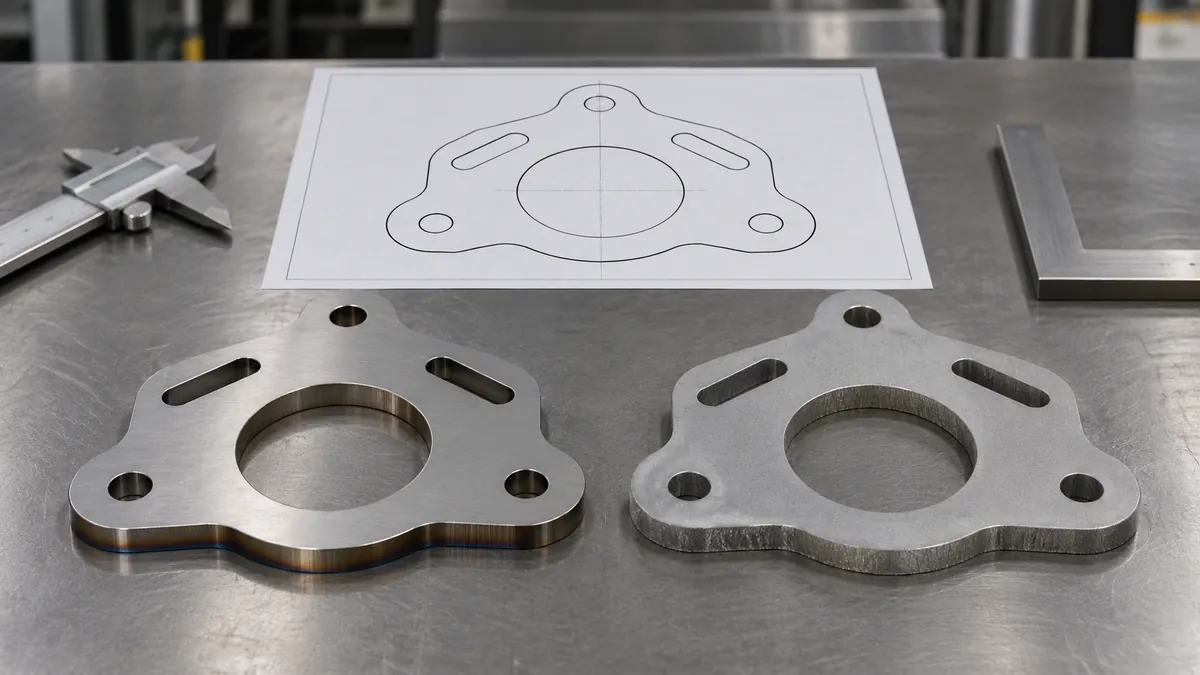
Compare the same part, not general claims
Material and thickness
Start with the material designation, supplied form, thickness and any coating or surface layer. If the material is not fixed, the quotations may not describe the same component. Waterjet cutting often uses abrasive for metal; the supplier should confirm the actual configuration and suitability for the named material. A laser provider should likewise confirm the actual material and thickness against its system capability. A generic web chart is not enough to approve a custom part.
For a buyer comparing two proposed routes, preserve material and thickness while holding other assumptions constant. If one supplier suggests a substitution, evaluate that as a separate change: material affects forming, joining, corrosion behavior, finish and cost beyond cutting alone. Keep a provisional quote clearly labeled when the material is unresolved, and ask the supplier to list the assumption in writing.
Geometry, holes and narrow features
Review the smallest holes, slots, internal corners, narrow webs, tabs and details that control fit. A part may look simple at an overall scale while containing one feature that governs whether it can be assembled. Identify functional dimensions and tolerances rather than applying an arbitrary tight tolerance to every edge. Ask the supplier how it will produce and inspect those features on the specified thickness and material.
A cutting-route name does not establish the minimum feature size or achievable tolerance. Those depend on the system, setup, workpiece, path, part support and inspection. If a hole controls a fastener or mating part, request a representative sample or measurement record using the agreed drawing revision. A visual photograph can reveal a gross mismatch but cannot replace measurement where the requirement is dimensional.
Edge condition and downstream finishing
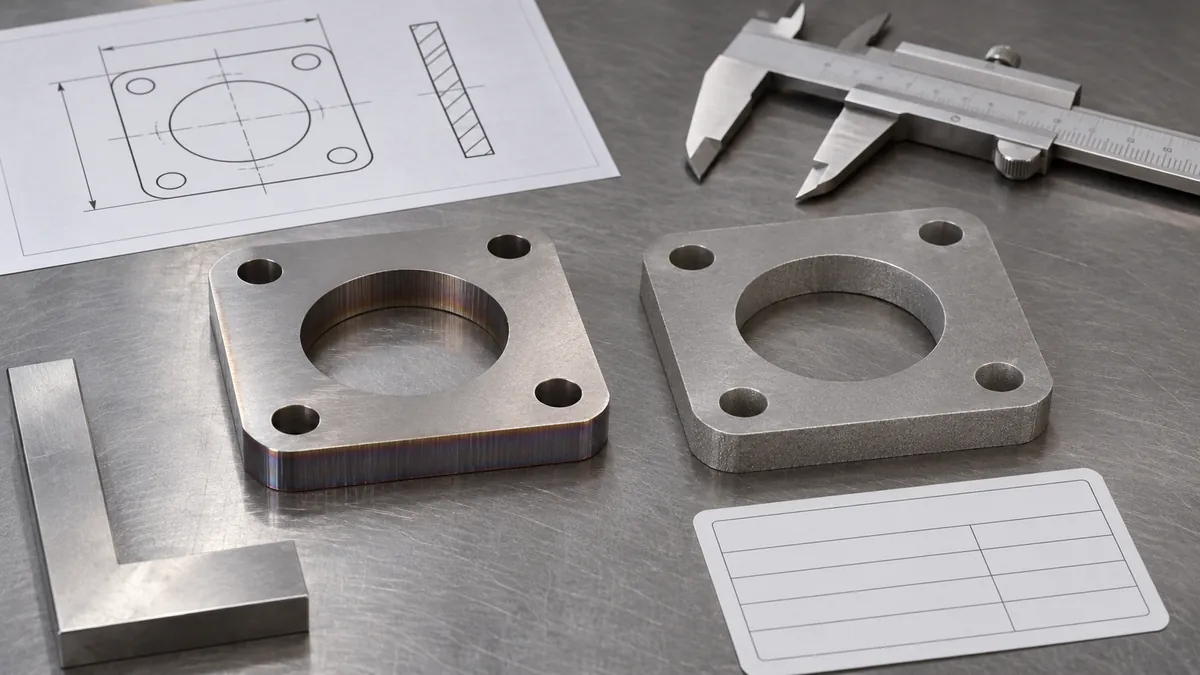
State what the edge must look and feel like at delivery, whether it is hidden or exposed, and what happens next. Buyers may need to consider burr, dross, taper, striation, roughness, heat tint, sharpness, surface contamination or marks. Not every factor matters for every part. Tie each criterion to a functional, safety, assembly or cosmetic reason and specify whether deburring, grinding or polishing is included.
A later bend, weld, coating or assembly can make the supplied edge important even when it will not remain visible. Ask where cutting ends and the next operation begins. If the edge is near a bend line or weld, clarify any required preparation and who owns it. If a cosmetic face is exposed after coating, show the face on the drawing and define the finished-state acceptance. Do not assume that a general “clean cut” statement means the same thing to the buyer and supplier.
Laser cutting introduces thermal energy, while waterjet uses erosive removal. That mechanism difference helps frame questions but does not prove a particular metallurgical outcome. Whether heat-related effects matter depends on the material, process, geometry, specification and use. Whether an erosive edge needs additional finishing also depends on the actual system and requirement. Obtain part-specific evidence rather than using an absolute statement such as “waterjet never affects material” or “laser always damages the edge.”
Quantity, setup and total quoted scope
Cost depends on more than the cutting mechanism. Quantity, nesting, setup, consumables, abrasive, material utilization, machine availability, part geometry, handling, inspection and secondary work can all affect a quotation. A quote with a lower cutting price may exclude deburring or a report. A higher price may include more operations. Neither explanation should be assumed until the supplier identifies the scope.
For a fair laser cutting vs waterjet review, compare the same drawing revision, material, thickness, quantity, packaging, finish and acceptance criteria. Ask whether the price is for a first article, engineering sample or production lot. Separate cutting from grinding, forming, welding and coating when those items matter to the comparison. Do not treat a supplier’s published hourly rate, speed ratio or thickness crossover as a universal purchasing rule.
Material handling and cleanliness
Ask what happens to the part between cutting and delivery. Depending on the route and later finish, the buyer may need to clarify residue removal, drying, rust-prevention handling, protective separation or identification. These are not automatic waterjet defects or universal laser requirements; they are controls to define when the material and process make them relevant. If a component is shipped to another facility for coating or assembly, identify the condition in which it should arrive and who is responsible for protecting it.
For a trial order, the buyer can define a small number of practical checks: confirm the material identity, inspect the cut features, assess the agreed edge criteria and record any rework before the next operation. This does not replace a formal quality plan where one is required. It helps make the sample decision reproducible instead of relying on a vague impression that one edge “looks better.”
Keep sample approval tied to its limits
A sample review should record what was actually checked. If the buyer measured hole position and slot width, record those values against the drawing revision. If the review focused on exposed edge appearance, state that separately. Do not let a successful visual sample review silently become evidence for material grade, corrosion performance, structural load, coating adhesion or every production dimension. Those properties require their own specifications and, where appropriate, test methods.
When the cutting route is still open, a useful sample comparison can use two parts made from the same material lot and drawing revision, with each supplier or route identified. The buyer can then compare only the relevant features and note any downstream cleanup. If the samples came from different materials, thicknesses or finishes, the comparison is confounded; differences cannot safely be attributed to the process name alone. A short sample record should capture the part identity, revision, supplier, route, material, thickness, checked features, result and any action required.
For repeat orders, maintain the approved sample and record together with the controlled specification. If the supplier changes the machine route or finishing sequence, ask whether the previously approved sample still represents the process. A change may be immaterial to a hidden noncritical edge, yet important to a fit-critical slot or visible face. The buyer can define a proportionate review rule instead of requiring a full reapproval for every operational adjustment or allowing any substitution without notice.
This recordkeeping helps resolve a common sourcing ambiguity: “same part” may refer only to the outside shape, while the material, edge treatment, inspection or next operation changed. A revision-controlled drawing and a compact acceptance record make those differences visible. They also help the buyer compare suppliers over time without assuming that a past quote or sample proves current equipment capability.
A practical route-selection framework
- Freeze the part definition. Confirm drawing number and revision, material, thickness, quantity and finish.
- Mark functional features. Identify the holes, slots, datums and edges that affect fit or appearance.
- Define the supplied edge. Specify relevant burr, taper, texture, sharpness or finishing expectations.
- Describe the next operation. Note whether the blank will be bent, welded, polished, coated or assembled.
- Ask for the specific configuration. Confirm laser type or waterjet configuration, including whether abrasive is used for the proposed metal.
- Request capability evidence. Ask how the supplier will demonstrate critical dimensions and edge conditions on the actual part.
- Compare equivalent offers. Align material, lot size, inspection, finishing and packaging scope.
- Control substitutions. Record who approves a route or material change and whether a new sample is needed.
Use the framework to decide what information is missing, not to mechanically select a technology. If the supplier cannot confirm the key feature or acceptance requirement, resolve the question before placing the production order. The answer might be to revise the geometry, change a tolerance, specify a different operation or request a sample; the correct response depends on the design and the buyer’s priorities.
Keep adjacent process questions separate during the review. A comparison with punching raises different tooling and feature questions than the thermal-versus-erosive comparison here. Detailed edge acceptance and coating preparation are also separate engineering questions. Do not allow a broad laser cutting vs waterjet discussion to replace the exact owner page or drawing requirement for those narrower issues; use the current internal link registry to route a reader to verified supporting content when appropriate.
Separate the process decision from product acceptance
Buyers sometimes ask a process question when the unresolved issue is actually a product requirement. For example, “Which cutting route is more accurate?” may conceal uncertainty about whether a hole needs to align with a screw, whether an edge is visible, or whether a bracket must fit a mating component. Translate the broad question into a measurable requirement before asking the supplier to select equipment. If the actual concern is a surface finish after coating, specify the appearance and preparation state; if it is assembly, identify the datum and tolerance; if it is a thermal material concern, state the material property and acceptance evidence that matter.
This translation prevents a machine comparison from substituting for design review. A process may be technically capable while the drawing still leaves a dimension ambiguous. Conversely, a drawing may be clear enough to let a supplier propose the route, provided the supplier confirms the proposed process and resulting part against the agreed criteria. The buyer should not pay for a more elaborate process merely because the specification is incomplete; first determine what outcome the product actually needs. That is the useful starting point for a laser cutting vs waterjet evaluation.
The same distinction helps when a supplier offers a substitution. Ask whether the change is only a route change or also changes material source, thickness, edge finishing, inspection, or the next manufacturing operation. Record the response against the part revision. If the substitution changes a critical or visible characteristic, decide whether an updated sample is needed. If it does not affect any acceptance requirement, a documented approval may be enough. The correct control should match the product risk and the buyer’s contract, not a blanket assumption that every substitution is harmless or unacceptable.
When a decision cannot be resolved from a drawing, the buyer can request a short technical review before confirming the order. The review should identify the missing information, the responsible party, the proposed evidence and the decision date. This is especially useful for a first custom part because it keeps an open question from surfacing after cutting or finishing has begun. It also makes a later repeat order easier: the approved route and inspection plan can be reused only while the part, material and conditions remain comparable.
Hypothetical hardware example
Imagine a flat mounting plate used inside a bathroom storage assembly. It has a group of fastener holes, a narrow slot for adjustment and an outside edge that becomes visible after the assembly is installed. The plate may later receive a coating. The buyer should mark which hole centers control assembly, define the slot fit, show the cosmetic edge and state whether deburring or surface preparation is required before coating.
One supplier proposes laser cutting and another proposes abrasive waterjet. The buyer should ask both to quote the same material, thickness, quantity and drawing revision. Each should identify the proposed route, included finishing and method for checking the holes and slot. If samples are made, review the same features and record any edge cleanup. The buyer should not conclude that the waterjet part is superior because it avoided thermal cutting energy, or that the laser part is superior because a supplier described it as faster. Neither statement answers whether the delivered plate meets the defined drawing.
This example is hypothetical. It is not a Koitor customer project, test result, production record or equipment statement. It illustrates how a process comparison can be translated into a buyer acceptance plan.
Common sourcing mistakes
- Choosing from a broad claim. A marketing comparison may describe one provider’s equipment, not the supplier being evaluated.
- Assuming waterjet means abrasive waterjet. Confirm the configuration for the material and job.
- Treating no added thermal cutting heat as no possible edge issue. Geometry, taper, texture and handling still need review.
- Treating every laser cut as having the same heat effect. Material, setup and requirements change the significance.
- Leaving holes and slots unspecified. Mark fit-critical features and acceptance dimensions.
- Using “clean edge” without a definition. Connect visual language to observable criteria or an agreed sample.
- Comparing different quote scopes. Normalize finishing, inspection, quantity and packaging assumptions.
- Forgetting the next process. Consider how the blank will be bent, welded, coated or assembled.
- Changing material and route together. Separate changes so the result can be evaluated.
- Treating one sample as proof of every order. A sample answers only the reviewed features and conditions.
Häufig gestellte Fragen
What is the main difference between laser cutting and waterjet cutting?
Laser cutting is a thermal process using focused light. Waterjet cutting removes material with a high-pressure water stream and often abrasive for metal. The actual part requirements and system determine the useful comparison.
Does waterjet cutting create no heat at all?
It does not use the same thermal cutting energy as a laser, but that does not establish that a finished edge has no variation, taper, texture or need for secondary work. Confirm the delivered condition for the specific part.
Is waterjet always more accurate than laser?
No universal ranking applies across all systems, materials and part geometries. Compare measured critical features and edge acceptance on a representative sample or through agreed inspection evidence.
Is laser always faster or cheaper?
No. Time and cost depend on equipment, material, thickness, geometry, quantity, setup, consumables, utilization and finishing. Compare equivalent supplier quotations rather than broad averages.
Can a waterjet cut metal?
Abrasive waterjet systems are used for metal cutting, but the supplier must confirm the configuration and suitability for the named material, thickness and part requirements. A process label is not capability evidence by itself.
Was muss ich für ein Angebot einsenden?
Send the controlled drawing and revision, material and thickness, quantity, finish, critical dimensions, edge requirements, downstream operations and any required inspection records. Ask the supplier to state its proposed route and assumptions.
Should the buyer specify the cutting process?
Specify it when the route is part of a validated or contractual requirement. If the supplier can propose the method, define the part and acceptance criteria and agree how any process substitution will be reviewed.
How can Koitor help with this decision?
Koitor Hardware is a family-owned custom metal hardware factory. Buyers can share a drawing or sample and clarify the relevant material, finish, fit and project requirements. This does not claim that Koitor owns or operates a particular laser or waterjet system.
Sources and scope
Scope note: This guide explains buyer comparison questions, not machine operation or a universal process ranking. Confirm material, configuration, acceptance and quote scope with the supplier. No Koitor laser or waterjet equipment, cost advantage, test result or guaranteed tolerance is claimed.
Review a metal part drawing and cutting requirement
Share the controlled drawing, material and thickness, critical features, edge criteria and downstream operations. Koitor can discuss the surrounding custom hardware project within its confirmed scope.
OEM / EIGENE MARKE
Verwandeln Sie diesen Beschaffungsleitfaden in ein Produktdossier
Teilen Sie uns Ihr Zielprodukt, die Größe, die Oberflächenausführung, die Bestellmenge und Ihre Verpackungsanforderungen mit. Ihr Team erhält vor der Angebotserstellung eine praxisorientierte Prüfung der Herstellbarkeit.


 English
 Español
 Português
 Français
 Deutsch
 العربية