
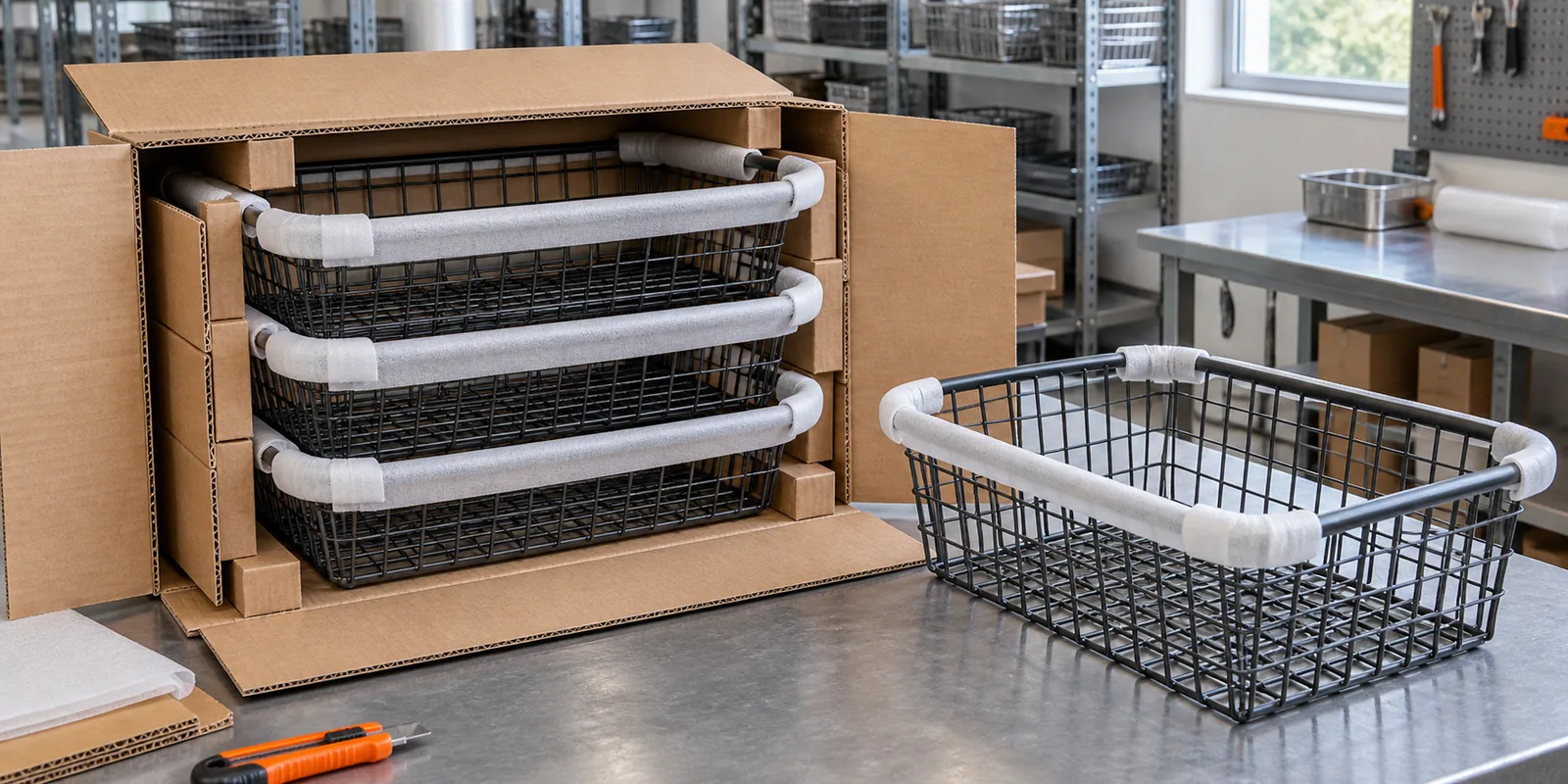
Metal basket nesting packaging can reduce carton volume only when the basket geometry, finish contact points, nesting depth, separators and removal method are controlled together. Importers should approve a complete packed sample with production-intent baskets. Unprotected metal-to-metal contact, concentrated rim pressure or excessive nesting depth can create scratches, coating marks, deformation and difficult unpacking.
What is metal basket nesting packaging?
Metal basket nesting packaging places compatible baskets partly inside one another so several units use less carton space than individually separated products. The method is common for tapered wire baskets and some formed metal storage products, but it is not suitable for every structure or finish.
A basket nests when its lower body enters the opening of another basket without locking, scraping or placing harmful pressure on the rim and side walls. The nesting depth determines both space saving and contact risk. Deeper nesting can reduce volume, but it can also increase friction, compress separators and make the inner basket harder to remove.
Nesting is different from simple stacking. Stacked baskets rest on defined supports or packaging layers, while nested baskets overlap in three dimensions. The package designer must understand where each rim, wire intersection, foot, handle or mounting feature touches the next product.
The complete pack may include sleeves, paper interlayers, foam pads, corrugated collars, rim protectors or formed inserts. These materials should locate the products and separate finished surfaces rather than merely fill empty space.
Koitor Hardware can review nesting proposals for custom wire and metal storage products. Working with a custom metal storage basket manufacturer helps buyers connect basket taper, rim design, welding, finish and carton planning before the structure is frozen.
Why can nested wire baskets become damaged?
Nested wire baskets become damaged when transport movement or carton compression creates repeated contact, concentrated force or difficult separation between finished products. The outer carton can remain intact while scratches or deformation develop inside.
Wire products have many small contact points. A top rim may touch the side wire of the next basket, a welded intersection may press through a thin sleeve, or a foot may rest on a visible surface. Repeated vibration at one point can mark powder coating or polished metal.
Geometry variation also matters. If basket width, taper or squareness varies, one unit may enter farther than intended. The products can wedge together or load the rim unevenly. A package designed around one ideal sample may fail when normal production variation is introduced.
Finish thickness changes clearance. A bare-metal nesting trial does not represent the final coated product. Powder coating around wires and joints can reduce the gap, while textured surfaces may create more friction than smooth samples.
Carton compression can transfer through the nested stack. If the package supports weight through basket rims or projecting handles, the metal structure may distort. Packaging should direct pressure into suitable supports and avoid using delicate product features as load-bearing pack components.
Unpacking can cause damage as well. Retail or warehouse staff may pull hard on a hook or decorative rail when baskets stick together. The pack should provide a clear removal sequence and accessible grip points that do not harm the finish.
Which basket features determine nesting feasibility?
Nesting feasibility depends on taper, rim shape, wire projections, handles, feet, mounting hardware, finish and dimensional consistency. Buyers should review these features on both drawings and finished samples.
- Side-wall taper: sufficient taper allows entry, while near-vertical walls may bind quickly.
- Rim geometry: rolled, framed or welded rims determine where the upper basket stops.
- Wire intersections: raised joints can create local rubbing or catch protective sleeves.
- Handles and hooks: projecting parts may prevent nesting or touch visible surfaces.
- Feet and brackets: bottom features need clearance and should not press into the basket below.
- Decorative panels: logos or sheet-metal faces may require dedicated separation.
- Fertigstellung: coating thickness, texture and appearance sensitivity influence the required gap.
- Production variation: width, angle, squareness and rim position affect nesting depth.
Buyers should define a controlled nesting stop. The stop may be a corrugated collar, foam block, shaped separator or product feature designed to carry contact safely. Relying on random wire-to-wire contact makes the final depth inconsistent.
For sets containing different basket sizes, confirm that each smaller basket is intentionally located. A very small basket can move inside a larger one even when the pair technically nests. Internal restraints may still be needed.
If nesting requires major changes to the retail product, compare the freight benefit with customer function and tooling cost. Shipping efficiency should support the product design, not weaken it.
How should importers compare nesting protection methods?
Importers should compare protection methods by contact separation, location control, pressure distribution, packing consistency, unpacking effort and material volume. No single material solves every nesting risk.
| Protection Method | Main Function | Buyer Review | Common Limitation |
|---|---|---|---|
| Individual soft sleeve | Separates finished surfaces and reduces dust | Seams, coverage, friction and tearing at wires | Does not control nesting depth by itself |
| Paper interlayer | Reduces broad surface rubbing | Placement, moisture sensitivity and movement | Can tear or shift around projections |
| Rim collar | Creates a controlled stop between baskets | Fit, compression and consistent orientation | Protects only defined rim zones |
| Foam or soft pads | Cushions selected contact points | Density, residue, retention and finish compatibility | Loose pads may move during packing |
| Corrugated divider or frame | Locates the nested set in the carton | Board direction, slots and packing sequence | Adds assembly steps and material volume |
| Formed insert | Controls complex geometry and removal | Contact pressure, tooling and recycling needs | May be less practical for early small batches |
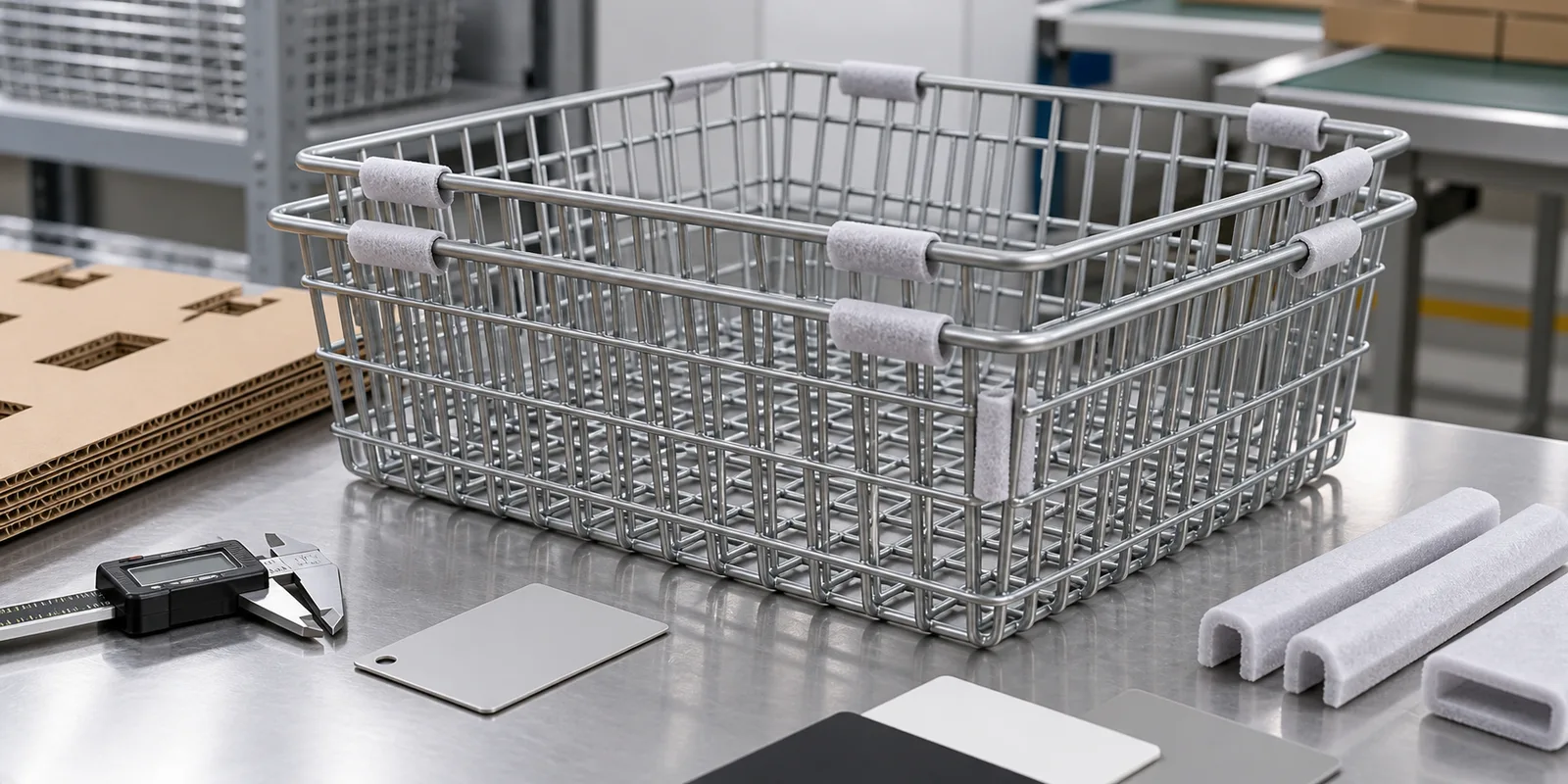
A sleeve may be appropriate for overall finish separation, while a rim collar controls depth. Combining two simple materials can be more reliable than adding one thick protective layer without a clear location function.
Material compatibility should be checked on the approved finish. Avoid assumptions that a soft-looking material cannot mark a surface. Seams, dust, trapped metal particles, adhesive and compression can change the result.
Sustainability and disposal requirements can influence the choice, but material reduction should follow a functioning design. A smaller pack that produces damaged baskets is not an efficient outcome. Buyers should first control movement and contact, then optimize material use.
How should a nested basket packed sample be tested?
A nested basket packed sample should be built with production-intent finished products, all separators, the retail pack and the planned master-carton arrangement. Buyers should document the packing sequence and inspect every unit after project-appropriate handling or transport validation.
- Confirm product identity. Record basket code, drawing revision, finish and sample date.
- Measure the baskets. Check width, depth, taper, rim position and squareness before nesting.
- Map contact points. Use the drawing and physical products to identify every possible product-to-product contact.
- Pack in the intended sequence. Apply sleeves, collars, pads and orientation exactly as production should.
- Check nesting depth. Confirm every basket stops at the intended position without excessive force.
- Check carton movement. Identify side movement, vertical movement and pressure on projecting features.
- Apply the project validation plan. Select handling and transport checks appropriate to the route and sales channel.
- Unpack in sequence. Observe removal effort, sticking, torn protection and risk to finished surfaces.
- Inspect every basket. Review rims, wires, welds, panels, feet and handles under consistent lighting.
- Record and revise. Link any mark or deformation to its likely contact point before changing the pack.
The validation plan should be defined for the actual project. Avoid unsupported universal claims such as “damage-proof” or guaranteed drop performance. Product weight, pack configuration, route and acceptance criteria all influence the result.
Use more than one basket when checking nesting because production variation is part of the risk. One perfectly matched pair cannot show whether the stop and separator remain effective across several finished units.
What common metal basket packing mistakes should buyers avoid?
Common mistakes include trial nesting before finishing, relying on sleeves to control depth, leaving handles or feet unprotected, and approving a carton with only one ideal sample.
- Allowing powder-coated rims to touch directly.
- Letting one basket enter until its side wires wedge against the next unit.
- Using a separator that tears on a weld projection.
- Placing loose mounting hardware inside the nested basket set.
- Supporting carton compression through a decorative handle.
- Changing coating texture without repeating the nesting review.
- Reducing carton height until the top basket is under constant pressure.
- Providing no clear unpacking sequence for warehouse or retail teams.
- Mixing basket revisions in one packing trial.
Another mistake is treating carton utilization as the only measure. Compare product protection, packing labor, material cost, carton volume and unpacking experience together. Guidance on related sourcing and packaging decisions is available in Koitor-Ressourcen.
What should a metal basket packing design checklist include?
A metal basket packing design checklist should define basket geometry, finish-sensitive areas, nesting stops, protection materials, component placement, carton arrangement and the approval revision.
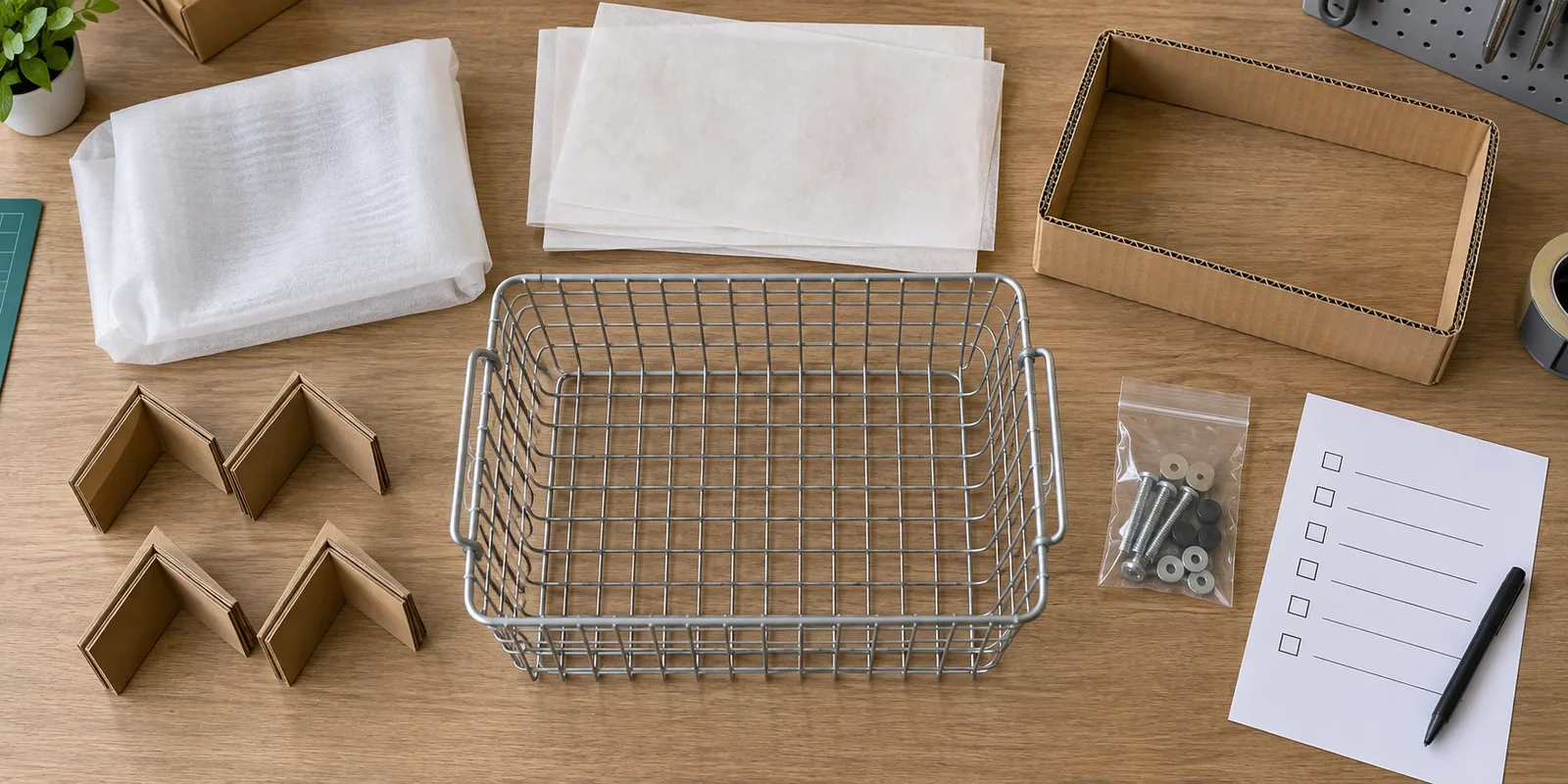
- Product code, drawing revision and finished sample reference.
- Basket width, depth, height, taper and rim construction.
- Handles, hooks, feet, brackets and decorative projections.
- Approved finish and appearance-critical zones.
- Intended nesting quantity and depth per set.
- Defined stop locations and allowed product contact points.
- Sleeve, paper, foam, collar or divider specification.
- Protection orientation and production packing sequence.
- Loose hardware location, seal and component count.
- Retail carton dimensions and master-carton quantity.
- Acceptable movement and pressure zones.
- Unpacking sequence and grip points.
- Project-specific handling or transport validation plan.
- Inspection records, approval date and packaging revision.
Koitor Hardware can review the basket structure and packed sample before quotation or bulk production. Packaging choices depend on basket geometry, finish, quantity and sales channel. Buyers developing broader storage ranges can also review OEM-Hardware für die Heim-Datenspeicherung options.
The checklist should record pack-out quantities as well as dimensions. The individual retail carton, inner pack and master carton must describe the same nesting set. If one document counts baskets while another counts nested sets, ordering and warehouse errors become more likely.
Include carton gross-weight planning without making unsupported universal limits. The acceptable configuration depends on the buyer’s route, warehouse practices and carrier requirements. A deeper nested set may reduce volume but produce a carton that is less convenient to handle.
Retail presentation also matters. If customers open the package directly, separators and sleeves should be removable without tools or excessive force. Protective materials should not hide installation parts or make the first basket appear damaged when the marks are only removable packing dust.
For recurring orders, keep the approved packaging revision connected to the current basket drawing. A small change to rim diameter, handle position or coating texture can alter contact points. Change control helps prevent an old nesting pack from being reused automatically for a revised product.
Frequently asked questions about metal basket nesting
Can every tapered wire basket be nested?
No. Taper helps, but rims, handles, feet, welds, finish thickness and dimensional variation can still prevent safe nesting. Confirm the complete finished product.
Is a protective bag enough between nested baskets?
A bag can separate surfaces but usually does not control nesting depth or carton movement. A defined stop, collar, pad or locating structure may also be required.
Should baskets be tested before or after powder coating?
Final nesting approval should use finished baskets. Coating changes dimensions, texture, friction and appearance sensitivity.
How many baskets should be packed in one nested set?
The quantity depends on geometry, weight, carton limits, handling and the protection design. Compare several configurations through a complete packed-sample review.
Where should screws and mounting parts be placed?
Seal, label and restrain them in a defined compartment away from finished surfaces. Loose metal parts should not move inside the nested basket set.
How can Koitor support nested basket packaging?
Koitor can review basket taper, rim contact, finish protection, separators, packing sequence and small-batch packaging samples. Buyers can send Koitor a basket drawing or sample for discussion.
Arbeiten Sie mit Koitor Hardware zusammen
Need to Reduce Basket Carton Volume Without Finish Damage?
Send Koitor your basket drawing, finished sample, nesting target, packaging material preference and carton plan. Our team can review rim contact, nesting depth, separator placement and small-batch packed-sample options before quotation.
OEM / EIGENE MARKE
Verwandeln Sie diesen Beschaffungsleitfaden in ein Produktdossier
Teilen Sie uns Ihr Zielprodukt, die Größe, die Oberflächenausführung, die Bestellmenge und Ihre Verpackungsanforderungen mit. Ihr Team erhält vor der Angebotserstellung eine praxisorientierte Prüfung der Herstellbarkeit.
 English
  Español
  Português
  Français
  Deutsch
  العربية