

A product photo can make a blanket ladder look simple: two uprights, several rungs, and a throw draped over each one. For an importer, that image leaves the important decisions unanswered. Will the intended textiles stay on the rungs without covering one another? Does the rack lean against a wall or stand independently? Which floor and wall contacts are allowed? Can the item be assembled, protected, and packed in the approved retail configuration?
A metal blanket ladder manufacturer can quote more consistently when the buyer provides the reference textiles, room context, finish expectations, assembly plan, and pack-out brief before sampling. This guide turns those choices into a product specification and a practical approval record. It does not assume one universal ladder design, load rating, or manufacturing route.
The goal is to approve a particular model for a defined assortment. It is not to infer performance from appearance, from another supplier’s product page, or from a generic statement that a rack is “heavy duty.”
Start with the textiles and the way buyers will use the rack
Define the assortment before selecting rung spacing. “Blanket” can describe a thin woven throw, a quilt, a bulky fleece layer, or a heavy folded cover. Their thickness, width, edge construction, and fold behavior change how much space each rung needs. A ladder that looks generous when empty may become crowded when a buyer hangs the actual products planned for launch.
Prepare a small reference set: one thinner throw, one typical item, and the thickest or widest textile that the product is expected to display. Record each item’s unfolded width and length, approximate folded width and thickness, and the fold or drape method used for the review. These are reference observations for the buyer’s own assortment, not universal limits for all blankets.
Decide whether the rack is intended for display, everyday access, or both. A retail display may prioritize visible color separation and a tidy drape. A home-storage item may need quicker removal and replacement, less textile overlap, or enough clearance for a user to reach the upper rung. If the same model must serve both roles, write down which objective takes priority when they conflict.
Also name the intended placement: bedroom, living area, guest room, or another indoor context. Record whether the ladder is expected to lean against a wall, rest on a floor at a specified angle, or stand clear of the wall. Do not treat a product photograph as proof that it is freestanding or self-supporting. The buyer should approve the actual use configuration and supplier instructions together.
Put geometry, contact points, and finish into the drawing brief
Rung count and outside height are not enough to communicate fit. Specify each rung’s centerline, clear spacing, usable width, end treatment, and relationship to the side rails. If the textile is intended to drape evenly, define how the buyer will judge that result—for example, the visible width of each drape, whether adjacent textiles may overlap, and whether the lower edge should clear the floor.
The side rails and the rungs create a system. Their spacing determines the usable textile width; their angle changes the distance between the rack and wall; their depth affects where a folded throw rests. The ends may also influence wall and floor contact. Put critical dimensions on the controlled drawing, identify which face is cosmetic, and mark any permitted contact pads or caps. A drawing should distinguish nominal dimensions from acceptance tolerances rather than leaving the supplier to infer them from a rendered image.
Finish selection should be a separate, explicit decision. “Black metal” could describe different substrates and finish systems. Name the intended color reference or approved physical sample, visible texture, gloss expectation, and the surfaces where appearance matters most. Agree how the buyer will inspect color variation between the rails and rungs under normal viewing light. Avoid unsupported claims such as scratch-proof, rust-proof, or suitable for every environment.
| Buyer input | What to define before sample approval | What to observe on the sample |
|---|---|---|
| Reference textiles | Size, thickness, fold method, and assortment role | Drape, overlap, movement, and access |
| Rung layout | Count, usable width, centerlines, spacing, end geometry | Whether the defined textiles fit the intended positions |
| Placement | Leaning or stand-off arrangement, wall and floor contacts | Contact points, angle, and clearance in the agreed setup |
| Fertigstellen | Color reference, sheen, texture, cosmetic faces | Match across components under agreed lighting |
| Assembly | Tool, fastener, sequence, and included parts | Alignment, repeatable assembly, and instruction clarity |
| Retail pack | Disassembled or assembled, protective materials, carton plan | Part protection, identification, and pack-out consistency |
A metal blanket ladder manufacturer cannot resolve these choices from a keyword or mood-board image alone. The buyer’s drawing, reference textile, approved finish sample, and packaging specification should point to the same model revision.
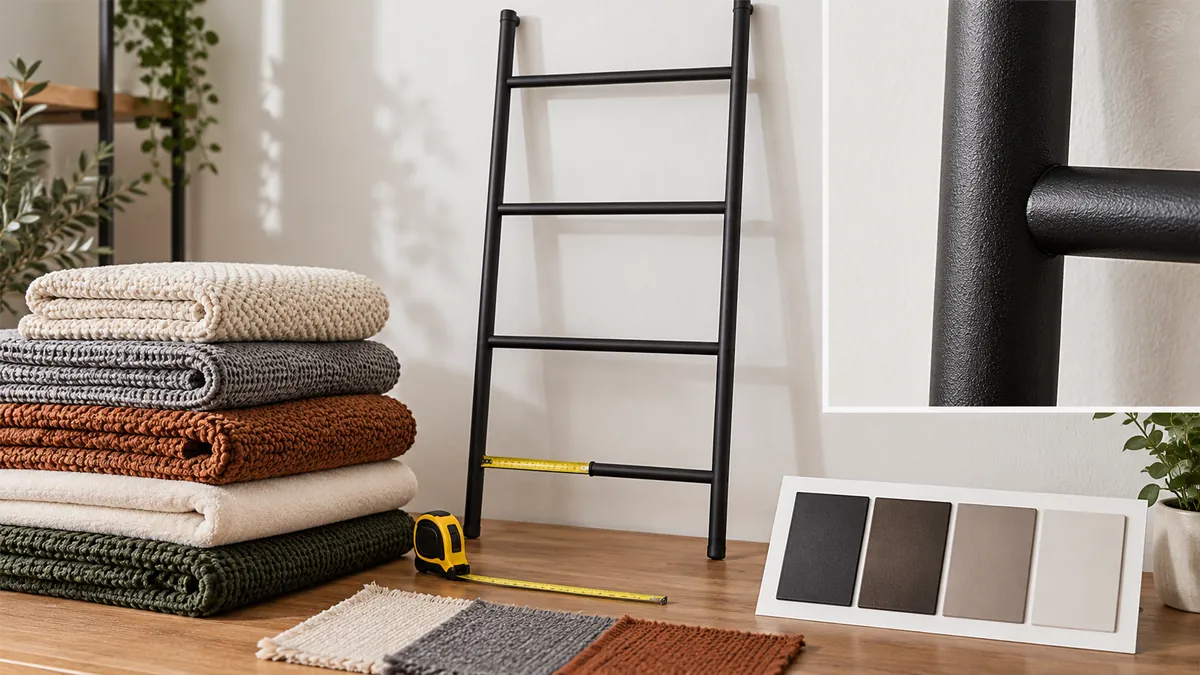
Review the full ladder as a product, not just a metal frame
A sample review should begin with identity. Record the model, drawing revision, finish sample, included feet or pads, fasteners, and any shelf or accessory. Photograph the received sample beside the revision information. If a supplier has shown multiple configurations, mark which one is being approved; a color image with similar geometry does not establish that the shipped sample matches the final bill of materials.
Next, check assembly and alignment. Assemble the product using the proposed instructions and included hardware. Confirm that the side rails face the intended direction, the rung positions match the drawing, and the product can be assembled without confusing left/right parts. If the ladder is shipped knocked down, have someone who did not help develop the drawing follow the instructions. Note any tool that is assumed but not included and any fastener that is difficult to access.
Observe the rack in the stated placement setup. Check whether the contact points match the approved design and whether the wall and floor surfaces used in the review are recorded. If a pad, cap, or protective foot is part of the retail unit, confirm that it is present, correctly located, and represented in the pack-out. A successful observation in one room or on one floor should not be generalized to every surface.
Use the reference textiles during the review. Load one textile at a time in the planned order, then observe how the total arrangement looks and whether removal of one throw disturbs the neighboring items. If the product is for display, take a front and side photograph of the approved arrangement. If it is for storage, include a simple access observation: can the intended user remove and replace the textiles without moving the rack into an unapproved position? These checks are acceptance criteria only when the buyer writes them into the sample plan.
The buyer should distinguish appearance checks from performance claims. A static sample review can show whether a textile fits in the agreed configuration, whether the finish appears consistent, and whether assembly follows the instructions. It does not establish a universal load capacity, fatigue life, coating durability, or stability under every floor and wall condition. If those performance statements matter commercially, define a separate test method, sample conditioning, acceptance limit, and responsible test provider before making the claim.
Convert sample approval into a repeatable production record
After the sample is accepted, freeze the information that made it acceptable. The approval record should list the final drawing revision, bill of materials, finish reference, component dimensions, assembly sequence, included parts, label and instruction version, and carton arrangement. Attach photographs showing the approved textile positions and wall/floor contact configuration. A verbal “sample approved” message without these references can leave room for later interpretation.
Agree a change-control route. A new rung spacing, rail angle, pad material, finish supplier, fastening point, or carton layout can change the product buyers review. Ask which changes require written approval and a replacement sample. The answer should distinguish a cosmetic adjustment from a structural or functional change; buyers should not assume a supplier will know which one matters to their assortment.
Request that the purchase order or technical annex cite the approved revision rather than repeating the entire product description in free text. Use a simple change log with date, revision, summary, reason, owner, and approval status. Where a physical golden sample is used, identify where it is retained and how a future comparison will be made. A sample is useful as a reference only if the parties can identify the model and revision it represents.
For quote comparison, ask suppliers to price the same configuration. Include material and finish expectations, rung count and spacing, protective feet, fasteners, assembly state, label and instruction requirements, and carton assumptions. If one quotation excludes parts or assumes a different pack-out, the price comparison is not like-for-like. Do not compare a blank frame against a retail-ready model as if they were the same deliverable.
Plan packaging around the approved product and textiles
Packaging should protect the ladder’s finish and keep its components identifiable, but more material is not automatically better. First decide whether the model ships assembled or disassembled. Then map contact points: rungs against rails, metal ends against the carton, hardware bags against visible faces, and one unit against another if cartons contain multiple pieces. Those interfaces guide the packaging review.
Inspect the actual packed sample, not only a carton drawing. Look for movement, scuffing, exposed corners, mixed fasteners, and a part that can puncture or abrade its neighboring surface. If the item is disassembled, keep parts organized by assembly step or mark them in a way that corresponds to the instruction sheet. Verify the retail barcode, carton label, SKU, and unit count against the buyer’s data. Do not invent drop-test results; if transit testing is required, the buyer and supplier should agree the test method and acceptance criteria for the specific pack.
The inner pack and outer carton must remain consistent with the approved product. A finish change can alter how components contact during transit. A new rung or longer side rail can require a different layout. A change in assembly state can affect carton dimensions. Set a trigger requiring a packaging review when the product or pack-out changes.
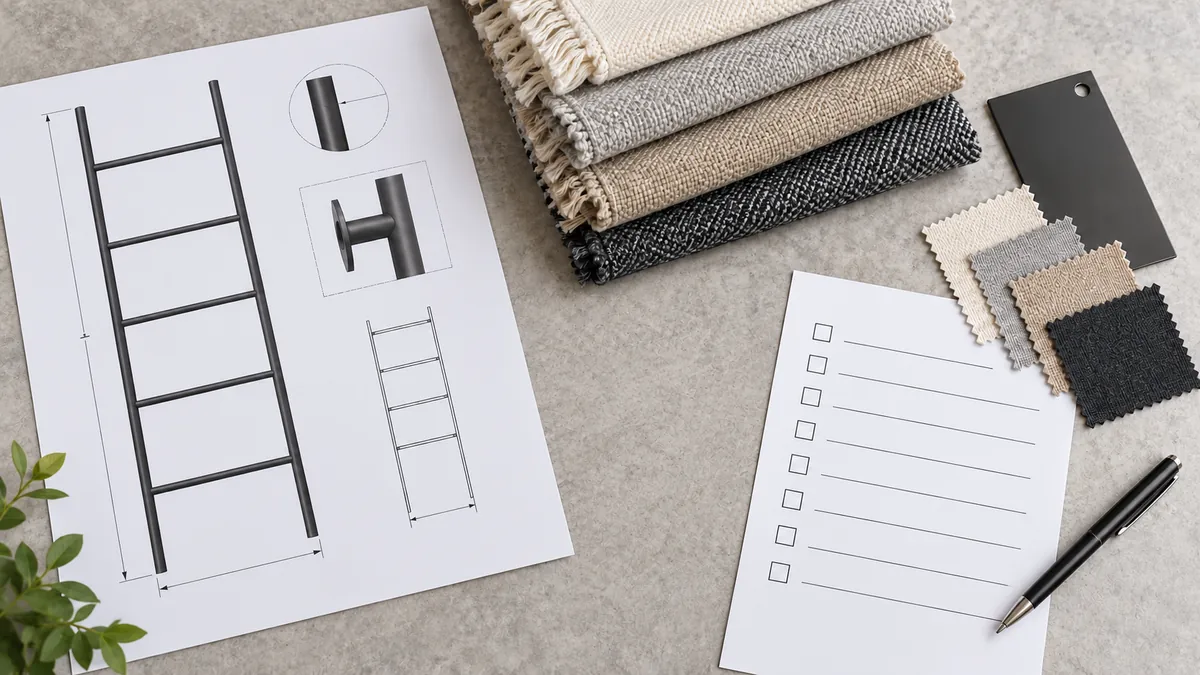
A practical buyer checklist and common questions
Before sending an RFQ, share the reference textiles, intended use, placement method, drawing or dimensioned sketch, finish reference, pack-out target, destination-market label requirements, and the decision-maker for sample approval. Ask the metal blanket ladder manufacturer to identify any assumptions in its quote and which components or services are excluded. A clear list is more useful than a broad request for “best quality.”
At sample approval, record the model and revision, assemble it as instructed, test the specific drape arrangement, check the stated wall/floor contacts, compare finish to the approved reference, and inspect the retail pack. Mark each result as pass, fail, or not applicable. Assign an owner and due date to any open issue. Do not convert a visual impression into an unmeasured claim.
Is rung spacing the only measurement that matters? No. Usable width, rung-end shape, rail angle, overall depth, contact points, and the thickness and fold of the reference textile all affect the arrangement. Define the complete geometry that controls the buyer’s use case.
Should the buyer approve one throw or several? Approve the smallest set that represents the assortment’s intended range, including a bulky or wide item if it will be marketed for that configuration. Record each textile and its placement so later reviews can repeat the same observation.
Can a product photo replace a dimensioned drawing? No. A photograph helps explain appearance but cannot reliably communicate tolerances, rung centerlines, interfaces, finish boundaries, or the approved revision. Use a drawing or controlled specification for those details.
Does sample approval prove load capacity or long-term stability? Not by itself. A sample confirms only the checks actually performed under recorded conditions. If a buyer needs a capacity or stability claim, establish a separate, defined method and obtain evidence for the exact model.
What should change after a supplier revises the finish or feet? Review the approved model again wherever the change affects appearance, contact, protection, assembly, or packaging. Update the drawing or bill of materials, sample record, instructions, and pack-out reference as needed.
Coordinate the manufacturing brief and sourcing handoff
A metal product supplier can discuss drawing revisions, finish references, assembly questions, and packaging details only when the buyer defines the intended product. Koitor’s documented experience is in bathroom and home-storage metal hardware; this article does not claim that Koitor currently manufactures blanket ladders or has approved this illustrative design. For adjacent-category inquiries, make the product, drawings, reference samples, expected order quantities, destination, and any required testing responsibilities explicit.
Importers can review Koitor’s OEM home-storage hardware information for documented product and sourcing context, then use the Kontaktseite to share a drawing or sample for a project-specific discussion. Supplier interest is not a feasibility confirmation; request a written response tied to the actual specification.
Sources and model-specific examples
- HOOBRO blanket-rack wholesale and OEM/ODM category
- Metal blanket ladder example with model-specific rung layout and contact pads
- Formost home-organization product range
These examples show possible configurations, not universal specifications, Koitor products, or verified performance.
Discuss a home-storage metal product brief
Share the drawing, reference textile dimensions, finish target, sample questions, and expected pack-out. Koitor can review the documented metal hardware scope and identify which project facts need confirmation before any quotation or sample plan.
OEM / EIGENE MARKE
Verwandeln Sie diesen Beschaffungsleitfaden in ein Produktdossier
Teilen Sie uns Ihr Zielprodukt, die Größe, die Oberflächenausführung, die Bestellmenge und Ihre Verpackungsanforderungen mit. Ihr Team erhält vor der Angebotserstellung eine praxisorientierte Prüfung der Herstellbarkeit.


 English
 Español
 Português
 Français
 Deutsch
 العربية