

A mixed-SKU carton should be identified from the buyer’s actual packaging hierarchy and receiving workflow—not by assuming that one homogeneous-case GTIN can describe several different products. Before approving a mixed SKU master carton GTIN label, determine whether the carton is itself a trade item, a logistics unit, or both under the buyer’s arrangement; then confirm which identifier and contents record the receiver expects. This is a B2B packaging-control guide, not a universal labeling rule. Koitor’s approved facts support general packaging preparation, but do not establish GS1 membership, EDI integration, identifier allocation, or barcode-verification services.
Why is a mixed-SKU master carton different from a homogeneous case?
A carton with one defined product configuration and quantity may be handled differently from a carton containing several distinct trade items. The physical box can look similar, but the contents have different product identifiers, variants, or quantities. A label that identifies one homogeneous case may therefore fail to describe a mixed carton accurately.
First separate the item being traded from the package used to move it. A GTIN identifies a trade item at a defined level when the responsible brand or data owner has assigned one. A logistic-unit identifier such as an SSCC identifies a particular shipping unit when the trading partners use that process. A packing list or advance shipping record describes the carton contents according to the agreed data exchange. Those identifiers and records can be related, but they are not interchangeable.
A carton may also be a fixed assortment offered and ordered as one trade item, or it may simply be an operational box assembled for shipment. The buyer must define which situation applies. Do not assume that every mixed carton is a new saleable item, that each mixed carton must carry an SSCC, or that every receiver expects the same barcode structure.
The practical problem usually appears at handoff: the supplier packs several SKUs together, the label identifies only one product or a generic carton, and the receiving team cannot match the scanned package to the correct quantities. The solution is not to invent another code. It is to agree on what the physical carton represents, what appears on the label, and which authorized record enumerates its contents.
What should buyers define before artwork or packing begins?
Define the order and packaging hierarchy before a label proof is approved. List the relevant levels—sellable product or pack, inner pack if used, master carton, and pallet or other shipping unit—and state which ones exist for this order. For every level, identify whether it contains one SKU or more than one, whether it is ordered as a trade item, and which party owns the product data.
The buyer’s routing guide, retailer instructions, customer EDI requirements, and shipment process may specify different information. Share the applicable current document with the supplier instead of using a prior order’s artwork as an implied rule. If the carton will be received by a third-party warehouse, confirm which party scans it and what system record is available at that moment.
A clear packaging brief should answer:
- Which buyer SKU or product variants may be packed together?
- Is the master carton always one fixed assortment, or can the contents vary by order?
- Is the carton itself ordered or invoiced as a distinct trade item, or only used as a shipping unit?
- Which identifiers belong to the product, consumer pack, case, or logistics unit?
- Who assigns or supplies each identifier, and who approves its data?
- What human-readable description or quantity must appear for warehouse staff?
- Which packing list, ASN, EDI message, or receiving record must match the carton?
- Who prints, applies, scans, and reconciles the label?
- What changes require a new label proof or buyer approval?
Record unresolved decisions as open. A supplier should not infer the buyer’s item-master policy from a brief email that says “add barcode.” Likewise, do not ask a factory to generate a brand’s GTIN or a serial logistics identifier unless responsibility and authorization are expressly assigned through the buyer’s own identifier process.
Which identifier belongs on the carton?
There is no single answer for every mixed box. Start by asking what the carton is in the buyer’s data model and how the receiver expects to identify it. A GTIN may identify a trade item or packaging level; an SSCC may identify an individual logistic unit; a recipient may require another agreed reference or a combination of human-readable information and electronic data.
| Carton situation | What the buyer should establish | Label and record question |
|---|---|---|
| One SKU and a fixed case quantity | Whether the case is a defined trade item with an assigned case-level identifier | Does the case GTIN and pack quantity match the item master and order? |
| Several SKUs packed together for shipment | Whether the carton is a mixed trade item, a logistics unit, or both | How does the label point to the record that lists each SKU and quantity? |
| A fixed assortment sold as one configured item | Whether the assortment has its own approved trade-item identity under the brand’s data process | Does the carton definition and identifier match the assortment actually ordered? |
| Contents vary from order to order | Whether a serialized logistics-unit identification and shipment record are required by the recipient | How will the unique carton reference map to that specific pack-out? |
| Carton placed on a pallet | Whether the carton and pallet each need identification for separate receiving or handling steps | Which code identifies the case, and which identifies the pallet or other logistics unit? |
GS1 US describes a “Mixed Case” packaging level as containing more than one type of each and more than one GTIN; its Data Hub guidance says it does not assign a GTIN-14 to that Mixed Case level. That is useful context for the buyer’s classification, but it is not a substitute for determining whether a particular mixed assortment is itself a defined trade item, which market’s implementation is being used, or what the recipient accepts.
GS1’s Logistic Label Guideline treats the SSCC as the unique identifier for a logistic unit and distinguishes trade-item information from logistic-unit identification. The guideline discusses heterogeneous logistic units and the information that should or should not be placed on a logistic label in its defined scenarios. A buyer should apply the current standard and trading-partner process to the actual carton; do not generalize one scenario into “all mixed cartons require an SSCC.”
The GS1 SSCC overview explains that an SSCC can identify a logistic unit such as a case, pallet, or parcel. Whether a particular carton receives one depends on the applicable supply-chain process. The carton’s product-level GTINs still describe the trade items inside it; a logistics identifier does not, by itself, provide a human-readable SKU-by-SKU contents list.
What should a mixed SKU master carton GTIN label communicate?
Use an approved carton manifest or equivalent shipment record to connect the physical package with its contents. The record should use buyer-approved product references, quantities, variants, and a carton or shipment reference that the receiver can resolve. The record’s level of detail depends on the buyer’s receiving process, but it should be consistent with the pack-out that was actually completed.
A mixed SKU master carton GTIN label should communicate the carton’s agreed identity without implying that one product code describes every item inside. The receiver also needs a clear route from that carton identity to the approved contents record, whether it is through a buyer reference, a required logistics identifier, or the recipient’s electronic shipment workflow.
For an illustrative mixed bathroom-hardware carton, the manifest might show:
| Carton reference — internal example only, not a GTIN or SSCC | Buyer SKU / description | Quantity packed |
|---|---|---|
| MIX-CARTON-A | Chrome towel ring | 8 |
| MIX-CARTON-A | Two-tier wire shower basket | 6 |
| MIX-CARTON-A | Six-hook towel bar | 12 |
This example uses a plain internal reference, not a scannable identifier. It is not an identifier format or recommendation. In the buyer’s real workflow, the authorized system or party supplies the applicable code and links it to the approved pack record.
At pack-out, compare the contents record against the physical carton: correct SKUs, finish or variant, units per SKU, carton reference, and packaging revision. If the carton contents change, update the record and determine whether the label or shipment message must also change. A label may be accurate when printed but become misleading if a picker substitutes a variant or removes units without updating the associated record.
The supplier and buyer should agree on the reconciliation point. The supplier may compile actual quantities during packing, while the brand owner may provide identifier data and the receiving partner may define the format. State who performs each step and who resolves discrepancies. Do not let several spreadsheets become competing “sources of truth” with different carton quantities.
What should buyers check in a label proof and sample carton?
Treat the first proof as a controlled packaging artifact. Check that it uses the approved product or carton description, buyer SKU references, recipient, human-readable quantity where requested, and the correct label revision. Confirm that the barcode data—if present—was supplied or approved by the responsible identifier owner and corresponds to the intended packaging level. A visual proof cannot confirm that the encoded value is valid or authorized.
For any barcode, use the buyer’s specified verification method and responsible party. A casual phone scan may show that a symbol can be read by one device; it does not establish that its data is correct, the code is authorized, or the receiver’s system will accept it. Never place sample, demonstration, or invented GTIN/SSCC values on production packaging. Use blank or clearly marked non-production proofs during artwork review.

Review the label on the actual packed carton, not only as a flat design file. The label must remain visible and legible after normal packing and handling for the agreed workflow. Placement, size, symbology, quiet zones, and human-readable fields should follow the current buyer instruction and applicable standard—not an article’s generic illustration.
Confirm carton contents with a representative sample pack-out. The buyer or authorized reviewer can compare the sample carton, its record, and any pallet or shipment reference without treating the exercise as a universal compliance test. Keep the approved proof, carton specification, sample review, and pack-out record tied to the same order and revision.
Which mistakes create mixed-carton receiving problems?
Common avoidable mistakes include:
- Applying one SKU’s homogeneous case label to a box that contains several unrelated SKUs.
- Treating the product GTIN, factory SKU, carton reference, SSCC, purchase-order number, and packing-list line as though they identify the same thing.
- Reusing an identifier from a prior carton even though the pack-out or buyer’s process has changed.
- Printing an identifier before the buyer or brand owner confirms who owns and supplies it.
- Sending a contents sheet that lists planned quantities rather than the quantities actually packed.
- Updating the label proof but not the packing list, ASN, or other receiving record.
- Treating a retailer or marketplace instruction as a rule for every customer and market.
- Assuming that adding more barcodes will fix an unclear packaging hierarchy.
- Approving a label from a screenshot without checking which carton level and revision it represents.
When a receiving discrepancy occurs, preserve the carton reference and compare the physical contents, order, approved label, pack-out record, and shipment message. Identify where the mismatch entered the process before changing the artwork or code. A corrective action might involve a clearer packing instruction, an updated data handoff, an additional review point, or a buyer-confirmed identification rule. Do not assign blame or assume that the label printer caused the discrepancy without evidence.
What belongs in a mixed-SKU carton RFQ and approval checklist?
Include the information needed to design and review the package before printing or order release:
- Order number and list of buyer SKUs, variants, and approved revisions.
- Carton hierarchy and whether each case is homogeneous or mixed.
- Whether the carton itself is a trade item, a logistics unit, or treated differently by the receiver.
- Applicable destination-customer routing guide and current label/EDI requirements.
- Identifier owner and the source of authorized product or logistics identifier data.
- Human-readable information and label artwork fields required by the buyer.
- Contents-record format and the mapping between carton reference, SKU, and quantity.
- Party responsible for printing, applying, scanning, and updating each record.
- Sample label and representative sample carton approval steps.
- Pack-out reconciliation method and discrepancy owner.
- Change-control triggers for SKU mix, quantity, label artwork, carton size, or receiver requirements.
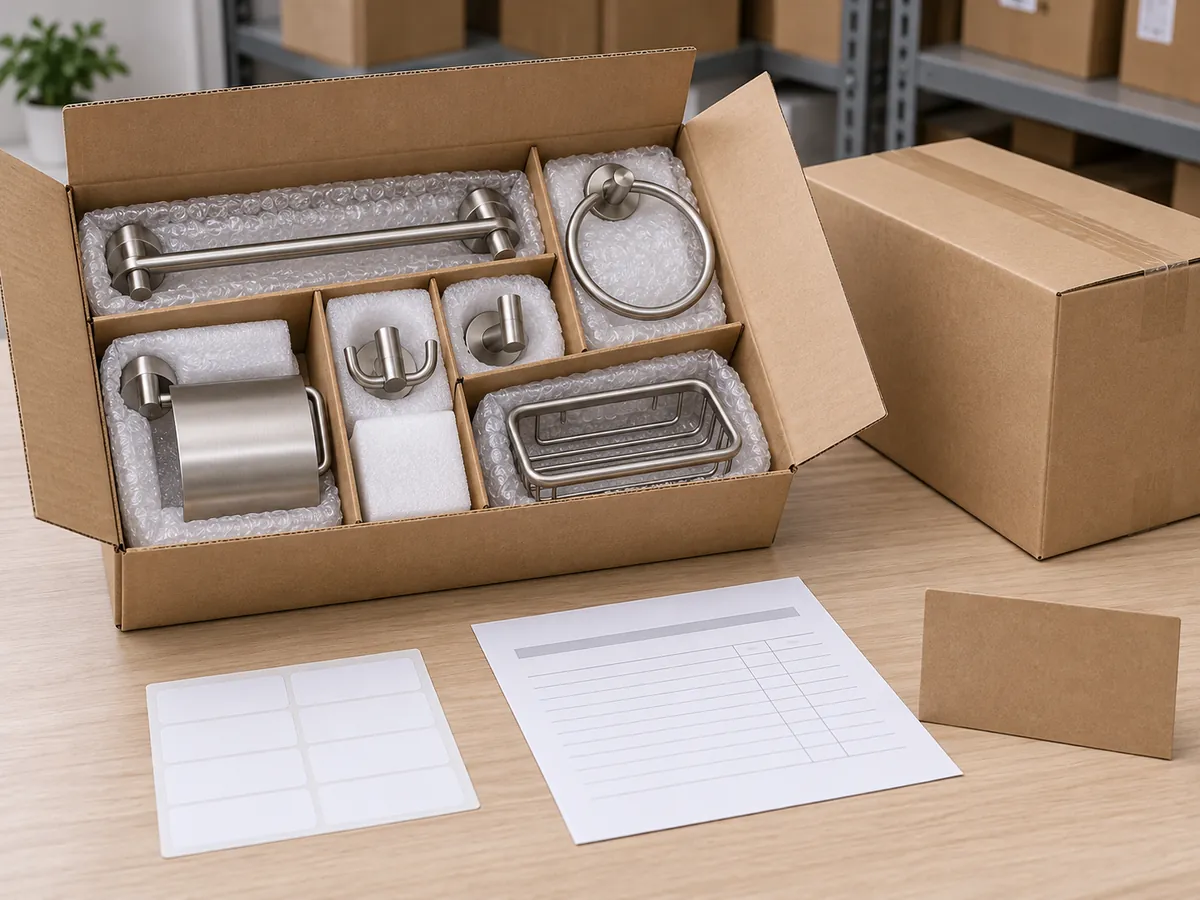
If the receiving partner’s rule is unclear, pause the label approval and request clarification from its standards or operations contact. A short written decision is safer than guessing from a prior shipment. Keep “proof received,” “data checked,” “sample carton reviewed,” and “recipient requirement confirmed” as separate statuses so that one completed step is not mistaken for all approvals.
How should an importer document final approval?
Save the approved label file, carton specification, contents-record example, revision, responsible-party decisions, and the order or pack-out identifier in one traceable location. When the factory uses that approved package for a later order, confirm that the SKU mix and quantities are still the same before reusing it. If the contents or receiver changes, obtain an updated buyer decision rather than assuming that a previous label remains suitable.
This is a supplier-coordination and packaging-control practice. It does not mean that a factory can authorize GS1 identifiers, validate every recipient’s system, or decide the buyer’s trade-item structure. The importer or brand owner retains responsibility for its identifier policy and customer-specific requirements unless a separate written arrangement assigns a task to another party.
Häufig gestellte Fragen
Can one GTIN describe a carton containing several different bathroom-hardware SKUs?
Do not assume so. First determine whether the carton is a defined trade item or a mixed logistics unit, then follow the identifier owner’s current rules and the receiving partner’s requirements. GS1 US Data Hub’s mixed-case guidance is specific to its own packaging-level workflow.
Does every mixed master carton need an SSCC?
Not universally. An SSCC identifies a logistic unit, but the buyer and receiver must establish whether the carton is handled as a logistic unit requiring that identifier in their process.
Is a carton reference the same as a GTIN or SSCC?
No. An internal carton reference can help associate a physical box with a contents record, but it should not be presented as a GS1 identifier unless it was assigned through the responsible system and is intended for that use.
Should a supplier decide which barcode the buyer uses?
The buyer should provide or approve the applicable data and recipient rule. The supplier can reproduce approved information and coordinate the pack-out record when that responsibility is agreed, but should not invent the buyer’s identifier policy.
Discuss packaging and carton requirements with Koitor
For a bathroom or home-storage hardware order with several SKUs, share the SKU list, approved package hierarchy, destination requirements, and carton-record questions before artwork approval. Koitor can discuss general OEM packaging preparation; this does not imply that Koitor assigns GS1 identifiers, operates an EDI service, or provides barcode certification.
Review a Mixed-SKU Packaging Brief
Send the SKU mix, carton hierarchy, destination packing guide, and label-proof questions. Koitor can review general metal-hardware packaging inputs while the buyer or brand owner retains control of its identifier policy.
OEM / EIGENE MARKE
Verwandeln Sie diesen Beschaffungsleitfaden in ein Produktdossier
Teilen Sie uns Ihr Zielprodukt, die Größe, die Oberflächenausführung, die Bestellmenge und Ihre Verpackungsanforderungen mit. Ihr Team erhält vor der Angebotserstellung eine praxisorientierte Prüfung der Herstellbarkeit.



 English
 Español
 Português
 Français
 Deutsch
 العربية