
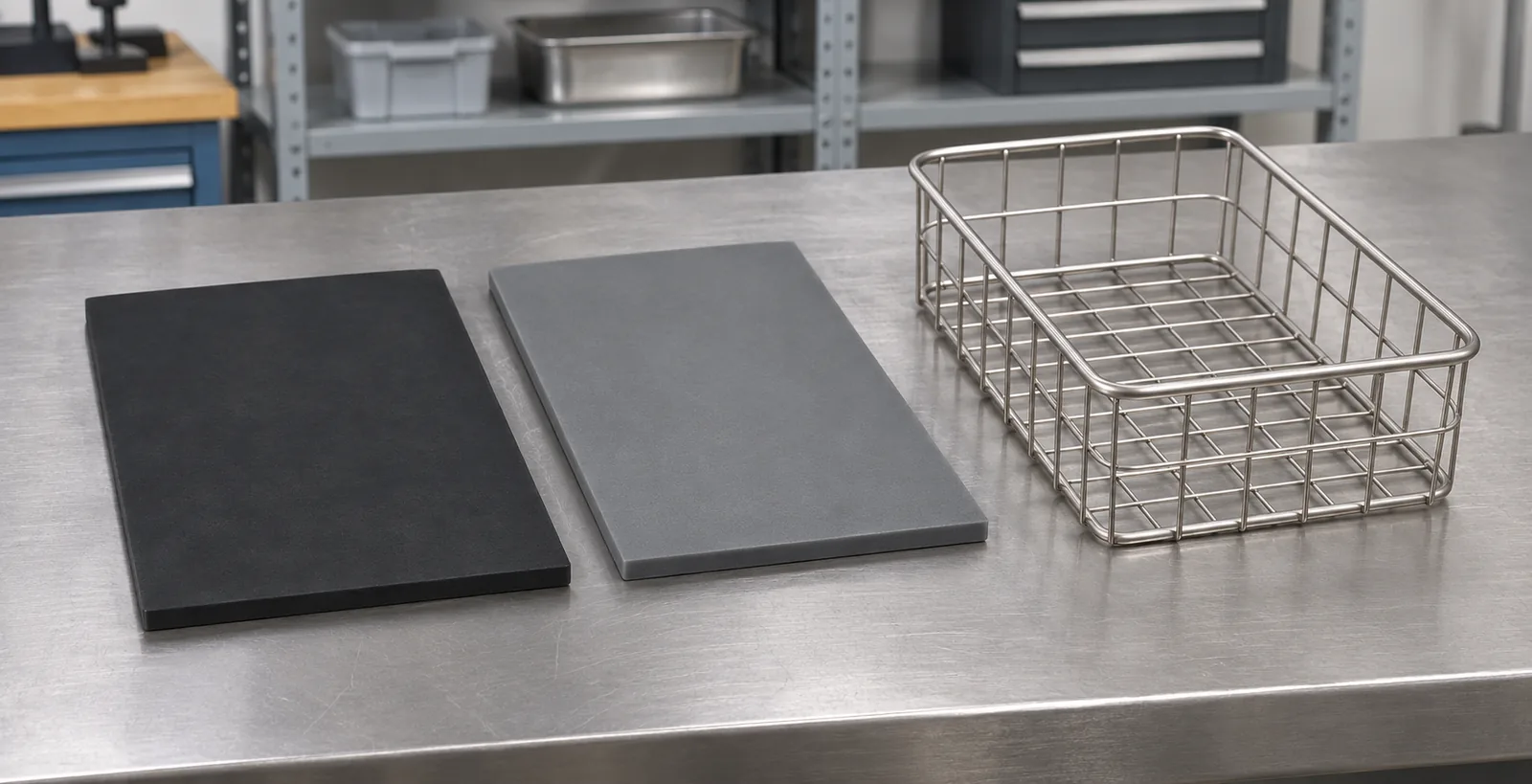
Neoprene vs nitrile is best treated as a comparison between two different elastomer families, not as a universal contest with one winner. Nitrile commonly refers to acrylonitrile-butadiene rubber (NBR), while neoprene commonly refers to chloroprene rubber (CR). NBR is often considered where oil exposure is a leading question; CR is often considered where weathering or ozone exposure is a leading question. Those are screening directions only: the exact compound, contact medium, part geometry, service conditions and supplier evidence determine whether a specific pad or seal is suitable.
For an importer developing metal bathroom or home-storage hardware, the practical first step is to identify what the rubber part actually does. A foot, bumper, spacer, seal and vibration pad have different contact and deformation demands. Record the contact media and environmental exposure separately, then request the compound identity and relevant evidence for the finished part. A label, color or hand feel cannot establish compatibility by itself.
What problem does a neoprene vs nitrile comparison solve for a buyer?
The comparison helps a buyer interpret a supplier proposal when a rubber component is included in a larger hardware assembly. It does not choose a compound for every use. It clarifies which questions should be answered before a material name is added to a drawing, sample approval or purchase specification.
For example, an importer may be reviewing a protective foot fitted to a metal storage stand. The buyer may want to know whether the pad will contact a cleaner, oil, cosmetic product, water, or another substance, and whether the product will sit in sunlight, humid air, or a stable indoor space. These are separate questions. The phrase “oil resistant” does not answer an outdoor weathering question, and an exposure profile associated with outdoor use does not automatically answer a compatibility question for a named cleaner.
This distinction matters because a rubber part is not selected in isolation. It may be compressed against a coated metal tube, snapped onto a bracket, bonded to a plate, or used to keep a product from contacting a shelf. Its intended function determines which failure would matter. A foot that is meant to remain attached may require evidence about fit and retention. A bumper may be judged by its contact surface and compression behavior. A seal may have a different design purpose altogether. The material-family comparison is one input to the decision, not the whole specification.
The buyer should also keep the intended product owner in view. This article is about understanding a material proposal for a purchased component; it is not a laboratory approval, a universal chemical compatibility chart, or a recommendation to change a known-good design. If the component is a new or changed part, record the drawing revision and the proposed compound with the same discipline used for dimensions and finish. If an existing part has already been accepted, a name change should trigger a review of the real requirement and available evidence before it is treated as equivalent.
How do the two material names differ, and what do they not prove?
Neoprene and nitrile are common names associated with different base polymer families. Neoprene is commonly identified as chloroprene rubber (CR); nitrile is commonly identified as acrylonitrile-butadiene rubber (NBR). The name helps classify the proposed material, but it does not specify every additive, formulation, hardness, manufacturing condition or finished-part property.
This is why two parts carrying the same family label can behave differently in practice. Rubber compounds may be adjusted for different product requirements, and a finished component has a shape, thickness, bond, compression state and surface that affect its behavior. A buyer cannot infer an exact service temperature, lifetime, resistance rating or chemical approval from “CR” or “NBR” alone. Nor should the buyer assume that every manufacturer uses identical formulations under a broad family name.
In a neoprene vs nitrile review, keep the family comparison beside the functional requirement instead of using the family name as the whole approval. A buyer can then distinguish a promising screening direction from evidence that is actually specific to the supplied component.
The comparison summarized by Elasto Proxy’s material discussion supports a bounded starting distinction: NBR is commonly associated with oil-oriented applications, while CR is often considered for weathering and ozone-related priorities. It does not establish compatibility with an unnamed fluid or a guarantee for a proposed hardware part. A product-specific decision still needs to identify the actual material and exposure.
The following table keeps the screening dimensions separate:
| Buyer question | Nitrile / NBR starting point | Neoprene / CR starting point | Evidence still needed |
|---|---|---|---|
| Is contact with oil or an oily substance central? | Often evaluated as an oil-oriented elastomer family | May be considered for other exposure priorities, but do not infer a fluid result | Exact medium, temperature, contact duration, compound and supplier data |
| Is outdoor weathering or ozone exposure central? | Do not assume an oil-oriented profile answers weathering needs | Often evaluated where weathering or ozone is a priority | Actual compound, exposure conditions and relevant evidence |
| Is the component a foot, seal, pad or bumper? | Family label alone does not define function | Family label alone does not define function | Geometry, retention, compression, contact surface and assembly details |
| Is the part being substituted? | A family change may change more than the label | A family change may change more than the label | Approved drawing/sample revision and the acceptance criteria |
The table is a way to frame questions, not a pass/fail matrix. It deliberately avoids numerical service limits and universal solvent rankings. Such values depend on the material grade, compound, test conditions and source context. A buyer should obtain evidence that applies to the actual proposed component rather than borrow a number from a generic chart.
How should buyers compare oil contact and weather exposure?
Start by writing down the exposure instead of asking only which rubber is “better.” A useful comparison gives the supplier enough information to identify the relevant compound and explain what evidence is available. “Bathroom use,” “water resistant,” or “chemical resistant” is too broad to define a specific exposure by itself.
For a proposed hardware pad, the exposure record can separate four fields:
- Contact substance: identify the actual product, cleaner, oil, lotion or other medium if known. If it is unknown, say so and treat compatibility as unresolved rather than assuming a result.
- Contact pattern: note whether contact is continuous, intermittent, splash-only, wiped away, or not expected. Include whether the material is under compression or rubs against another surface.
- Environment: distinguish indoor, outdoor, covered outdoor, humid, sun-exposed or ozone-relevant conditions where those are part of the intended use. Avoid replacing a real environment with a vague “weatherproof” label.
- Part function: state whether the component is a foot, spacer, bumper, gasket or other item, and describe what the assembled product must do.
This four-field record prevents two different questions from being collapsed into one. A buyer might prioritize oil-contact evidence for a pad near lubricated equipment, while another project may prioritize weathering for a component used outside. If both conditions matter, both should be stated. A family comparison cannot tell the buyer which exposure is more important; that priority comes from the intended market and use.
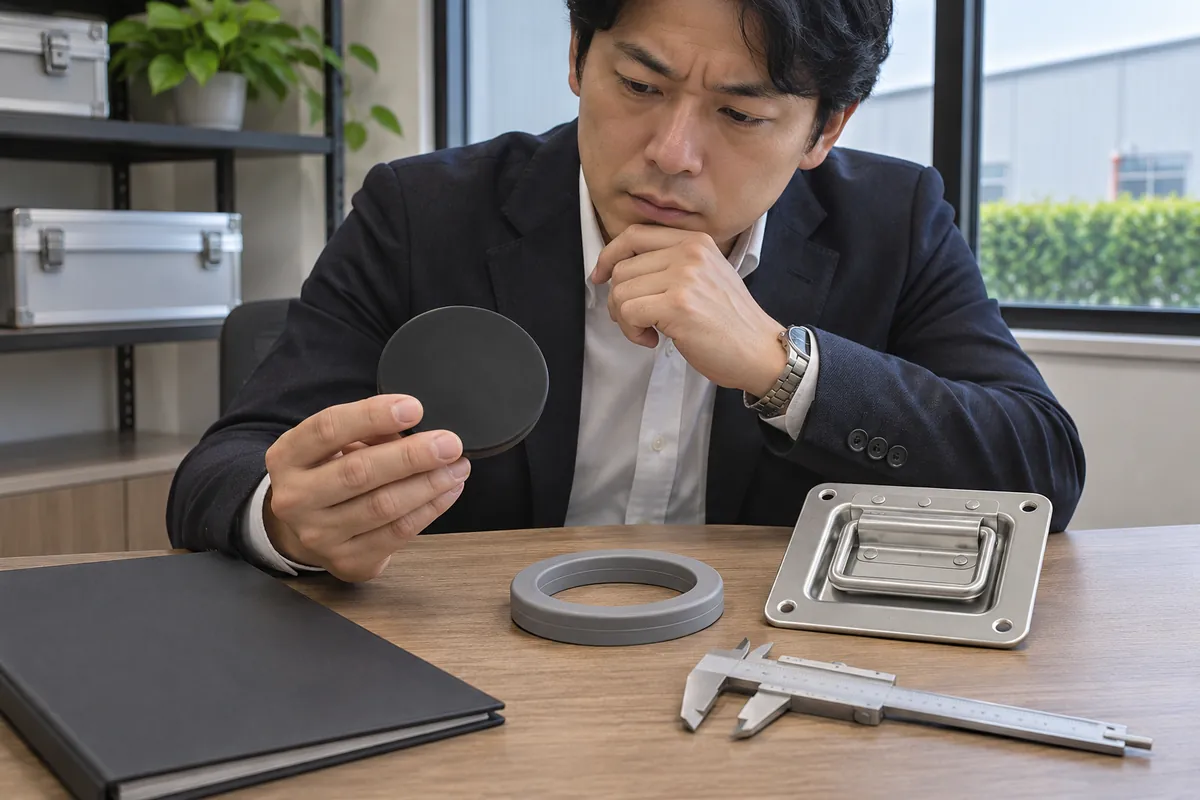
When an exact medium is known, ask the component supplier whether its information covers that substance and the expected contact conditions. When the answer is only a broad family description, record the limitation. Do not turn a general statement into an approval for a formulation or assembled product that was not evaluated. A sample can help establish fit, dimensions and appearance, but a short visual inspection does not prove chemical compatibility or long-term weathering behavior.
The same caution applies when a buyer compares documents. A technical sheet may describe a family, a named commercial compound, or a test specimen with a specific method. These scopes are not interchangeable. Check the material designation, document revision, specimen construction, test conditions and the part being proposed. If the sheet does not identify a field needed for the decision, ask the responsible supplier to clarify it rather than filling the gap with an assumption.
For metal hardware programs, rubber pads may be only one component in a broad assembly. Buyers can also review the mechanical and fit questions covered by Koitor’s rubber compression-set mounting pad guide und rubber abrasion-resistance guide. Those pages address separate decisions; they do not supply a substitute for compound-specific exposure evidence.
What information should a buyer request before approving a compound?
Ask for a traceable description of the actual proposed component. The goal is not to demand proprietary formulation details. The goal is to understand whether the material statement and the buyer’s requirement refer to the same part, revision and exposure.
A practical request can include:
- Part identity and function. Record the component name, drawing number or sample reference, the product it attaches to, and whether it is a foot, pad, seal or bumper. Avoid calling every small rubber item a “gasket” if it performs another function.
- Compound designation. Ask whether the proposal is CR, NBR or another identified material family, and whether a commercial grade or compound designation is available. Keep the response attached to the drawing or approved sample record.
- Exposure assumptions. List the fluids and environmental conditions the supplier was asked to consider. Mark unknown conditions as unknown. If the market may expose the part to several cleaners or oils, define which ones are in scope.
- Evidence scope. Request the applicable technical information and ask what it covers. Does it refer to a raw material, a test specimen, a molded component, or the finished assembly? What does it not establish?
- Construction and geometry. Confirm dimensions, thickness, attachment method, hardness requirement if one exists, compression, contact face and any relevant interface with coated or polished metal.
- Revision control. Identify the approved revision and what will happen if the compound, supplier, geometry or attachment changes. A changed part should not inherit approval automatically just because its name remains the same.
The buyer should avoid asking for one universal “resistance certificate” unless the project has defined what substance, method and acceptance rule are intended. There is no single label that can answer every exposure. If a document uses a test result, clarify its conditions and whether those conditions resemble the intended use. The buyer should not extrapolate a short laboratory exposure into a life guarantee for a product used in a different environment.
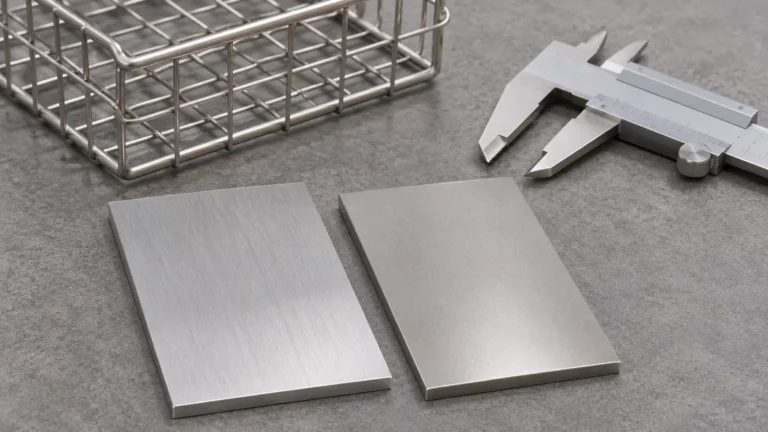
This is also where a measured sample review helps. Compare the received component with the drawing, record what can be observed, and keep unanswered performance questions separate. A caliper can check dimensions; a visual check can note visible defects; neither verifies the polymer formulation. A supplier declaration may identify a material family; it does not automatically establish a specific end-use approval. Matching evidence to the question is more valuable than collecting a large folder of documents that do not cover the real decision.
What mistakes cause buyers to overread the comparison?
The most common risk is treating a general family tendency as a guaranteed finished-part outcome. “NBR is for oil” or “CR is for weather” can be a useful first question, but it is not a complete specification. Buyers should ask what the relevant exposure means for the exact component and which evidence supports the answer.
Other avoidable mistakes include:
- Using color as identification. Black, gray or another appearance does not prove whether a part is CR, NBR or a particular compound. Do not identify a material from color or feel alone.
- Copying a rating without its conditions. A value in a supplier document may relate to a specific grade, test fluid, temperature, time or specimen. Removing those conditions can make the statement misleading.
- Confusing a product form with a polymer family. A rubber sheet, molded foot, bonded pad and seal can share a family name while differing in construction and application.
- Importing a glove or gasket conclusion into a mounting pad. Similar material names do not make the geometries or functional stresses the same. A glove-use comparison is not automatically a pad-approval method.
- Treating a sample’s feel as performance proof. Flexibility or firmness by hand is not a defined measurement and does not prove exposure compatibility, retention, compression behavior or service life.
- Changing material without changing the approval record. If the approved drawing names a compound or grade, a substitute should be documented and reviewed instead of being accepted silently.
- Asking for “chemical resistance” without naming the chemical. The supplier cannot map a broad request to a specific contact medium and condition if the buyer has not defined them.
- Assuming the metal and rubber have one supplier. A hardware manufacturer may coordinate a bought-in pad or foot, but the party responsible for the compound evidence should be explicit. Do not infer who formulates or tests a component from who assembles the product.
Before comparing quotations, normalize the scope. One offer might identify a named compound and provide evidence for a stated exposure; another might name only a broad family. Those offers are not automatically equivalent. A lower price or familiar label does not resolve a missing requirement. Ask each supplier to quote the same drawing revision, material description, quantity, finish, packaging and evidence request where those items are relevant.
If the buyer cannot yet define the exposure, record that the compound decision remains open. A staged approach can be more practical: first confirm the component geometry and available material options; then identify the target market and contact conditions; then decide whether additional technical evidence or a project-specific test is needed. Do not imply that Koitor has performed a test when no such evidence is in the project file.
How can an OEM supplier support the component review?
An OEM supplier can help connect the component proposal to the metal product drawing, sample and assembly details. Koitor Hardware is a family-owned custom metal hardware factory; its relevant contribution is a project discussion about the supplied metal hardware and the interface the buyer specifies. That discussion does not make Koitor the owner of an unverified rubber formulation, laboratory result or end-use guarantee.
For a bathroom or home-storage item, the supplier discussion can clarify where a pad sits, whether the pad must remain attached, which surface it contacts, how the component affects fit, and whether a drawing revision changes the interface. A buyer can provide a physical sample or drawing and ask the supplier to mark the relevant location. That makes it easier to distinguish a metal geometry question from a compound question that belongs with the rubber-component provider.
Small-batch OEM development can be useful when a buyer is testing a new product configuration, a private-label assortment or a mounting arrangement. The buyer can state the intended function and target conditions early, then confirm the sample’s geometry and any specified material before bulk production. MOQ, sample timing and production scheduling depend on the product, finish, quantity and project details; they should be confirmed for the actual request rather than treated as a universal commitment.
A clear development record should separate:
- the metal part and its revision;
- the rubber component and its stated compound;
- the supplier responsible for compound information;
- the environment or contact condition the buyer has defined;
- the evidence reviewed and the limits of that evidence;
- the sample disposition and any open item before production.
The same separation supports change control. If a buyer requests a different foot profile, attachment method or color, the change may affect the fit or identity of the component. If a supplier proposes a different rubber family, the change may affect a material requirement. Keep both changes visible, and do not use an accepted appearance sample as proof of a performance question it did not address.
For projects involving metal storage products, Koitor’s OEM home-storage hardware overview describes the appropriate product-development route. Buyers can send the drawing, sample and the unresolved requirement through the Kontaktseite. The request should make clear whether the buyer needs help with metal geometry, with a bought-in component, or with the scope of a material document.
Buyer checklist before requesting a quotation
Use this list to keep the material discussion tied to an actual product decision:
- Identify the component as a foot, pad, seal, bumper, spacer or another function.
- Provide the current drawing, sample or product reference and revision.
- State whether the proposed material family is CR, NBR or still undecided.
- Name each oil, cleaner or other contact medium that matters; mark unknowns honestly.
- Describe indoor, outdoor, humid or other weathering conditions that belong in scope.
- Explain whether the component is compressed, bonded, snapped on, rubbed or replaceable.
- Ask who supplies the compound information and which document covers the exact part.
- Separate visible sample checks from performance or chemical-compatibility evidence.
- Define the acceptance record for any material substitution before bulk production.
- Request a clear note of exclusions and unresolved conditions.
- Align quantity, MOQ, packaging, finish, sample requirements and private-label details in each quotation.
- Keep any project-specific test request separate from a general material-family comparison.

For readers reviewing hardness rather than polymer identity, see the live shore hardness guide for rubber hardware pads. Hardness is a different property question: it should not be substituted for exposure compatibility, compound identification or an assembly fit decision.
Häufig gestellte Fragen
Is nitrile always better than neoprene around oil?
No. NBR is commonly treated as an oil-oriented family, but an exact fluid, compound and use condition still need review. The broad family name does not guarantee that a proposed pad or seal will suit every oil or operating condition.
Is neoprene always better outdoors?
No universal conclusion follows from the family label. CR is often considered where weathering or ozone is a priority, but the exact grade, part design, exposure and supplier evidence matter. The buyer should confirm the actual requirement for the finished component.
Can I identify the material by color or touch?
No. Appearance and hand feel do not establish the polymer family or compound. Use a traceable designation and the supplier’s relevant documentation, tied to the component and revision under review.
Does a material sheet prove the assembled product will last a certain number of years?
Not unless the evidence actually supports that specific service-life statement under relevant conditions. A general sheet or test specimen should not be converted into a lifetime guarantee for a different component and environment.
What should happen if a supplier proposes a substitute compound?
Record the proposed family or grade, identify the change against the approved drawing or sample, and compare it with the original exposure and function requirements. Ask for the responsible supplier’s evidence and document the approval or remaining open questions before production.
Arbeiten Sie mit Koitor Hardware zusammen
Review a Rubber Component in Your Hardware Project
Send the metal drawing or sample, component function, named exposure and any compound document you have. Koitor can discuss the hardware interface and project scope while the responsible component supplier confirms material-specific evidence.
OEM / EIGENE MARKE
Verwandeln Sie diesen Beschaffungsleitfaden in ein Produktdossier
Teilen Sie uns Ihr Zielprodukt, die Größe, die Oberflächenausführung, die Bestellmenge und Ihre Verpackungsanforderungen mit. Ihr Team erhält vor der Angebotserstellung eine praxisorientierte Prüfung der Herstellbarkeit.
 English
 Español
 Português
 Français
 Deutsch
 العربية