
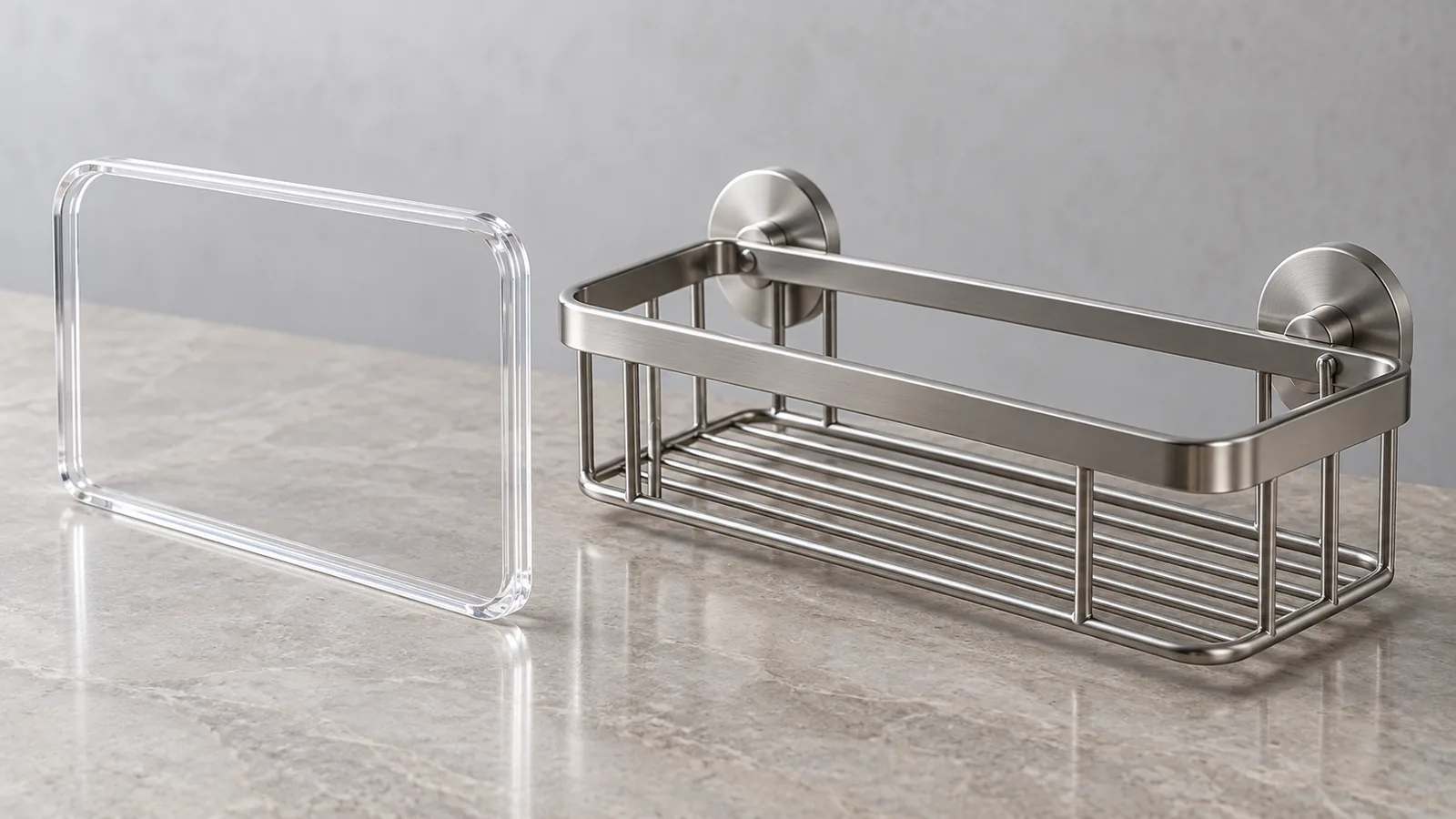
For a purchased clear cover used with a metal bathroom organizer, compare the exact resin grade, forming route, surface expectations and exposure conditions—not just the words polycarbonate or ABS. The buyer question behind “polycarbonate ABS scratch transparency stress cracking” is whether the selected cover stays clear, fits its frame and resists cracking under the intended cleaning and assembly conditions. None of those outcomes can be inferred from appearance or a resin-family name alone. Request grade-specific supplier information and approve a representative part in the finished interface.
Why do clear-cover material choices affect sourcing decisions?
A transparent cover may protect stored items, create a finished appearance or form part of an organizer assembly. If it scratches easily, hazes, discolors or develops cracks, the product can look defective even when its metal frame is acceptable. These risks are affected by the resin grade, geometry, molding quality, surface handling, mounting stress, cleaner exposure and how the part is packed and assembled.
The phrase polycarbonate ABS scratch transparency stress cracking groups several buyer concerns, but it is not a single standardized test or a universal material ranking. “Scratch resistance” needs a defined surface, contact and evaluation method. “Transparency” should be judged against an agreed appearance reference under consistent lighting. “Stress cracking” requires consideration of both the chemical environment and the stress state of the part.
First determine the cover’s function and consequence of failure. A decorative panel may have different acceptance priorities from a cover that clips into a load-bearing assembly or remains under pressure at fasteners. Mark the visible face, edge, attachment points and any areas that must remain clear on the drawing. Then identify which properties are essential and which are preferences.
What does supplier material data prove—and what does it not prove?
Request the exact commercial grade rather than accepting a generic material label. “Polycarbonate” or “ABS” does not identify the specific formulation, additives, color, manufacturing route or relevant chemical-resistance behavior. Ask the supplier to provide a current data sheet and explain whether it applies to the part’s actual grade and color.
Toray’s published information illustrates why grade-level evidence matters. Its transparent ABS resin information describes a portfolio with different grades and properties, while its chemical-resistant transparent ABS grade explains that cracking can occur when chemicals penetrate areas of concentrated stress. It describes a particular grade and evaluation approach; it does not establish performance for every ABS part, cleaner or bathroom cover. Likewise, a polycarbonate chemical-resistance reference is a material-screening source, not a substitute for verifying the offered grade, molded part and actual exposure.
Separate material data from finished-component evidence. A resin data sheet may list properties measured on specimens under stated conditions. It does not by itself establish that a finished cover will retain clarity after repeated cleaning, fit a particular metal frame, or avoid cracking at a mounting point. Processing, residual stress, part thickness, geometry and the contact chemical can change the result.
How should buyers compare polycarbonate and ABS for a clear cover?
There is no universal winner. Compare the proposed grades against the buyer’s actual priorities and ask the supplier to identify trade-offs. A material with a preferred impact or heat property may not automatically give the best surface appearance or chemical compatibility for the application. A supplier’s general family comparison is only a starting point.
| Buyer concern | What to request or define | Sample review | What the evidence cannot prove alone |
|---|---|---|---|
| Clarity and appearance | Grade, color/transparency target, visible surfaces and reference lighting | Compare assembled samples in consistent lighting; note haze, streaks and visible defects | Long-term clarity under unknown use and cleaning |
| Surface scratching | Agreed handling or abrasion method and acceptance criteria | Inspect the same visible face before and after the agreed check | Universal scratch resistance from a visual inspection |
| Chemical exposure | Named cleaner or exposure category, concentration and method where relevant | Use the representative part and documented conditions if testing is required | Compatibility with every household chemical |
| Stress cracking | Geometry, attachment points, residual/assembly stress considerations and exposure | Inspect stressed areas after the agreed exposure and conditioning | A result on an unstressed coupon may not represent the assembled part |
| Fit and retention | Frame dimensions, clip/fastener points, gaps and assembly method | Fit the cover to the actual rack and inspect movement or local stress | Bulk consistency from one prototype |
| Supplier control | Exact grade, source, revision and change-notification agreement | Match sample identification to the approval record | Material identity from color or appearance |
This comparison is a structure for discussion, not an acceptance standard. Ask the supplier to propose a test method when a performance claim is important, then agree the conditioning and pass/fail criteria before testing. Avoid comparing data from different methods as if they were directly equivalent. Treat “polycarbonate ABS scratch transparency stress cracking” as the scope for several separate buyer criteria, not as one pass/fail property.
What should a buyer inspect on the actual sample?
Review the cover in the assembled product. Check the visible face, edges, corners, holes, clips and contact points. Look for scratches, haze, flow marks, warpage, sharp edges, cracks or uneven gaps. Compare parts from more than one sample when possible, and record the drawing revision and supplier identification.
Fit is part of the material review. A cover that is forced into an undersized frame may carry stress around clips or fasteners; a loose fit may rattle or move. Observe assembly without adding unapproved force. Identify whether the issue comes from cover dimensions, frame dimensions, attachment design or an assembly sequence. Do not diagnose resin chemistry from a single visual symptom.
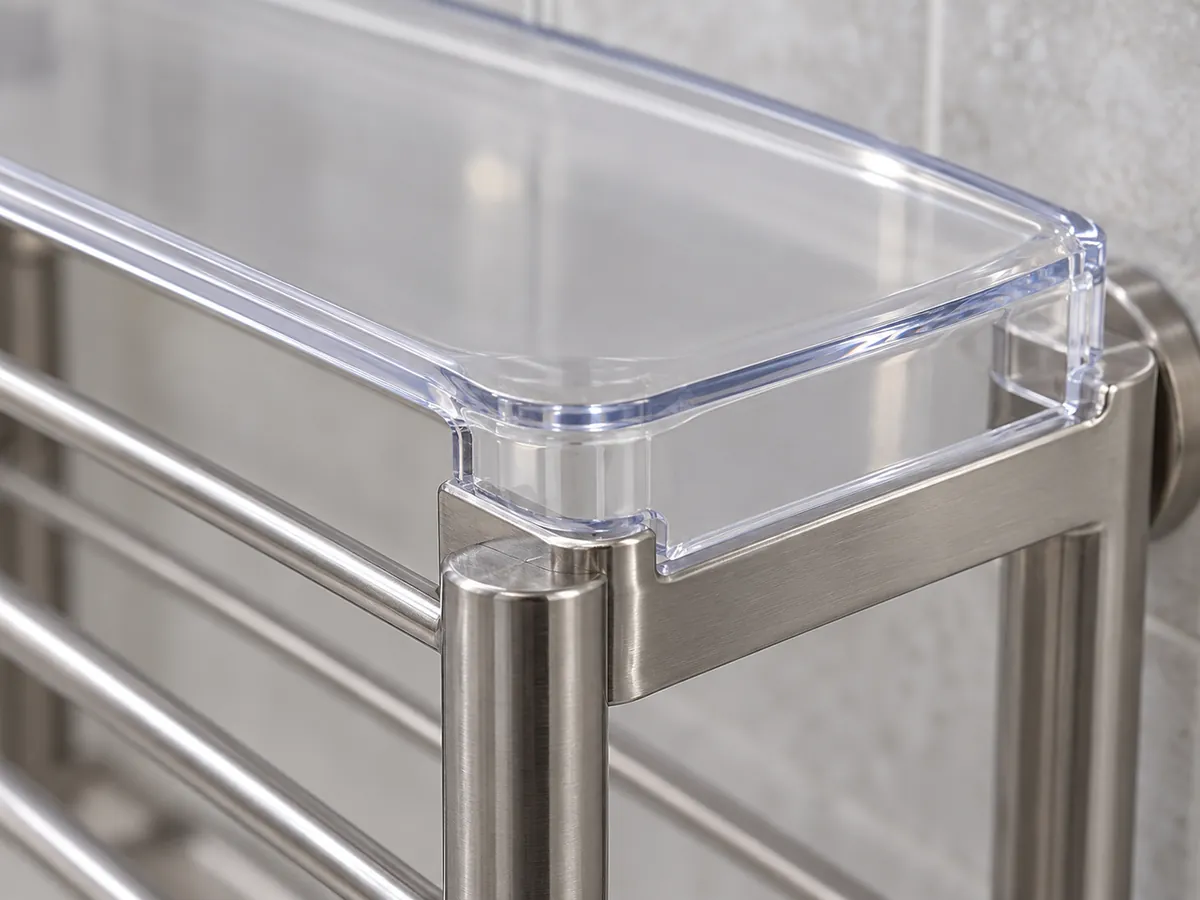
If the cover will contact cleaners, agree which products or chemical categories matter. A test using a substitute liquid or an unspecified concentration may not represent actual use. Record the material grade, sample condition, exposure method, observation timing and the area examined. Where cracking has significant safety or commercial consequences, use a qualified test provider or an appropriate product-specific test plan.
How should scratch and transparency checks be made repeatable?
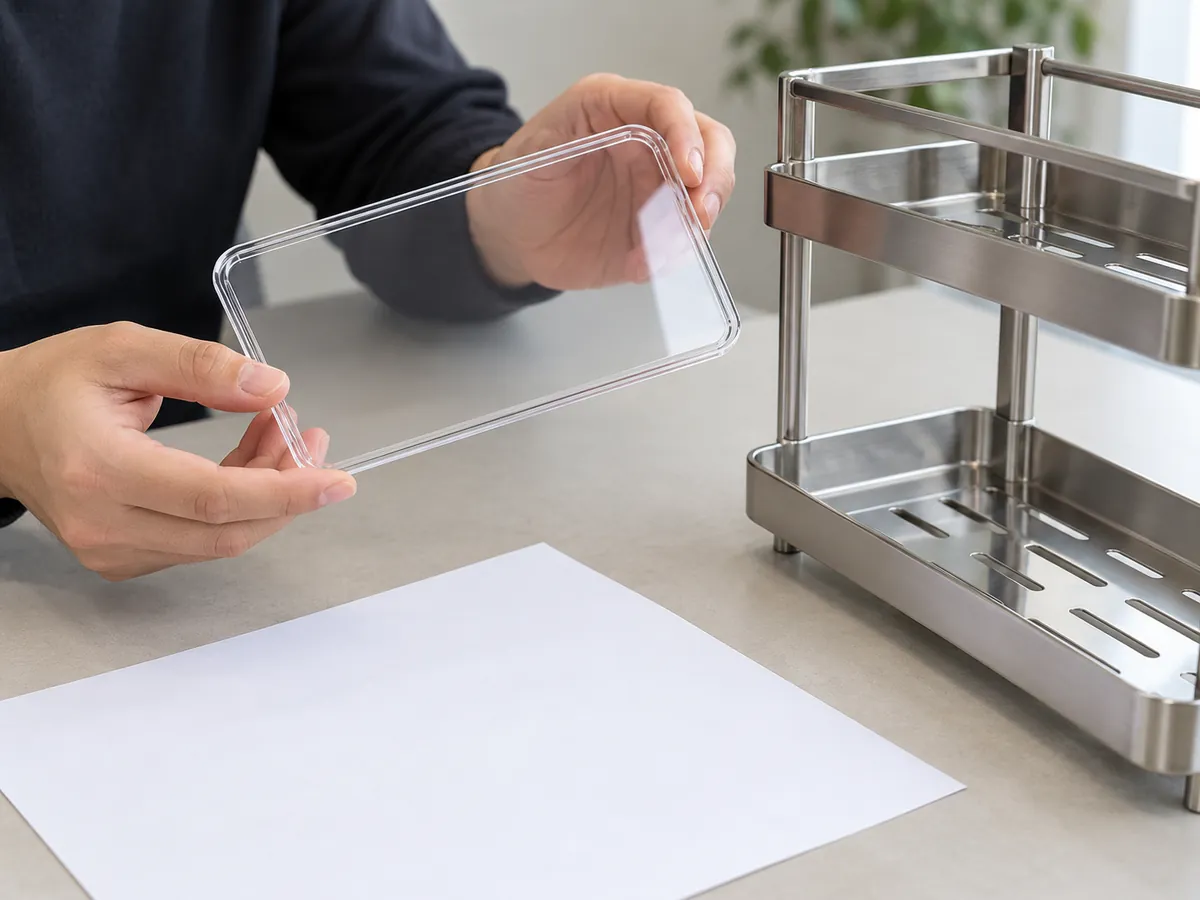
Start with a visual reference and consistent conditions. The buyer and supplier should agree which face is inspected, the light source or environment, viewing distance if relevant, and which defects are unacceptable. This helps distinguish a true batch difference from changes in lighting or handling. Keep protective film on or remove it according to the agreed inspection sequence.
For scratch testing, define the method instead of writing only “scratch resistant.” The load, contact material, number of passes and evaluation method should be suitable for the cover and its intended use. Do not copy a test value from a different resin, geometry or product category without confirming applicability. If no formal method has been selected, describe the buyer’s actual handling concern and ask the supplier to propose a controlled comparison.
Clarity also needs a reference. Decide whether the buyer is evaluating general transparency, distortion, haze, color or another visible feature. Record the sample and lighting conditions so that future production checks can be compared consistently. A photograph can help document an observation, but camera exposure and background may change the apparent result.
How can buyers reduce avoidable stress-cracking risk?
Consider the chemical and the stress together. A cover may be exposed to a cleaner while constrained at a clip, screw or tight corner. Toray’s explanation of chemical penetration at stress-concentration areas is a reason to examine both conditions; it does not mean every cleaner will crack every part or that a material family is automatically unsuitable.
During design review, look for sharp internal corners, abrupt thickness changes, high interference at clips and over-tightened fasteners. Ask the component supplier whether the design or molding process creates known stress-sensitive areas, and what grade-specific evidence is available. These are supplier questions, not a diagnosis of an unseen part.
If a sample shows whitening, crazing or a crack, preserve the part and document its assembly, exposure and handling history. Compare an unexposed sample, if available, and avoid sanding or bending the affected area before review. The root cause may involve material, molding, residual stress, assembly or chemical exposure; do not assign it without evidence.
What belongs in the RFQ and sample approval record?
The RFQ should separate mandatory requirements from preferences. A clear appearance may be mandatory on a front-facing surface, while a particular resin family could remain a supplier proposal if the buyer has no reason to prescribe it. Conversely, where chemical exposure or a specific compatibility requirement is known, name the relevant condition and request evidence for the exact grade. This keeps the supplier’s technical proposal reviewable without implying that a single family name guarantees the result.
Ask how the offered material is identified and what happens if the grade or source changes. A buyer may not need a proprietary formulation or confidential process details, but should be able to link the approved sample to a declared grade and supplier. If the component is sourced through an assembler, identify who passes material and change information to the buyer. Agree what records are available for repeat orders and how a substitution is proposed before it is implemented.
For sample approval, state which faces and dimensions matter, what lighting or visual reference is used, and whether chemical or scratch evaluation is required. If there is no agreed method, write the unresolved question down rather than treating an informal inspection as a completed performance test. Keep photos with the sample revision, but do not use photos alone to prove material identity or stress resistance.
Record responsibility for the test, sample preparation and interpretation before the work begins. This prevents a later disagreement about whether a pass result applies to the part, method and exposure the buyer actually specified.
- Cover drawing or controlled sample, including revision and visible-face designation.
- Exact proposed material grade, color and any relevant supplier declaration.
- Function of the cover and the metal features to which it attaches.
- Critical dimensions, gaps, clips, holes and assembly conditions.
- Clarity, appearance and scratch concerns expressed as reviewable criteria.
- Cleaning products or exposure conditions that matter to the target market.
- Any agreed test method, sample conditioning and acceptance criteria.
- Sample identity and whether the sample represents the intended production route.
- Changes that require buyer notification or a new approval.
- Packaging method that protects the visible surface from abrasion in transit.
A clear cover may be a purchased component. Confirm which supplier is responsible for its resin data, molding process and change control. Koitor’s documented scope is custom metal bathroom and home-storage hardware; this article does not claim that Koitor manufactures or molds polycarbonate or ABS covers. For an OEM assembly, identify the party responsible for the plastic component and align its requirements with the metal-frame interface.
Häufig gestellte Fragen
Is polycarbonate always clearer or more scratch resistant than ABS?
Do not assume so from the family name. Specific grades, surface finish, color, geometry and processing affect the finished part. Define the buyer’s appearance need and compare actual representative samples.
Does a material data sheet prove cleaner resistance?
Not unless the data addresses the offered grade and relevant chemical conditions. A generic material value or a test on an unstressed specimen may not represent an assembled cover under use.
Can visual inspection identify polycarbonate versus ABS?
No. Appearance alone is not reliable grade identification. Request supplier documentation and a traceable part or material declaration.
Should a buyer test every cleaner?
Not necessarily. Identify the cleaners and use conditions that matter for the target product, then agree a representative evaluation with the supplier. Avoid claiming compatibility with chemicals that were not tested.
Who should resolve cracking found during sample review?
The buyer, component supplier and assembler should preserve the sample and trace the material, geometry, process, assembly and exposure conditions. Root cause should be established from evidence rather than assumed from the crack appearance.
Arbeiten Sie mit Koitor Hardware zusammen
Review a Metal Organizer Interface for a Purchased Clear Cover
Share the rack drawing or sample, cover fit points, finish and packaging requirements. Koitor can discuss the metal hardware interface and OEM review inputs; plastic molding capability is not implied.
OEM / EIGENE MARKE
Verwandeln Sie diesen Beschaffungsleitfaden in ein Produktdossier
Teilen Sie uns Ihr Zielprodukt, die Größe, die Oberflächenausführung, die Bestellmenge und Ihre Verpackungsanforderungen mit. Ihr Team erhält vor der Angebotserstellung eine praxisorientierte Prüfung der Herstellbarkeit.
 English
 Español
 Português
 Français
 Deutsch
 العربية