
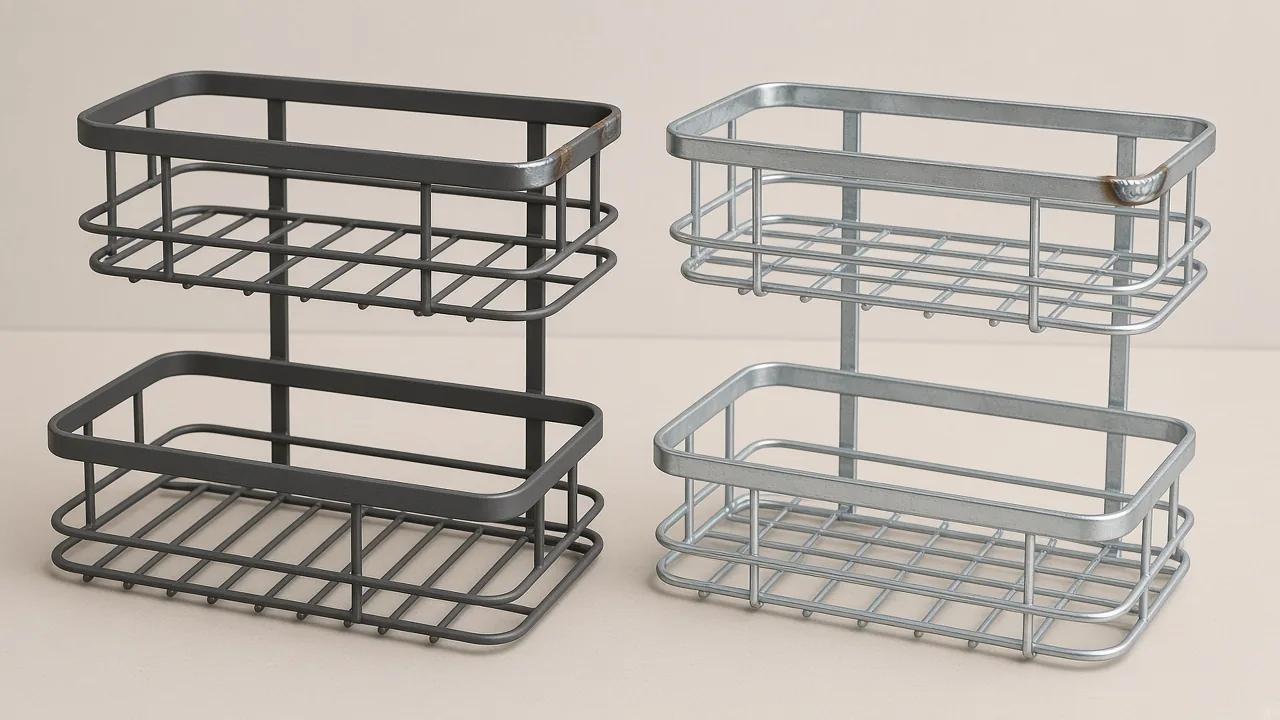
Asking “vinyl or powder?” does not yet freeze the substrate. A pregalvanized vs powder coated wire basket decision should start with the wire route: pre-galvanized wire, or bare wire that is then coated, and what happens at cut ends and welds on that route. If the route is not written, a rust-resistant line and a top-coat label are both unfinished.
This guide is for importers and private-label teams writing a wet-zone kitchen or bath wire basket, rack, or caddy program. It does not own a vinyl-versus-powder coating-system comparison, and it does not own incoming rust-and-scale photographs. Koitor Hardware, a family-owned China OEM manufacturer of kitchen and bath metal storage hardware, can review a route brief with a drawing or a sample; the buyer still has to name the route and the claim.
Why asking for vinyl or powder does not yet freeze the substrate route
Vinyl and powder are top-coat systems. They sit on a substrate. The same powder label can be applied over pre-galvanized wire or over bare wire that was cleaned and then coated. Those two routes do not fail in the same place. Cut ends, welds, and any later scratch behave differently, so the RFQ should name the route before it names only the top coat.
A rust-resistant line that mentions only “powder coated” is a substantiation problem if the substrate is still open. Advertising claims need a reasonable basis before they are made; the U.S. FTC Policy Statement Regarding Advertising Substantiation is a useful reminder of that duty, not a Koitor laboratory result. The file should say which route was used, what was done at cut ends and welds, and which words are then allowed.
Vinyl versus powder coated wire shelving is the neighboring coating-system page. Use it when the question is what those top-coat labels mean, including coverage talk at welds and cut ends from the coating side. This page asks a prior question: what is the wire itself, before that top coat is chosen?
Worked example: a listing says “powder coated rust-resistant basket.” The factory used bare wire, coated after welding. Rust starts at cut ends where the film is thin. The top-coat label was not false as a process name. It was incomplete as a route file, because the cut ends were never named.
Worked example: another factory uses pre-galvanized wire and then a powder top coat. Welding burns zinc at the joint, and the joint is not touched up. The top coat is the same word on the carton. The weld evidence is different. A shared powder photograph is not a shared route.
Custom metal storage basket manufacturing can quote a wire basket, but only if the inquiry lists the substrate route and the intended listing language. A request that only says “powder coated basket” is not yet a route file.
What changes at cut ends and welds on each route?
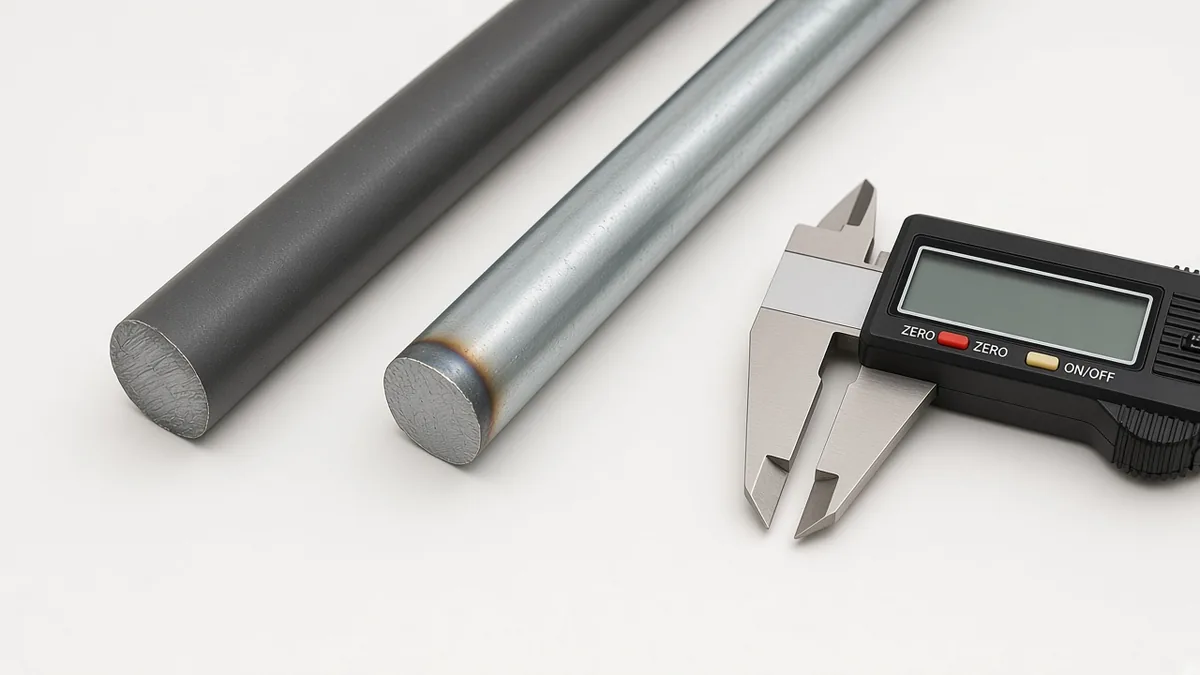
Pre-galvanized wire arrives with a zinc coating already on the round wire. When the wire is cut, the end is a fresh steel face unless the project agrees an end treatment. When the wire is welded, zinc at the joint can be burned or displaced. The route file should say whether cut ends are left as-cut, coated after cutting, or otherwise treated, and whether welds are cleaned, touched up, or left as-welded.
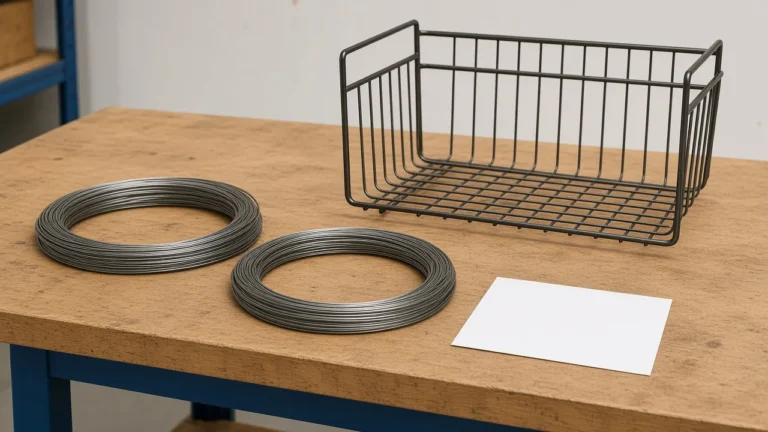
Bare-then-coat wire is formed and usually welded as bare or lightly prepared metal, then powder or vinyl is applied to the assembly. Cut ends and welds can be covered by the same top coat if the film can reach them. Faraday effects, hanging marks, and thick-to-thin film at a cut face still need to be observed. The route file should say whether coating is done after all cutting and welding, and how hanging marks or uncoated faces are treated.
A mixed route is common and must be written, not assumed. Some programs use pre-galvanized wire and then add powder. That is not the same as pre-galvanized wire left without a top coat, and it is not the same as bare wire plus powder. If both zinc and a top coat are present, name both, and still freeze the cut-end and weld evidence for that mixed route.
Welding stainless and galvanized dissimilar joints is a neighboring process page when coating removal or dissimilar joints are the question. Use it for welding practice. This page only asks which substrate route the program froze, and what a buyer should see at the joint on a finished sample.
Do not invent a zinc-coating class, a film thickness, or a Koitor salt-spray hour figure here. If a project later names a zinc-wire standard or a coating-thickness method, those names belong in the project file after both sides agree them. ASTM B117 und ISO 9227 remain method names only if a cabinet test is later added. Hours are not years, and they are not a substitute for a named route.
Stainless wire is a third family and should not be silently filed under either route. If the SKU is stainless, say so, and do not use a pre-galvanized or bare-then-coat checklist as a substitute. This page is for steel-wire routes that involve zinc, a top coat, or both.
Scratch and cut-through behavior should be written as observation, not as a guarantee. A pre-galvanized route may still have zinc beside a later scratch; a bare-then-coat route may expose steel at a chip. Neither sentence is a promise that the basket will not stain. They are reasons to look at the actual sample after an agreed handling check, if the project wants one.
Hanging holes, ground marks, and fixture contact points are part of the evidence. A route that coats after welding can still leave a bare hook mark. A pre-galvanized route can still show a ground face at a weld. Photograph those points on the first article.
| Route element | What to freeze | What a finished sample should show | What to keep off artwork until then |
|---|---|---|---|
| Substrate route | Pre-galvanized wire, bare then coat, or a written mixed route | The sample and the tag match the written route | A top-coat label used as if it named the substrate |
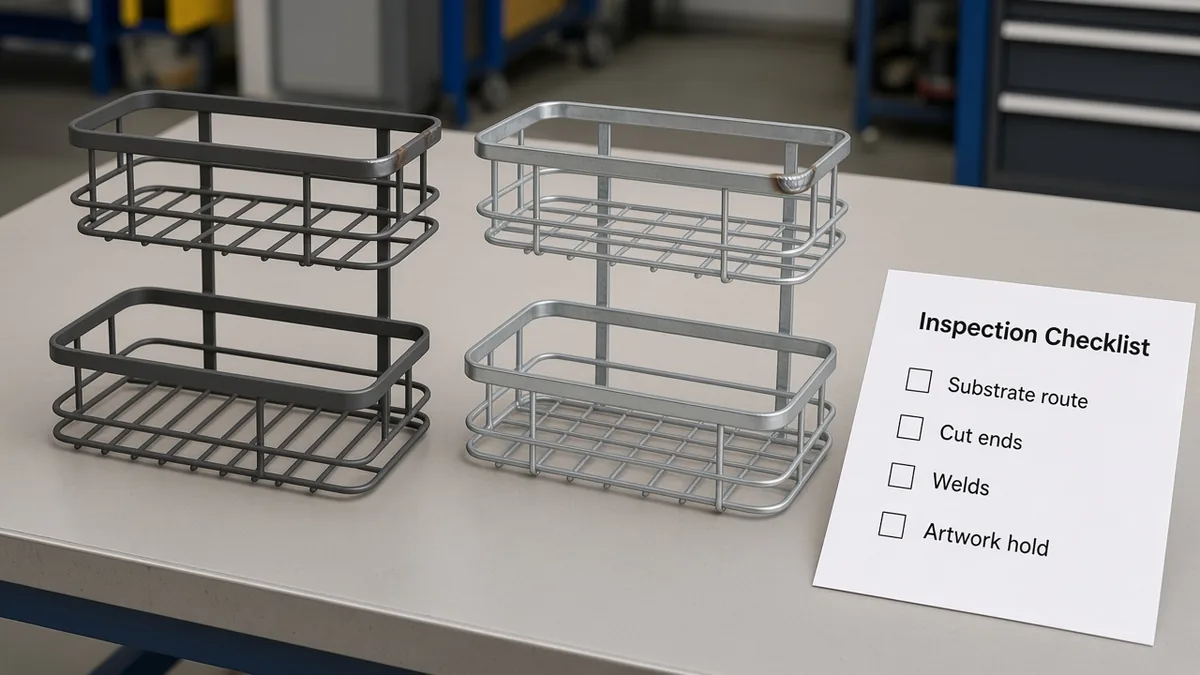
| Cut ends | As-cut, coated after cutting, or another agreed end treatment | The end faces are included in the observation photographs | A side-only beauty photo that hides the ends |
| Welds | Whether zinc was burned, whether a top coat covers the joint, and any agreed touch-up | The joints are visible in the file, not only mid-span wire | A rust-resistant line that never looked at a weld |
| Top coat, if any | Powder, vinyl, or none, as a separate choice after the route is named | The top-coat name matches the coating-system file, not a substitute for the route | “Powder coated” used alone as the whole rust story |
| Evidence method | Visual photographs and, if later agreed, a named test method without invented hours | The record shows the route and the joints, not only a carton adjective | An open-ended rust slogan on the carton |
| Neighbor files | Incoming rust-and-scale photographs and vinyl-versus-powder system choice stay separate | A pass on a neighbor does not freeze this route | Incoming coil photos used as if they named cut-end treatment |
What evidence belongs in the rust-resistant file for each route?
For a pre-galvanized route without a top coat, the file should include incoming zinc condition, cut-end treatment, weld appearance, and a finished photograph of those points. For a bare-then-coat route, the file should include incoming bare-wire condition by reference to the incoming gate, the fact that coating is applied after fabrication, and finished photographs of film coverage at ends and welds.
For a mixed pre-galvanized-plus-powder route, include both sets of points: the zinc is present on mid-span wire, the powder is the visible top coat, and the joints still need their own photographs. Do not let the powder face hide a burned zinc weld in the record.
If the program will print rust-resistant language, choose words the route file can support. A process phrase such as “pre-galvanized wire, cut ends coated after fabrication” is closer to a file than a short retail adjective. If the route is still open, stay silent on the carton.
Do not print an open-ended rust slogan, and do not write a slogan that the basket will not rust. A pregalvanized vs powder coated wire basket question can be answered on this page without putting those promises on the sell-in sheet.
Keep any later cabinet method in its own clause, separate from the route definition and separate from any sampling plan. You may later agree how many baskets in a lot are looked at, using a scheme such as ISO 2859-1 if both sides want a sampling standard. That scheme does not define the substrate route.
Change of mill, a switch from pre-galvanized to bare wire, or a switch of top coat is a change-control event. A first-article pass on one route does not travel with a silent substitute. Write that rule in the brief.
How should this page sit beside incoming rust limits and finished coating-system choice?
Incoming rust-and-scale photographs gate the metal before forming. A pre-galvanized coil with white rust, or a bare coil with bloom, can already be out of limit before the route’s cut-end rule matters. Do not use this route page as a substitute for the incoming gate, and do not use incoming photographs as a substitute for cut-end and weld evidence.
The vinyl-versus-powder page remains the place to compare top-coat systems, including how those systems cover welds and ends in general language. Once a buyer has chosen a top coat, they still need the substrate route on this page. The two files should point at each other without repeating one another’s core answer.
Finished rust acceptance at welds and cut ends, if a later construction page exists, is the inspection of the chosen route, not a third secret route. Ask that later file to cite the route written here, so a finished inspector knows whether they are looking at a zinc-plus-powder joint or a bare-then-coat joint.
Do not mix stainless, aluminum, or mixed-metal programs into this steel-wire route file. Those families need their own sentences. A stainless rim on a steel-wire basket is a mixed construction and should be named as such, because the joint is no longer only a zinc or powder question.
What artwork should stay off the carton until the route is frozen?
Until the substrate route, the cut-end rule, and the weld evidence exist, keep rust-resistant language and any zinc or “galvanized” adjective off the carton, the insert, and the online title, or write only a cautious process phrase that matches the unfinished file. A pregalvanized vs powder coated wire basket heading in a search field is not permission to print a zinc claim the route has not frozen.
Photography should show a cut end and a weld, or should be captioned so a shopper is not shown only mid-span wire as if it were the joint. A hero image that hides ends is a poor basis for rust-resistant artwork even when the route is otherwise written.
Translations must keep the route words together. A version that drops “pre-galvanized, ends coated after cutting” and keeps “rust-resistant powder” is a new, weaker method and a stronger claim.
Channel copy should follow the same file. A marketplace bullet that says “galvanized” when the route is bare-then-coat, or “powder coated” when the buyer thinks they purchased exposed zinc, is still a claim conflict. Align the bullet with the written route.
Instructions and care cards should not undo the route. If the sheet tells the shopper to grind, cut, or drill the basket, that new bare face belongs in an exclusion or in a written end-treatment note. An instruction that creates a new cut end is a new condition.
Color families can share a top coat and not share a route. A black powder basket on pre-galvanized wire and a black powder basket on bare wire will look similar in a catalog and fail in different places. If the program will offer more than one route under the same color, say so on the SKU list, or do not share the artwork.
Private-label buyers sometimes inherit a factory “usual powder basket” phrase from a previous program. That habit is not a route. Ask whether the current metal is pre-galvanized or bare, and ask what the factory does at ends and welds, before the first article is signed. A powder face from another mill will not automatically clear this listing.
If the inquiry is still early and the route is not chosen, you can freeze a written requirement that the route, the cut-end rule, and the weld photographs exist before artwork is released. Do not print a rust-resistant or zinc line while that holding requirement is the only thing in the file. Convert it into a named route and a first-article record first.
Spare wires, extra shelves, or a second basket in a set should follow the same route. A spare shelf supplied in bare-then-coat finish next to a pre-galvanized main basket is a mixed set and will confuse returns. Either match the route or describe the spare honestly.
Field cuts by the installer, if the SKU is meant to be cut to length, are a planned new end and must be in the file. If the product is not meant to be cut, say so, and keep DIY cutting out of the lifestyle copy. A route file that assumes factory-only cuts is undone by a marketing line that says “cut to fit.”
If a later finished lot stains, start the review with the written route, the incoming photographs, and the cut-end and weld record, in that order. Do not begin by changing only the top-coat adjective. The first question is which substrate was actually used, and whether the joints were observed.
Translations should treat “galvanized,” “pre-galvanized,” “powder,” and “vinyl” as technical words, not as interchangeable rust adjectives. A language version that collapses those words into one short rust phrase is a new claim. Keep the route name visible in every language you will publish.
If a buyer later adds a vinyl top coat to a program that was frozen as powder on pre-galvanized wire, update both this route file and the coating-system file.
The substrate may stay the same, but the top coat, the joint coverage, and the artwork words all change. Do not assume the old weld photographs still represent the new film. Re-shoot the joints on the first article that uses the new top coat, and attach those photographs to the updated route file.
Buyer checklist for the substrate route
Use this list before a rust-resistant or zinc-related line is approved for a wet-zone wire basket or rack.
- Freeze a pregalvanized vs powder coated wire basket as a substrate-route choice, not only as a top-coat label.
- Write whether the wire is pre-galvanized, bare then coated, or a mixed route with both zinc and a top coat.
- Write the cut-end treatment and include end-face photographs on the finished sample.
- Write the weld treatment and include joint photographs, including any burned zinc or hanging marks.
- Keep the vinyl-versus-powder system choice in its own file, and keep incoming rust-and-scale photographs in their own gate.
- Do not invent a zinc class, a film thickness, or a cabinet-hour rating in the listing; name methods only after both sides agree them.
- Treat a mill or route change as a new first article.
- Keep rust-resistant artwork off the carton until the route file exists, and do not print an open-ended rust slogan.
- Align marketplace bullets with the written route, especially the words galvanized, powder, and vinyl.
- Send the drawing or sample, the intended listing phrase, and the route choice with the inquiry.
Häufig gestellte Fragen
If I already chose powder, is the substrate decided?
No. Powder can sit on pre-galvanized wire or on bare wire. Name the route, then keep the powder choice in the coating-system file.
Is pre-galvanized wire better than powder?
This page does not rank the routes. It asks you to freeze one route and to look at cut ends and welds for that route. A ranking without that file is a slogan, not a method.
Do cut ends need a treatment?
They need a written rule. Leaving them as-cut is a rule if you accept that face in the observation. Coating after cutting is a different rule. Silence is not a rule.
Can incoming coil photographs replace weld photographs?
No. Incoming photographs gate the metal before forming. Weld and cut-end photographs show what the route did during fabrication. You need both for a wet-zone rust-resistant program.
What if we change from bare-then-coat to pre-galvanized mid-program?
Treat it as a new route and a new first article. The carton words, the weld evidence, and the cut-end rule all need to be updated before the next lot ships under the old artwork.
What should a first sample include?
A finished basket or rack on the written route, photographs of cut ends and welds, the top-coat name if any, the intended listing phrase or an explicit decision to stay silent, and a pointer to the incoming photograph file for that metal.
Arbeiten Sie mit Koitor Hardware zusammen
Need a wire substrate-route brief reviewed?
Send Koitor your drawing or sample, the intended listing phrase, and the substrate route you want frozen. Our team can review pre-galvanized versus bare-then-coat evidence at cut ends and welds before quotation, without inventing a coating class or a rust slogan. MOQ can start from about 100 pcs depending on the product; samples usually take 5–7 working days after details are confirmed; bulk production usually takes 4–6 weeks depending on the project.
OEM / EIGENE MARKE
Verwandeln Sie diesen Beschaffungsleitfaden in ein Produktdossier
Teilen Sie uns Ihr Zielprodukt, die Größe, die Oberflächenausführung, die Bestellmenge und Ihre Verpackungsanforderungen mit. Ihr Team erhält vor der Angebotserstellung eine praxisorientierte Prüfung der Herstellbarkeit.
 English
 Español
 Português
 Français
 Deutsch
 العربية