
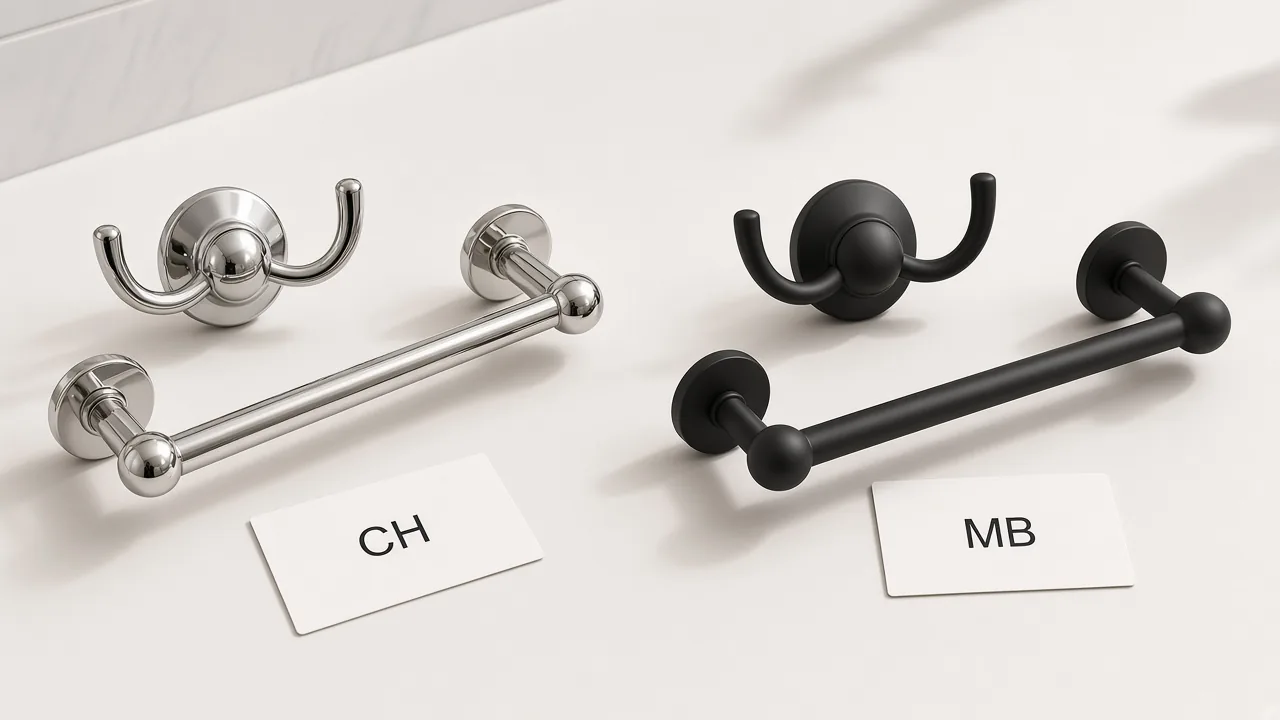
Private label bathroom finish family SKU architecture is the way a collection shares posts, screws, flanges, and hole patterns across chrome, nickel, matte black, or other finishes without turning every SKU into a silent mix. Buyers should freeze that architecture before they photograph a set, or a later colorway will arrive with a different hole pattern and a bag of screws that no longer fit the first lots.
Sharing components is not the same as forcing every accessory onto one mounting plate. A shared mounting-plate program is a useful neighbor when the collection truly uses one plate. This page owns the broader family: which parts may be common, which hole patterns must stay identical, and how SKU codes should say so.
This page is written for importers and private-label teams building screw-mounted bathroom accessories such as robe hooks, towel bars, and similar posts. It does not own hospitality project procurement schedules, and it does not reopen a single-SKU set-screw seating file.
What should a finish family share, and what must stay unique?
A finish family is a set of SKUs that a catalog presents as the same design in more than one finish. The buyer expects the same projection, the same hole pattern, and often the same screw pack. If those expectations are not written, a factory can treat each finish as a new part and quietly change a flange or a hole.
Share what the installer will not see as a “new design”: posts, cover flanges, screw length and head, hex-key drive if used, and the hole pattern on the wall. Keep unique what the finish process actually changes: the visible coating, sometimes a slightly different color of a plastic insert, and the SKU code itself.
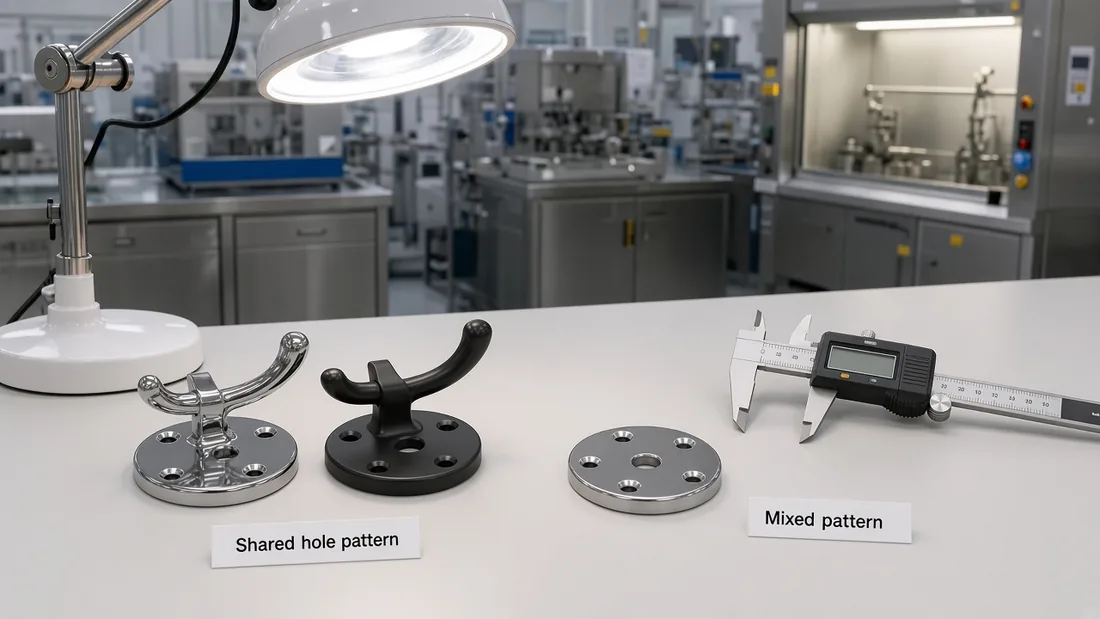
Do not assume a matte-black lot can inherit a chrome hole pattern without a check. A new flange tool, a different vendor for a post, or a late “improved” plate can break the family. The first-article for a new finish should include a hole-pattern overlay against the retained chrome, or whatever finish was sealed first.
Custom towel-rack manufacturing und Fertigung von maßgefertigten Badbeschlägen can quote a family, but only if the inquiry lists the shared set and the unique set. A request that only says “the same hook in two colors” is not yet an architecture.
How should SKU codes and hole patterns stay honest?
SKU codes should carry the shared design identity and the finish, not hide a new hole pattern inside a color suffix. If a black hook uses a different plate, it is not the same design with a color code. Give it a new design identifier, or stop and fix the plate.
Hole-pattern control means a stated spacing, a stated hole size, and a retained plate or a simple gauge. Measure by a written method, and keep that method out of any sampling-plan sentence. A new finish lot that “looks like” the first is not proof that the holes still match.
| Family element | Usually shared across finishes when… | Must become unique when… | What to freeze |
|---|---|---|---|
| Posts and cover flanges | The visible design and the wall interface stay the same | A finish needs a different geometry or a new tool | Drawing identity and a hole-pattern overlay for each new finish |
| Screws and anchors | Length, head, and drive still serve every finish of the design | A new plate thickness or a new market kit changes the pack | Screw length, drive, and kit photo per design, not only per color |
| Hole pattern | The installer is told the family uses one template | A factory or a tool change moves a hole | Spacing, hole size, and a retained plate or gauge |
| SKU code | The code is design plus finish, and the design is truly shared | The hole pattern or the post changes | A coding rule that forbids a color suffix on a new geometry |
| Photography and listing | Lifestyle images show the same mounts in each finish | A new finish was shot with a different plate or projection | A photo sample that matches the shared architecture |
| Spares later | A spare post or screw from one finish still fits another of the same design | The later lot drifted | A retained shared component and a note in the spare file |
What should first-article and pack checks include?
For the first finish, seal the design, the hole pattern, and the screw pack. For each later finish, overlay the plate, trial the same screws, and compare projection and flange seating with the sealed unit. Do not seal a beauty shot of a black hook without the plate view.
Pack checks should confirm that the screw bag and any hex key match the family rule, not only that the hook is the right color. A black carton that ships a shorter screw than the chrome carton will show up in the field as “the black one does not sit.”
What the factory can control, and what stays a project agreement
A factory can hold shared components, overlay hole patterns, and pack a consistent kit when the architecture is written. Custom bathroom hardware manufacturing can also keep a retained plate and a retained post as the family gauge.
The factory cannot honestly promise that every future colorway will stay interchangeable unless the file says so and later lots are checked. Koitor can review a finish family as a family-owned China OEM manufacturer of bathroom and home-storage metal hardware; the buyer still has to write the shared and unique lists.
Incoming inspection should include a hole-pattern or template check when a new finish or a new lot of a shared plate arrives. Keep that method separate from any sampling-plan numbers. Commercial terms for extra finishes, tooling, or samples remain project-specific under careful approved wording.
Buyer checklist for private label bathroom finish family SKU architecture
Use this list before a second finish is photographed or tooled.
- List the designs in the family and the finishes that must share each design.
- Write which posts, flanges, screws, and hole patterns are shared, and which items are unique to a finish.
- Forbid a color suffix on a SKU that no longer shares the hole pattern.
- Seal the first finish with plate, projection, and kit photos, not only a face view.
- Overlay each later finish against the retained plate or gauge.
- Trial the same screw pack on every finish of the design unless the file changes the kit in writing.
- Keep measurement methods and any sampling plan in separate clauses.
- Update spare-part notes so a later finish can still use the shared post or screw.
- Do not treat a shared-plate collection page as a substitute if some SKUs use unique plates.
- Do not promise interchangeability in a listing unless the checks are on file.

Installers remember a template. If the chrome hook in a first house uses 32 millimetres between holes and a later black hook in the same collection does not, the installer will blame the brand, not the unfinished architecture file. Write the template in millimetres or inches as a project figure with a method, and do not invent a Koitor-standard spacing here.
Retail sets that box a hook and a bar together must follow the same rule. A mixed-finish gift set is especially risky: if the black bar uses a different plate than the chrome hook in the same carton, the customer has two templates on one wall. Check mixed sets as their own first article.
Plastic or zinc inserts, set-screw drives, and cover-flange inner fits are easy to forget in a color extension. If the chrome unit uses one insert and the black unit uses another with a slightly different shoulder, the flange will sit high. Include those hidden parts in the shared list or the unique list, not in a vague “same as chrome” line.
Artwork and carton prints should show the architecture honestly. A family hero image that crops away the plate can hide a drift. Keep at least one pack or instruction diagram that shows the hole pattern for the design, and reuse it for every finish of that design.
A second factory or a second plating shop does not automatically inherit the shared plate. If a colorway is moved, overlay the plate again. The coding rule travels; the physical gauge may not.
Do not use a field touch-up story as a substitute for family architecture. A later nick on a matte-black hook is a finish-control question on its own live neighbor page, which is not in the box internal-link file used here and is therefore not hyperlinked. This file only asks whether the black SKU is still the same design.
When the shared list, the unique list, the SKU coding rule, and the overlay checks are written, private label bathroom finish family SKU architecture is ready to quote. If the file only says “available in four finishes,” the hole pattern is still open.
Worked example: a robe hook sealed in chrome is extended into matte black and brushed nickel. The black flange comes from a new tool with a slightly longer pitch. The nickel uses the original tool. If all three SKUs share one color-suffix family code, a later spare plate will be a lottery. Give the black hook a new design identifier, or bring the tool back to the sealed pitch, and overlay all three before the listing is shot.
Worked example: a towel bar and a paper holder are sold as a “same collection” in four finishes, but only the bar was overlaid. The paper holder uses a smaller plate that drifted on the third finish. Collection photography still shows them together. Treat each design as its own overlay, even when the marketing name is shared.
Worked example: a distributor asks for a unique logo stamp on the black finish only. A stamp that sits on a visible face may be only a finish-unique mark. A stamp that moves a hole or a post shoulder is a new geometry. Classify it before the SKU code is reused.
Projection and flange sit-down belong in the same overlay session as the holes. A plate can keep the hole spacing and still sit proud because the boss height changed. Installers will feel that as a rock or a gap, and they will describe it as “the black one is different,” which is an architecture failure, not only a finish complaint.
Instruction sheets should reuse the same hole diagram for every finish of a design. Translating the sheet is fine. Redrawing the holes for a colorway is a signal that someone already changed the plate. Compare the diagrams as well as the metal.
Warehouse location codes sometimes split finishes into different bins and different buyers. That is operationally convenient and architecturally dangerous if the shared plate is revised in only one bin. The effectivity of a plate change must list every finish SKU that uses the plate, not only the color that raised the complaint.
Marketplace titles that say “same as the chrome version, in black” are claims. They should follow the overlay, not precede it. If you cannot yet prove the holes, do not write that sentence.
A family can include a special length—for example a longer bar—without breaking the rule, if the longer bar is a new design identity with its own plate and its own overlays across finishes. Trouble starts when a longer bar inherits the short-bar SKU root and a short-bar plate is still in the kit.
Set-screw drives, if the family uses concealed posts, should stay common unless a finish cannot take the same drive. That kit question has its own page in this batch; here, only record whether the drive is in the shared list so a black carton does not drop a different key.
Incoming photos from a factory should include the plate of every finish in the shipment sample, not only the hero hook face. A color-only photo set cannot support an architecture file.
If a finish is retired and later revived, overlay it again. Tools get repaired. Memory is not a gauge.
Coding templates can be simple: a design stem, a finish suffix, and a rule that a geometry change requires a new stem. Fancy configurators are optional. The rule is not.
Quality teams sometimes accept a black hook because the finish matches a chip, and they skip the plate. Split the checks: finish against the finish standard, geometry against the family gauge. A lot can pass shade and still fail the architecture.
Sales samples that travel in a shared suitcase get mixed. A sales hook with a unique “improved” plate can become the unofficial standard in a region. Collect travelling samples periodically and overlay them, or the field will train itself on the wrong template.
Anchors for different wall types can change without breaking the family, if the plate and the screw length through the plate stay as written. A kit that adds a longer toggle for one market is a kit variant, not automatically a new design, as long as the plate is unchanged and the instruction still matches.
Do not hide a hole-pattern change inside a packing improvement. A new inner tray that needs a smaller plate is a geometry change first. Approve the plate, then the tray, then the SKU code.
If two finishes must ship from two purchase orders, still name them as one family in the quality file. Purchase-order split does not justify two templates.
A simple cardboard hole template in the buyer’s office is often enough for a quick incoming check, provided it was taken from the sealed plate and is marked with the design stem and the date. Replace it if it wears. A worn template will accept drift.
When those overlay habits, the coding rule, the kit consistency, and the travelling-sample control are in place, the finish family will survive a second season. That is the practical test of private label bathroom finish family SKU architecture, not a catalog color grid alone.
European and US screw heads can differ even when the hole pattern is shared. If a market kit changes the head style, keep the plate and the hole sizes, and record the kit as a market variant under the same design stem. A new head is not a license to move the holes.
Powder, plating, or PVD may need slightly different masking at a flange edge. Masking is a finish-process note. If masking requires a different flange undercut that changes sit-down, it has become a geometry note and belongs in the unique list or in a revised shared drawing approved for all finishes.
A buyer who already has thousands of chrome units in stores should treat a mid-life plate change as a family event. Notify every finish, every warehouse, and every instruction reprint. A quiet change in one colorway will otherwise appear as a random field complaint six months later.
Keep a short family map in the purchase file: design stems, finishes, shared components, unique components, and the date of the last overlay. The map is easier to audit than a long email thread, and it is the right attachment to a new colorway request.
When a new colorway is requested, attach the family map, the retained plate photo, and the current screw pack, not only a Pantone or a finish name. That single habit prevents most silent hole-pattern drift before tooling or photography starts on the new finish. Keep the map and the last overlay date in the same request so the review starts complete and the hole pattern is not left to memory on either side of that new finish colorway order.
Häufig gestellte Fragen
Can every accessory in a bath collection share one hole pattern?
Only if the designs truly share a plate or a post. A hook and a long bar often need different patterns. Family architecture allows more than one design; it requires each design to stay consistent across finishes.
Is a shared mounting plate the same as a finish family?
No. A shared plate is one way to build a family. A family can also share posts and screws with more than one plate, as long as each design is identified and overlaid.
Does a new finish always need a new first article?
Yes, at least for the plate, the kit, and the finish itself. A delta on the plate is not optional if the installer will use the first template.
What if a factory already changed a black plate to “improve” it?
Stop, overlay, and decide whether the black SKU is still in the family. If the holes moved, change the code or change the plate back.
Should spare posts be finish-specific?
If the post is a shared component, a spare can be finished to match or supplied as a common primed part only when the file allows it. The fit must still match the retained post.
Can a longer bar stay in the same SKU stem as a short bar?
No, if the plate or the hole pattern changes. Treat the longer bar as its own design and overlay each finish of that design.
Do retired finishes need a new overlay when they return?
Yes. Tools and suppliers move. Overlay against the current retained plate before the finish is sold again.
How should a first family sample be submitted?
Send at least two finishes of one design, both plates, the screw pack, and a written shared-versus-unique list. A single chrome beauty shot is not a family sample.
Arbeiten Sie mit Koitor Hardware zusammen
Need a finish family quoted with a shared hole-pattern rule?
Send Koitor the intended finish set, the shared-component list, and the hole-pattern drawing. Our team can review the collection architecture and small-batch OEM options before quotation.
OEM / EIGENE MARKE
Verwandeln Sie diesen Beschaffungsleitfaden in ein Produktdossier
Teilen Sie uns Ihr Zielprodukt, die Größe, die Oberflächenausführung, die Bestellmenge und Ihre Verpackungsanforderungen mit. Ihr Team erhält vor der Angebotserstellung eine praxisorientierte Prüfung der Herstellbarkeit.


 English
 Español
 Português
 Français
 Deutsch
 العربية