
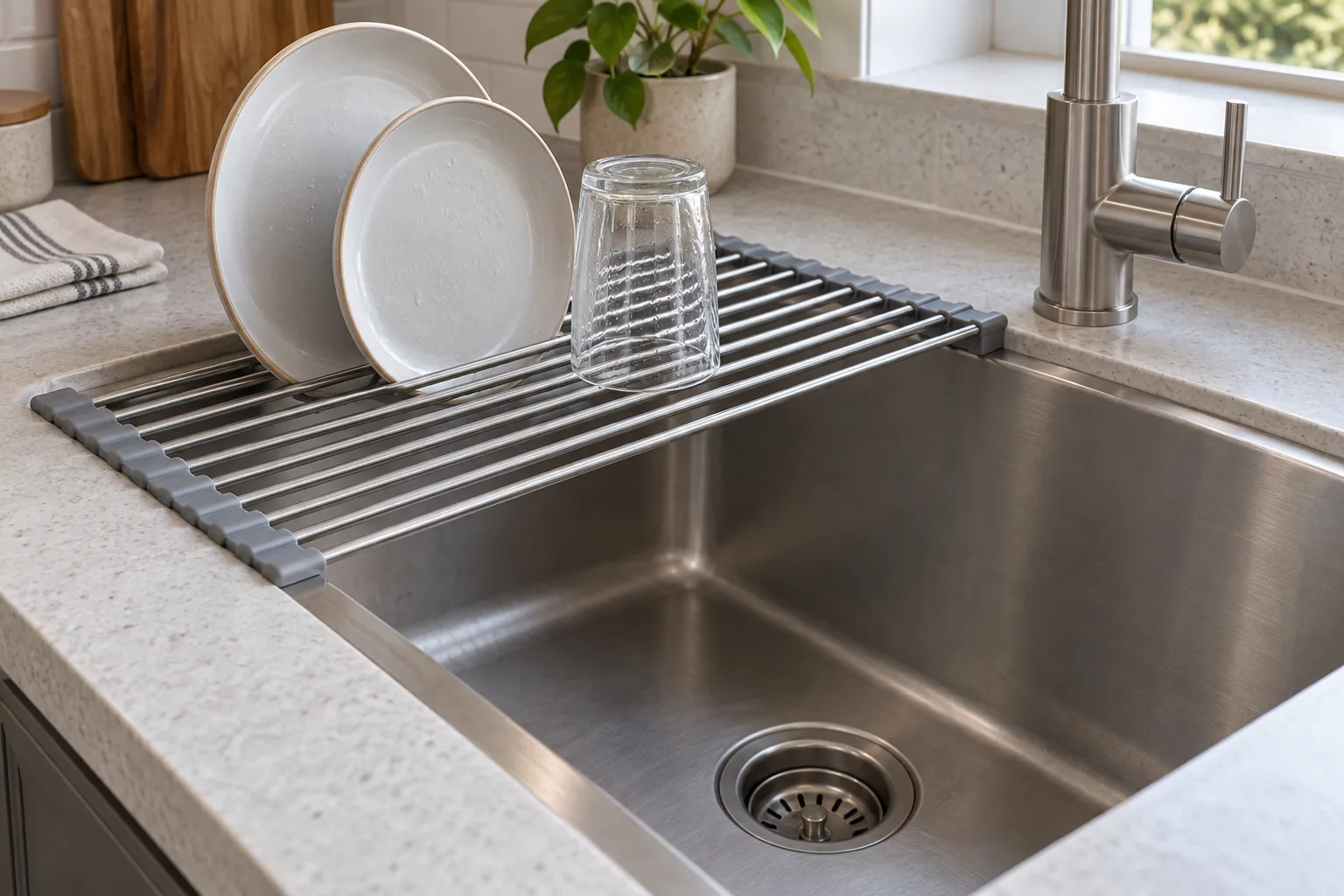
A roll up over sink drying rack should be specified against a named sink, not just by the rack’s outside length. Buyers need to compare the clear bowl opening with the rack’s usable span, identify where both ends actually rest, and check faucet and rim interference. Then test the production-intent sample on that sink with a buyer-defined load and movement check. A product can have the right nominal length yet sit poorly if the support ledges, rim shape or working area differ.
For importers and private-label teams, the key fit question is: Which measured sink surfaces support the rack, and what happens to the sink’s working space when the rack is in use? Record the sink model or controlled reference, installation type, rack orientation and sample configuration. “Fits most sinks” is not a useful substitute for a named dimension and an approval method.
This guide focuses on roll-up rack support across a reference sink, clearance during use and the rack’s rolled storage envelope. It does not evaluate plate-slot spacing, general dish-rack drainage, food-contact suitability, a universal load rating or a current Koitor roll-up product. Koitor’s exact rack and silicone sleeve supply are unconfirmed.
What must a buyer measure before selecting a roll-up rack?
Measure the sink and proposed rack as separate but related geometries. A catalog’s overall rack dimension does not automatically equal its supported span or the clear sink opening. The rack may need end pads or rod ends to extend past the bowl and contact usable ledges on both sides. Those contact points matter as much as the opening itself.
For a roll up over sink drying rack, collect these measurements from the sink drawing or a controlled reference sample:
- Clear distance across the bowl where the rack will span.
- Width and shape of the ledge or rim available on each side.
- Rim height and any change in level between the two bearing surfaces.
- Sink outside dimensions and countertop cutout only if they affect rack placement.
- Faucet base, handles, soap dispenser or other fixtures that could intersect the rack.
- Backsplash or wall clearance if the rack is expected to sit close to the rear edge.
Then record the rack’s overall width and length, useful rod span, end-cap or pad footprint, rolled diameter and any dimensional tolerance the supplier can document. Confirm which measurement appears on the drawing. “Rack width” might mean overall edge-to-edge length; it does not say how much length remains to sit on each ledge after the rack crosses the opening.
Published products illustrate why models should not be treated as interchangeable. Elkay lists model LKDR1718RU as a roll-up rack with dimensions of 17-3/4 by 17-5/16 by 3/8 inches. Kohler’s K-28929 listing describes a different roll-up multipurpose rack with a 19-1/2 by 11-inch working surface. These are product-specific reference values, not general sizing rules. A buyer should measure the intended sink and compare it with the exact rack drawing and end-support geometry.
| Measurement | What the buyer should record | Approval question |
|---|---|---|
| Sink clear opening | Width at the actual rack position | Does the rack cross the bowl without contacting the drain or bowl walls? |
| Usable ledges | Contact width on both sides, including level difference | Do both rack ends have the intended bearing area? |
| Rack overall dimensions | Edge-to-edge envelope by drawing revision | Is there enough length to bridge and rest beyond the opening? |
| End pads or sleeves | Footprint, position and construction | Do they land on the intended surfaces without interfering with fixtures? |
| Faucet and fixtures | Base, handle and spout clearance | Can the buyer still use the faucet as intended with the rack installed? |
| Rolled envelope | Outside diameter and package length | Where will the rack be stored, and how will it be packed? |
Where should the rack ends bear on the sink?
Both ends should contact the buyer-approved support surfaces in the same orientation used for the sample review. If the rack lands partly on the counter, partly on a rim and partly on a raised workstation ledge, document that arrangement. Do not assume the apparent top edge is a continuous flat support surface.
Check the contact area at the left and right ends, then view the rack from above and from the side. Unequal ledge height or a curved corner may cause one end to sit differently. A rubber or silicone covering could affect the contact surface, but its material, hardness and friction should not be inferred from appearance. Ask the relevant component supplier for the drawing and revision if the end sleeves are purchased separately.
For an undermount sink, the countertop may provide the bearing ledge. For a top-mount sink, the rim geometry may occupy that space or raise the rack at the edge. Workstation sinks can include ledges intended for accessories, but their width and position are model-specific. Verify which surfaces the rack is designed to touch; a model page that says “workstation” does not establish compatibility with another sink brand or ledge layout.
The sample check should confirm the rack stays where placed under the buyer’s agreed conditions. Record whether the ends walk, lift, shift or rotate during the specified loading and handling steps. These observations are not a universal safety test or load rating. The test load, placement and acceptance criteria must be defined for the product and use case.
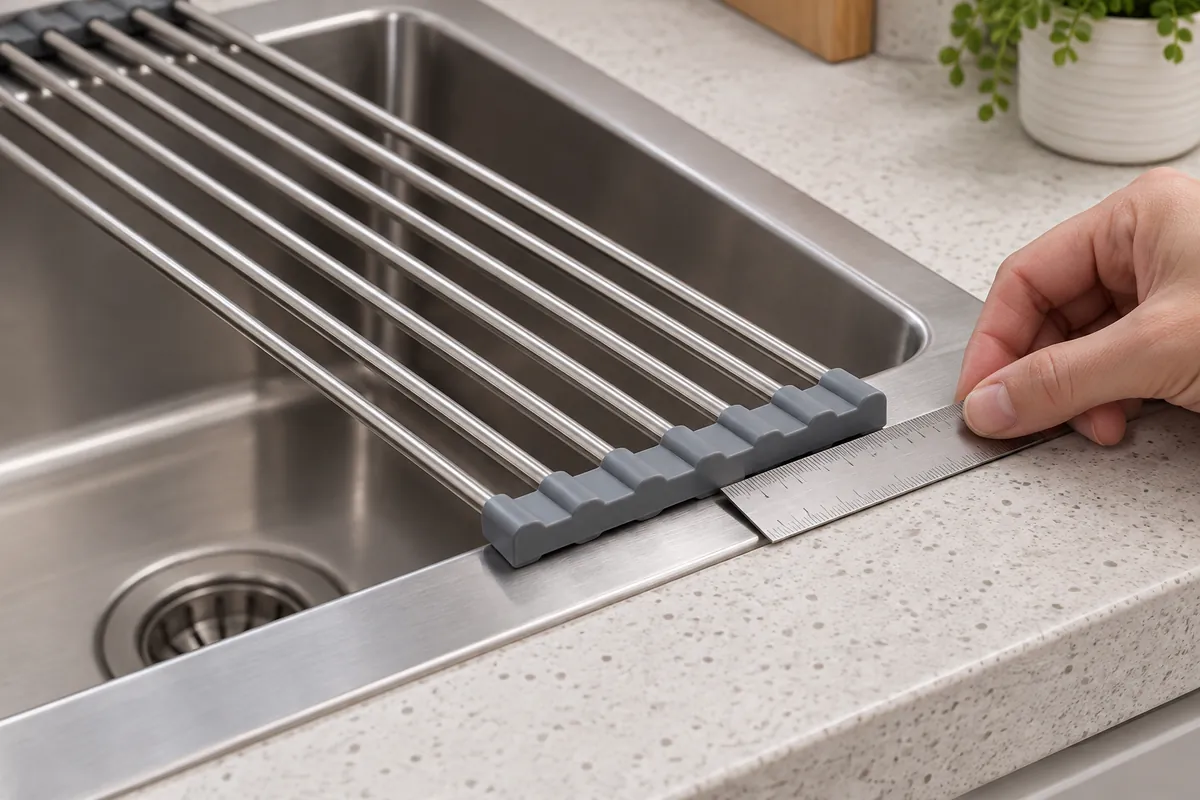
Measure the usable bearing surface at both ends; a single overall rack width does not describe the sink interface.
How does the rack change sink working space?
Test the sink with the rack both in place and removed. A roll-up rack can provide a temporary surface, but it can also cover part of a one-bowl opening while dishes or utensils are drying. The buyer should decide whether the intended use prioritizes drying space, access to the bowl, faucet use or quick removal.
Place the rack in its approved orientation and check:
- How much of the bowl remains accessible for washing, rinsing or filling.
- Whether the rack blocks the faucet handle, spray head travel or normal spout movement.
- Whether dishes or cups placed on the rack interfere with the faucet or backsplash.
- Whether the rack can be lifted or moved without striking a fixture.
- Whether the sink opening is still usable for the target household or kitchen workflow.
Do not convert one user’s workflow into a broad claim about all sinks. The research pack records a discussion where a rack across a one-bay sink reduced the available working opening and another where a raised sink edge affected a conventional draining accessory. These are examples of questions to reproduce on a buyer’s chosen sink, not measured market-wide failure patterns.
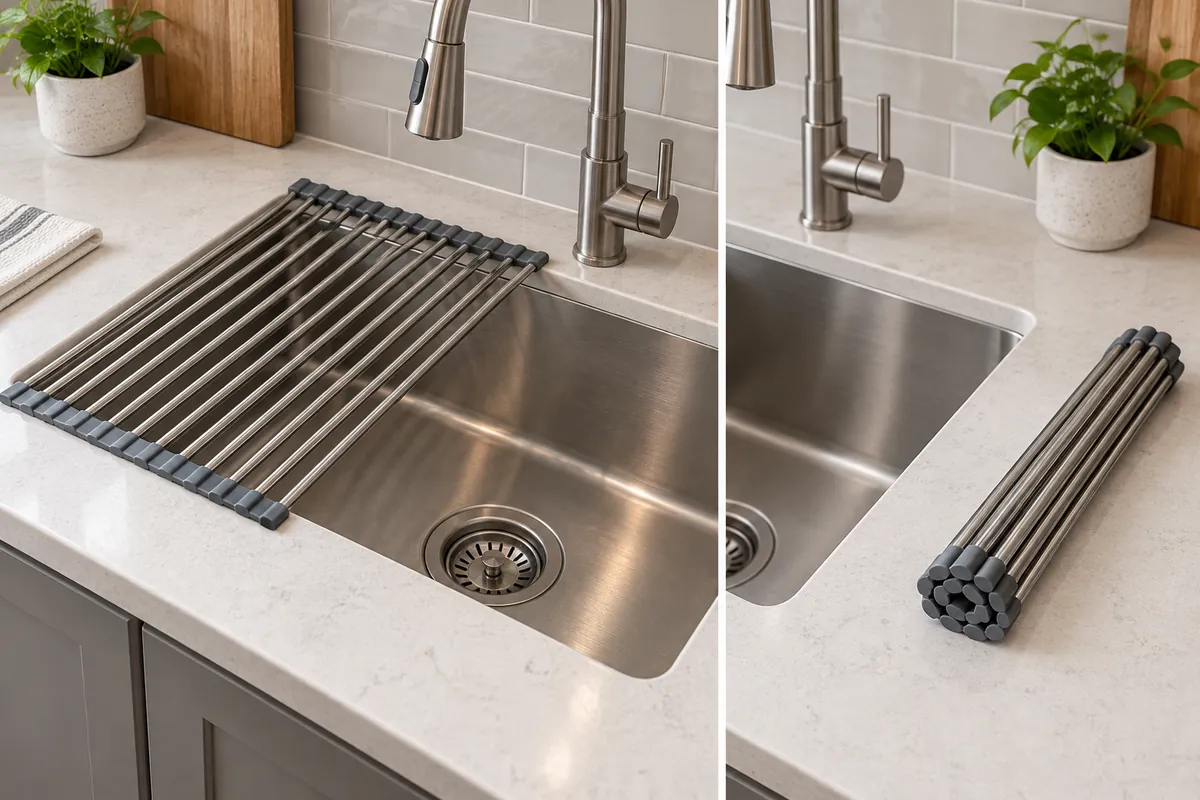
The two states illustrate how the rack can occupy the bowl during use and take a different envelope when stored.
If the rack is meant for light, temporary placement, define that use in the packaging and product scope. If it is expected to remain across the sink while dishes are being handled, test the actual configuration and agreed load. Avoid claiming that a rack is stable, heat-safe or suitable for food preparation unless the exact product and evidence support those statements.
How should the buyer test a sample on the actual sink?
Use the sink model or controlled physical reference intended for the assortment. A countertop mockup may help screen dimensions, but it does not reproduce every rim, workstation ledge, faucet or installation detail. Label the sink, rack and any end components before taking measurements.
A repeatable sample review can follow this sequence:
- Record the sink reference. Note model or drawing, installation style, clear opening, ledge dimensions, rim height and relevant fixtures.
- Inspect the rack configuration. Record rack model, drawing revision, overall dimensions, rod arrangement, end pads or sleeves and orientation.
- Place the rack without added load. Check both ends for contact and note visible gaps, rocking, edge overlap or interference.
- Check in-use clearances. Move the faucet through the intended range and place representative dishware only if that is part of the planned use.
- Apply the agreed sample load. The buyer and supplier should set the load amount, placement and acceptance criteria first. Do not borrow a competitor’s rating or infer a load capacity from rod appearance.
- Observe movement. Under the defined handling, note end lift, sliding, rolling, deflection or contact with the bowl. Record the exact position and test condition.
- Remove and roll the rack. Observe whether the rods roll together as intended, whether sleeves remain positioned and what outside diameter results.
- Repeat only the required conditions. If the buyer has multiple sink models or rack orientations, test and document each one separately.
A result applies only to the tested combination and conditions. A change in sink rim, rack length, rod spacing, end cap or component revision can change the fit. If a supplier revises any support feature, ask whether a new sample check is necessary before reusing the previous approval.
What should the drawing and supplier package show?
The drawing should distinguish the rack’s overall envelope from its usable span and bearing surfaces. Mark the intended sink opening, the required overhang or bearing area at each end, end-pad positions, rod count and rolled envelope. Include a side view if rim height, faucet base or workstation ledges affect the placement.
For each purchased sleeve, cap or coating, identify the supplier and part revision. This is especially important if the product combines metal rods with elastomeric components. A generic term such as “silicone” does not establish food-contact status, temperature rating, dishwasher suitability or long-term friction. Those claims need the relevant component documents and project-specific approval.
Packaging should protect the rods and end components while keeping the final pack size workable. Record the rolled diameter, length and orientation in the package. If multiple racks are nested, confirm how contact between rods, end sleeves and retail packaging is controlled. A prototype that rolls neatly by hand does not automatically prove that every component will remain in position after shipping; inspect the production-intent pack and receiving condition.
For a broader discussion of commercial sink rack products, link buyers to the custom kitchen storage rack manufacturer page. It owns the commercial product-intent conversation; this article covers the roll-up rack’s sink interface. The OEM home-storage hardware page explains how buyers can start a broader project discussion with Koitor Hardware.
Koitor is a family-owned custom metal hardware factory. Its documented metal fabrication, rod and wire work, and packaging knowledge can inform buyer discussions about metal structure and supplier coordination. This does not confirm a current roll-up sink rack, silicone sleeve or complete sink-accessory kit. Confirm the actual product scope and component supplier before quoting or making a capability claim.
What can product specifications prove?
A manufacturer specification can identify a particular model’s listed dimensions, construction and intended fit. It cannot prove that another rack will fit a different sink. Elkay’s LKDR1718RU listing and specification sheet identify a model-specific size and stainless rods with silicone coating. Kohler’s K-28929 roll-up multipurpose rack page gives a different working-surface size. These examples help the buyer request dimensions; they do not establish compatibility with a sink outside the named product system.
When comparing documents, confirm the model number, revision and measurement definition. A working surface can differ from an outer dimension. A “sink fit” description can refer to a specific product line. Keep source documents with the quote and sample record, and test the actual pair before describing compatibility.
What should importers checklist before approval?
Before signing off, confirm that the specification answers these questions:
- Is the sink model or reference drawing named?
- Are the clear bowl opening and both support ledges recorded?
- Are rack overall size, usable span, orientation and end-pad footprint specified?
- Have rim height, faucet base, handles and relevant clearance points been reviewed?
- Does each end make the intended contact on the selected sink?
- Were rack movement and deflection observed under buyer-defined sample conditions?
- Was remaining bowl access checked with the planned use configuration?
- Were rolled diameter, storage position and shipping package dimensions recorded?
- Are sleeve or cap suppliers, component revisions and claims documented?
- Does a sink, rack or component revision trigger another fit review?
The final record should say which sink and rack were checked, what positions and conditions were used, and what passed or needs revision. Keep the product claim limited to the models covered by that evidence. “Sized for sink model X” is more actionable than “universal fit,” and it is easier for sales, quality and sourcing teams to support.
Häufig gestellte Fragen
How do I size a roll up over sink drying rack?
Measure the clear sink opening and the usable ledge at both ends, then compare those surfaces with the rack’s overall dimensions, support footprint and usable span. Approve the selected combination on the actual sink.
Is rack length the same as supported span?
No. Overall length includes the portions outside the sink opening. The supported span depends on where each end contacts the sink and how much bearing area the buyer requires.
Will a roll-up rack fit a workstation sink?
Some model-specific racks are designed for workstation systems, but sink ledges and dimensions vary. Confirm the named sink model and the rack’s intended bearing points.
Can the buyer rely on a published load rating?
Use a rating only when it is documented for the exact model and conditions relevant to the buyer. Do not infer one from rod diameter, material name or another product’s test.
What should be checked when the rack is rolled up?
Record the rolled outside diameter, overall length, end-cap or sleeve position and package orientation. Verify the approved sample and production-intent package rather than assuming the rolled envelope from the flat drawing.
Does silicone coating prove food-contact suitability?
No. A coating name alone does not establish food-contact compliance or safe use. Request applicable documentation for the exact component and intended market before making such a claim.
Discuss a Kitchen Storage Drawing or Sample
Share the sink reference, rack drawing, end-support details and package target with Koitor Hardware to discuss the metal structure and project scope. Specific rack and component supply needs confirmation.
OEM / EIGENE MARKE
Verwandeln Sie diesen Beschaffungsleitfaden in ein Produktdossier
Teilen Sie uns Ihr Zielprodukt, die Größe, die Oberflächenausführung, die Bestellmenge und Ihre Verpackungsanforderungen mit. Ihr Team erhält vor der Angebotserstellung eine praxisorientierte Prüfung der Herstellbarkeit.


 English
 Español
 Português
 Français
 Deutsch
 العربية