
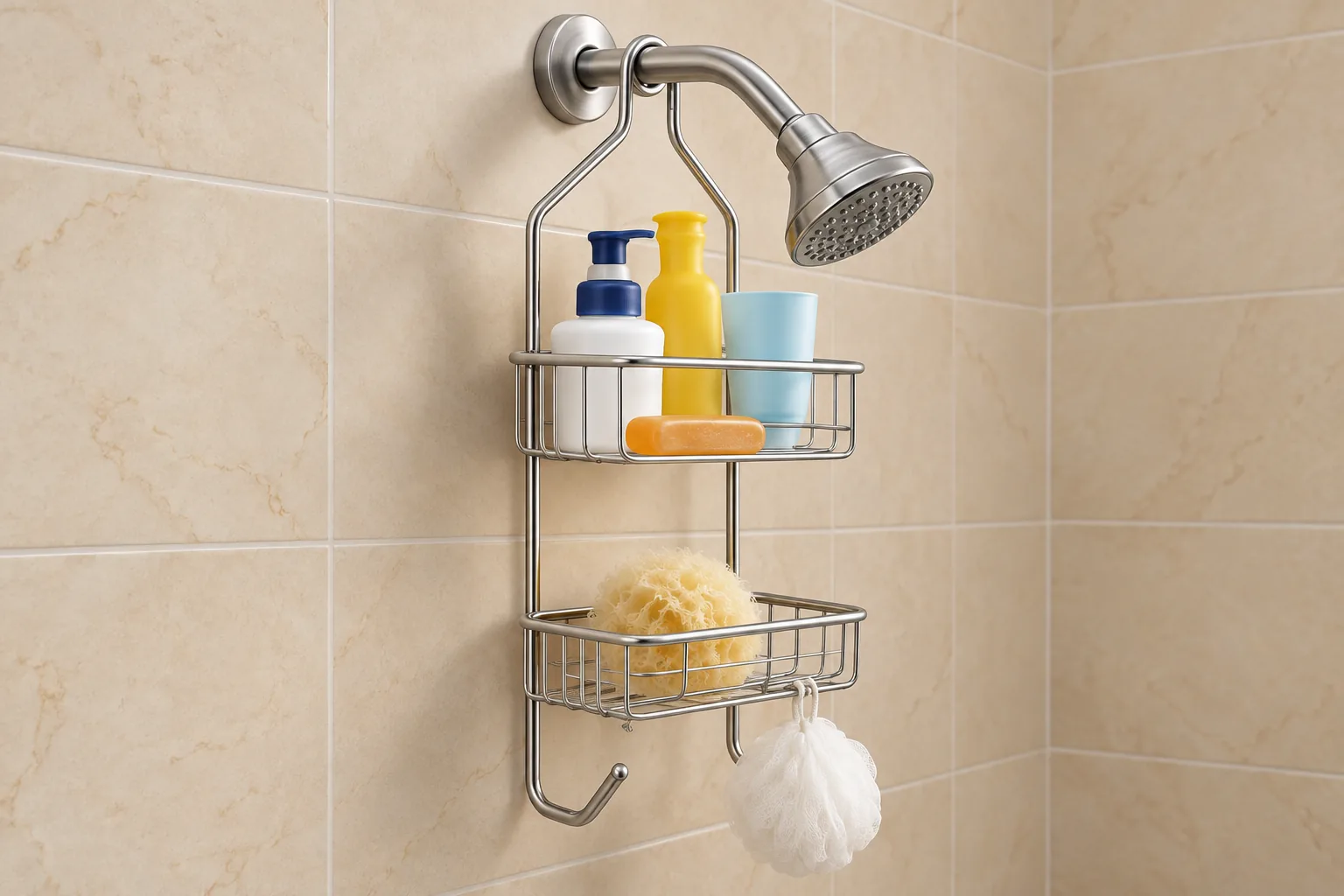
Shower caddy shower arm width compatibility depends on the actual pipe or riser envelope, the caddy hook's clear opening and the clearance needed for the basket to hang without binding or rotating. Buyers should measure the plumbing member the hook is designed to engage, then review the complete caddy on a representative shower-arm fixture. A pipe-hung caddy is supported by its hook on the shower arm or riser; it is not a wall shelf or a bracket projecting from the wall.
In buyer research, the exact phrase “shower caddy shower arm width compatibility” is a useful shorthand; the RFQ should replace it with the project's actual dimensions, interfaces and sample acceptance observations.
Related project context: Fertigung von maßgefertigten Duschablagen. For a project-specific review, buyers can Kontaktieren Sie Koitor with a drawing or sample.
Why do shower-arm caddies fail to fit a nominal pipe size?
A product name such as shower-arm caddy does not identify the member the hook surrounds. Some designs hang over an exposed shower arm, some fit a vertical riser, and others use a distinct holder or rail. Buyers must label the intended interface and show its path relative to the showerhead and wall outlet. The caddy's hook should carry the product on that plumbing member; the wall escutcheon is not a separate caddy bracket.
Nominal plumbing descriptions may not capture decorative sleeves, joints, bends, collars or local changes in diameter. A hook may clear the pipe at one point but collide with a larger fitting farther along. Measure the outside envelope where the hook sits and note any taper or obstruction along the installation path. Do not assume an opening dimension from an online photo or from a different shower fixture.
The hook's inside opening is only one part of fit. Throat width, return geometry, insert material and the direction the caddy is installed affect whether it can be placed and removed. A generous opening may help pass a fitting but can allow wobble if the hook is much larger than the supported member. The buyer should define both the fit envelope and the desired seated condition on the sample.
Forum questions about unusually wide shower arms illustrate a real product-fit problem but do not establish its frequency. They help define the buyer question: which arm sizes and shapes does the product intend to accommodate, and what happens when the pipe has an enlarged coupling? Keep those observations as problem evidence, not as proof of market size, plumbing standards or Koitor customer experience.
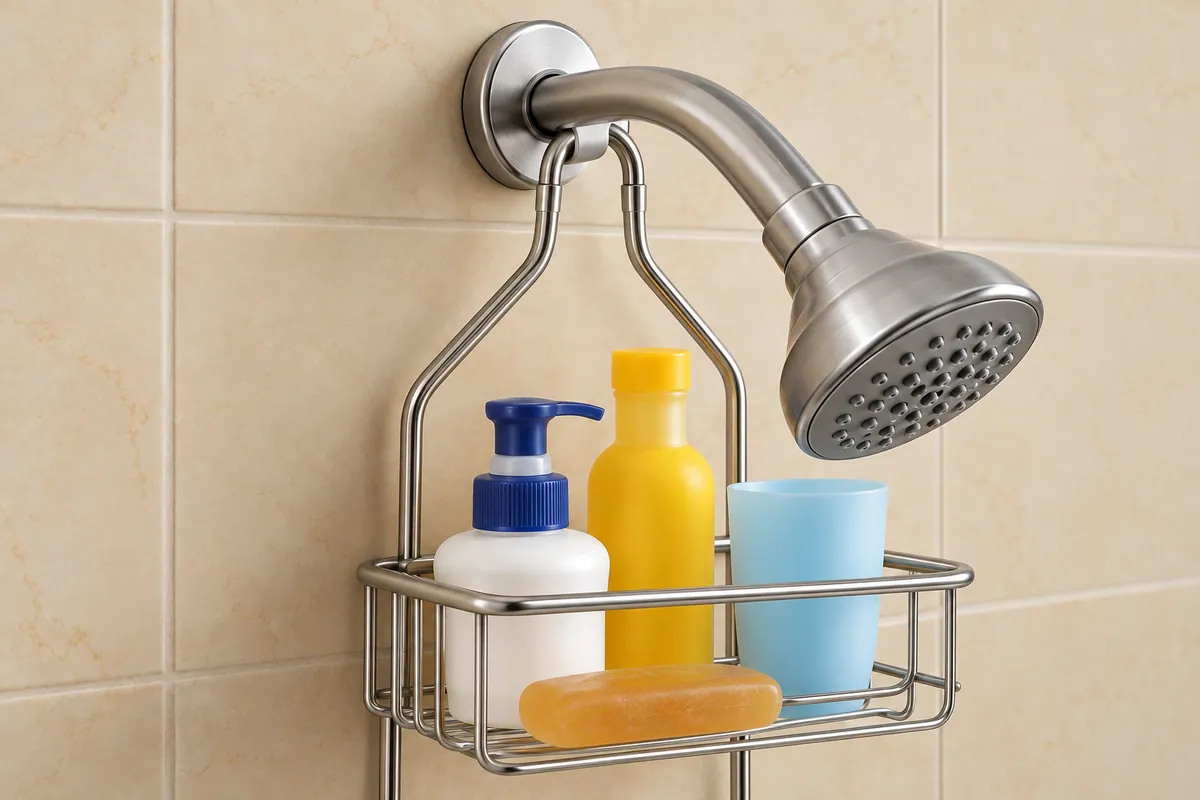
What should the product drawing show at the hanging interface?
Show the caddy from the side and front with the target pipe or riser in place. Identify the exact supporting member, the hook's clear opening, its throat and the contact points. Mark whether the basket hangs from a horizontal arm, a vertical riser or another named part. This prevents a design review from substituting a wall bracket or suction mount for the pipe-hung structure and keeps product images consistent with the released assembly.
Define the supported envelope from actual buyer research or specified fixture samples. Record outside diameter or width where relevant, local couplings, angle and insertion path. If the interface is intended for more than one pipe profile, identify the range and any excluded shapes. Do not assert universal compatibility with all showerheads, arms or risers; different trim systems can present different envelopes even when they serve similar plumbing functions.
Clarify whether the hook includes a sleeve, insert or protective pad and how that component is retained. These details affect contact, clearance, finish and packaging. If the hook is bare metal, the buyer may have different surface concerns than with a lined interface; neither condition can be assumed from a rendered image. Ask the supplier to return the material and assembly scope for the exact proposed hook.
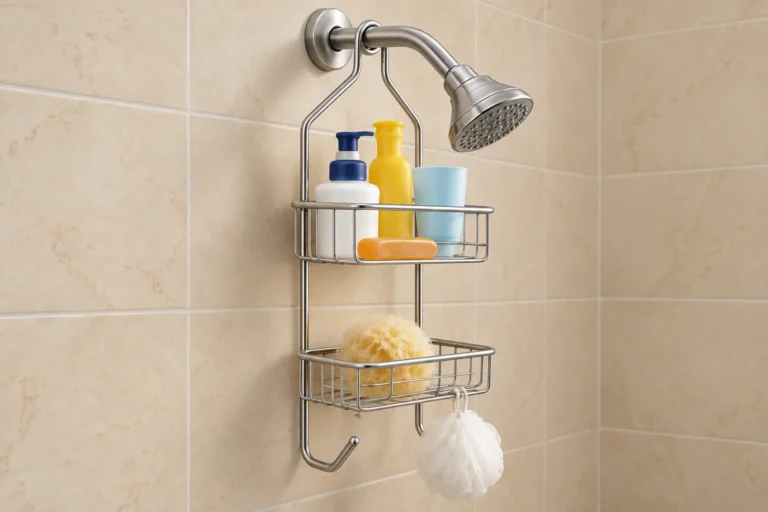
The central frame also needs a defined relationship to the hanging point. Identify how the vertical support wires descend from the hook to the basket tiers, and how much side-to-side or rotational movement is acceptable. A correct image should show those support lines and the pipe-hung hook clearly. It should not depict a caddy as if a separate horizontal bracket were anchored into the shower wall.
How should buyers compare hook and retention concepts?
A simple open hook may allow fast installation and removal, while a closed or partially retained interface may resist accidental disengagement in a particular orientation. Inserts or sleeves can change contact and noise but add material, assembly and fit dimensions. These are design tradeoffs rather than universal recommendations. Compare how the actual caddy seats, whether the user can remove it without dismantling plumbing, and what the buyer expects during ordinary use.
Anti-rotation can come from hook geometry, separation between support wires, basket mass distribution or an added contact feature. The drawing should identify which feature is intended to control movement. Do not add an extra strap, wall fastener or adhesive as a hidden fix unless the approved product design includes it. Any modification changes installation behavior and should be shown consistently in the sample, instructions, images and packaging.
The distance between the shower arm and the basket can influence clearance from the wall and the showerhead. A short drop may crowd bottles near the fixture; a longer drop can change leverage and movement. Buyers should evaluate the actual tier spacing and pipe position without inventing a stability number. Check that the showerhead remains usable and that the caddy does not block controls or the intended spray direction under the named setup.
Compare suppliers using the same pipe envelope, hook geometry, support-wire layout, basket form, finish and packaging. A caddy that uses a wider hook or an insert may require a different material or assembly scope. Ask suppliers to call out the included fixture assumptions and unresolved dimensions. The objective is not to choose the largest possible opening; it is to qualify a fit that matches the buyer's target bathroom assortment and user expectations.
| Fit item | What to define | Sample observation |
|---|---|---|
| Supported member | Arm or riser; profile and envelope | Hook passes and seats at target point |
| Hook opening | Clear throat and insertion path | No binding or unintended disengagement |
| Insert/contact | Material and retention scope | Contact occurs where drawing shows |
| Support wires | Number, route and basket connection | Both wires descend continuously |
| Installed clearance | Head, controls, wall and basket tiers | No unintended interference |
How can buyers validate fit on a sample fixture?
Build or select a representative shower-arm fixture with the measured pipe shape, exposed length, wall outlet and any nearby coupling. Use the exact shower caddy sample and install it without adding a hidden bracket or touching the wall for support. Confirm that the hook passes over the intended member and seats where specified. Record the fixture and caddy revisions so a second supplier or quality inspector can reproduce the observation.
Observe whether the hook binds during placement, sits fully, contacts the pipe where intended and can be removed by the expected user action. Check rotation and sliding separately. If a liner or insert is present, inspect that it remains in its intended position. Avoid applying unapproved force or turning a fit check into a load test; performance claims require a separately agreed method and evidence.
Examine the full supporting structure after hanging. Confirm that both long vertical support wires remain continuous from the hanging frame to their intended basket connections, and that neither is replaced by a wall-mounted projection. Check basket level, spacing, clearance from the showerhead and access to controls. Photograph the top hook and the complete descent so that product art and production documentation preserve the same structure.
If the sample fits one riser but not a coupling or alternate diameter, record that limitation. The buyer can choose a different hook, a broader interface or a narrower supported range, but each change should be reflected in the released specification. Do not convert one passing fixture into a claim that all bathroom plumbing is compatible. Re-run only the checks affected by a documented design change, and retain the reason for the decision.
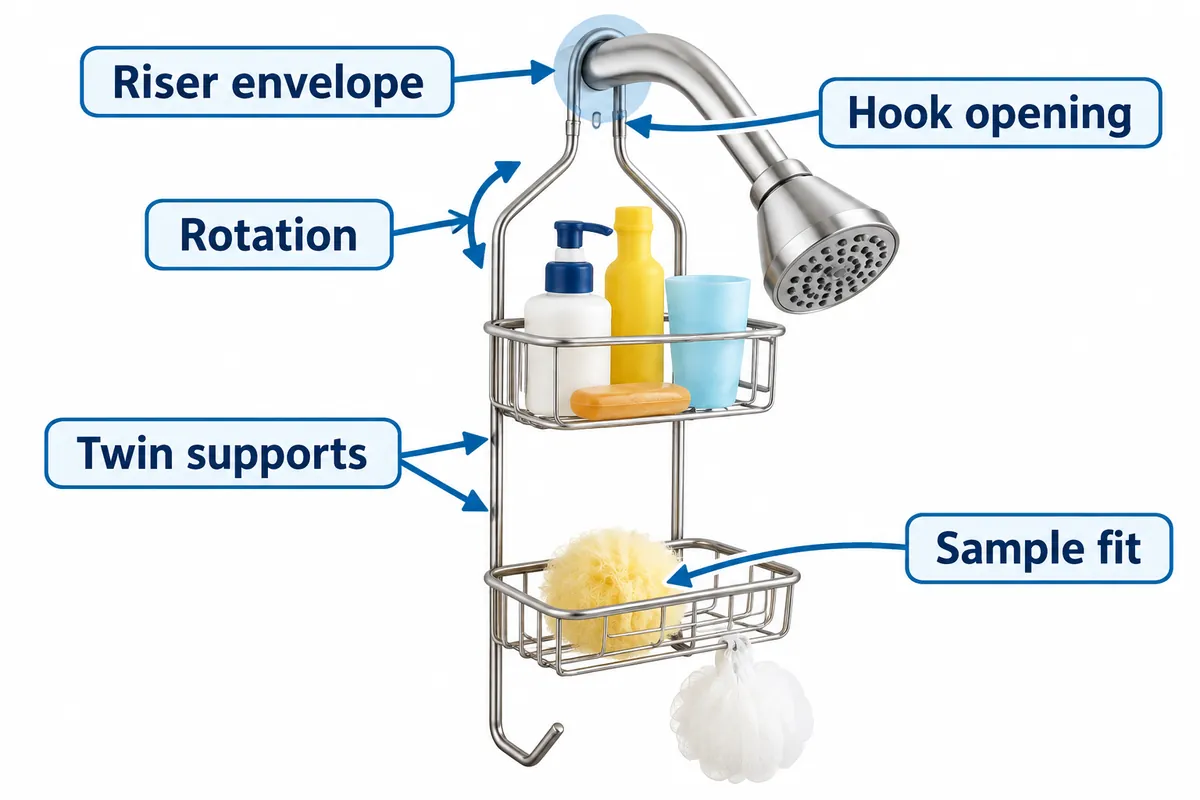
What should the buyer checklist cover beyond diameter?
The measurement should include the supported pipe envelope at the actual hook location, not just an assumed nominal value. Add hook throat, opening, material or insert, installation path and any nearby joint that restricts movement. If the caddy hangs from a curved shower arm, use the curve and its clearance in the fixture. If it hangs from a vertical riser, state that instead. The selected image, drawing and product copy should all show the same interface.
Check the caddy's orientation under its own configuration and the buyer's intended product arrangement. Bottle placement may change how the unit hangs, but the article does not define a load rating. If the buyer wants a retention or stability test, specify a qualified product-specific setup and record results separately. The fit guide's sample checklist is a design-review aid, not a safety certification or plumbing assessment.
Include corrosion and cleaning only as project requirements, not as assumptions based on a chrome appearance. Buyers should identify material and finish expectations, water exposure, care language and available evidence. Similarly, packaging should retain the hook and protect the finish without bending the support wires. A packaging review should use the final caddy, not just a flat graphic of how the product is meant to hang.
For the search phrase “shower caddy shower arm width compatibility,” the practical result should include a defined pipe envelope, hook drawing, support-wire view, installation notes and a sample record. A readable label on an illustration cannot replace these product dimensions. Keep the evidence package together so distributors, private-label teams, customer service and quality staff explain the same supported fit range.
How should buyers protect product and image accuracy?
Show the caddy hanging from the intended shower plumbing in product photos. If the basket is supported by the shower arm, make the hook contact visible and keep the wall escutcheon recognizable as part of the plumbing only. Do not create a visual that suggests the caddy bolts into the wall, rests on a wall bracket or uses suction cups when none are part of the approved design. Accurate imagery prevents buyer confusion before purchase.
A product specification should distinguish the shower arm or riser from the showerhead itself if the caddy does not attach to the head body. State the interface in clear installation language and avoid ambiguous phrases such as wall-mounted shower basket. If several plumbing configurations are common in the target market, show which one the hook is designed around and list those not validated.
When a product reference image is used in content development, preserve the basket's hook and support-wire geometry instead of borrowing the silhouette of another caddy. A wall-projected basket may look plausible but answers a different buyer question and can misrepresent the mounting system. Review all three images against the approved physical sample and reject any picture with a missing support wire or altered mounting relationship.
Koitor's verified facts support custom metal bathroom and home-storage manufacturing, but not this exact shower-arm caddy as a current mass-produced SKU. Treat it as adjacent sourcing knowledge and ask any prospective supplier to confirm process scope, purchased components, finish route and test responsibility. That distinction lets buyers use the guide without inferring unverified plumbing expertise or product performance from the article's topic.
An example of buyer-facing information is available in an anecdotal buyer discussion about an oversized shower arm. It is context for the specific source product or process, not a universal specification for this project.
Buyer approval checklist
- Name the supported part: shower arm, vertical riser or other specific member.
- Measure the actual envelope, couplings, exposed length and hook insertion path.
- Show hook opening, insert/contact details and both descending support wires.
- Hang the sample on a representative pipe fixture without a wall bracket or suction aid.
- Record hook seating, rotation, clearance, finish, packaging and unverified configurations.
Häufig gestellte Fragen
Is a shower-arm caddy wall-mounted?
Not when its design hangs from the plumbing pipe. The hook carries it on the shower arm or riser; the wall escutcheon is part of the plumbing, not a separate caddy bracket.
Is the showerhead body the same as the shower arm?
No. Buyers should identify the exact supporting member. A hook may fit the arm or riser rather than the showerhead body, and product instructions should name it accurately.
Can a wider hook guarantee compatibility?
No. It may clear a larger pipe but can introduce excess movement or interfere with nearby fittings. Validate the target envelope and seated condition on a sample.
Do the two vertical support wires matter?
Yes. They form the frame path from the hanging structure to the baskets. Images and samples should preserve both wires as the approved product design shows.
Does this article prove Koitor makes this caddy?
No. It is adjacent sourcing guidance. Confirm the exact current product capability and any development, component or validation scope directly.
Discuss your product specification
Share the drawing, target interface, finish and sample requirements so the project scope can be reviewed.
OEM / EIGENE MARKE
Verwandeln Sie diesen Beschaffungsleitfaden in ein Produktdossier
Teilen Sie uns Ihr Zielprodukt, die Größe, die Oberflächenausführung, die Bestellmenge und Ihre Verpackungsanforderungen mit. Ihr Team erhält vor der Angebotserstellung eine praxisorientierte Prüfung der Herstellbarkeit.
 English
  Español
  Português
  Français
  Deutsch
  العربية