
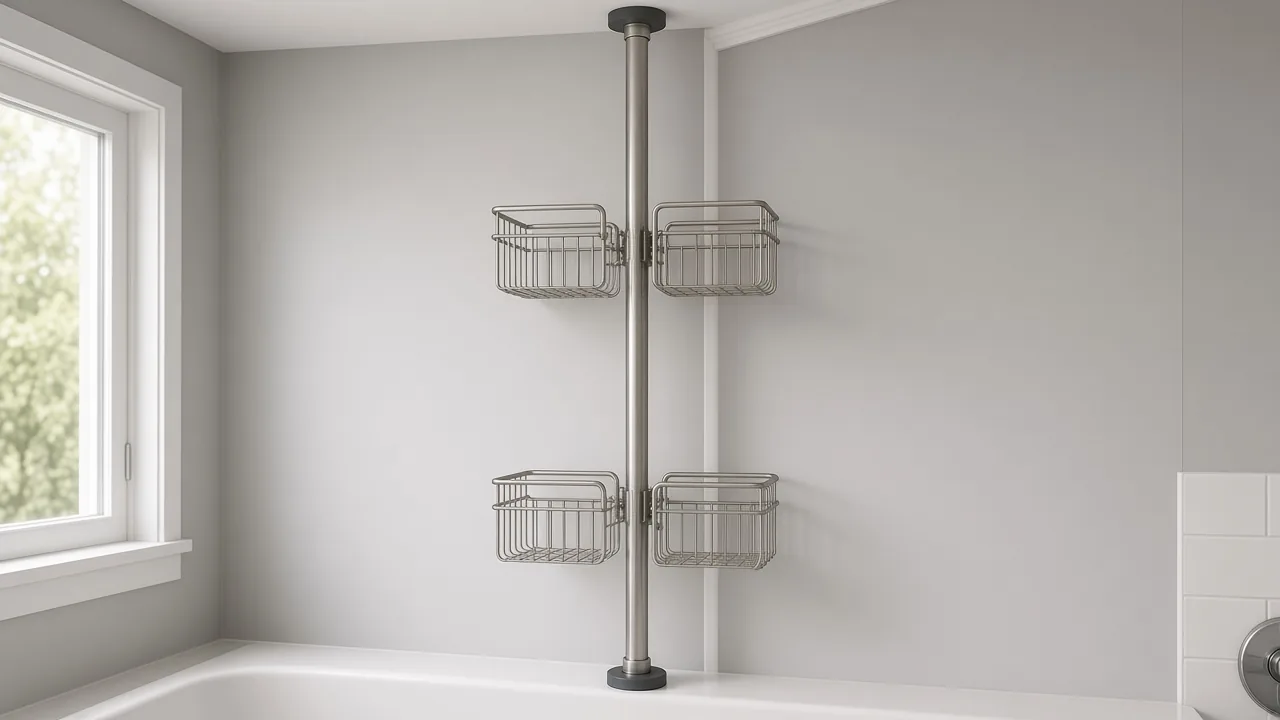
A bright mid-span tube is not a claim file. A tension pole shower caddy rust proof line should stay off artwork until spring seats, telescoping joints, and basket-to-pole hardware are named as first-to-rust observation points and checked on an assembled sample. Mid-span brightness does not clear those joints, because soapy water collects at overlaps, spring seats, and fasteners.
This guide is for importers and private-label teams writing a tension-pole shower caddy specification. It does not own ceiling-height fit, foot-pad slip or ceiling marks, or hanging-hook basket construction. Koitor Hardware, a family-owned China OEM manufacturer of bathroom and home-storage metal hardware, can review a joint-observation brief with a drawing or a sample; the buyer still has to name the claim and the interfaces.
Why a mid-span tube does not clear a rust-resistant listing line
Shoppers are sold aluminum tubes and rust-resistant collection names. Returns and complaints, when they come, often start at a brown ring under a lock collar, a stained spring seat, or a rusted screw at a basket clamp, not at the middle of a visible tube.
A listing line is a substantiation problem. Advertising claims need a reasonable basis before they are made; the U.S. FTC Policy Statement Regarding Advertising Substantiation is a useful reminder of that duty, not a Koitor laboratory result. The file should say which joints were observed, in what assembled state, and which words are then allowed.
Do not treat height fit as a substitute. Tension pole shower caddy height range freezes endpoints and pole-section combinations. That page does not name rust observation points, and this page does not rewrite the height table.
Worked example: artwork says the caddy is rust-resistant. The sample tube looks bright at mid-span. After a wet-room placement, rust appears at the inner-to-outer overlap where water sat. The tube alloy was not the whole story. The joint was never in the claim file.
Worked example: the outer tube is aluminum or stainless, but the internal spring is carbon steel and the basket screws are a mixed metal. A shopper sees the tube and trusts the line. The first stain is at the seat and the screw. If those parts are not named, the line is not earned.
Foot-pad slip and ceiling-mark exclusions belong on their own page. A pad that does not stain a ceiling still leaves the spring under that pad in the wet zone. Keep those decisions apart.
Which interfaces should the claim file treat as first-to-rust sites?
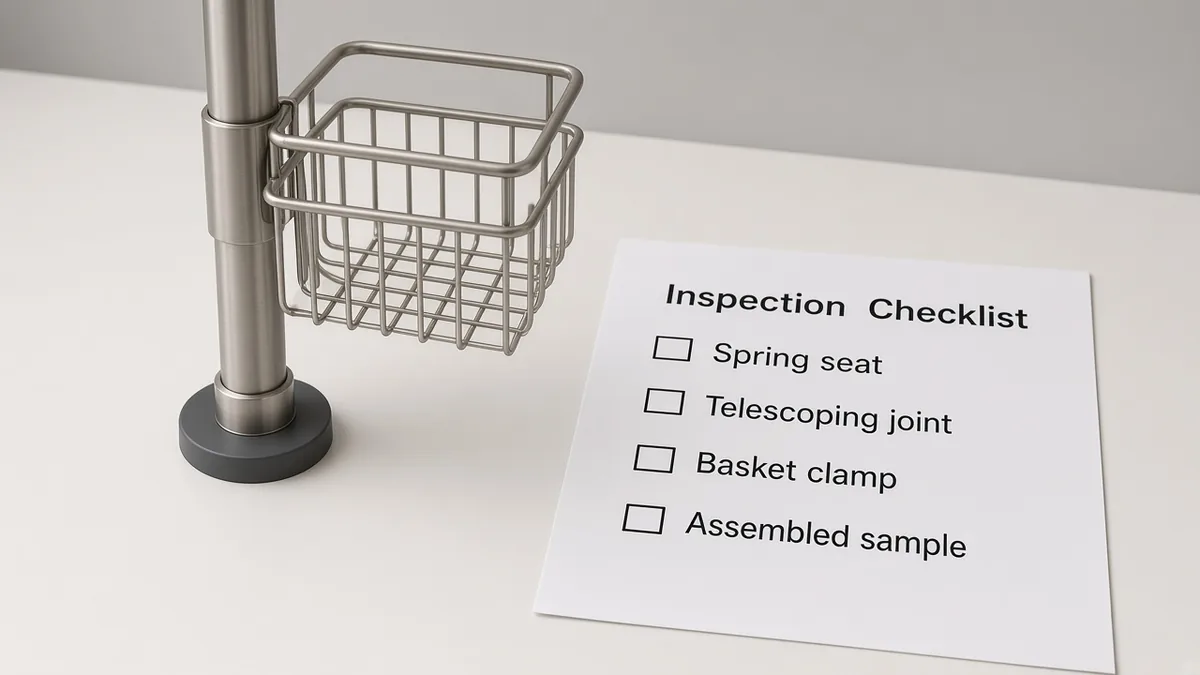
Write a named list for the SKU that will actually be sold, not a generic “all joints.” A tension-pole caddy is a wet-zone assembly. The usual first sites are the spring seat under the ceiling pad or inside the upper tube, the spring itself, the inner-to-outer telescoping overlap, the lock collar or twist lock, basket-to-pole clamps or screws, and any drain hole or relief at a section joint.
Say whether the spring is exposed, capped, or seated in a cup, and whether that cup can hold soapy water. A hidden carbon-steel spring can rust out of sight while the outer tube still photographs well. If the spring alloy is not yet agreed, write “to be named on the sample” rather than inventing a Koitor standard spring.
The telescoping overlap is a moving joint. Height adjustment rubs coating or plating, and the overlap can trap water. Record which section is inner, which is outer, and whether the lock collar is drained, sealed, or simply a friction sleeve. A collar that looks tidy dry can rust at the crease after a week in a shower.
Basket-to-pole hardware is often a different metal or a different finish from the pole. Screws, rivets, welded brackets, and plastic saddles each fail in a different way. If the basket can be moved up the pole, the clamp leaves a wear track. That track belongs on the list.
Mixed metals deserve their own line. An aluminum or stainless outer tube with carbon-steel fasteners, a zinc collar, or a plated screw can stain at the contact even when each part looks acceptable alone. Write the materials you will actually use, after sample confirmation, and keep them in the observation map.
Do not invent a universal joint design in this article. Corner poles, straight poles, and poles with a built-in soap tray do not share every interface. The buyer’s drawing or the retained sample should freeze the list for that program.
Lock types should be named, because they change where water sits. A twist collar, a spring-pin lock, a compression sleeve, and a simple friction telescope do not leave the same crease. If the SKU can be sold with more than one lock, each lock needs its own line on the map, or the artwork must say which lock the claim covers.
Repeated height adjustment is a wear condition, not only an installation step. A pole that is set once in a showroom is not the same as a pole that is moved when a shower head or a curtain changes. Write whether the observation includes a stated number of adjustments, and look at the rub band on the inner tube after those moves. Do not invent a cycle count here; write the number the sample room will actually run.
Custom shower caddy manufacturing can quote a tension-pole SKU, but only if the inquiry lists the intended listing language and the joint map. A request that only says “rust-resistant tension pole” is not yet a claim file.
| Interface | What to freeze | What an assembled sample should show | What to keep off artwork until then |
|---|---|---|---|
| Spring seat and spring | Location, whether the seat can hold water, and the spring family once the sample is agreed | No unchecked staining or scale at the seat after the agreed wet observation | A line based only on the outer tube alloy |
| Telescoping overlap | Inner and outer sections, lock type, and whether the collar drains or traps water | The overlap and collar are included in the observation, not only mid-span tube | A beauty photo of a dry, fully extended pole |
| Basket-to-pole hardware | Clamp, screw, rivet, or weld, and whether the basket can be moved | Fasteners and wear tracks are observed in the installed attitude | A rust-resistant line that ignores the screws |
| Mixed-metal contacts | Which parts are a different metal or finish from the visible tube | Contacts are named and included in the specimen | A claim that treats the pole as one metal throughout |
| Cut ends and relief holes | Open tube ends, drain holes, and any punched relief at a joint | Those openings are in the wet-zone map | A mid-span coupon used as if it were the joint |
| Wording after the map | Rust-resistant, a narrower process phrase, or silence | The chosen words match the file, not a retail slogan | An open-ended rust slogan on the carton |
What must a sample or salt-spray specimen include that a mid-span coupon leaves out?
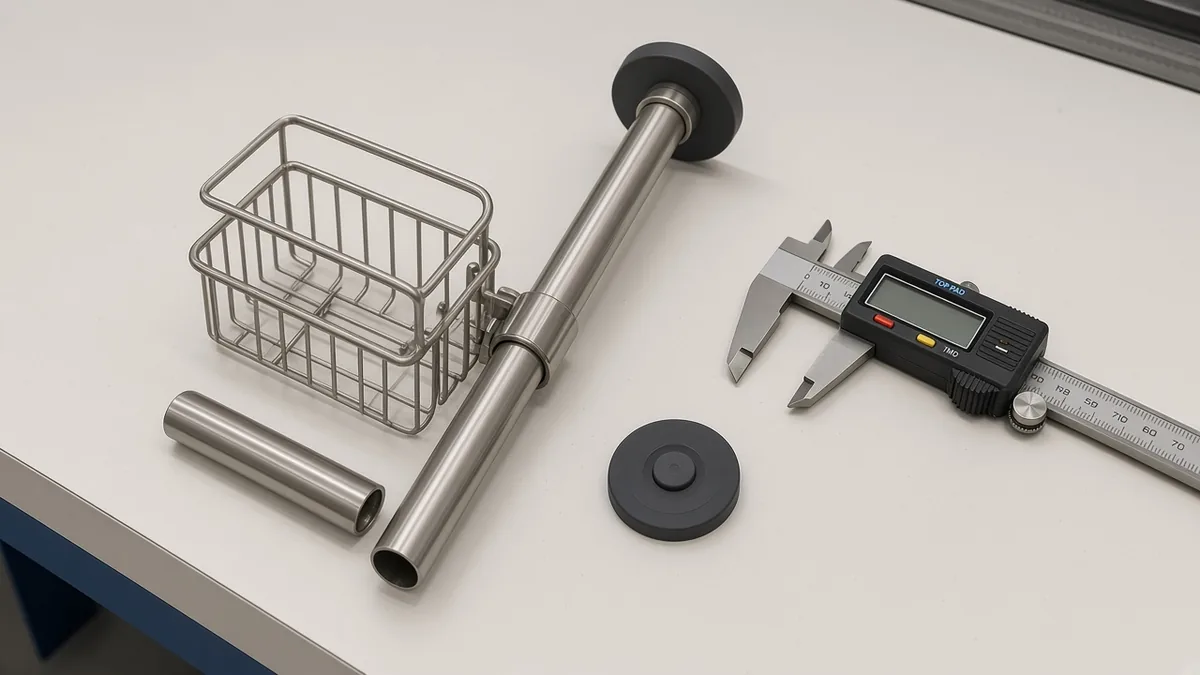
If a project uses a salt-spray or similar method, the specimen should include the joints that will live in the wet zone, in an attitude that represents installation. A cut coupon from mid-span tube is useful for coating thickness or alloy checks. It is not a substitute for a lock collar, a spring seat, or a basket screw.
ASTM B117 describes apparatus and conditions. It does not prescribe exposure periods or interpret results for a shower caddy. ISO 9227 names NSS, AASS, and CASS methods in the same spirit: a method, not a service-life year. Do not convert hours in a cabinet into years in a bathroom, and do not invent a Koitor hour figure here.
Writing a method and writing a sampling plan are different jobs. You may later agree how many assembled poles in a lot are observed, using a scheme such as ISO 2859-1 if both sides want a sampling standard. That scheme does not tell you where to look. Name the interfaces and the accept-or-reject signs first.
Keep the sample assembled as sold, or assemble the joints that the shopper will install. A disassembled tube that is washed and sprayed as loose parts can hide the crevice that exists once the inner tube is inserted. If a packing method leaves joints open, say whether the observation is done after assembly.
Record orientation. A collar that drains in one attitude can hold water when the pole is vertical in a tub. Photograph the seat, the overlap, the collar, and the fasteners after the agreed observation, with the same lighting each time so later lots can be compared.
Salt spray test report interpretation helps a buyer read what a report actually covers. This page only asks whether the report’s specimens included the tension-pole joints you have now named. A report that tested a hanging basket, a flat panel, or a mid-span tube is a different file.
If no cabinet method is agreed, a wet-room or wet-cloth observation on the assembled joints can still be written as a project method, as long as the duration, water type, and accept signs are named. Do not dress that method up as a standard hour rating it does not have.
Photograph each named joint before and after the observation, in the same attitude and with a simple scale in the frame if you need one. Keep those photographs in the claim file with the date and the specimen identity. A verbal “it looked fine” will not help a later lot when a spring or a screw is substituted.
Substitution is a change-control event. If production later swaps a spring, a collar finish, or a basket screw, the joint map is open again. A first-article pass does not travel with a silent substitute. Write that rule in the brief so a cheaper fastener cannot inherit the listing line.
How should listing language be chosen after the joint map is frozen?
Once the interfaces and the observation method exist, choose words that the file can support. Many programs are safer with rust-resistant, or with a process phrase such as “coated steel pole with observed joints,” than with a stronger retail adjective. If the file is still incomplete, the honest choice is silence: no rust line on the carton, the insert, or the online title.
Do not print an open-ended rust slogan, and do not write a slogan that the pole will not rust. Those phrases overstate what a joint map can prove. Jewelry and precious-metal advertising guides in 16 CFR 23.11 contrast rust-proof and rust-resistant wording in their own scope; they are a terminology reminder, not an automatic rule for shower caddies. Use them only as that contrast, then write the words your file can defend.
If only some parts are included in the observation — for example the outer tube and the baskets, but not the spring — the line must not imply the hidden parts were cleared. Either add those parts to the specimen or narrow the sentence so a shopper is not promised a result you did not look at.
Translations must carry the same limit. A version that drops “joints observed” and keeps a short adjective is a new, stronger claim. Keep the limit and the product name together in every language you will publish.
Photography should not hide the collar, the seat, or the screws. A hero image that shows only a dry mid-span tube, fully extended, is a poor basis for rust-resistant artwork even when the file is otherwise complete. Keep at least one straight photograph of the joints you named.
A tension pole shower caddy rust proof phrase in a keyword field is not permission to print that phrase on the carton. The keyword describes the retail question. The artwork may use a narrower phrase, or none, after the observation file is agreed.
Retail collection names and brand adjectives on competing cards are not evidence. A shopper may search those words; the factory still needs the joint list and the assembled observation. Do not copy a retail brand name onto Koitor artwork, and do not treat a competitor’s adjective as a tested finish.
If the program will sell both a coated-steel pole and an aluminum or stainless pole under similar photography, keep two files. The joint map, the spring, and the fasteners may not be the same. A shared lifestyle photo is not a shared claim.
What belongs in the height-range or slip file instead?
Minimum and maximum height, the number of pole sections, and which section combination reaches a given ceiling belong in the height-range specification. This page may mention that a pole is adjusted in a wet zone, because adjustment wears a joint, but it should not republish the height table.
Foot-pad compound, preload or lock, and excluded ceiling or tub-ledge finishes belong in the slip and mark file. A pad can be acceptable for slip and still leave a rust question at the spring seat under that pad. Do not merge the two checks into one sentence.
Hanging, hook-over shower caddies are a different mount. Their welds, hook thickness, and cut-end coating are not this SKU. Do not copy a hanging-caddy rust file onto a tension pole, and do not use a tension-pole joint map to clear a hook-over basket.
Packaging rust during ocean freight is also a different file. Incoming wire condition and finished-goods packing aids do not replace joint observation on the assembled pole. If a lot rusts in a carton, ask whether that is a packing issue or a joint that was already out of limit.
Spare springs, extra screws, and touch-up paint, if they are in the box, should be described honestly. A spare carbon-steel spring in a bag can rust in transit and alarm a customer even when the installed spring is still acceptable. If a spare is included, give it the same observation or the same packing protection as the installed part, or say that it is a service part with its own condition.
Install instructions should not undo the file. If the instruction sheet tells the shopper to oil the collar, leave the spring exposed, or cut a tube, that step belongs in the observation or in an exclusion. An instruction that creates a new open end is a new cut-end condition.
Channel copy should follow the same file. A marketplace bullet that adds a stronger adjective than the carton is still a claim. If the English insert is silent, the bullet should stay silent, or should use only the narrower phrase the joint observation supports. The tension pole shower caddy rust proof retail question can be answered on this page without putting those exact words on the sell-in sheet.
Buyer checklist for tension-pole joint rust observation
Use this list before a rust-resistant or similar line is approved for a tension-pole shower caddy.
- Write the intended listing phrase as a claim that needs a joint map, not as an adjective on a mid-span tube photo.
- Name the spring seat, the spring family once the sample is agreed, the telescoping overlap, the lock collar, and the basket-to-pole hardware for this SKU.
- State whether mixed-metal fasteners or a different finish appear at those contacts.
- Require an assembled specimen or an assembled observation, in the installed attitude, rather than a mid-span coupon alone.
- If a salt-spray or similar method is used, treat ASTM B117 or ISO 9227 as methods only; do not convert hours into years or invent a factory hour rating.
- Keep the observation method in its own clause, separate from any later sampling plan.
- Choose rust-resistant language, a narrower process phrase, or silence after the file exists; do not print an open-ended rust slogan.
- Leave height-range fit, foot-pad slip, and hanging-caddy construction on their own pages.
- Make sure translated artwork keeps the same wording limit as the English file.
- Send the drawing or sample, the intended listing phrase, and the joint list with the inquiry.
Häufig gestellte Fragen
Can I rely on an aluminum or stainless tube to clear the joints?
No. The visible tube is only one part. The spring, the seat, the lock collar, and the basket fasteners may be different metals or finishes, and they often trap water first. Name those parts in the file.
Is a mid-span salt-spray coupon enough?
No. A mid-span coupon does not include the crevice at a telescoping overlap or the contact at a screw. If a cabinet method is used, the specimen should include the joints you have named, in an assembled attitude.
Does a height-range sample also clear rust language?
No. A pole can fit a ceiling and still rust at a joint. Height endpoints belong on the height-range page. Rust observation belongs here.
What if I do not want any rust line on the carton?
That is an acceptable outcome. Silence is better than a phrase the file cannot support. You can still keep a joint-observation method for internal quality even when artwork stays quiet.
Can Koitor invent a standard hour rating for this SKU?
No. Hours, if used at all, are a project agreement after a method and a specimen are named. This article does not publish a Koitor hour figure, and a report should not be read as bathroom years.
What should a first sample include?
An assembled pole or the assembled joints, a named interface list, photographs of the seat, overlap, collar, and fasteners, the intended listing phrase or an explicit decision to stay silent, and any method you want the factory to repeat.
Arbeiten Sie mit Koitor Hardware zusammen
Need a tension-pole joint brief reviewed?
Send Koitor your drawing or sample, the intended listing phrase, and the joint list you want observed. Our team can review spring seats, telescoping overlaps, and basket hardware as a construction and acceptance brief before quotation. MOQ can start from about 100 pcs depending on the product; samples usually take 5–7 working days after details are confirmed; bulk production usually takes 4–6 weeks depending on the project.
OEM / EIGENE MARKE
Verwandeln Sie diesen Beschaffungsleitfaden in ein Produktdossier
Teilen Sie uns Ihr Zielprodukt, die Größe, die Oberflächenausführung, die Bestellmenge und Ihre Verpackungsanforderungen mit. Ihr Team erhält vor der Angebotserstellung eine praxisorientierte Prüfung der Herstellbarkeit.
 English
 Español
 Português
 Français
 Deutsch
 العربية