
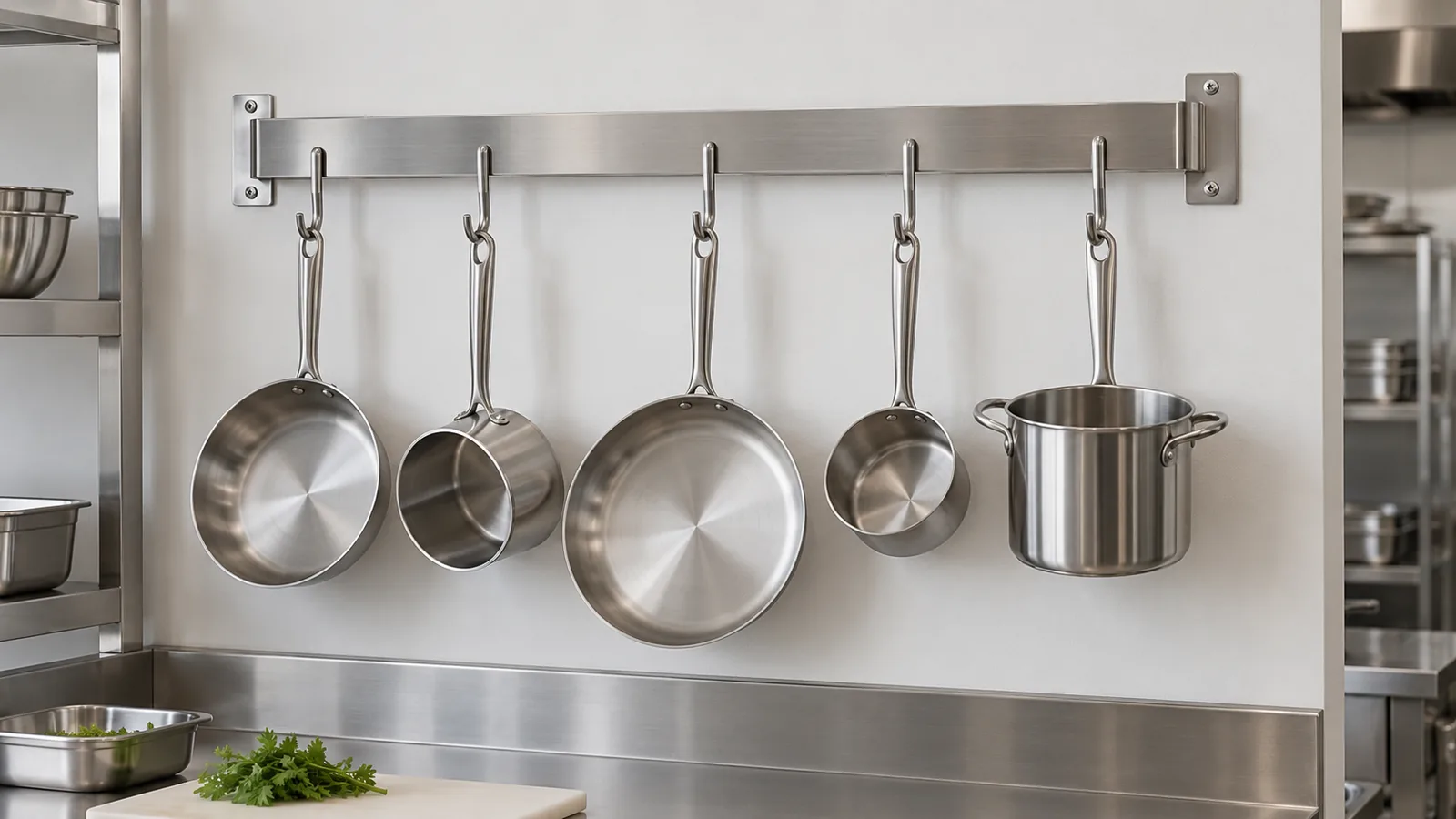
For commercial pot racks, an importer should define the cookware set, mounting format, usable rack dimensions, bar or shelf layout, hook arrangement, included hardware and packaging scope in the same RFQ. Then compare supplier quotations against those controlled fields and review a representative sample with the buyer’s named cookware before approving production. This process makes unlike configurations easier to compare without assuming that a product listing, appearance or generic load claim proves suitability for a particular kitchen.
What decision should a commercial pot-rack RFQ support?
A commercial pot-rack RFQ should establish which rack configuration the buyer wants to evaluate and what evidence will make a sample acceptable. Buyers often see products described with different combinations of wall or ceiling mounting, rail-only or shelf-plus-rail construction, number of bars, hook quantity, finishes and included accessories. A quote is difficult to compare if two suppliers are pricing different arrangements under a similar product name.
For commercial pot racks intended for more than one cookware assortment, state which variants are essential and which are optional. This keeps the quote focused on the assortment decision instead of inviting suppliers to price unrelated options.
Begin with the channel and use case. A distributor may need a repeatable catalog model, while a project buyer may need a defined layout. State whether the request is for a standard model, a modification or a new drawing-based product; do not expect a supplier to infer this from “commercial pot rack.”
Record the cookware that the rack must accommodate. Useful inputs can include the types of pots and pans, their approximate overall envelopes, the handles or loops that hang from hooks, and whether the product will be merchandised with cookware or sold as a rack alone. These details are for fit and configuration review; they do not establish a load rating. If a buyer has not selected the cookware assortment yet, identify representative items or mark the dimensions as provisional so the supplier does not treat them as final.
Separate purchase decisions from product claims. A buyer may specify a finish preference, mounting format or hook style, but any claimed capacity, certification or suitability for a particular installation must be supported for the exact model and conditions. For general kitchen-storage capability context, see Koitor’s custom kitchen storage rack manufacturing page. It is a related category resource, not a claim that Koitor currently offers commercial foodservice pot racks.
Which configuration fields belong in the RFQ?
The RFQ should identify the product envelope, rack architecture, attachment points, accessories and shipment format. A short written brief can be sufficient for an early feasibility discussion, but the approved configuration should be recorded in a drawing, specification sheet or controlled sample record before order release.
Start with the rack type: wall-mounted, ceiling-mounted, freestanding or another arrangement. Name each rail or shelf, its position, and whether hooks are fixed or removable. If the supplier offers options, identify the requested model or option code instead of relying on a product photo.
Separate overall dimensions from usable dimensions. Overall width and projection describe the footprint; usable bar length and clear space between supports affect cookware arrangement. Define measurement points in a drawing. Identify the offered bracket or suspension interface, while leaving project-specific mounting suitability to the responsible reviewer.
The table below gives a practical starting set. It is a comparison aid, not a universal engineering specification. Dimensions, hook counts, finishes and hardware scope depend on the selected design and supplier model.
| Campo «Solicitud de presupuesto» | What the buyer should record | Why it improves the comparison |
|---|---|---|
| Rack architecture | Wall or ceiling format; rail-only or shelf-plus-rail; number of bars or shelves | Prevents different product configurations from being priced as equivalents |
| Fit envelope | Overall size, usable bar length, projection and relevant clearances | Separates the outside footprint from the space available for cookware |
| Hook layout | Hook type, quantity, spacing intent and whether hooks move or remain fixed | Makes the intended hanging arrangement reviewable against actual cookware |
| Included scope | Brackets, hooks, fasteners, end caps, instructions and any separate items | Identifies inclusions and exclusions before price comparison |
| Commercial terms | Quantity by model, sample requirement, destination and packing format | Keeps quotation assumptions visible across suppliers |
Attach a sketch, CAD file, annotated photo or reference sample where available. Label its revision and visible surfaces. State the requested finish and the sample or reference that controls appearance; a color name alone may be ambiguous.
How can buyers compare quotations fairly?
Compare each supplier’s quoted scope field by field, not only the unit price. A low quotation may exclude hooks, mounting hardware, an extra rail, a specific finish, retail packaging or a sample round. A higher quotation may include those items or may describe a different configuration. The buyer should request a clear inclusions-and-exclusions list and reconcile each offer against one controlled requirement.
Use a matrix that leaves room for the supplier’s exact model, assumptions and deviations. For example:
| Comparison item | Buyer requirement | Supplier A | Supplier B | Open question or deviation |
|---|---|---|---|---|
| Mounting format | Wall-mounted, project interface under review | Model and interface | Model and interface | Who confirms substrate and installation details? |
| Rack layout | Two rails with named shelf option | Included configuration | Included configuration | Is the shelf included or optional? |
| Hook set | Removable hooks, buyer-defined quantity | Quantity and type | Quantity and type | Are the hooks repositionable after installation? |
| Acabado superficial | Buyer-selected finish and approved reference | Finish name and process, if stated | Finish name and process, if stated | What sample or record controls appearance? |
| Pack-out | Each rack protected; accessory set identified | Carton and unit contents | Carton and unit contents | How are loose hooks and hardware contained? |
Separate written facts from assumptions. If a quote says “heavy duty” without a model-specific rating or evidence, record the claim as unverified. Where rated performance matters, define the required evidence, test setup and responsible reviewer before committing.
Published examples show model-specific scope: a Regency model sheet lists usable length, hooks, material and separately sold mounting hardware; an IMC/TEDDY catalog y Streivor range show other configurations. These are supplier examples, not universal specifications.
Ask each supplier to return a completed matrix and mark every exception. If an alternative is proposed, request its effect on configuration, fit, surface appearance, included hardware, packaging and sample approval. Keep the original requested configuration in the comparison record so an alternative does not quietly replace the baseline.
What should the buyer verify on a representative sample?
Review the sample against the RFQ and drawing, using the intended cookware or a named representative set. A sample can confirm the delivered configuration and visible fit details under the conditions reviewed; it does not automatically establish bulk consistency or long-term performance.
First confirm identity. Match the model, drawing revision, finish, hook set and accessory list to the quotation. Count loose components and check the bag or pack that contains them. If a rack has more than one size or finish option, mark the sample so it cannot be confused with another version. Photograph the item next to the drawing revision and record any deviation before the supplier makes a correction.
Then check the product envelope. Measure the overall dimensions and the usable hanging area against the defined measurement points. Verify that bars, shelves, supports and bracket positions match the released drawing or sample brief. Do not compare measurements taken from different datums as if they describe the same feature. If a bend, weld, joint or support position is critical to appearance or fit, identify the exact point to inspect and the agreed tolerance or acceptance note.
Use the cookware set to check the intended arrangement. Place the buyer’s representative pans on the rack, position the hooks as designed, and verify that handles do not collide in the planned arrangement. Confirm that items can be placed on and removed from the rack without changing the specified configuration. If the buyer expects hooks to slide or be repositioned, check that action on the sample and record the allowed movement. The result applies to the cookware set and layout that were actually reviewed; it should not be generalized to every pan size or handle shape.
Inspect visible contact and finish areas under consistent lighting. Look for obvious scratches, unfinished edges, inconsistent appearance, loose parts or gaps that conflict with the buyer’s approved criteria. A visual review can identify visible issues; it cannot prove material grade, coating adhesion, corrosion life or internal weld strength. If one of those properties is commercially important, agree a separate method and objective record with the supplier or an appropriate evaluator.

Record the model and revision, sample date, finish, dimensions, cookware, accessory count, observations and approval status. List each change with its revision or follow-up action. Do not approve from a photo when the open issue concerns physical fit or movement.
How should mounting, load and listing claims be handled?
Treat mounting interface, rated capacity and commercial listings as model- and condition-specific requirements. A product photograph or an apparently substantial bracket cannot establish a safe capacity or confirm suitability for a particular wall, ceiling or kitchen project.
For mounting, ask the supplier to identify the offered bracket, mounting plate and hardware scope. The RFQ should say whether fasteners are included, sold separately or selected by the project installer. Installation conditions can vary by wall or ceiling construction, finish, backing and local requirements. The product supplier’s general description should not replace project-specific review by the responsible installer, designer or qualified professional. This article does not provide anchor instructions or an installation safety verdict.
For a load claim, request the exact model identification, test or evaluation method, fixture or mounting configuration, load location, duration, acceptance criteria and record owner. Ask whether the data applies to the quoted model and its current revision. A result from a different size, bracket, fastener or mounting surface may not answer the buyer’s question. If no substantiation is available, do not use an unsupported capacity figure in a listing or purchase specification; define a documented validation path instead.
If a listing or certification matters for a channel, ask which exact model and finish are covered, who issued the documentation, what version or scope applies and whether any exclusions are stated. A product name or a supplier’s general “commercial” positioning is not proof of a listing. A buyer should make the acceptance decision with the relevant project or compliance reviewer rather than infer that one catalog entry covers every variant.
How do finish, accessories and packaging affect the order?
Finish, accessories and pack-out should be tied to the same item code and approved revision as the rack. A change to any of these can affect quotation comparability, sample matching and what the receiving team finds in the carton.
For the surface, state the buyer’s required appearance and finish system only to the level that is known and commercially necessary. If a supplier proposes an alternative, ask for a representative sample and document the difference. Product geometry, sharp edges, welded intersections and contact points can make appearance vary across a structure. Do not claim that appearance alone proves adhesion or corrosion performance. Where a test result is necessary, define the method and acceptance scope separately.
List every loose or optional component: hooks, brackets, end caps, fasteners, shelf inserts, assembly tools or printed instructions. State whether accessories are packed together or separately, and how the buyer or distributor will identify them by SKU. If the assortment includes multiple rack sizes, decide whether accessories are interchangeable or specific to one configuration; do not assume compatibility based on a similar appearance.
Packaging should protect the finish and keep small components associated with the correct model. Ask for the unit pack form, separation between metal surfaces, protection around exposed corners, accessory containment, carton quantity and master-carton identification. A buyer can review a packaging sample for fit and handling, but a package review does not prove that transit damage is impossible. If distribution conditions require a formal transit evaluation, define the packaging configuration and procedure with the responsible parties.
For resale, assign responsibility for artwork, labels, instructions and barcodes. Approve their revisions and specify how mixed versions will be identified at receiving.

What should be approved before the purchase order?
Before order release, the buyer should be able to trace the PO to one controlled rack configuration, its approved sample and an agreed pack-out. The supplier should identify any unresolved item as an open question rather than relying on an informal message or image.
Use this checklist for the final handoff:
- Confirm the commercial pot-rack model, buyer SKU and drawing or specification revision.
- Record wall, ceiling or other configuration; rail or shelf arrangement; and the included hook set.
- Identify overall and usable dimensions with measurement points.
- Name the cookware assortment or representative items used for fit review.
- List the finish requirement and the reference that controls sample appearance.
- State which accessories and mounting parts are included, excluded or project-selected.
- Capture each supplier deviation and the buyer’s disposition.
- Link the approved sample record to the quoted configuration and PO line.
- Specify unit packaging, accessory containment, carton quantity and identification.
- Assign responsibility for any capacity, listing, installation or transit evidence required by the buyer.
For custom metal storage products, drawing and sample review can align forming, welding, finish, assembly and packaging with a buyer’s design. Koitor Hardware is a family-owned factory focused on bathroom and home-storage hardware; a current commercial pot-rack product is not confirmed. Buyers can share a drawing or sample through Página de contacto de Koitor to discuss a specific project. Confirm any new product scope directly.
Frequently asked questions about commercial pot racks
What information should an importer send for a commercial pot-rack quote?
Send the intended rack format, overall and usable dimensions, bar or shelf layout, hook arrangement, accessory scope, finish request, quantity, destination and pack-out requirements. Add a drawing, annotated photo or sample when available, and mark which values are final versus provisional.
Should buyers compare wall-mounted and ceiling-mounted racks in one RFQ?
They can request both as alternatives if the project genuinely allows either configuration, but each option should be quoted as a separate scope. The mounting interface, usable geometry, included parts and project review may differ. Do not assume the two formats are interchangeable because both hold cookware.
Does a sample approval guarantee that every production unit will match?
No. A sample approval records the agreed design and the checks performed on that sample. It does not, by itself, establish that every later unit will be identical. Buyers should link the approved sample to a controlled drawing or specification and agree any production, inspection and change-control requirements with the supplier.
Can a buyer infer capacity from a rack’s material or appearance?
No. Material description and visual appearance alone do not establish a model’s rated capacity. If capacity matters, request model-specific substantiation with the relevant configuration and test conditions, and have the project reviewer assess its applicability.
Are mounting fasteners always included with a commercial pot rack?
No. Inclusion varies by model and supplier. The Regency example cited above identifies mounting hardware as sold separately for that model. List the fastener scope in each quotation and confirm that the responsible installer selects hardware for the actual substrate and project conditions.
What should happen when the supplier proposes a different hook or finish?
Treat the proposal as a controlled alternative. Compare its fit, included quantity, appearance, compatibility with the intended cookware and packaging. Request an updated quotation and representative sample where needed, then record the accepted revision before the PO is released.
Planning a metal kitchen-storage project?
Share your drawing or sample, target configuration, quantity and packaging brief to discuss the manufacturing questions that need confirmation. Commercial pot-rack capability is not implied by this article.
OEM / MARCA BLANCA
Convierte esta guía de abastecimiento en un resumen del producto
Indícanos el producto que deseas, el tamaño, el acabado, la cantidad del pedido y los requisitos de embalaje. Tu equipo recibirá un análisis práctico de la viabilidad de fabricación antes de recibir el presupuesto.


 English
 Español
 Português
 Français
 Deutsch
 العربية