
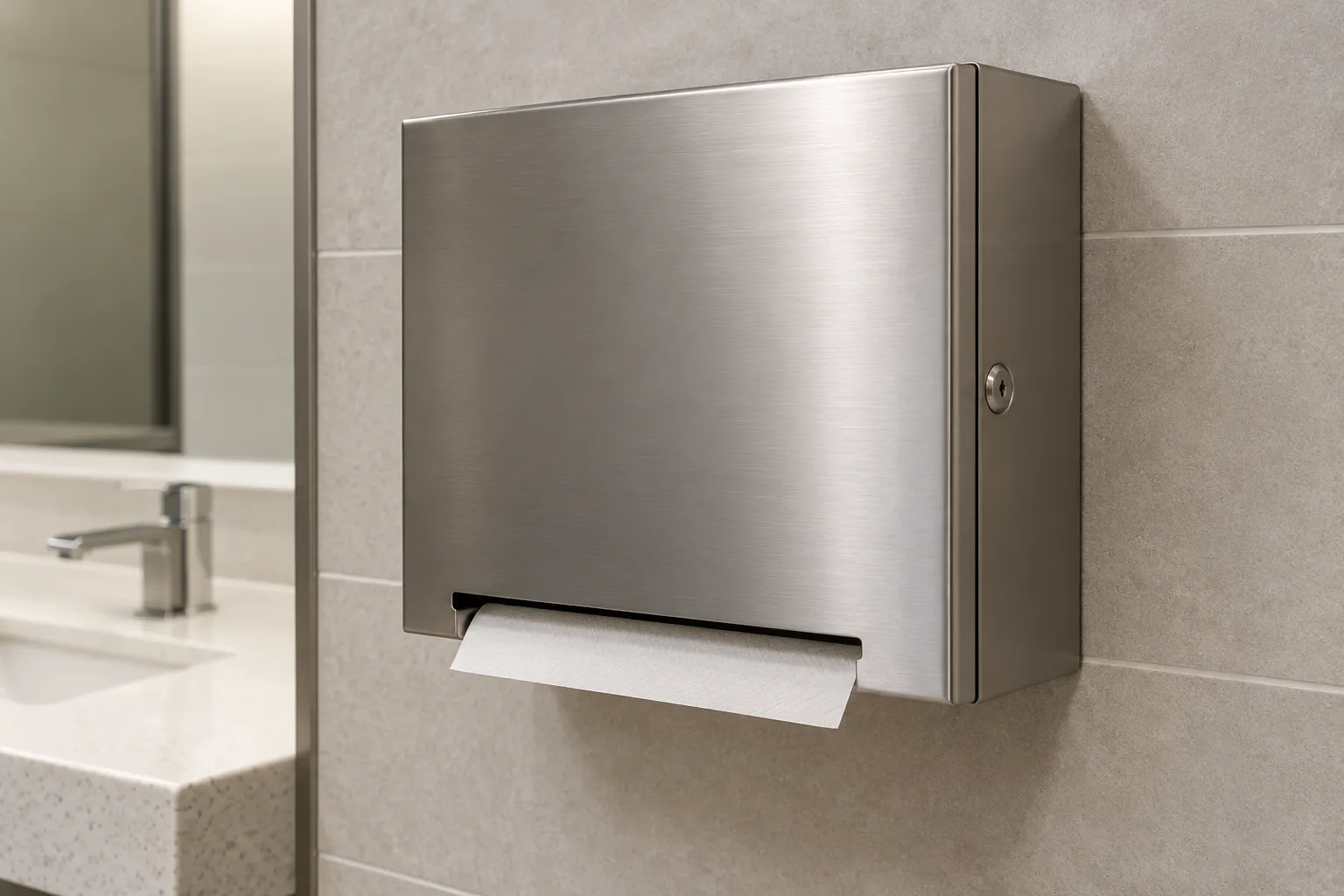
A commercial paper towel dispenser specification should identify the refill and the exact dispenser configuration that the buyer will approve—not only the cabinet’s outside dimensions or finish. For an importer sourcing a wall-mounted folded-towel unit, the RFQ should connect the towel fold and finished dimensions to the usable cavity, outlet opening, refill access, lock/door arrangement, mounting pattern and shipping pack.
The practical approval test uses the refill intended for the program. A product sheet may state a towel type or approximate capacity for one model, but the buyer still needs to confirm that its chosen refill loads, feeds and can be replaced through the selected unit. This guide covers buyer questions for a metal housing and does not claim that Koitor currently manufactures commercial dispensers, locks or dispensing mechanisms.
Why should the refill be defined before comparing models?
“Paper towel” can describe different folded formats, dimensions, stack thicknesses and dispensing behavior. A C-fold, multifold or Z-fold label can help identify the intended supply, but the importer should still provide the refill SKU or physical sample and its finished width, depth and stack height. A supplier’s advertised capacity for one named refill does not establish the same count with a different fold or sheet thickness.
Public product sheets show that these details vary by model. A current KWC Professional wall-mounted EXOS model sheet identifies Z-fold towels, a stated capacity range, an enclosure thickness, a key lock, overall dimensions and included mounting material. Its recessed EXOS model has a different installation form and different overall dimensions while describing a similar refill family. An older Franke/Reece sheet lists its own material, dimensions, nominal capacity and wall-mount fixing details. Treat each as that model’s published specification—not as a universal requirement. See the KWC wall-mounted dispenser sheet, KWC recessed dispenser sheet, y Franke/Reece specification sheet.
These examples help an importer build a comparable RFQ. They do not show which refill, capacity or model is right for a different project. Ask suppliers to name the towel format they have assumed, and keep that assumption visible when comparing quotations. If the towel source may change during the product’s life, define which alternate refill is in scope and require a separate fit/dispensing check before promising interchangeability.
What belongs in a commercial paper towel dispenser RFQ?
Start with the use setting and service routine. A hotel, office, school, health facility or other commercial environment may have different refill frequency, tampering concerns, cleaning routines and wall constraints. These are buyer inputs, not proof of any compliance outcome. The procurement brief should state whether the unit is wall-mounted or recessed, who will refill it and which refill supply is available in the target market.
Then define the selected model’s measurable envelope and internal fit. Request an overall drawing plus a view of the usable cavity and outlet. Have the supplier distinguish outside cabinet size from internal clearance and from the opening through which towels are dispensed. Specify the towel fold, sample or SKU, individual-sheet dimensions where known, stack size and approximate refill pack height. Ask the supplier to identify the basis for any capacity figure: named refill, stack arrangement and whether the number is approximate or tested for that model.
| RFQ item | Buyer should provide | Supplier should return |
|---|---|---|
| Refill identity | Fold type, SKU or physical sample; sheet dimensions and stack height | Assumed compatible refill and loading orientation |
| Usable cavity | Required refill envelope and service clearance | Internal clear dimensions and reference points |
| Outlet | Desired sheet presentation and sample review conditions | Opening geometry and any model-specific feed assumption |
| Housing | Material/finish brief and visible faces | Model drawing, finish sample and construction details stated for that unit |
| Refill access | Service direction and available space | Door swing, hinge side, lock position and refill sequence |
| Montaje | Surface datum, wall type and planned layout | Hole/slot pattern, template and included hardware list |
| Order configuration | Keying, labels, packaging and SKU variants | Component list, option codes, carton and revision identification |
Do not compare model capacities without comparing the refill and loading basis. A number such as “400 towels” belongs to a specific supplier’s model documentation. It is not automatically a usable count for every folded towel or for a unit that a buyer intends to refill differently. For an assortment with several markets or towel suppliers, make a refill-to-model matrix rather than assuming the same cabinet accepts every stack. That matrix belongs in a commercial paper towel dispenser specification and should name each supplier refill SKU.
How can a buyer test refill access and dispensing on a sample?
Use the exact refill or a controlled representative sample. Open the unit using the intended key or access method, load the stack in the specified orientation and close the door. Observe whether the refill can be placed without forcing the stack, whether the door closes normally and whether the outlet remains clear. Then draw sheets at different stack levels: after loading, at a typical mid-fill point and when only a few towels remain.
The goal is to document the behavior of the reviewed configuration, not to promise a universal dispensing result. Note whether sheets separate as intended, whether the stack shifts, whether an edge catches and whether the next sheet is accessible. If the buyer changes the fold, dimensions, stack compression or loading orientation, repeat the check with the revised refill. A successful trial with one sample does not establish long-term mechanism durability or performance across a production lot.
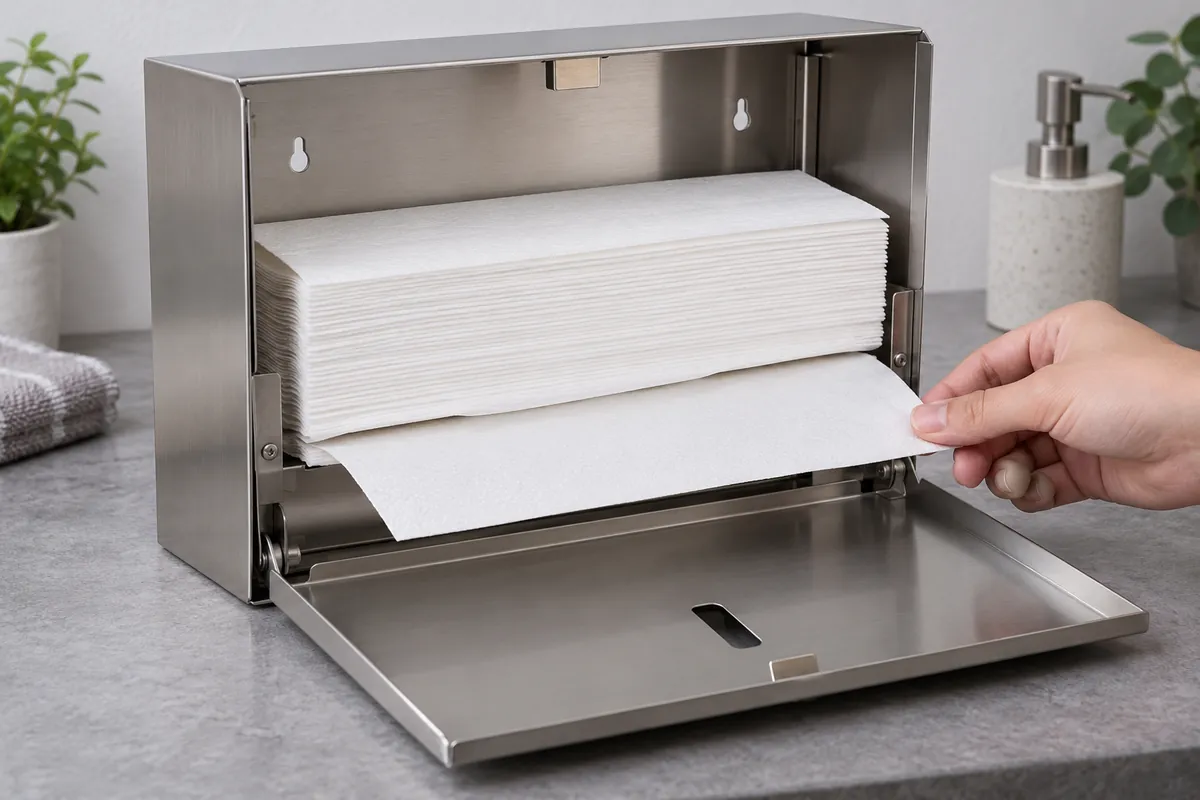
Review door access and replenishment as part of the same sample procedure. Identify which side or face opens, the hinge direction, how the key is inserted and whether a user can service the unit in the planned location. Confirm that an installed neighbor, shelf, partition or mirror will not block the opening path. These checks are especially relevant when the buyer is ordering multiple units for a fixed room plan.
If a viewing window or refill indicator is specified, check the location against the stack and the expected viewing direction. A visible window on a product photograph is not enough to establish that the buyer can tell when the actual refill is low. Record what the feature should show and approve it on the selected model. Avoid making an operating or low-refill claim unless the specific design and test condition support it.
What metal, finish, door and lock details need approval?
The enclosure drawing should identify its material and finish for the selected model, along with the key dimensions and visible surfaces. If a supplier offers several grades, thicknesses or finish options, record the selected option instead of using a generic “stainless” label. Product sheets may state a material grade or nominal thickness for their own units; those values should not be copied as a default for another design.
Mark cosmetic faces, corners, bends, seams and the dispensing outlet for review. Look for edges or joints that may contact towels during loading or use, and confirm that the outlet shape does not have a visible burr or unfinished edge. Inspect the finish under the agreed lighting and retain a reference sample if color or surface appearance matters. Visual inspection can identify visible surface concerns, but it cannot by itself prove material grade, coating adhesion, corrosion performance or service life.
For doors and locks, identify the hinge side, opening direction, lock type, key coding or key supply responsibility, and any replacement-key process relevant to the buyer’s SKU plan. A key lock can be one model feature; it does not establish a security rating. If a multi-SKU program requires common keys or separate keying, state the requested arrangement and ask the supplier to document the model options and sample key. Confirm that the lock, door gap and hinge remain aligned after representative opening and closing during sample review.
How should mounting, packaging and reorder control be handled?
For a wall-mounted unit, share the wall reference, available envelope and planned mounting height or datum with the responsible installer or project team. Request a dimensioned hole/slot pattern or model-specific template and compare it against the intended surface. State which party supplies fasteners. If anchors depend on the building substrate, leave their selection to the responsible installer or buyer’s construction specification; do not imply that the dispenser’s included screws prove suitability for every wall.
Recessed models require a different opening and depth conversation from surface-mounted models. Confirm the selected installation type before sign-off, then review the drawing against the wall build-up and surrounding finish. Do not substitute one mounting type for another based only on a similar exterior appearance. Any code, accessibility or installation compliance question must be verified against current official requirements for the specific market and project; the examples in this article are not legal guidance.
Packaging should protect the visible front, outlet edge, corners and supplied hardware. Decide whether the unit ships assembled or with removable components, then request a trial pack showing the protective film or separator, inner packaging, carton restraint, accessories and label. Inspect the packed sample after a representative handling check and record the packaging revision. A trial pack supports a packing decision; it does not guarantee zero transport damage on every route.
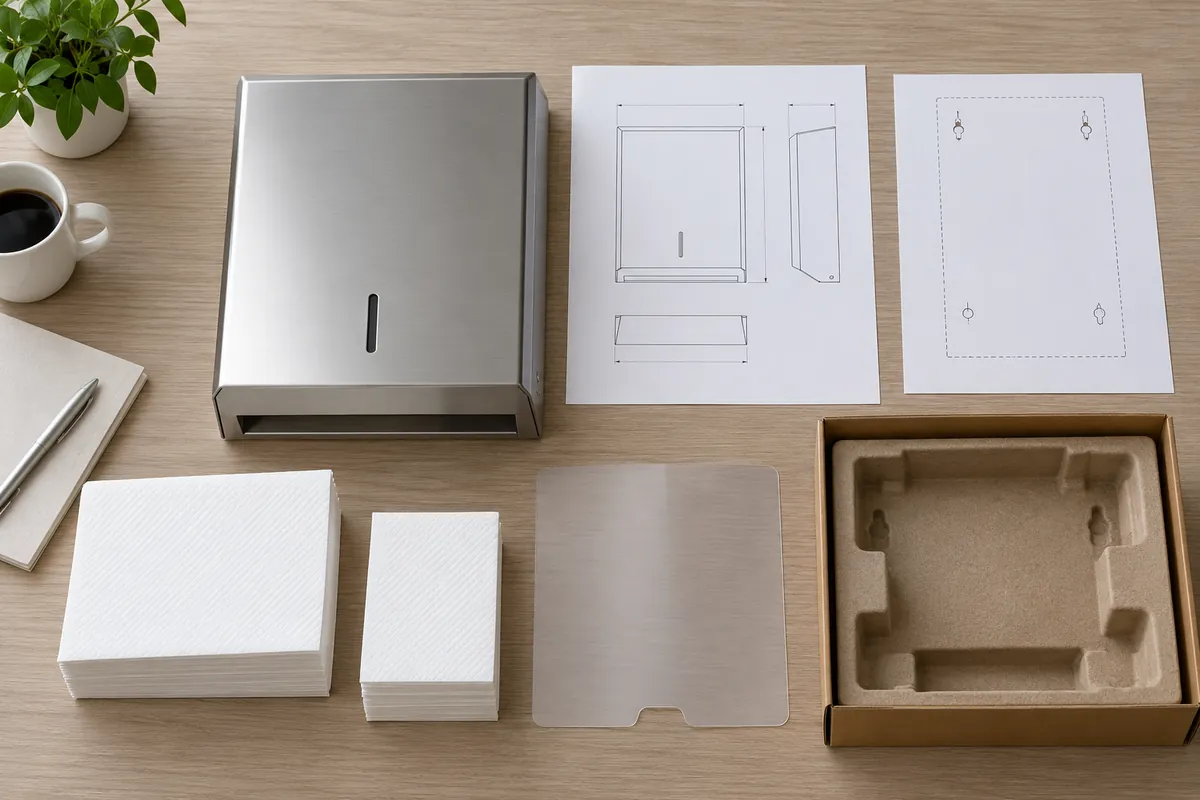
The approved order record should connect the dispenser model code to the drawing revision, refill code, keying arrangement, finish sample, mounting template, included hardware, carton configuration and label. If any input changes, mark the revision and decide which parts of the sample review need to be repeated. Keep the same identifiers on the sample record and purchase-order line so a reorder does not rely on a product nickname alone.
Commercial washroom dispensers are an adjacent product area to Koitor’s documented metal storage hardware work. Buyers looking at broader metal bathroom accessory sourcing can review the custom bathroom hardware manufacturer page for the verified company scope, but this article does not represent a current Koitor dispenser line or confirm that a proposed mechanism is in scope.
Buyer checklist before sample approval
- Name the target market, use setting, refill routine and surface-mount or recessed configuration.
- Provide the actual folded refill or its SKU, fold type, dimensions and stack-height information.
- Have the supplier mark overall dimensions separately from usable cavity and outlet geometry.
- Record the capacity basis and avoid comparing figures tied to different refill samples.
- Load and draw towels at high, typical and low fill; note catches, movement and refill steps.
- Check door swing, hinge side, lock/key arrangement and installation-service clearance.
- Review material and finish references, visible edges, seams and cosmetic surfaces against the approved sample.
- Confirm wall datum, hole/slot locations, fastener responsibility and mounting template.
- Inspect protective packaging and connect model, refill, drawing, key, finish and carton revisions to the SKU.
- Keep capacity, compatibility, durability and compliance statements limited to evidence for the named model and test conditions.
The key sourcing decision is to make the refill part of the approved product definition. A commercial paper towel dispenser specification becomes more useful when it ties one identified towel supply to the cavity, outlet, refill access, lock/door, mounting and pack-out that were actually checked. That record gives buyer and supplier a common basis for quotation, sample changes and reorders, while keeping model-specific claims attached to the evidence that supports them.
Preguntas frecuentes
Can a supplier’s stated capacity be used for any folded towel?
No. Capacity figures are model- and refill-specific examples. Ask which fold and stack the supplier used, then verify the intended refill in the actual unit. A different sheet size or thickness can change the usable count or dispensing behavior.
Should the importer choose wall-mounted or recessed before the sample?
Yes, when the project design already defines the installation type. They can differ in overall dimensions, opening requirements and wall interface. If both forms are being evaluated, treat them as separate configurations and sample them separately.
Does a successful towel draw test prove long-term reliability?
No. A limited sample test documents how that sample and refill behaved in the conditions tried. It does not establish mechanism life, full-lot consistency or performance across other refill formats. Any broader performance requirement needs an agreed model-specific test method and evidence.
Does a product sheet prove local installation or accessibility compliance?
Not by itself. Confirm applicable requirements with the current official authority or responsible project professional in the target jurisdiction. Supplier literature may be model-specific and may not address the buyer’s site conditions.
Does Koitor currently manufacture commercial paper towel dispensers?
The approved company facts do not confirm a current commercial dispenser product or lock/dispensing mechanism capability. This guide explains what a buyer can specify and approve; it does not make a Koitor production claim.
Discuss a Metal Storage Project Brief
Planning a new storage hardware SKU?
Share the buyer specification, drawings or sample, target quantity and packaging requirements. Koitor can first review whether the request fits its verified manufacturing scope.
OEM / MARCA BLANCA
Convierte esta guía de abastecimiento en un resumen del producto
Indícanos el producto que deseas, el tamaño, el acabado, la cantidad del pedido y los requisitos de embalaje. Tu equipo recibirá un análisis práctico de la viabilidad de fabricación antes de recibir el presupuesto.

 English
 Español
 Português
 Français
 Deutsch
 العربية