
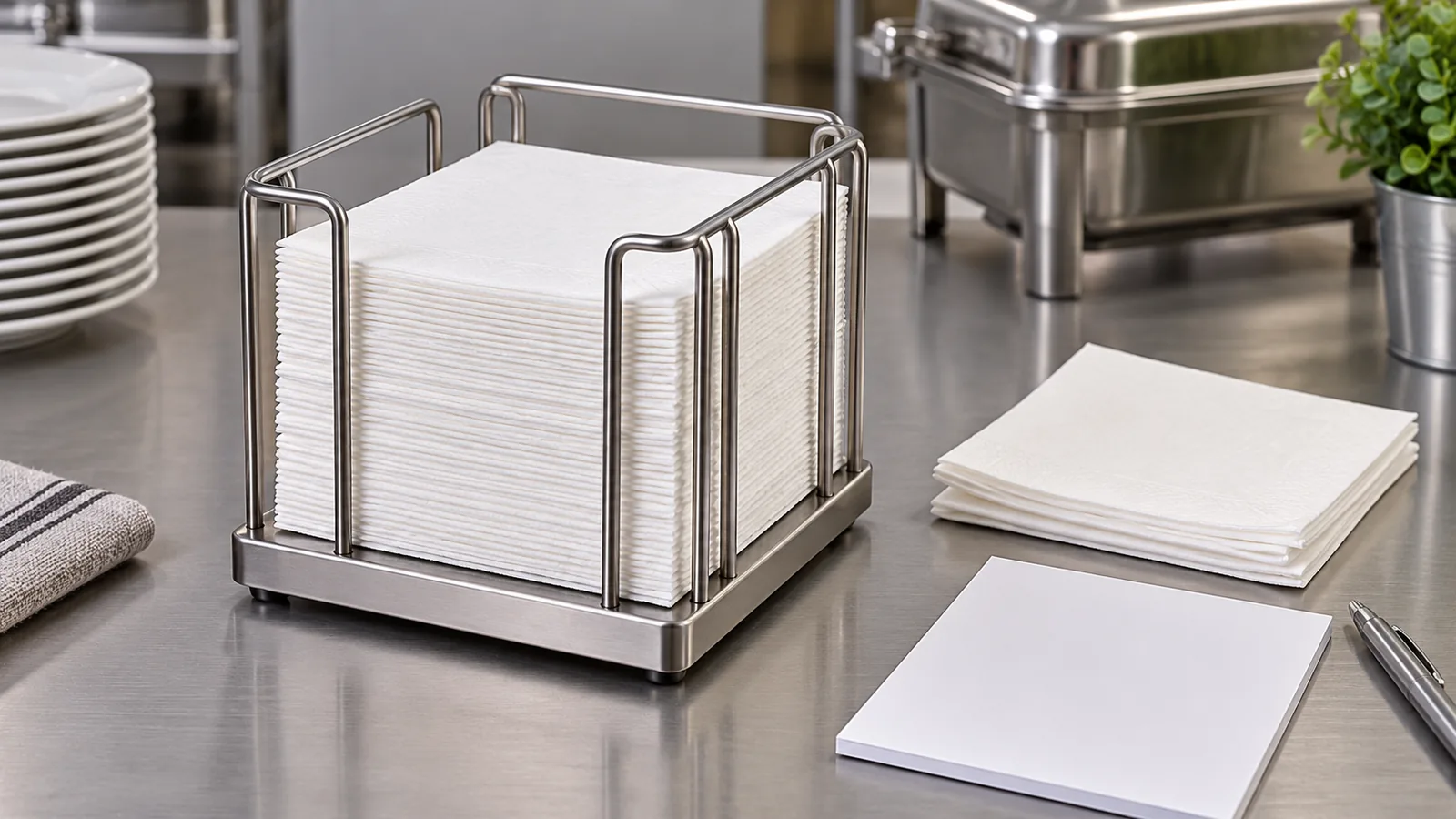
A vertical napkin holder should be approved against the buyer’s actual folded napkin, intended stack range, refill direction and tabletop footprint—not a vague promise that it “fits standard napkins.” For importers, the useful specification is a small set of measurable product and use conditions, followed by a sample check with the same napkin SKU that will be sold or supplied to the end user. There is no single universal folded format that should be assumed across beverage, luncheon, dinner and hospitality napkins.
What should an importer define before comparing holders?
Start by identifying the product architecture and the napkin format. “Vertical” can describe an open freestanding holder with upright side rails, but search results also include built-in counter dispensers and high-volume systems. These are different products with different installation and refill requirements.
This guide covers freestanding tabletop holders for folded paper napkins. It does not cover counter-cutout dispensers, interfold dispensers, roll holders or cloth napkin rings. A buyer can avoid a specification mismatch by recording these basics in the RFQ:
- Napkin SKU and folded dimensions: provide the supplier with the actual folded width and height, not only the unfolded sheet size or a supplier’s format name.
- Fold style and orientation: a quarter-fold napkin and a side-fold napkin may present different edges and thicknesses even when their nominal unfolded sheets are similar.
- Stack condition: state whether the holder must accept a full refill, a defined working quantity, or both full and partly used stacks.
- Access direction: specify where the user loads the stack and from which edge a napkin is removed.
- Use setting: tabletop service, buffet, café counter and home retail use may lead to different footprint, appearance and refill priorities.
- Product boundary: state whether the requested item is freestanding and whether it needs feet, a logo, a particular finish or retail packaging.
Professional product catalogues illustrate why “standard napkin” is too vague. Contacto lists holders associated with distinct beverage, luncheon, dinner and guest-towel formats and gives product-specific dimensions in its napkin-holder catalogue. Treat these as examples of product variation, not a universal sizing standard. A separate built-in vertical dispenser publishes its own napkin range and counter cutout, which shows why its fit data should not be copied into an RFQ for a freestanding holder.
Which dimensions belong on a napkin-holder specification?
Record the napkin envelope, holder envelope and stack envelope separately. This makes a drawing review clearer than a single overall width and height because each measurement serves a different decision.
| Buyer input | Qué grabar | Why it matters for review |
|---|---|---|
| Folded napkin width and height | Actual dimensions of the selected napkin SKU and fold | Defines the paper envelope the holder must accept |
| Napkin thickness | Compressed thickness of one napkin or a small representative stack, measured consistently | Helps estimate stack depth without treating sheet count as a fixed dimension |
| Full stack thickness | Typical refill state and maximum intended stack envelope | Checks side clearance, loading and refill fit |
| Partly used stack | Minimum practical quantity or a sample condition | Shows whether the remaining stack stays accessible and controlled |
| Internal holder clearance | Clear width, height and depth between product features | Connects the sample geometry to the selected napkin |
| Opening and removal path | Loading opening, user approach and direction of withdrawal | Helps catch trapped corners, snagging and awkward retrieval |
| Base footprint | Overall width and depth, including feet or protruding parts | Supports tabletop placement and packaging review |
| Overall height | Height from table contact points to highest rail or panel | Helps assess access and the visual profile against the buyer’s use setting |
Use a controlled measurement method: lay the napkin flat after the intended folds, square the edges without stretching it, and measure the folded envelope. Paper can compress, spring back or vary slightly by lot and ply. If the stack is bulky or embossed, measure the actual samples rather than calculating its volume from sheet count alone. Record the napkin brand or internal SKU, fold, ply if known, and the sample date so another reviewer can reproduce the check.
Do not invent a clearance allowance before you have the napkin sample and holder architecture. A tight fit may make refill difficult or pinch corners; a loose fit may allow a partly used stack to lean or slide. The acceptable range depends on the paper, stack condition, rail placement and removal path. The buyer and supplier should agree on the intended fit in the approved drawing and confirm it on a representative sample.
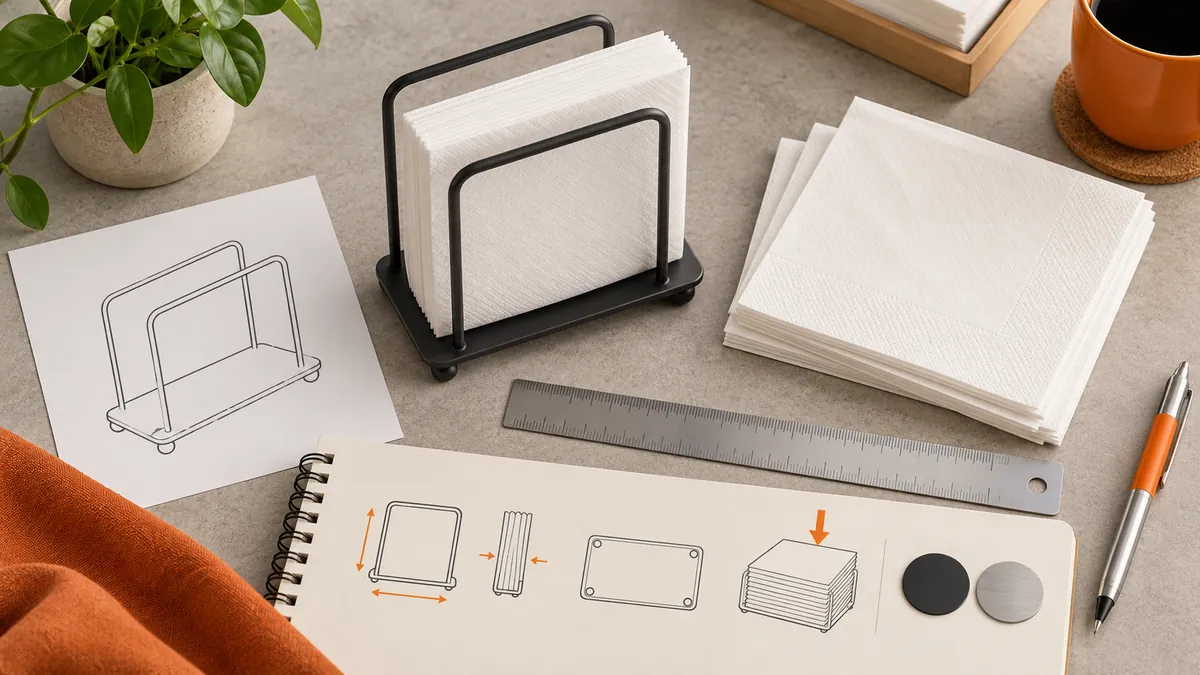
How do architecture and retrieval affect fit?
A vertical napkin holder is not defined by its outside dimensions alone. Its rails, end stops, base and opening determine how the stack is supported and how a user can refill or remove napkins.
When reviewing a drawing or sample, identify which surfaces restrain the stack and which edge stays open. An open side can make loading easy, but it may offer less control when the holder is moved. A front rail can retain the stack, but if it crosses the natural removal path, a user may have to pinch or bend a napkin. A wide base may increase the tabletop footprint; a narrow base may suit a small counter but can be more sensitive to the stack position and user action. These are design trade-offs to check, not universal rankings.
Ask the supplier to show the intended loading and removal direction on the drawing. Then check:
- Does the napkin enter without forcing or folding its corners?
- Can the user reach and grasp one napkin without pulling the entire stack?
- Does the stack move freely enough for normal use, while remaining supported?
- Can the user refill the holder without removing a fixed part or disturbing the table setup?
- Do rail ends, joints or edges contact the paper in a way that catches or tears it?
- Can the partly used stack remain in the intended orientation?
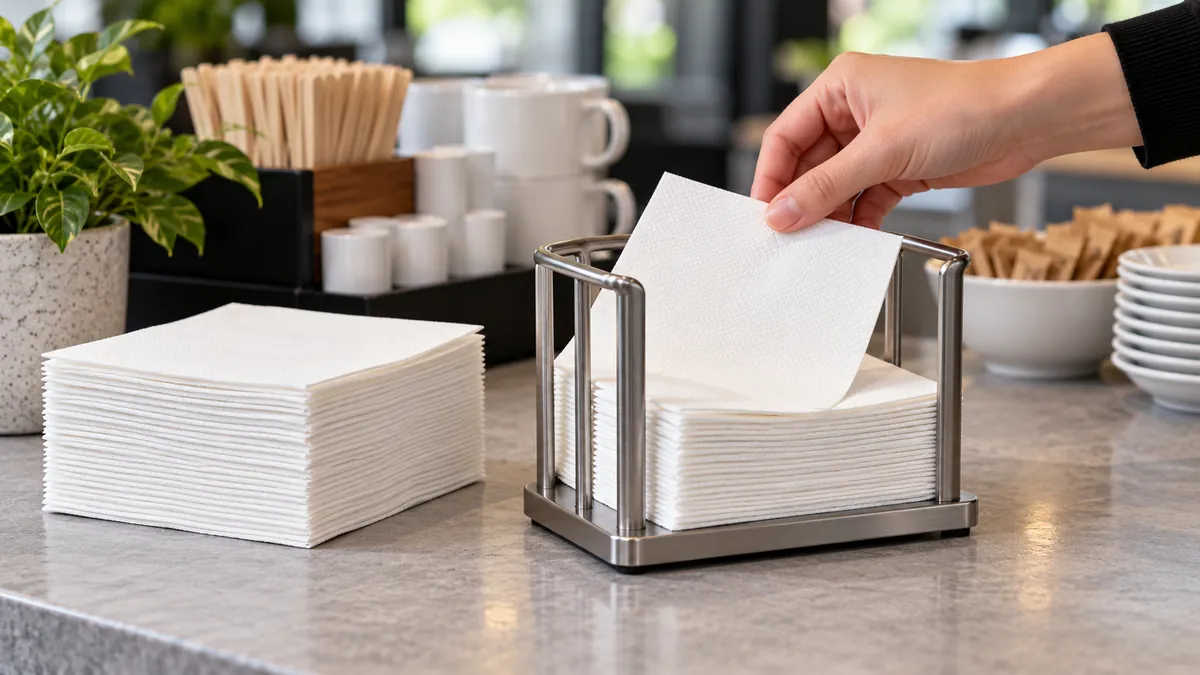
Test the actual user motion with one napkin at a time. A holder can accept a full stack and still be awkward to use after most of the stack has been consumed. Conversely, a simple concept drawing may look easy to retrieve from but reveal a snag point once the paper compresses against a rail. The useful result is a documented buyer observation—such as “one napkin can be removed from the front with the partly used stack remaining in place”—rather than an unsupported broad claim about ease of use.
What should the RFQ say about material, finish and construction?
Describe what the product needs to look like and how it will be evaluated; do not rely on a material label or product weight as a quality shortcut. Metal choice and construction affect forming, joining, finishing, appearance, cost and pack protection, but the right combination depends on the design and order requirements.
An RFQ can state the proposed material or ask the supplier to recommend an option for review. If the material grade is important to the buyer, request it as an explicit drawing or purchase-specification field and agree how it will be documented. A visual check alone cannot establish a hidden alloy grade. Likewise, a heavier holder is not automatically more stable or more suitable: footprint, contact points, center of the loaded stack, rail geometry and removal force all contribute to how it behaves on the table.
For a coated, plated or polished appearance, define the visible surfaces, target color or finish reference, acceptable cosmetic faces, edge expectations and the approval sample. A coating or plating process can change clearances at joints and contact points, so discuss those areas before finalizing the design. Avoid broad claims such as “rust-proof” or “scratch-proof” unless the buyer has a defined test, conditions and acceptance criteria that support the wording.
For formed wire or sheet construction, the drawing should make important joins and transitions clear enough for the supplier to review. The buyer can mark exposed surfaces, areas where joints should be minimized visually, and any edge or corner that contacts napkins or hands. For feet or pads, specify whether they are required and how they should be supplied or attached; do not assume they are included simply because they appear in a reference image.
Koitor’s published OEM home-storage page describes a general custom metal hardware project process using buyer drawings or samples and discussion of product structure, materials, finish and packaging. That supports general sourcing guidance for custom metal products. It does not establish that Koitor currently manufactures this napkin-holder category or has a specific design, tooling or test result for it. Buyers should confirm product-specific capability directly with any supplier before adding it to a sourcing plan.
How should a buyer test the pre-production sample?
Use the buyer’s real napkins and a short written acceptance sheet. A sample review should cover both the product’s fit and the user’s interaction with it; a photo or overall dimension alone does not establish that a holder works with the intended refill.
A practical review sequence is:
- Identify the sample. Record supplier, sample revision, date, finish direction, drawing revision and napkin SKU. Keep photos with the same record.
- Measure the folded napkin. Capture folded width and height using the agreed fold and measurement method.
- Load the full stack. Confirm that it enters through the intended opening without crushing corners or forcing the rails apart.
- Try repeated single-napkin removal. Use the intended removal edge and ordinary hand motion. Record catches, bunching, multiple napkins pulled together or a need to lift the holder.
- Repeat with a partly used stack. Observe whether the napkins remain reachable, stay in the intended orientation and can be removed without holding the stack in place.
- Check the table interface. Place it on the buyer’s representative tabletop surface. Observe rocking, sliding or a tendency to shift during normal retrieval; record the conditions rather than assigning an unverified performance rating.
- Inspect contact points and finish. Look for sharp or rough areas, visible defects on agreed cosmetic faces, loose joints, unstable feet or marks transferred to the paper.
- Compare to the drawing. Measure the agreed critical dimensions and document any deviation for disposition.
- Review the pack-out. Check whether the sample’s finish could contact other metal parts or move inside its individual and master packaging.
- Approve or revise. Mark the sample as approved for the stated use, or list the exact correction and request a new revision.
The sample should be checked in the state the buyer expects in the market. If the final product will be sold with a particular napkin bundle or recommended for a defined napkin format, include those exact samples. If the buyer expects compatibility with more than one format, treat each format as a separate fit case and state what the holder must accommodate. Avoid converting an informal hand check into a quantified load or durability claim.
How can the buyer prevent carton and revision problems?
Treat packaging and sample identification as part of the product approval. A satisfactory tabletop sample can still arrive with finish damage or be difficult to track if the production version, pack method or drawing revision is unclear.
Before order confirmation, agree the product’s individual protection, internal separation, carton arrangement and SKU identification. For a finished metal holder, consider where metal-to-metal contact could occur and whether the holder can shift during handling. Ask the supplier to propose a pack-out for review, then inspect a packed sample if the product has exposed cosmetic faces or protruding rails. Do not claim that a packaging method prevents all transit damage; packaging is a risk-control choice that should be checked against the product and distribution route.
Keep the approved sample, drawing revision and purchase specification connected. A change to wire spacing, base dimensions, feet, finish or carton insert can affect the fit or the appearance. If the buyer approves a revision, record what changed and whether the napkin-fit check must be repeated. This small control helps a purchasing team distinguish the approved configuration from an earlier concept sample.
What should an importer put in the napkin-holder approval checklist?
Use this list to make the RFQ and sample decision repeatable:
- Product type: freestanding tabletop holder for folded paper napkins.
- Napkin reference: buyer SKU, fold style, folded width and height, ply or thickness observations.
- Stack range: full refill condition and partly used condition to be checked.
- Holder geometry: internal clearances, opening, support rails, removal path and base footprint.
- Use direction: loading side, refill method and expected user access.
- Construction and appearance: specified material or recommendation for approval, finish/color reference, cosmetic surfaces and edge expectations.
- Table interface: feet or pads if required; sample observation on representative surface.
- Acceptance record: sample ID, drawing revision, dimensions checked, retrieval notes, finish observations, approved deviations and sign-off.
- Pack-out: individual protection, separation, carton arrangement and SKU/revision identification.
- Supplier capability: verify the supplier’s actual product experience and proposed process before assigning the item to a production program.
A clear RFQ asks suppliers to quote the same configuration. If a supplier proposes a different material, joint or finish, record it as an alternative with the related change in cost, appearance, production route or sample approval. That keeps price comparison useful without treating two different product definitions as equivalent.
Frequently asked importer questions
What size napkin fits a vertical napkin holder?
The holder fits the folded dimensions and stack range for which its usable clearance and access were designed. Measure the buyer’s actual folded napkin and verify it in the sample. Product catalogues show different formats; they do not establish one universal size for all napkins.
Is a freestanding vertical holder the same as a built-in dispenser?
No. A freestanding holder sits on a table and is loaded as a tabletop product. A built-in dispenser may require a counter cutout, mounting space and a defined dispensing mechanism. Use architecture-specific dimensions and do not transfer built-in dispenser fit data to a tabletop RFQ.
Should I approve the sample with a full stack only?
No. Check both the intended full refill and a partly used stack. The second condition helps reveal whether the remaining napkins lean, shift, become hard to reach or require a different removal motion.
Does a heavier holder mean it is more stable?
Not by itself. Stability depends on the holder geometry, base contact, table surface, loaded stack and the forces created during retrieval. Observe the actual sample under the intended use conditions and record what happens.
What should be fixed before mass production?
Agree the actual napkin reference, folded envelope, stack condition, internal clearance, refill direction, removal path, base footprint, finish reference, approved sample revision and pack-out. Repeat relevant checks after a material or geometry change.
Trabaja con Koitor Hardware
Review a Custom Metal Hardware Brief
For a custom metal hardware inquiry, share the drawing or sample, dimensions, finish reference, packaging needs and expected order range. Koitor can discuss general structure and manufacturability questions; confirm product-category capability for each specific item.
OEM / MARCA BLANCA
Convierte esta guía de abastecimiento en un resumen del producto
Indícanos el producto que deseas, el tamaño, el acabado, la cantidad del pedido y los requisitos de embalaje. Tu equipo recibirá un análisis práctico de la viabilidad de fabricación antes de recibir el presupuesto.


 English
 Español
 Português
 Français
 Deutsch
 العربية