
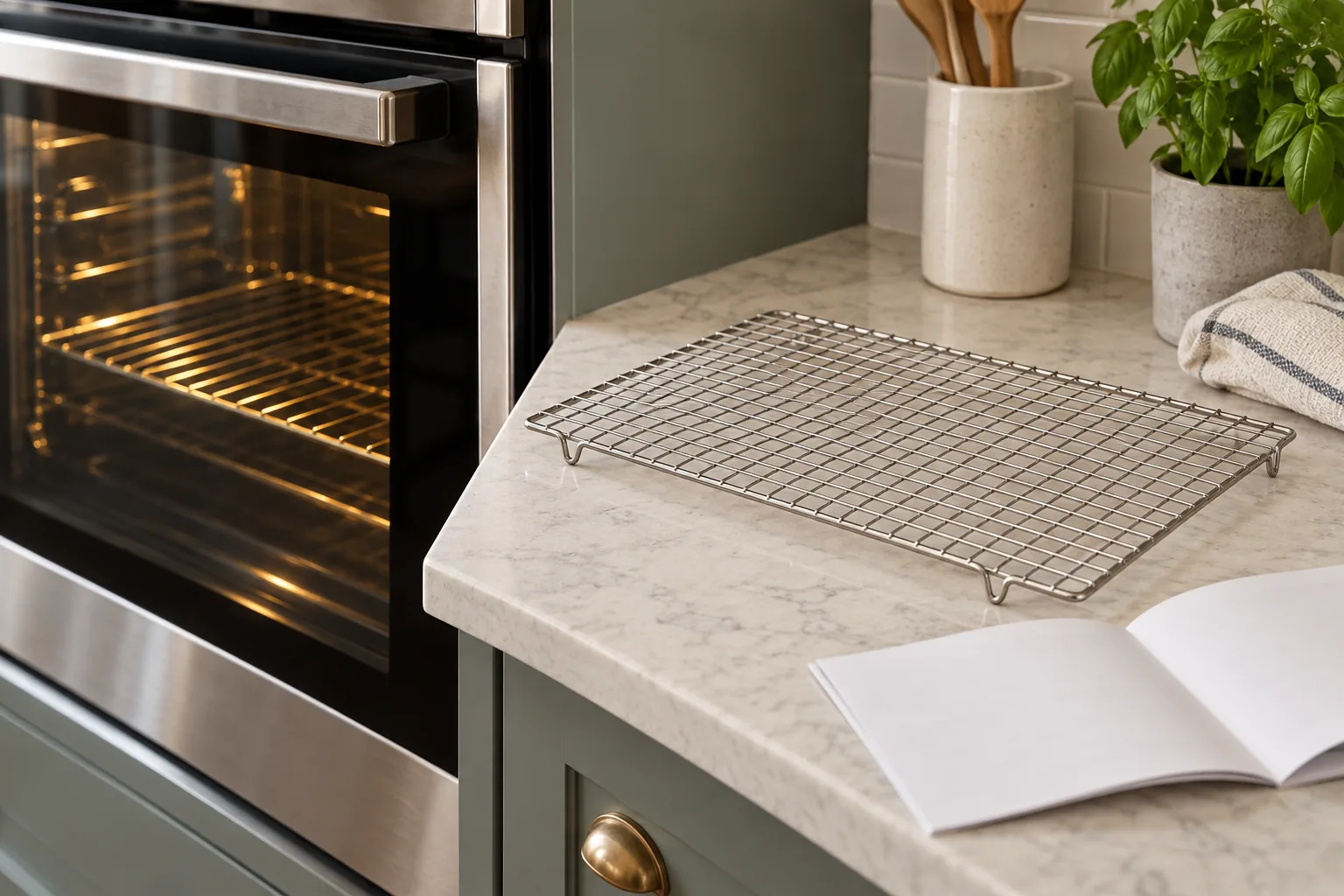
Short answer: some cooling racks are expressly designed and rated for oven use, while others are marked for cooling only. A steel or stainless-steel description, a non-stick finish, a gold or copper appearance, or a familiar wire pattern does not settle the question. The buyer needs the current instructions for the exact model and finished construction, with any stated temperature, duration, broiler, food-contact and care limits.
That distinction matters when an importer is preparing a product listing, package, instruction sheet or retail claim. A component data sheet or a supplier’s general statement may describe one material without covering the assembled rack, its finish, joints, legs, coatings or intended food exposure. The approved claim must match the product version that will be manufactured and shipped.
This guide is a supplier-evidence checklist for kitchenware buyers. It does not assign a universal oven-safe temperature, recommend an at-home test, or establish that Koitor manufactures oven-rated kitchen racks. Buyers should route regulatory and product-safety questions to qualified specialists for the target market.
Why “cooling rack” is not a use specification
The product name describes a common function, not necessarily every permitted use. A rack may be intended to elevate baked goods while they cool on a counter. Another may be designed and documented for both cooling and oven use. Similar geometry can hide meaningful differences in substrate, surface treatment, joints, attachments and instructions.
Current maker examples show why buyers should avoid a category-wide answer. Nordic Ware’s Stackable Cooling Grids page identifies its model as copper-plated steel wire and explicitly says it is not safe for oven or dishwasher use. The maker’s separate Large Baking & Cooling Grid is described as a non-stick steel grid with a stated oven limit of 425°F. A third, distinct aluminum Multi-Purpose Oven & Cooling Rack is listed with a 500°F oven limit and broiler use. These are manufacturer-specific product statements, not ratings that transfer to another rack because it looks similar.
The practical buyer question is therefore not “Are cooling racks safe?” It is: Which exact finished item is approved for which defined use, under what conditions, and what controlled evidence supports the claim?
Start with the finished SKU and intended use
Before requesting a test report or approving packaging copy, write down the product identity. A useful review record should make it possible to identify the same item in the quotation, drawing, sample, bill of materials (BOM), report, label and production order.
| Identity or use field | What the buyer should record | Por qué es importante |
|---|---|---|
| SKU and revision | Item number, drawing revision, sample date and change status | A report for an earlier construction may no longer represent the order |
| Substrate | Base metal and, where relevant, grade or supplied material specification | A broad word such as “steel” is not a complete construction identity |
| Surface system | Uncoated, plated, painted, powder-coated or other stated finish; include supplier and revision where applicable | The finished surface is part of the marketed item and may affect permitted use |
| Attached parts | Feet, sleeves, clips, handles, soldered or welded joints, pads and purchased components | A temperature claim may apply to the weakest or limiting element of the assembly |
| Caso de uso | Cooling only, baking support, roasting, broiling or another specific use | These uses are not interchangeable |
| Conditions | Temperature, duration, placement, load and any stated oven type or restriction | A number without its conditions cannot guide a buyer or end user |
| Contact mode | Direct food contact, incidental contact, non-contact component or packaged separation | Compliance review depends on the actual intended exposure and applicable market |
| Care instructions | Hand wash, dishwasher restriction, utensil limitation and cleaning method | Care claims are independent of oven claims |
Do not approve a generic product family claim if the range contains different coatings, sizes, wire diameters, assembly details or materials. If several SKUs are genuinely identical except for dimensions, the responsible technical reviewer should define whether grouping is justified and document why. Similar appearance is not evidence of equivalence.
Request instructions that name the product
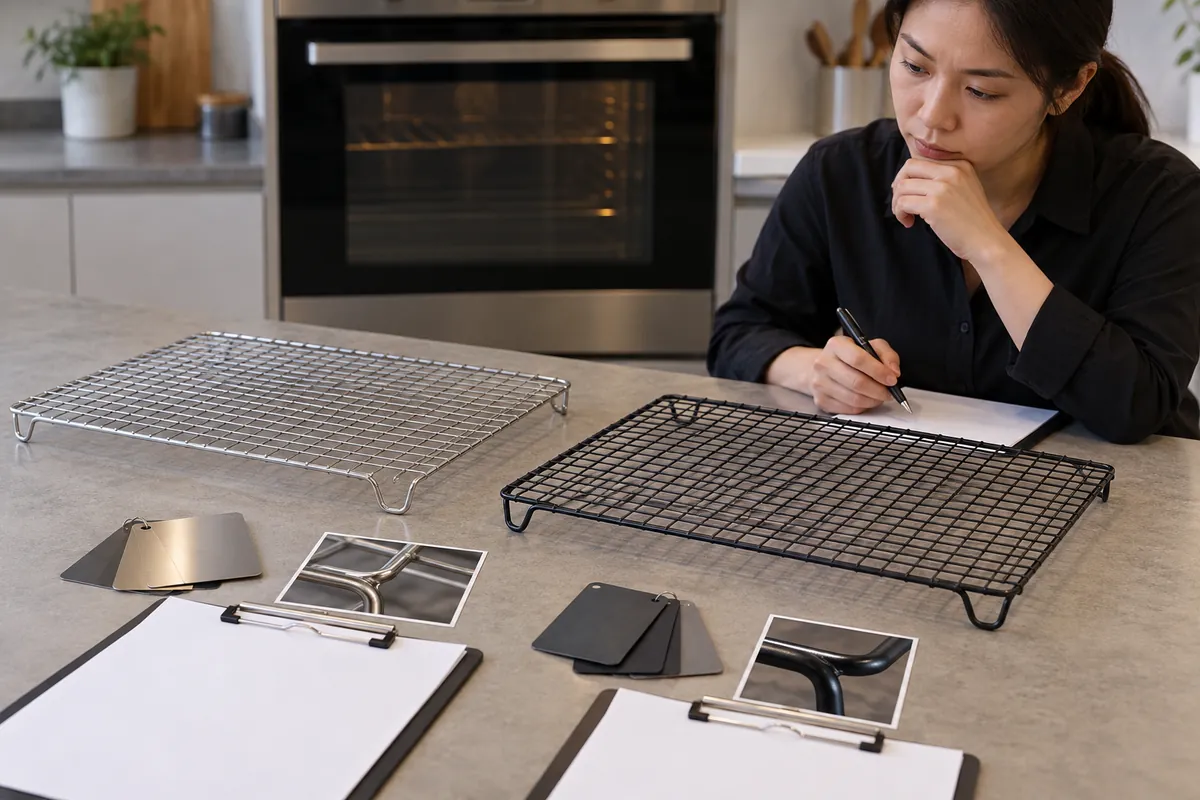
Ask the supplier or brand owner for the current use-and-care document tied to the exact model and revision. The document should answer, in plain language:
- Is the rack for cooling only, or is oven use expressly allowed?
- What maximum temperature is stated, and does the maker specify a duration or other boundary?
- Is broiler use separately allowed, prohibited or unaddressed?
- Are there exclusions for direct flame, heating elements, self-clean cycles, particular foods or other conditions?
- Is the rack intended to be used alone, or only with a named pan or configuration?
- What cleaning and utensil restrictions apply?
- Which model number, material/finish version and date or revision does the instruction cover?
An unanswered field is not permission. If a current maker document is silent about broiling, for example, the buyer should not convert an oven limit into a broiler claim. The same applies to dishwasher use, which has separate exposure conditions and care effects.
Ask for the underlying report or other technical basis when the product claim, market rules, customer policy or risk review requires it. Check the report’s subject, model identity, sample construction, conditioning, procedure, acceptance criteria and conclusions. A report naming a raw coating, metal coupon or resin does not automatically establish suitability of the finished rack. The scope must connect to the product and intended use being approved.
Separate the claim types
Several claims may appear together on product packaging, but each requires its own support. Buyers should review these separately rather than treating “oven safe” as a master approval.
Oven and broiler claims
An oven rating should identify its limit and conditions. Do not extrapolate from the metal’s melting point, a generic material property or another maker’s product page. A coating or attachment may have its own limits, and the whole assembly can have a different use boundary from an isolated component.
Broiling may involve different placement and heat exposure from ordinary baking. Unless the exact maker instruction or applicable evaluation covers broiler use, do not assume an oven rating includes it. Likewise, a maximum-temperature statement should not be rewritten as an unlimited-duration guarantee.
Direct food-contact and market review
If the rack is intended to touch food, define the contact in the product’s actual use. Identify the food categories, temperature, time, repeated-use pattern and cleaning conditions that the intended claim covers. The U.S. FDA page on food types and conditions of use provides reference categories for food-contact-substance notifications; it is not a certificate for a finished rack, a universal test protocol or a finding that a particular SKU complies.
The buyer should request evidence and have it assessed against the destination market and the finished construction. Do not accept a vague “FDA approved” statement as a substitute for identifying the applicable regulatory basis, tested or reviewed construction, supplier, report scope and limitations. The same caution applies to broad “food grade” language without an exact material and intended-use basis.
For a product that is sold only as a cooling rack but will predictably contact baked goods, the product team still needs a clear intended-use position. A marketing decision to add baking, roasting or broiling can change the evidence needed and the risk allocation. Escalate questions about legal scope or test interpretation to the competent regulatory specialist.
Pan fit, care and other instructions
A rack that fits a sheet pan is not necessarily approved for every oven condition. Verify dimensions, support points, overhang, stability and the instructions for both products. A rack maker’s statement does not automatically approve a separate pan, nor does a pan’s rating automatically cover a rack.
Dishwasher use, abrasive cleaning, metal utensils and storage conditions are separate instructions. Nordic Ware’s examples demonstrate this distinction: the Stackable Cooling Grids page excludes both oven and dishwasher use, while its Large Baking & Cooling Grid gives an oven limit and separately says it is not dishwasher safe. Buyers should preserve those differences in their own product documents.
Use an evidence matrix before approving retail copy
A release matrix helps purchasing, product, quality, compliance and marketing teams work from one version of the truth.
| Claim or decision | Minimum record to review | Reviewer / owner | Release question |
|---|---|---|---|
| Model is oven-safe | Current SKU-linked instruction; temperature and conditions; construction identity | Product and technical reviewer | Does the statement cover the exact finished model and intended use? |
| Broiler use | Explicit model-specific instruction or relevant assessment | Product safety / technical reviewer | Is broiler use affirmatively supported rather than inferred? |
| Direct food contact | Intended-use description and market-specific evidence tied to material/finish and assembly | Regulatory specialist | Does the evidence cover the actual foods, conditions and contact surfaces? |
| Dishwasher care | Current use-and-care instruction for the model | Product team | Is the dishwasher statement distinct from oven suitability? |
| Pan compatibility | Dimensions and configuration of rack and named pan | Product engineering | Is the pairing identified and stable under the specified use? |
| Package and listing language | Approved wording linked to evidence revision | Compliance and marketing | Do title, icons, bullets and instructions avoid broader claims? |
| Production control | Approved BOM, drawing, finish, supplier and change process | Sourcing and quality | Can the shipped version be matched to the reviewed version? |
Store the evidence alongside the approved drawing, BOM and controlled label artwork. Record who reviewed it, which markets were considered, the approval date and any unresolved limitations. This does not replace a formal compliance system; it makes the buyer’s claim decision traceable.
Tie the evidence to the sample and production BOM
A sample review is useful only when the sample’s identity is controlled. Mark the model and revision, list its material and finish, and note any bought-in parts or substitutions. If testing is performed, the tested sample should be traceable to that description. The purchase order should then require the same approved construction or a documented change review.
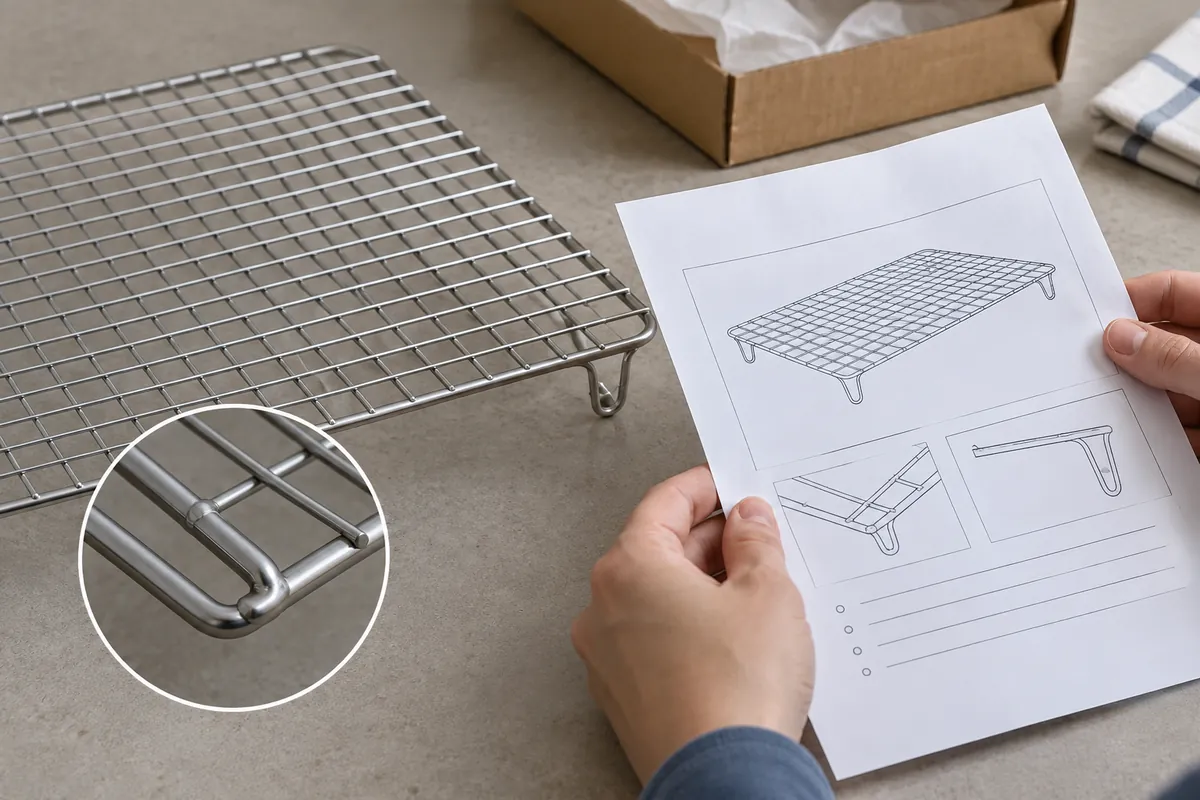
For a metal rack, relevant drawing details may include wire or sheet configuration, dimensions, bends, weld or joint positions, edge finish, support legs and the location of any coating or attachment. These details help a supplier understand what must be reproduced. They do not, by themselves, prove oven suitability, food-contact compliance or durability.
Separate three types of evidence:
- Identity evidence: drawing, BOM, revision, supplier and sample records show what item is under review.
- Claim evidence: instructions, applicable reports and qualified assessments support the specific use statements.
- Production evidence: inspection or change-control records show whether the shipped items remain aligned with the approved identity.
One cannot substitute for the others. A well-made sample does not prove a test claim. A technically relevant report does not prove later batches use the same finish. A final visual check may catch obvious differences but does not verify a chemical or temperature-performance claim.
Build change triggers into supplier control and material review
Re-review is needed when a change could affect identity, use or evidence scope. The change list should be agreed before production rather than improvised after a substitution.
Potential triggers include:
- A different base metal, grade, wire size or sheet thickness
- A new coating, plating, paint, pretreatment or finish supplier
- A change in coating formulation, application method or curing instructions
- A different joint, attachment, foot, cap, handle or bought-in component
- A change to geometry that affects support, stability or pan fit
- A new factory or production line
- Revised use instructions, temperature claims or food-contact statements
- A change in target market or the foods and conditions described in the claim
Not every drawing change automatically invalidates every piece of evidence. The competent reviewer should decide which evidence remains applicable and document the rationale. Buyers should avoid assuming that a supplier’s “equivalent material” declaration is enough when the change affects the finished system or the regulated claim.
Practical RFQ and sample-approval checklist
Before an RFQ is finalized, specify the intended claim and ask the supplier to identify gaps instead of guessing. At sample approval, check that the physical item corresponds to the described revision and that the controlled documents use the same product identity.
- [ ] State whether the SKU is cooling-only or proposed for a specific oven use.
- [ ] Identify the target market and the proposed consumer-facing language.
- [ ] Define direct food-contact surfaces and representative use conditions.
- [ ] Obtain the current model-specific use-and-care instruction.
- [ ] Record temperature, duration, broiler status and exclusions separately.
- [ ] Identify the base material, finish, attachments and purchased parts.
- [ ] Review reports for sample identity, scope, method, limits and conclusion.
- [ ] Keep oven, broiler, dishwasher and food-contact decisions in separate fields.
- [ ] Match the sample, drawing, BOM, report and package-art revision.
- [ ] Set change triggers and designate who must approve a substitution.
- [ ] Preserve the evidence and approval record with the order documentation.
A checklist should prompt a decision, not automatically pass a product. If the evidence is incomplete, label the claim as unresolved and route the question to the appropriate technical or regulatory owner.
Why material names and one-off trials are not enough
“Stainless steel,” “aluminum” and “coated steel” describe broad material families. They do not specify the exact finished construction or the conditions the manufacturer has evaluated. Geometry, joining, finish, attached components, use duration and market claim all affect what evidence is relevant. A material property may inform a review, but it cannot replace product-specific instructions and assessment.
Likewise, a single informal heating trial is not a validated test. It may not reproduce the intended load, duration, temperature distribution, repeated use, cleaning, production variation or food-contact conditions. It also may not be documented in a way that supports a retail claim. Buyers should not ask staff or consumers to improvise tests as a substitute for competent evaluation.
The supplier’s role is to provide accurate construction identity and controlled documents for the product it supplies. The importer or brand owner remains responsible for deciding whether the proposed claims fit its product and markets, with qualified review where needed. Contractual responsibilities should be explicit; they should not be implied by a generic quotation or a supplier’s marketing phrase.
Questions importers should ask during a supplier review
Use direct questions that request evidence and scope:
- Which exact model and revision does this oven-use statement cover?
- What are the finished rack’s materials, surface treatment and attached components?
- Is the rack intended for oven use, and what temperature and other conditions are stated?
- Is broiler use explicitly addressed? If not, what wording should be withheld?
- Which surfaces may contact food, and what evidence addresses the intended market and use?
- Does the evidence cover the finished rack or only an individual raw material or coating?
- Which cleaning instructions and restrictions are model-specific?
- What change to the BOM, finish, supplier or production site requires re-review?
- How will production lots be matched to the approved drawing, sample and claim?
- Who on the buyer’s side owns final technical, regulatory and packaging approval?
A strong supplier response identifies the exact item, provides current documents and makes limitations visible. A confident verbal assurance without traceable product evidence is not enough for a controlled private-label claim.
Preguntas frecuentes
Are all cooling racks oven-safe?
No. Some makers label particular racks for cooling only; other exact models are designed for oven use with stated limits. Check the current instructions for the SKU and revision.
Does stainless steel automatically make a rack oven-safe?
No. A broad metal name does not establish the suitability of the finished assembly or its finish, joints and attached parts. Use product-specific documentation.
If a rack is oven-safe, is it automatically broiler-safe?
No. Broiler use should be expressly covered for the exact product or assessed by a qualified reviewer. Do not transfer a general oven statement to a different heating condition.
Does an oven rating also approve direct food contact?
No. Food-contact suitability and oven-use instructions are distinct questions. Identify the intended contact and market, then review evidence for the finished product and use.
Can a coating supplier’s data sheet approve the complete rack?
Not by itself. The document may cover a coating material or application under a defined scope. The reviewer must determine whether it represents the actual finished rack, its process and intended use.
Does one successful heating trial prove the retail claim?
No. An informal trial does not establish repeatable performance or compliance across the intended product, conditions and production. Use an appropriate documented assessment.
What if the maker provides no temperature limit?
Do not invent one from the base metal or another model. Keep the claim unresolved, ask for substantiated instructions or assessment, and obtain qualified review before approving copy.
The sourcing takeaway:
Treat “oven-safe” as a controlled, model-specific claim. Define the exact product, intended use, market, food-contact conditions and care instructions; request evidence that matches that finished construction; then align the sample, BOM, production controls and retail copy. Keep oven, broiler, dishwasher and food-contact decisions distinct, and reopen review when a material, finish, component or use claim changes.
Koitor can discuss metal rack structures and manufacturing feasibility from a buyer drawing or physical sample. That discussion does not establish current oven-rated rack production, food-contact certification or testing capability. Use the evidence matrix above to assign those product and regulatory decisions to the qualified parties responsible for them.
Sources
- Nordic Ware Stackable Cooling Grids: material, oven and care instructions
- Nordic Ware Large Baking & Cooling Grid: model-specific 425°F limit and care instructions
- Nordic Ware Multi-Purpose Oven & Cooling Rack: aluminum construction and model-specific 500°F/broiler instructions
- FDA food types and conditions of use reference
Trabaja con Koitor Hardware
Need Help With a Custom Metal Hardware Project?
Share a drawing, sample, finish requirement, target dimensions and packaging plan. Koitor can discuss metal rack structure and manufacturing feasibility; oven suitability, food-contact status and product claims must be supported for the exact finished item by the responsible qualified parties.
OEM / MARCA BLANCA
Convierte esta guía de abastecimiento en un resumen del producto
Indícanos el producto que deseas, el tamaño, el acabado, la cantidad del pedido y los requisitos de embalaje. Tu equipo recibirá un análisis práctico de la viabilidad de fabricación antes de recibir el presupuesto.


 English
 Español
 Português
 Français
 Deutsch
 العربية