
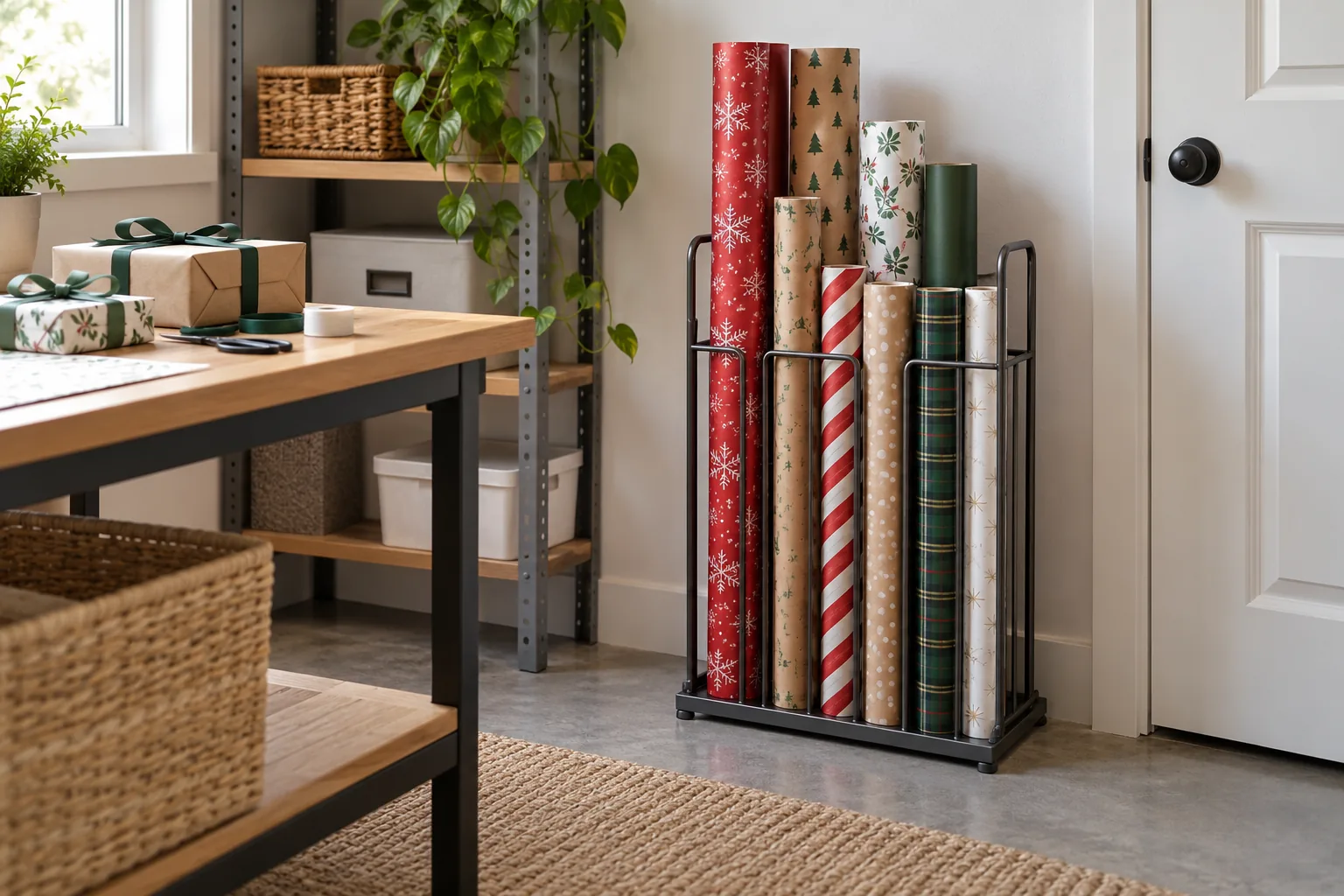
A gift-wrap roll storage rack should be specified as a complete system around the rolls a buyer expects customers to store. The importer needs to define the roll width and diameter range, decide how the bottom supports the roll, determine how an upper retainer limits movement, and confirm how the mounting rail or door interface connects the parts. A retainer by itself is not a complete storage solution. The final sample should be loaded with representative rolls and checked for fit, access, installation and packaging.
Why Is the Roll Retainer Only Part of the System?
A long wrapping-paper roll needs support along its length and a way to remain in the intended storage position. Many products use a lower basket or cradle and a separate upper retaining component. The distance between them affects what roll lengths can be accommodated. The attachment rail or mounting surface also connects the entire arrangement to a wall or door.
Elfa’s published gift-wrap center instructions, for example, describe its own model-specific relationship between a retainer, lower basket and stored roll height. The Container Store assembly guide also lists separate components within its installation kit. These examples show why buyers should treat the interface as a system question. They do not establish universal dimensions or prove cross-brand compatibility.
The buyer should distinguish this storage-only rack from a paper dispenser or cutter. Commercial dispensing products may have loading shafts, cutting blades or other mechanisms. Those functions are outside this topic and should not be implied for a household storage organizer. If a project needs dispensing or cutting, it requires a separate product brief, safety review and evidence set.
What Roll Assortment Should the Buyer Measure?
Build a representative assortment from the products that will be stored or sold alongside the organizer. Measure each roll’s overall length, outer diameter and width, including any loose paper ends or packaging. Record whether sleeves, bands or decorative wrap alter the dimensions. Include the largest and smallest formats expected by the sales plan.
Do not rely on a nominal “standard roll” label when the assortment contains different sizes. A longer roll may require greater separation between support points. A larger diameter may need a wider basket or retainer opening. The intended orientation also matters: vertical storage can use a compact footprint but may require a different method to keep the roll upright; horizontal storage calls for support along its length.
| Buyer field | Evidence to record | Fit question |
|---|---|---|
| Roll length | Actual sample dimensions | Is the support-to-retainer spacing suitable? |
| Outer diameter | Measured at the widest point | Does the basket or cradle receive it? |
| Roll count | Planned assortment and target load | Can users retrieve one roll without disturbing others? |
| Paper end condition | Loose, tucked, banded or wrapped | Could the exposed edge catch on a wire or divider? |
| Orientation | Vertical, horizontal or mixed | Does the system retain the roll as intended? |
| Storage location | Door, wall, closet or utility area | Is the mounting interface appropriate? |
| Additional items | Scissors or accessories if included | Are these part of the product scope or separate? |
Use the actual rolls in a sample test. A rendering or dimensional drawing can reveal nominal space but cannot show how loose paper edges, unevenly wound rolls or mixed diameters behave during retrieval. Record the sample mix so that capacity claims remain tied to a stated method.

How Should Lower Support and Upper Retention Be Reviewed?
The lower basket or cradle should support the roll without blocking the user’s intended removal path. Check how the roll rests, whether the bottom edge can be reached, and whether a user can lift one roll without dragging adjacent rolls. If a basket has dividers, test the intended range of widths rather than just one sample.
The upper retainer needs a separate fit check. Determine whether it restrains rolls of different diameters, whether the ends can be loaded and removed, and whether the retainer position can be adjusted. If adjustment uses slots or a rail, confirm which settings are part of the design and whether the selected basket or retainer is specified as compatible. A similar-looking part from another system is not proof of interoperability.
Observe contact between the organizer and the paper roll. Wire ends, joints, burrs or finish irregularities may catch or mark the paper. A buyer should inspect relevant contact areas on a finished sample. That inspection is not evidence of archival or damage-free storage; such a claim would require separate substantiation.
What Mounting Interface Must Be Confirmed?
The mounting system may use a wall rail, a door-mounted track or another interface. The product drawing should identify included parts, connection points, orientation and installation sequence. Buyers should ask which items are included in the kit and which are sold separately. If a retaining part requires a specific rail, that dependency should be stated in the product schedule and packaging.
A door or wall installation brings different project questions. Buyers need to verify the actual door or wall construction, available space, clearances and fixing method with the responsible installer. This article does not specify anchors, permissible load or installation safety. The supplier can provide product dimensions and installation instructions for the exact design; site-specific mounting suitability must be assessed by the project professional.
Check the open and closed door movement if the product is intended for a door. A rack may fit on the door face but interfere with a handle, hinge, casing or adjacent cabinet when the door moves. A physical mock-up can reveal this interference. For a wall location, review adjacent shelves, stored items and user access.
How Should Buyers Define Capacity and Accessibility?
Capacity is not just a count of rolls. If the rack is tightly loaded, individual rolls may be hard to retrieve. A practical product should be reviewed for the buyer’s intended count and selection behavior. Document what sizes were included, how they were arranged and whether some spaces are reserved for larger rolls.
Check the user’s hand path. Can a roll be removed and returned without uninstalling the retainer? Is there enough space above or beside the organizer to lift a long roll out? Does the lower basket have an opening that remains accessible in the intended location? A small display photo can hide these practical limitations, so test the actual product in a representative room or mock-up.
If the organizer is sold as a kit with accessories, define those separately. Do not imply that scissors, blades, dispensers or other tools are included unless the bill of materials confirms them. A storage-only rack should be represented as storage-only in the product listing and images.
What Should Be Checked in Packaging and Assembly?
For a multi-part kit, buyers should verify part identification, included fasteners, instructions and assembly order. Make sure the package list matches the product page and purchase order. Test assembly using the supplied hardware and the current instruction sheet. Note whether the basket, retainer and rail are separate SKUs or bundled components.
The pack should protect surfaces and keep small parts identifiable. Review whether components can rub together during transit, whether long rails are protected against bending, and whether the carton contents remain organized after movement. Packaging validation is distinct from in-use retention testing; one does not prove the other.
An installation guide should identify the selected mounting interface and the order for attaching components. If the product offers multiple positions, show how the buyer chooses the position based on roll length or location. Avoid using instructions copied from a different rack system. Confirm that diagrams match the exact revision.

Importer Sample Approval Checklist
- Identify the product as storage-only or separately scope dispensing features.
- Measure the buyer’s real roll assortment by length and outside diameter.
- Define the intended orientation, target count and retrieval motion.
- Approve the lower support and upper retainer as a matched system.
- Confirm component compatibility using the model-specific drawing.
- Load a physical sample with representative rolls, including extremes.
- Check access, interference, roll movement and contact points.
- Confirm wall or door installation details with the responsible professional.
- Record every included component, fastener and instruction.
- Review the packaged kit for part identification and transit protection.
- Tie claims and capacity language to the demonstrated sample arrangement.
Include the kit identity on both the purchase order and sample label. If a buyer approves the retainer and basket together, note whether one part can be reordered alone and which revision it belongs to. This control helps avoid receiving a matching-looking component that uses a different rail or connection. It also gives merchandising teams a dependable basis for explaining which parts are included in the retail pack.
Plan the Retail Assortment and Replacement Path
An organizer may be sold as a standalone product or as part of a broader home-storage system. In either case, the buyer should decide whether the customer is expected to store one paper type or a mixed collection that includes tissue rolls, ribbons or gift bags. Do not add adjacent items to the capacity promise unless the compartments and retrieval route were evaluated for them. A roll rack that is designed for long paper rolls may not have an appropriate support for small loose accessories.
If the assortment includes different roll lengths, document whether the upper retainer can be repositioned and how the user identifies a suitable position. A modular rail may offer adjustability, but the buyer must confirm which components are compatible and supplied. A buyer who sees a similar rail in a retail catalog should not assume the parts interconnect; profile, slot and hook details can be proprietary. Ask for a drawing and supplier confirmation for the exact parts.
Replacement planning matters for long-term retail programs. The buyer should preserve model numbers for the basket, retainer and rail and clarify whether they can be ordered separately. If the kit is sold in separate cartons, the product page and pack list should explain the complete set needed for the intended configuration. A replenishment order should carry the same component revision or trigger review if one part has changed.
Recheck the Pack After a Design Revision
If the supplier changes the basket depth, retainer opening, rail or hardware, compare the revised set with the approved roll samples. A change can affect support spacing or the storage path even when the overall silhouette appears unchanged. Preserve the prior drawing and sample identity, then record what was compared before applying the former compatibility or capacity statement to a new version. This creates a clear handoff between sourcing, quality and product-data teams.
Before approving artwork, reconcile the product diagram with the actual packed parts. If a buyer must purchase the rail separately, show that relationship clearly in the kit description. Keep the bill of materials, installation steps and retail images aligned so customers do not mistake a single retainer for a full organizer. For a revised kit, have the product owner compare the new pack list with the retained sample and note which components changed.
Record the approved gift-wrap roll storage rack scope with the sample identity and current drawing revision so later product changes trigger the right review.
Preguntas frecuentes
Can an upper roll retainer be sold as the complete organizer?
Not if the intended system also requires a lower basket or another support. The product listing and bill of materials should make included and required parts clear.
Are gift-wrap rack parts interchangeable across brands?
Do not assume so. Rail profiles, slots, hooks, dimensions and connection details are model-specific. Obtain written compatibility confirmation for the exact parts.
Does a published roll count apply to every paper assortment?
No. Count depends on dimensions and loading method. Check with representative rolls and report the assumptions.
Is a gift-wrap storage rack a paper cutter?
Not necessarily. Storage and dispensing/cutting are different product functions. Do not represent a storage organizer as a cutter unless the design and evidence support it.
Can wall and door installation use the same fasteners?
Not as a general rule. Substrate and assembly differ. Follow exact instructions and have the site-specific mounting method confirmed.
What Can Koitor Discuss?
Koitor’s confirmed capabilities include custom metal hardware discussions, sample development, metal forming, finishing, assembly and packaging. The company’s current manufacture of gift-wrap racks, specific modular-system compatibility, rated storage capacity or a certified installation method is not confirmed. A buyer can explore the home storage OEM context y custom metal storage rack page, then send the product drawing, roll samples, mounting requirements and target quantity through the contact page. The actual kit design and fit must be assessed for each project.
When comparing supplier proposals for gift-wrap roll storage rack, use the same reference samples and acceptance notes to keep the purchasing decision traceable.
Developing a Roll-Storage Kit?
Share the roll size range, lower-support concept, retainer drawing, mounting location and planned assortment for a product-fit discussion.
OEM / MARCA BLANCA
Convierte esta guía de abastecimiento en un resumen del producto
Indícanos el producto que deseas, el tamaño, el acabado, la cantidad del pedido y los requisitos de embalaje. Tu equipo recibirá un análisis práctico de la viabilidad de fabricación antes de recibir el presupuesto.



 English
 Español
 Português
 Français
 Deutsch
 العربية