
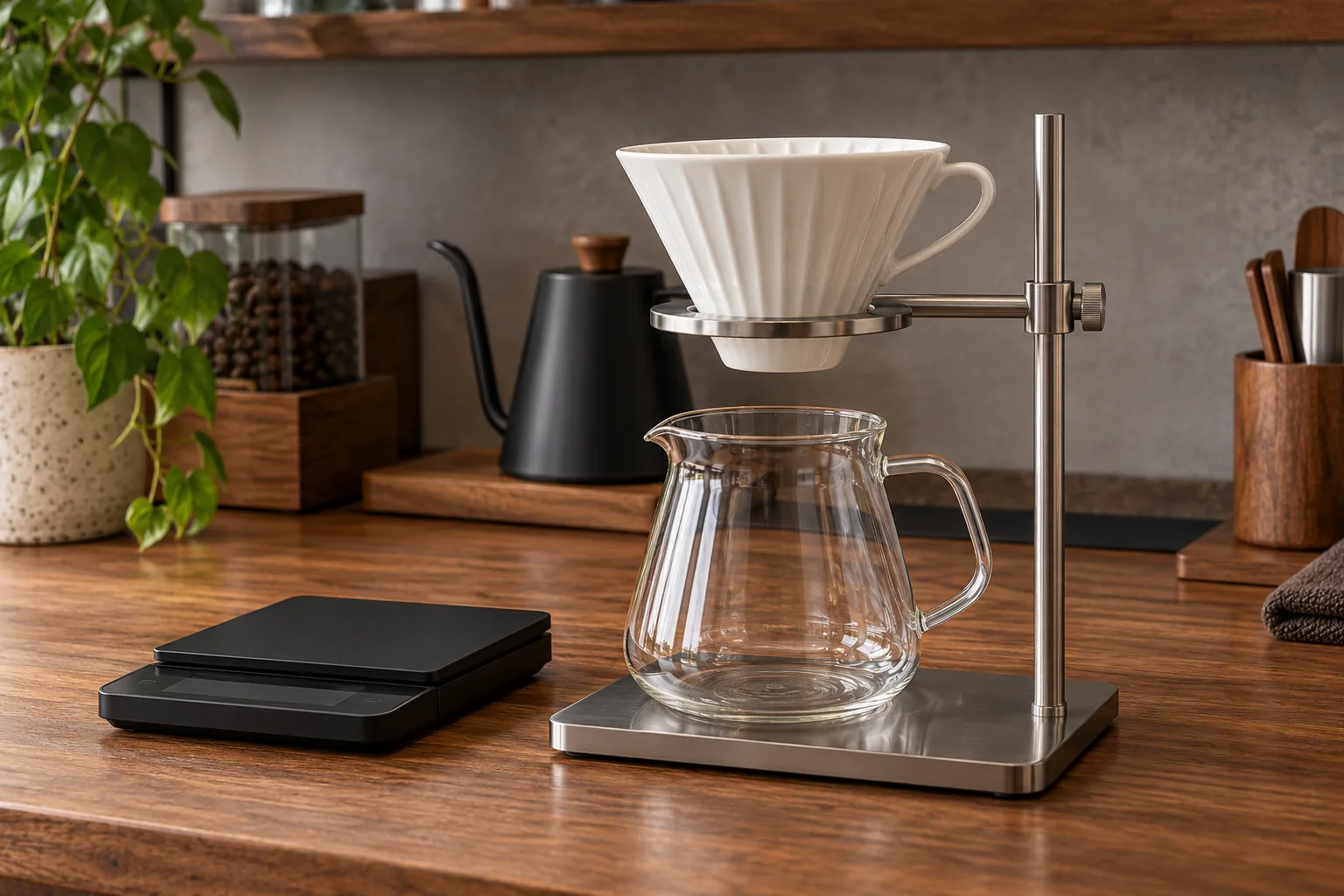
For procurement, the metal pour over coffee stand specification starts with the exact reference parts and intended arrangement. A metal pour-over coffee stand specification should define the dripper, receiving server and any scale that will be used with the support. Checking only the stand’s top opening can miss a server handle that collides with a base, an outlet that does not align with the vessel opening, or a scale that occupies more vertical space than the assembly provides. Approve the complete intended set with identified models and revisions.
This is a sourcing guide for importers and housewares product teams. It does not provide brewing advice or claim improved coffee quality, universal compatibility, temperature rating, load capacity or food-contact status. The buyer’s task is to define actual component interfaces and confirm them against a production-intent sample.
Why does the complete assembly matter?
A pour-over station can include several independently sourced parts: stand, dripper, paper filter, server and optional scale. Each part has its own outside shape and use envelope. A stand that appears to support one dripper may not seat another. A server that fits below the frame when empty may be difficult to position or remove when its handle is turned toward a crossbar. If a scale is part of the intended product experience, its height, footprint and control access need to be included.
Hario’s Walnut Series drip stand product page identifies a stainless support with a wood base and names specific dripper/server families. Its V60 Drip Station page provides a different, model-specific list and exclusions for some servers and scales. Those are evidence that manufacturers define pairings and compatibility boundaries for named products. They do not prove that a generic metal stand fits all products with the same broad category name, nor do they establish a brewing benefit for another design.
The buyer should therefore create an assembly list before asking for a quote. Record each reference item’s brand, model, revision, dimensions or drawing, and whether it is included in the sale. If a product is intended to be stand-only, state that clearly and use the other components as fit references.
How should the dripper-to-support interface be reviewed?
Start with the dripper base and the stand opening or support surface. Identify the actual bearing points and how the dripper is placed and removed. A ring, frame, or cutout should correspond to the intended base geometry without relying on a promotional photo. If the dripper has a flange or shoulder, show whether it rests on top of the support or passes through an opening. The drawing should mark the opening dimensions, support thickness and surface finish, but the acceptance values should come from the actual design and sample rather than invented universal clearances.
Check the dripper’s lower outlet in relation to the receiving vessel. The goal is to verify the specified arrangement, not promise ideal flow or brewing results. If the stand has height adjustment or detachable parts, record each position and hardware configuration. Confirm that assembly and adjustment do not change the intended contact or cause a component to be omitted from a kit.
A buyer worksheet might include:
| Component | Interface to identify | Evidence for approval |
|---|---|---|
| Dripper | Base profile, shoulder and outlet location | Model, revision, drawing or sample |
| Stand | Opening, bearing edge, support depth and height | Controlled drawing and placement check |
| Server | Body, handle, rim and removal path | Exact vessel and orientation |
| Scale | Footprint, height and display/control access | Exact model and stack review |
| Filter | Shape and placement where relevant | Reference paper or specified consumable |
| Base | Feet, wood or protective contact parts | Included parts and revision |
| Kit | Stand-only or multi-component set | BOM, product photos and carton list |
| Embalaje | Separation, protection and assembly parts | Approved pack configuration |
This record keeps the article’s compatibility claim within its evidence. It does not imply that any named source product is suitable for an unlisted combination.
How should the server and scale envelope be checked?
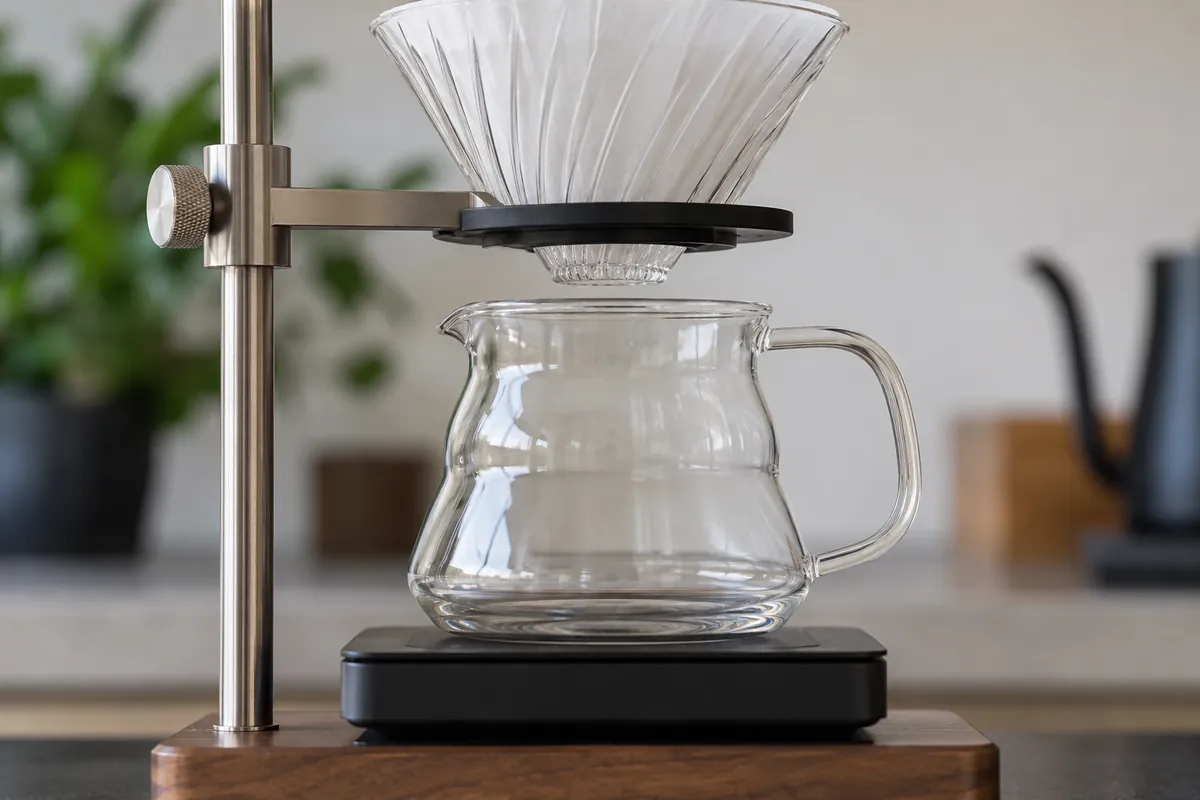
Place the intended server below the dripper in the exact direction shown in the product instructions. Check whether its rim reaches the expected position and whether the handle can be grasped and rotated without colliding with a support leg or base. Then remove and replace it while the stand is assembled. An empty outline on a CAD drawing can identify possible interference, but a sample reveals how the parts are actually handled.
If a scale is used, decide whether it sits under the server, between the base and vessel, or in another arrangement. Its overall height can alter the position of the server and the clearance to the dripper outlet. Check the display and buttons from the intended user position. Do not treat a stand as scale-compatible simply because the scale’s footprint fits on the base; vertical stacking, controls and vessel placement also matter.
The sample inspection should include the complete set in both static position and normal placement/removal sequence. Document observations such as touching, rocking, obstructed controls or blocked removal. These are observations for the named components and test arrangement. Avoid converting them to a universal performance statement or an unsupported stability claim. Any necessary force, load or cycle evaluation requires a separately agreed protocol and responsible technical review.
What should the RFQ tell the supplier?
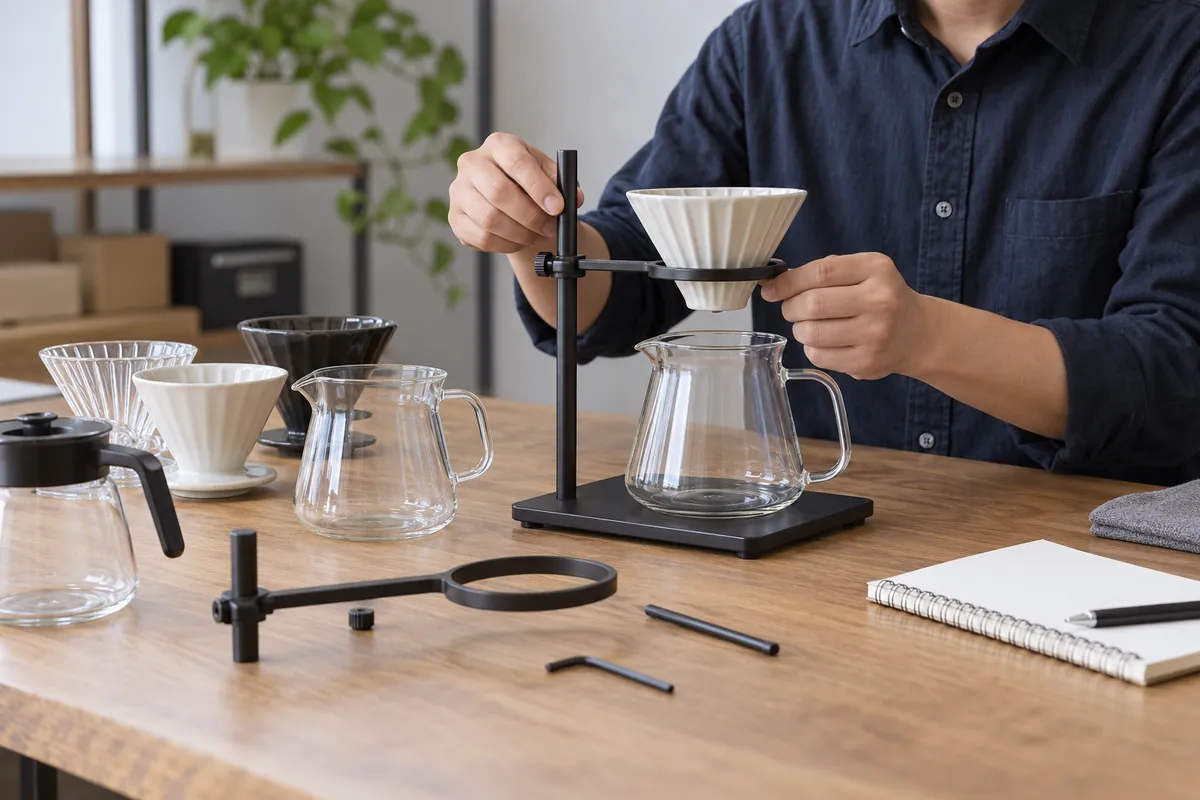
Send the stand supplier drawings or samples of the dripper, server and optional scale. Include target finish, intended arrangement, product dimensions, contact points, packaging scope and whether the stand ships assembled. Ask for a drawing that shows support opening, vertical gap, base footprint, joins, fasteners and any purchased parts. Identify which components are supplied by the buyer and which are quoted by the stand supplier.
If the design includes a wood base, pad, magnet or purchased insert, assign a source and revision. The exact reference materials in a third-party product listing do not establish Koitor’s current production scope or prove that those components are included in any proposed product. A buyer should request a written BOM rather than infer supply from an image.
A useful RFQ sequence is:
- Freeze the exact dripper, server and scale models.
- Record the intended stack and orientation.
- Provide supplier drawings or controlled sample references.
- Define the support contact and outlet alignment to be reviewed.
- Specify server handle direction and extraction path.
- Include optional scale access and display visibility.
- Confirm kit contents, purchased component sources and exclusions.
- Approve a complete sample against the documented configuration.
- Record drawing revisions and approved exceptions.
If the buyer plans several combinations, identify which are essential and which are optional. A support might be qualified for one dripper-server pairing and not another. The published SKU matrix should make that distinction clear.
How should sourcing teams separate fit from use claims?
A fit review answers whether the specified pieces physically seat, align and can be placed or removed in the agreed arrangement. It does not establish temperature suitability, a load rating, food-contact compliance, brewing quality, or safety. Those require evidence appropriate to the specific materials, design and destination market. The supplier pages used here are product-level examples, not transferable test certificates.
Likewise, the term “stainless” alone does not establish the alloy grade, finish specification or resistance in a given environment. If the buyer has material or finish requirements, list them separately and verify them in the quote and approval record. If a wood base is present, identify its finish and care requirements with the responsible supplier. Do not derive a long-term durability claim from a short sample session.
For broader context on metal storage components, buyers can review Koitor’s Accesorios de almacenamiento doméstico OEM y Fabricación de estanterías metálicas a medida pages. These do not confirm a current coffee stand catalog. Buyers can share drawings and reference samples through the contact page for a bounded metal-component feasibility discussion.
Which dimensional information should stay controlled?
Keep reference dimensions tied to source drawings and revision dates. Record the dripper base and support opening, the server height and handle direction, and the overall stack height with the selected scale. If a supplier gives nominal dimensions but no tolerance or revision, do not invent a tolerance band. Ask for the current technical file and identify any fields that remain unconfirmed. The sample establishes the reviewed combination at that time; it does not establish every unit or variant.
When the support uses a wood or acrylic base, verify the supplier and exact component specification rather than assuming another material is equivalent. A material substitution can affect footprint, joining details, contact and product appearance. No Koitor capability for these purchased components should be implied without an approved company fact.
How can buyers keep the SKU matrix understandable?
If the assortment contains several stands or companion parts, list each intended combination in a simple matrix. One row can represent a stand revision; columns can identify the dripper, server, scale, base and supplied accessories. Mark each cell as approved, not reviewed, or explicitly excluded. This prevents a product page from silently extending one sample check to every component in a category.
Do not copy a branded compatibility list as if it were a universal standard. The Hario examples show that one manufacturer can name specific combinations and exclusions for its own products. An importer should use the same discipline for its own assortment while keeping the underlying reference identifiers and evidence. If a new server is introduced, review its body, handle, rim and removal path; if a scale changes, check stack height and control access again.
Check the online product imagery against the matrix. A lifestyle image can suggest that a server or scale is included even when the carton contains only the stand. Captions and SKU descriptions should state what is included and what is shown only for fit demonstration. A consumer-facing buyer should not have to infer a bundle from an illustrative assembly.
How should the buyer document unresolved combinations?
Not every proposed component will be available at the first review. List any missing dripper, server or scale and mark its fit as pending. Do not release a broad compatibility statement based on the components that happened to be available. A drawing review can close some dimensional questions, but placement, removal and control-access questions should remain open until the reference part is checked. Keep the reason and evidence beside each outcome: approved for a named model and revision, excluded by design, or not evaluated. If the stand opening or base height changes, revisit the affected pairings. This prevents an incomplete sample from becoming an overbroad sales claim.
What belongs in the final sample file?
Retain the component list, supplier identifiers, drawings, stand revision, photos of the assembled set, placement and removal observations, finish references, kit contents and packaging approval. Note whether any item was substituted during the sample review. If the scale or server was unavailable, state that the corresponding compatibility is pending. Do not let a drawing review silently stand in for a missing component sample where the interface is critical.
During reorder, compare the approved stand, purchased component sources, material/finish details and assembly revision. A substitute dripper can change support fit; a different server can change handle clearance; a different scale can change total height. Route the change to the relevant fit check before expanding published compatibility.
What should the buyer’s listing say?
The description should identify the stand-only or bundled configuration and name any approved companion components precisely. If a server is pictured but not included, disclose that. If the stand has been reviewed with a certain dripper and scale, limit compatibility wording to those reference models. This gives distributors a clear specification without implying an undocumented universal pairing.
What is the buyer’s practical decision?
Approve the product only for the combinations actually reviewed. A good specification names the dripper, server and optional scale, records how each one contacts or clears the stand, and states what is included in the SKU. It also separates physical-fit evidence from any other functional, material or compliance claim.
That specificity helps product and sourcing teams avoid a common shortcut: treating a broad product category as a shared interface standard. A short, controlled compatibility matrix can prevent costly confusion between “stand fits a dripper” and “complete assembly works with this exact dripper, server and scale.”
Source basis: Hario Walnut Series Drip Stand y Hario V60 Drip Station. Listed pairings and exclusions are source-model-specific; no universal fit or brewing claim is transferred.
Keep the metal pour over coffee stand specification tied to the named sample, drawing revision and included components.
Keep the metal pour over coffee stand specification tied to the named sample, drawing revision and included components.
Developing a Metal Support or Organizer?
Share component drawings or samples, contact surfaces, finish expectations and kit or packaging scope for a bounded metal-component feasibility discussion.
OEM / MARCA BLANCA
Convierte esta guía de abastecimiento en un resumen del producto
Indícanos el producto que deseas, el tamaño, el acabado, la cantidad del pedido y los requisitos de embalaje. Tu equipo recibirá un análisis práctico de la viabilidad de fabricación antes de recibir el presupuesto.


 English
 Español
 Português
 Français
 Deutsch
 العربية