
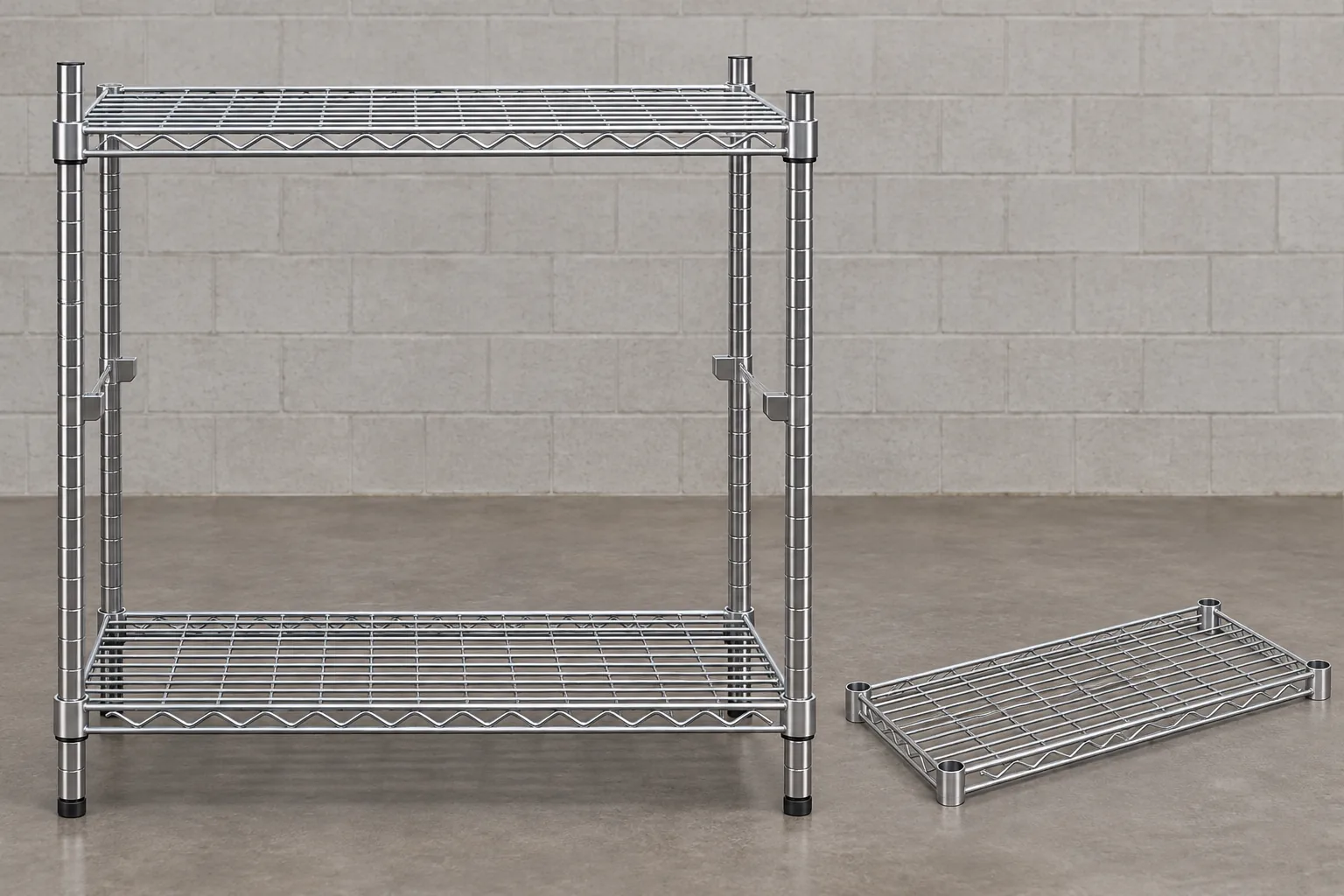
Removable wire shelving can describe a useful product operation, but “adjustable” and “removable” are not interchangeable terms. A shelf may move to another height during reconfiguration yet still depend on a particular assembly sequence. Another system may allow an intermediate shelf to be removed while other levels remain in place. For an importer or product manager, the important question is not which label sounds more flexible; it is which operation the actual product supports, under what component rules and with what buyer-approved configuration.
This guide is for commercial rack importers, distributors, private-label product managers and hospitality or display buyers reviewing shelf architecture before RFQ and sample approval. It focuses on specifying the product behavior and evidence. Manufacturer examples are limited to their named systems and do not establish a universal structure. No exact Koitor product reference for an independently removable wire shelf architecture was found; the images are conceptual, and no current Koitor capability is implied.
Removable wire shelving: define the buyer’s operation
Start by asking what the user needs to do. Is the shelf height expected to change between orders? Must one middle shelf be removed without disturbing adjacent levels? Does the buyer need access to a tall object, a shelf to be replaced, a configuration that ships in separate levels, or an assortment that supports several product sizes? These are different requirements. A supplier’s use of “adjustable” may not answer all of them.
Write the operation as an observable requirement. For example: “The buyer needs to remove the intermediate shelf at level three while leaving the top and bottom shelves installed, using the supplier’s documented procedure.” That is clearer than “fully adjustable.” It gives the supplier a specific behavior to confirm and lets a sample review test the requirement without inventing a performance claim.
Distinguish height adjustment from independent removal. Height adjustment means a shelf position can be changed within the system’s allowed configuration. The maker may require a sequence, access to posts, retainer changes or partial disassembly. Independent removal means a specified shelf can be taken out while identified neighboring or fixed components remain in place. The terms can overlap in a product but should not be treated as synonyms.
Ask what “independent” means in the maker’s instructions. Does the shelf release from supports without moving another level? Are the supports themselves removable? Must the unit be unloaded, braced, or handled by two people? Does the maker limit which shelf positions can be removed? Request the current product-specific instructions. This article does not offer assembly or load-handling steps.
Define the use setting and buyer role. A display rack, storage unit, hotel utility rack and back-of-house shelving system can have different priorities. An importer may prioritize shared posts and shelf sizes; a distributor may need replacement shelves; a project buyer may need a particular opening height. State the relevant decision rather than assuming that all users value the same flexibility.
Identify the product family and exact configuration. Record manufacturer, model, finish, shelf size, post type, support or sleeve type, included parts and any optional shelves. If the supplier presents a product family with multiple shelf architectures, request a drawing for the exact SKU. A family-level page cannot establish that every SKU provides each operation.
The purchase decision should also capture what must remain fixed. Some systems identify specific top and bottom shelves as required components while intermediate levels are optional or movable. Metro’s QwikSlot product information provides a named example: certain product descriptions specify standard top and bottom Super Erecta shelves, with optional intermediate QwikSlot shelves. That is specific to the listed system, not proof that every wire rack needs fixed end shelves.
Compare height-adjustable and independently removable architectures
A conventional adjustable system may use posts with repeated engagement points and supports that allow shelves to be placed at selected heights. The product may be reconfigured by lifting or unloading shelves and changing the support positions. Whether a shelf can be removed without disturbing other levels depends on the product design and instructions. Buyers should not infer that behavior from a photo of a shelf standing at a different height.
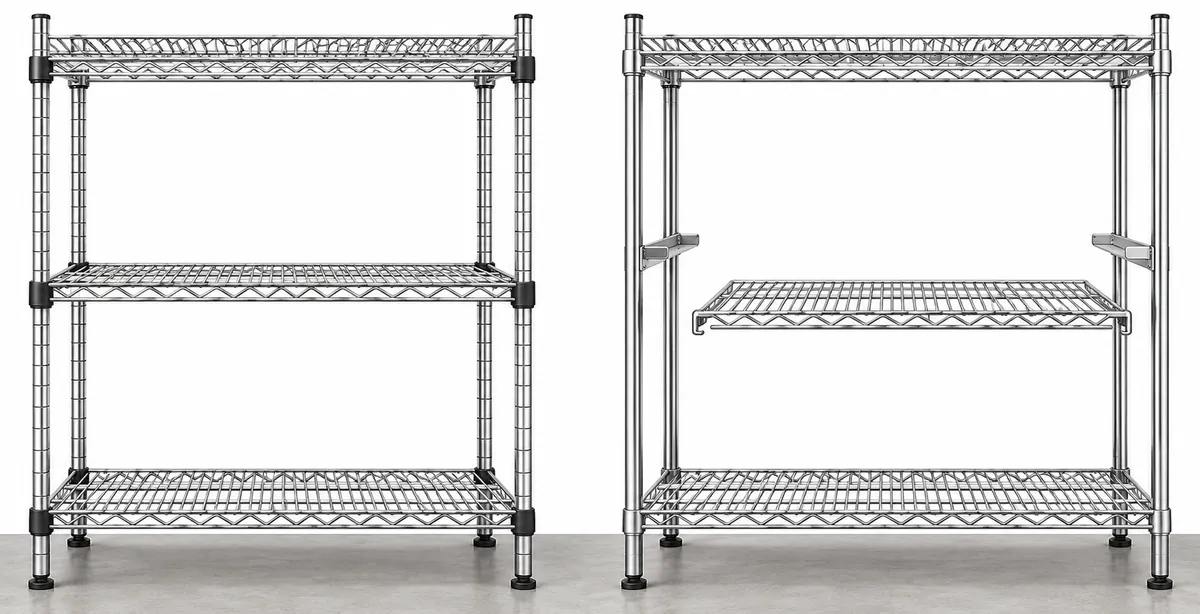
An independently removable intermediate shelf is a separate architecture claim. A maker may provide a special shelf and support arrangement that allows selected levels to be removed while other shelves remain. The specific positions, compatible shelf types and installation constraints must be verified for the offered model. CoolRack Solutions, for example, describes a system with individual-level removal without dismantling other levels and notes a dimension-based compatibility review for existing racks. Those are supplier claims for its own offering, not independently verified structural or savings conclusions.
A system can also combine fixed and removable components. The top and bottom may be specified as standard members, while middle shelves are optional. A buyer should identify which elements are required for the configuration and whether the supplier allows the unit to operate with one or more intermediate shelves absent. This question should be answered by the system maker, especially where the intended configuration differs from the published product.
Do not assume that more removable parts create more flexibility at no cost. The architecture may introduce dedicated supports, compatibility constraints, extra part numbers or handling rules. Conversely, a simpler adjustable arrangement may be sufficient if users only change shelf spacing during planned reconfiguration. Compare what the buyer needs, the number of operations, available replacement parts and documented constraints.
Think about the operational lifecycle. Is the shelf removed temporarily for cleaning, permanently to create a taller bay, or to replace a damaged level? Is it moved by a facility team or by a service technician? Does it need to return to the same position? Those answers affect documentation, spare inventory and labeling. They do not automatically establish a need for a particular architecture.
A buyer should ask a supplier to demonstrate the selected function on the actual model or provide a product-specific instruction. A video or catalog illustration can help, but it may show a different product family or omit required steps. If an import order depends on this feature, have the supplier identify the exact model and approved configuration on the drawing and commercial offer.
The comparison should be framed as “required operation versus documented architecture,” not “flexible versus rigid.” That phrasing avoids unsupported judgments. A fixed shelf can be appropriate where the layout never changes; an adjustable shelf can satisfy multiple height plans; an independently removable shelf may address an access or replacement requirement. Selection depends on the defined buyer use.
Map component roles and compatibility boundaries
Build a component map before comparing price or listing options. Identify posts, shelves, supports, clips, sleeves, collars, cross-members, fixed end levels and optional intermediate levels. For each component, record the maker’s part number, size, finish and permitted combination. The buyer should distinguish a shelf that rests on supports from a member that the manufacturer identifies as part of the required frame configuration.
The support interface can be product-specific. A system may use a shelf shape that engages a dedicated support; another may rely on a different post groove, clip or fitting. A shelf that has the same nominal width or wire spacing does not necessarily fit the support. Ask the maker for a parts list and dimensioned interface drawing. Avoid cross-brand compatibility claims unless the manufacturer explicitly documents them.
Metro’s product descriptions show why component roles matter. Its named QwikSlot shelf page identifies specific standard top and bottom shelves while describing intermediate QwikSlot shelves as optional. Another listed configuration similarly calls out member roles. This can guide a buyer to ask which shelves are mandatory, but the exact model documents govern. Do not extract a universal design principle from one supplier’s product architecture.
For an existing rack, identify whether the buyer wants to replace one shelf, add a level, change its height, remove it independently, or mix new and retained parts. Provide manufacturer and model information, post diameter or type if documented, shelf dimensions, support references, finish and current configuration. If the rack was assembled from mixed brands or sources, label that history as uncertain and ask the supplier for a compatibility review.
A dimensional compatibility review should identify the actual measurement references. “Fits a 24-inch rack” may refer to nominal shelf size, outside dimension, usable surface or a maker’s series. Record inside and outside dimensions only where the supplier’s drawing defines them. Ask whether post height, groove spacing, support geometry, corner openings or shelf perimeter affect fit.
Do not infer structural capacity from the number of shelves, wire thickness or visual similarity. If the buyer has load requirements, request current product documentation for the exact configuration and intended distribution of load. A claim for one shelf or a complete rack may not apply when shelves are missing, moved or replaced. The responsible maker should define supported configurations and the relevant test or rating basis.
Finishes and environments should also be documented separately. Record whether the proposed rack will be used indoors, in a humid location or in a specified commercial environment, and ask the supplier for the relevant finish/material information. This guide does not claim corrosion resistance or washdown suitability based on appearance. If the buyer has cleaning or exposure requirements, request evidence for the exact model and finish.
A component map is useful for importers managing multiple SKUs. It can show which shelves are universal only within a specified family, which support pieces are shared, which shelf levels are optional, and which combinations are excluded. Keep the source document and revision with the data. If the maker changes an interface or support kit, update affected listings and review open orders.
Specify the removal or adjustment procedure as a product requirement
The buyer should not write a procedure from a product photograph. Request the manufacturer’s current instructions that explain which shelf levels can move, what tools or supports are required, whether adjacent shelves must be unloaded or repositioned, and what configuration limits apply. If the supplier cannot provide an instruction, ask for written confirmation of the intended behavior and a product sample review plan.
Keep the requirement outcome-based. State what must be possible and what the buyer wants to remain in place. For example, “Remove a designated intermediate shelf while keeping identified top and bottom shelves and posts assembled, following the maker’s procedure.” Avoid specifying an unverified method such as lifting a loaded shelf, removing clips under load, or altering supports. Installation safety belongs to the manufacturer’s instructions and the qualified person performing the work.
Ask whether adjustment requires complete unloading. This can be material for a hotel, service operation or retail display, but the answer must come from product instructions. Do not assume that any system permits a height change while loaded. If the buyer needs reconfiguration during operation, state that explicitly and have the supplier confirm whether the product supports it. Otherwise, the product should be changed only according to the published procedure.
Clarify whether a removable shelf is intended to be removed frequently or only during initial assembly. The word “removable” may describe how a part is assembled without implying a daily user operation. Ask for the maker’s intended service context and any limitation on repeated removal. Do not claim cycle life or durability without test data.
Confirm which shelf levels are eligible. A design may allow only intermediate levels to be removed, while top and bottom shelves remain fixed. There may be different parts or supports for the end levels. Ask the maker to mark eligible positions on the drawing and identify how the buyer should distinguish them in a kit or inventory.
If the rack is intended to be anchored, moved or used with accessories, ask how those elements affect the configuration. This article does not specify anchoring or stability procedures. The maker should confirm any required base, brace, wall attachment or accessory for the selected arrangement. Do not assume that an independently removable shelf design preserves every original function after a member is removed.
For private-label development, place the user operation in the product brief and design review. The supplier should respond with a proposed architecture, component map, assembly/service documentation and any limitations. Prototype and production intent should be distinguished: a one-off demonstration does not establish that a bulk configuration includes the same supports or instructions. Record the approved configuration and any changes before order release.
Compare maintenance, replacement and assortment implications
Independent removal may matter when buyers need to access a tall object, replace one damaged shelf or maintain an assortment without disassembling the entire rack. These are potential use cases to evaluate, not guaranteed benefits. The buyer should identify the actual task and ask whether the maker’s supported procedure achieves it. If the feature is not needed, it may not justify a different architecture.
Replacement availability is a separate procurement question. Ask whether shelves, posts and supports are sold individually, in sets or only as part of a complete unit. Confirm part numbers, finish, size and lead time. A removable shelf is easier to replace only if the buyer can identify and source the correct replacement. Do not infer serviceability from the fact that a shelf can be detached.
For a distributor, assortment planning should distinguish rack sets from shelf-level components. A set may include required end shelves and optional intermediate shelves; replacement stock may use separate codes. Record which pieces are included in the carton and what the buyer must order for a complete configuration. If the product family uses dedicated supports, include them in the replacement-parts list.
Packaging and fulfillment can also differ. Ask the supplier for carton dimensions, pack quantity, protection and component labeling. A rack kit with multiple shelf positions may be packed differently from a single replacement shelf. Any claim about freight savings or damage reduction should be based on quoted pack data or observed results. Do not estimate from a product photograph.
SKU complexity can be measured in the buyer’s own catalog. Count the combinations of shelf size, finish, post height, support type and number of levels. Compare how many products a distributor must stock to meet the requested configurations. A modular platform could share components, but that should be established from the supplier’s parts list, not assumed from a common brand name.
For a hospitality or project purchase, create a schedule that identifies each rack location, intended shelf count, height plan, removable level requirement, accessories and operating owner. If the same model is used in several spaces, note whether each installation has the same component arrangement. A clear schedule helps prevent one unit from receiving a different shelf architecture by mistake.
If the buyer expects future expansion, ask which additional shelves or supports remain available and how long the maker supports the system. Do not promise future availability unless the supplier confirms it. A product may be revised or discontinued. The buyer can request notice of part changes and keep a cross-reference for approved successors, but each successor still needs fit review.
Build a sample and RFQ checklist
A useful RFQ makes the required operation testable and ties the quote to the exact product. Include the intended environment, rack dimensions, shelf count, required positions, which levels must remain, which shelf must be independently removable, the expected adjustment scenario and any existing product references. Ask the supplier to return a drawing, component map, current instructions and written compatibility limits.
| Buyer input | Supplier evidence to request | Approval question |
|---|---|---|
| Product family and model | Current product page, drawing and part numbers | Does the evidence match the exact SKU? |
| Rack configuration | Required posts, top/bottom members and intermediate levels | Which components must remain installed? |
| Required operation | Adjustment or independent removal described in plain terms | Does the maker document this operation? |
| Shelf positions | Drawing marking eligible levels | Are some levels fixed or restricted? |
| Support interface | Support/clip/sleeve part numbers and dimensions | Are all parts included and compatible? |
| Existing rack | Maker, series, measurements and photos | Does the supplier confirm compatibility or only estimate it? |
| Use conditions | Location, cleaning and any buyer-stated load requirements | What product evidence applies to these conditions? |
| Replacement scope | Individual shelf, kit or complete rack | Which items are included, sold separately or unavailable? |
Review the sample against the approved requirement. Identify the product and component codes first. Confirm that the sample’s shelf levels and supports match the drawing. Have the supplier demonstrate the operation under its published instructions, and record what other parts must remain. Do not improvise a demonstration or test beyond the maker’s method.
The sample approval record should include reviewer, date, source documents, observed configuration, unresolved items and disposition. A label such as “approved” should name what was approved: finish, dimensions, architecture, operation or complete SKU. If only the appearance was approved, state that fit and operation remain open.
For quality control, define visible incoming checks and documents separately. Visual checks can verify quantity, obvious damage, finish appearance and presence of parts; they do not prove load rating, hidden material or operation under all configurations. If functional verification is required, ask the maker for a documented method and let the buyer’s quality team define acceptance.
Set hold conditions in advance: unclear product identity; missing model drawing; no confirmation of the required removal operation; unknown component compatibility; ambiguity about fixed members; or an unsupported load, stability or safety claim. Name who resolves each issue. This prevents a catalog label from becoming the sole basis for procurement.
Preguntas frecuentes
Does adjustable wire shelving mean each shelf can be removed independently?
Not necessarily. Height adjustment and independent removal describe different operations. Ask the manufacturer to confirm the exact behavior and procedure for the selected model.
Can an intermediate shelf be removed while the rack stays assembled?
Some product architectures describe that feature, but it is model-specific. Confirm which shelves and supports remain installed and follow the maker’s current instructions.
Are top and bottom shelves always fixed?
No universal rule should be inferred. Some named systems specify standard top and bottom shelves with optional intermediate levels. The exact product drawing governs.
Can a replacement shelf from another brand fit by dimension?
Dimension similarity does not confirm support engagement, component fit or approved configuration. Obtain a manufacturer compatibility statement for the rack family.
Does removing a shelf change the rack’s load rating or stability?
That depends on the specific product and configuration. Ask the manufacturer for documentation that addresses the intended arrangement; do not infer performance from appearance.
Technical references
- Metro QwikSlot wire display shelf — named configuration with maker-stated top/bottom and intermediate shelf roles.
- Metro QwikSlot stationary security shelving — model-specific configuration details.
- CoolRack shelving products — supplier-stated individual-level removal and compatibility-review information for its own system.
- Koitor OEM manufacturing information — verified Koitor metal-hardware scope; no exact independent-removal rack capability is implied.
For projects involving metal hardware within Koitor’s documented scope, see Koitor’s OEM manufacturing information. Buyers should have the rack maker confirm the exact configuration and removable wire shelving operation before purchase release.
Discuss a Metal Hardware Specification
Share a controlled drawing, finish reference and sample requirements for a project review. The rack manufacturer should confirm shelf architecture, compatibility and permitted reconfiguration for the selected model.
OEM / MARCA BLANCA
Convierte esta guía de abastecimiento en un resumen del producto
Indícanos el producto que deseas, el tamaño, el acabado, la cantidad del pedido y los requisitos de embalaje. Tu equipo recibirá un análisis práctico de la viabilidad de fabricación antes de recibir el presupuesto.



 English
 Español
 Português
 Français
 Deutsch
 العربية