
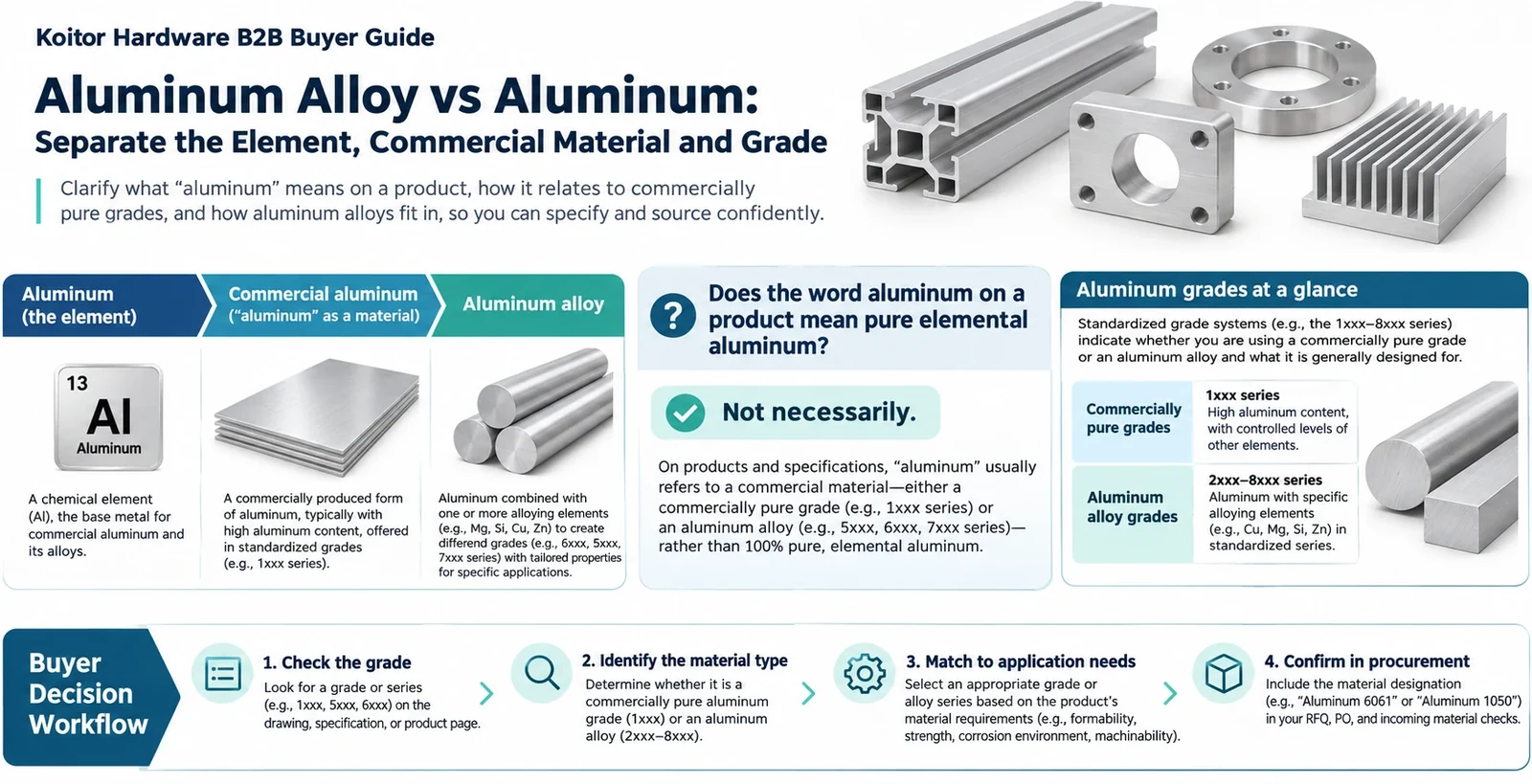
Aluminum alloy vs aluminum is a terminology question because “aluminum” can name the chemical element and also serve as everyday shorthand for many commercial aluminum materials, including alloys. An aluminum alloy uses aluminum as its principal base with other elements added or controlled to produce a specified material. “Commercially pure aluminum” is an industrial material category, not a promise of perfectly pure laboratory metal. A buyer cannot reliably tell whether two quotes describe different materials until the grade or designation, product form, condition, and relevant finish are identified.
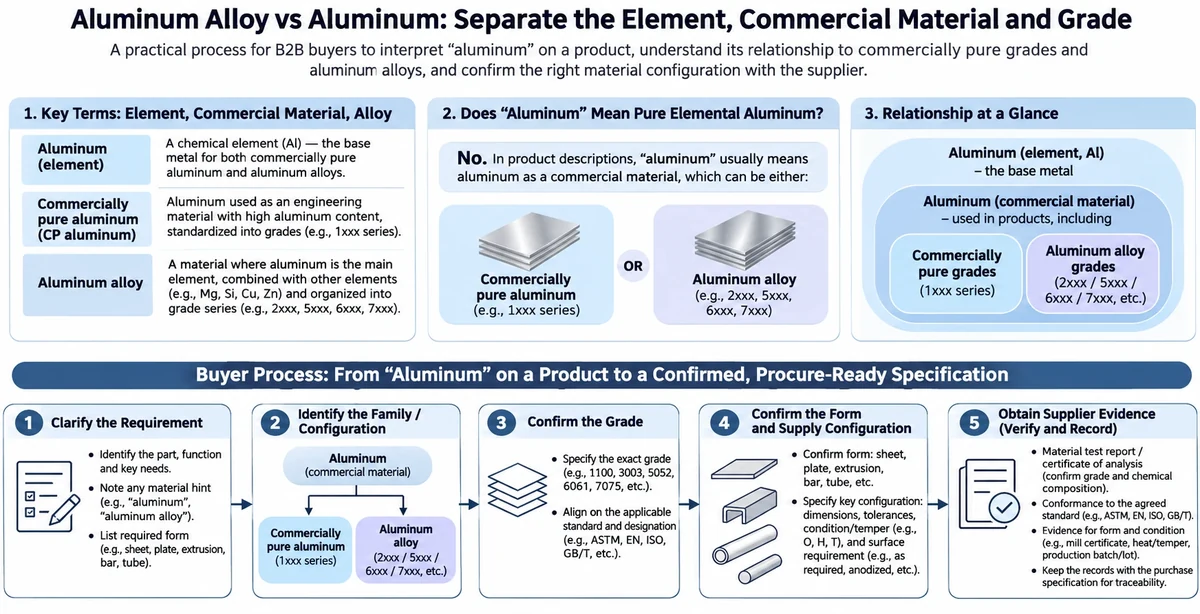
Why does the difference matter in a supplier quotation?
A quotation may say “aluminum bracket,” while a drawing or purchasing record says “aluminum alloy.” The two phrases do not necessarily describe different proposals. One may use aluminum as a general commercial name; the other may be emphasizing that the material is alloyed. If the buyer compares these phrases as if one necessarily means pure metal and the other a distinct alternative, the comparison may be based on wording rather than material identity.
The useful next question is not simply “is it aluminum?” but “which controlled material designation and product condition are being offered?” Depending on the product and required records, a buyer may need a grade, temper or condition, product form, thickness, finish, and supplier document. Not every project requires every field, but the quotation should contain enough detail for the buyer’s decision and future reorder.
This article explains the relationship between the element, commercial material, and grade terminology. It does not rank aluminum and aluminum alloys by strength, corrosion resistance, cost, or suitability. Those properties depend on the specific material and product conditions. The focus also differs from a comparison between two named alloy grades: it resolves what broad wording means before grade-to-grade performance is discussed.
What does “aluminum” mean in materials terminology?
Aluminum is a chemical element, commonly represented by the symbol Al. In commercial conversation, however, “aluminum” often refers broadly to products made from aluminum-based materials. Those products may be commercially pure grades or aluminum alloys. Everyday usage is therefore broader than the strict element name.
When a supplier says “aluminum,” the phrase may identify a product category rather than a complete chemical composition. A buyer should not infer that the product is made from pure elemental aluminum with no controlled additions. Nor should the buyer assume that the supplier has identified a particular alloy just because the word appears in the quotation.
A clearer purchase record can distinguish the levels:
| Description level | What it identifies | Example buyer record |
|---|---|---|
| Element | The chemical element aluminum | Aluminum (Al) is the base element under discussion |
| Commercial material family | A broad market grouping of aluminum-based material | Commercially pure aluminum or aluminum alloy |
| Grade or designation | A specific recognized material identity | Supplier-stated grade or designation from the controlled specification |
| Product form | How the material is supplied or made into stock | Sheet, plate, extrusion, casting, or another defined form |
| Condition or temper | A specified material condition where applicable | Exact designation and temper from the drawing or supplier document |
| Acabado superficial | The specified appearance or coating condition | Finish name, color, preparation, and acceptance reference as applicable |
The table separates concepts; it is not a full standards list and does not assign a composition limit. Exact naming systems vary by product form and specification. If grade designation matters, buyers should reference the applicable controlled standard or supplier documentation rather than relying on a general blog taxonomy.
What is an aluminum alloy?
An aluminum alloy is an aluminum-based material in which other elements are added or controlled as part of the material specification. Alloying elements may include silicon, magnesium, manganese, copper, zinc, or others, depending on the grade family. The composition and processing route are controlled by the applicable designation and product specification.
Alloying is not simply “adding another metal.” Silicon is an example of an element used in aluminum alloy systems, and the relevant composition may include several controlled constituents. The grade name and specification identify what is allowed; a generic phrase such as “aluminum alloy” does not define the complete chemistry.
The word “alloy” also does not automatically mean stronger, more corrosion resistant, easier to form, or better for a particular product. Those conclusions require a comparison between specific grades, conditions, product forms, and design requirements. A buyer should not transfer a property from one grade pair to all aluminum materials.
An alloy designation can be useful when a material’s formability, finish, joining, or required documentation matters. Yet the designation must be used accurately. The product form and condition may affect how a material behaves during forming or machining, and the finished assembly can introduce additional requirements. A grade name is an important identity field, not a complete product performance statement.
Is commercially pure aluminum perfectly pure?
No. “Commercially pure” is a commercial material category that permits controlled composition under an applicable specification; it does not promise atomically pure aluminum or laboratory-grade elemental metal. Buyers should use the precise designation and specification relevant to the product rather than interpret the word “pure” literally.
The exact permissible composition depends on the applicable grade and standard. This guide does not set a numeric cutoff or reconstruct a complete series table. If a buyer needs to know the composition range, request the applicable material specification or certificate from the responsible supplier and verify that it corresponds to the actual supplied product.
The Aluminum Association’s standards resources distinguish commercially pure aluminum categories from alloy series, and identify families with controlled composition designations. A buyer can use that terminology to understand why “commercially pure” and “perfectly pure” are not equivalent phrases. The controlling record for a specific order remains the designated standard, grade, product form, and supplier documentation.
How should a buyer compare aluminum descriptions from two suppliers?
Normalize the two quotations before comparing price or making a material decision. A comparison should include the specific grade or designation if stated, product form, condition or temper where relevant, dimensions, finish, and supporting documentation. If one supplier gives only “aluminum,” ask for clarification rather than assuming the quote is equivalent to a second proposal that names a grade.
| Quote field | Proposal A | Proposal B | Buyer’s comparison question |
|---|---|---|---|
| General description | “Aluminum” | “Aluminum alloy” | Are these broad labels or controlled material identities? |
| Grade/designation | Supplier-stated field | Supplier-stated field | Is the grade exact and applicable to the product form? |
| Form | Sheet, plate, extrusion, casting, or other | Sheet, plate, extrusion, casting, or other | Are both products supplied in comparable forms? |
| Condition/temper | Stated or not stated | Stated or not stated | Does the drawing or process require this information? |
| Finalizar | Stated finish or reference | Stated finish or reference | Are appearance and surface requirements comparable? |
| Evidence | Document, declaration, or certificate as required | Document, declaration, or certificate as required | Does the evidence identify the supplied batch or material? |
If information is missing, the comparison is incomplete. Ask the supplier to state what is actually being offered and which record supports that statement. Avoid treating an unanswered field as a confirmed match.
What information belongs on a drawing or RFQ?
The RFQ should describe the buyer’s requirement at the level needed to control the product. For a metal bracket or storage component, that may include material designation, product form, thickness, dimensions, finish, and any relevant manufacturing notes. The buyer should not add an alloy grade without confirming that it suits the product design and supply conditions.
A practical material note can include:
- Material designation. Use the exact grade or specification when the project requires it. If the buyer permits supplier alternatives, say how alternatives must be proposed.
- Product form. State whether the component is sheet, plate, tube, extrusion, casting, or another form where relevant.
- Condition or temper. Include it when required by design, processing, or the material specification.
- Finish requirement. Identify the intended finish, color, surface appearance, or coating reference separately from the base material.
- Evidence. State which supplier document or batch record is needed, if any.
- Change control. Clarify whether a change in grade, source, form, temper, or finish requires prior review.
This is not a universal checklist for every part. A simple product may need fewer controlled fields than a component with a demanding forming operation or specified material evidence. The goal is to make the purchasing decision clear, not to add technical labels without purpose.
Does alloying determine how a finished part performs?
No. A composition label is only one input to a product decision. Material form, condition, thickness, geometry, manufacturing process, joining method, surface finish, and assembly all contribute to the finished part. A general alloy description cannot establish the strength or corrosion behavior of a finished towel rack, bracket, shelf, or basket.
If a design requires a particular mechanical or appearance outcome, the buyer should define the product-level requirement and ask what evidence supports it. A drawing may identify dimensions and material; a sample review may show fit and appearance; a separate test or certificate may be needed for a specific requirement. Each method answers a different question.
The buyer should avoid saying that “all alloys are stronger” or “commercially pure aluminum is always too soft.” Those are overgeneralizations. The correct comparison is between specified materials under relevant conditions, tied to the product’s design and manufacturing route. No material substitution should be approved solely because two suppliers use the same broad word.
What mistakes should buyers avoid?
Treating “aluminum” and “aluminum alloy” as complete grade names
The terms can overlap in everyday commercial usage. Ask for the specific material designation and product form if a difference matters.
Assuming “commercially pure” means laboratory purity
Commercial material categories use controlled specifications. They are not claims of absolute purity. The applicable designation and documentation should answer the buyer’s question.
Treating “alloy” as a performance guarantee
Alloying does not automatically improve every property relevant to a product. Avoid universal statements about strength, corrosion, cost, sustainability, or workability.
Comparing different product forms as if only composition changed
Sheet, extrusion, casting, and other forms have distinct product and process contexts. If two proposals differ in form as well as material grade, the buyer should identify both differences before comparing.
Omitting condition or temper when it matters
A grade alone may not communicate the full supplied condition. Include the condition when the drawing, process, or controlled requirement depends on it.
Assuming the material certificate proves the whole finished product
A material record can support material identity. It does not by itself prove the finished part’s dimensions, appearance, assembly, load performance, or compliance with every requirement.
How can an OEM factory support material clarification?
Koitor Hardware is a family-owned custom metal hardware factory focused on bathroom and home storage products. For a confirmed OEM project, buyers can share drawings or samples and clarify product dimensions, finish, assembly, packaging, and requested material information with the factory. Direct communication helps identify missing fields before quotation and sample review.
That role should not be overstated. Koitor’s approved scope does not establish aluminum smelting, alloy development, extrusion, or certified chemical analysis. If a project requires a specific material grade or certificate, the responsible material supplier must identify the actual material and provide the agreed documentation. The factory can discuss the supplied product and project communication within confirmed capability, but a general article is not a material approval.
For the company’s metal product scope, see Fabricación a medida de accesorios de baño. A buyer can share the drawing, sample, target finish, and material requirement through the contact page so that the quotation conversation uses the same controlled description.
Buyer checklist before approving an aluminum quotation
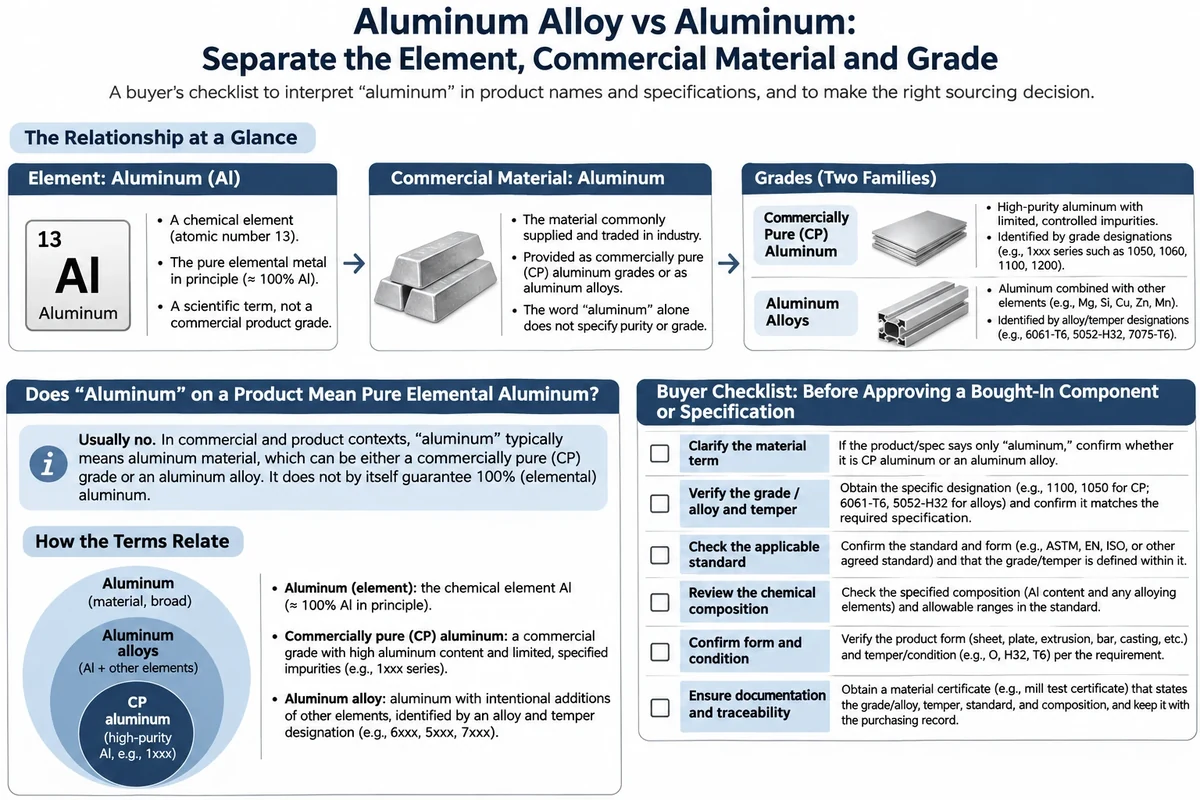
- Clarify whether “aluminum” is a broad commercial label or a specific designation.
- Request the exact grade or material specification when required.
- Identify the product form and supplied condition.
- State temper or condition when the design or process requires it.
- Keep base material separate from surface finish and coating requirements.
- Ask what supplier document identifies the actual material.
- Compare proposals across the same fields before comparing price.
- Do not infer strength, corrosion resistance, or suitability from the word “alloy.”
- Record approved substitutions and the evidence used to review them.
- Keep the drawing revision and material documentation with the order.
- Escalate material or performance decisions to the responsible engineering or quality reviewer.
- Avoid adding numeric composition or performance criteria without a project basis.
How should a buyer handle an unclear material substitution?
If a supplier proposes a different aluminum description, ask the supplier to identify the exact material and compare it with the approved drawing or purchase specification. Record whether the difference is only terminology or whether the grade, form, condition, source, or finish also changes. If a controlled requirement is affected, route the substitution to the responsible engineering or quality reviewer before approving production.
A change record should preserve the original requirement, the proposed designation, the supporting supplier document, the sample or review method, and the approval scope. If an alternative is approved for one project or order only, state that limit so it does not become an undocumented default for future purchasing. A broad “aluminum alloy” label is not enough to establish equivalence.
How do material form and manufacturing route affect the record?
The same broad material family can appear in several product forms, and a form can have a manufacturing route that matters to the part design. Sheet or plate, extrusion, and casting should not be treated as interchangeable merely because each is described as aluminum-based. The quotation should name the offered form when it affects geometry, processing, or the buyer’s specification. The actual route and material identity should come from the supplier rather than being inferred from the finished shape.
For a hypothetical bracket, a buyer might review whether the drawing expects a formed sheet component, an extruded section, or a cast shape. That description helps frame the discussion but does not establish which route is technically or commercially appropriate. If a supplier proposes another form or route, the buyer can review the dimensional, finish, assembly, and documentation consequences with the responsible engineering contact. The route alone does not prove strength, dimensional consistency, or performance.
The purchase record should therefore keep material designation and product form in separate fields. If the buyer requires a particular process for a reason, state that reason and define how the requirement will be verified. Otherwise, avoid specifying an unverified process solely because it appears in a general material explanation. This keeps the RFQ focused on controlled requirements rather than assumptions about how every aluminum component must be made.
Which documentation should accompany the ordered material?
The appropriate document depends on the purchase requirement and supplier’s product. A quotation may reference a technical data sheet, material declaration, certificate, or other record. Buyers should confirm what each document identifies, which product form or batch it covers, and whether its designation matches the drawing. A generic document for a product family may not identify the exact lot or condition supplied on a specific order.
When documentation is required, put the requirement in the RFQ or purchase specification before ordering. State the document type, supplier or batch identification expected, and whether the buyer needs it before production, shipment, or incoming inspection. Do not assume that a document title alone proves every requested property. Read the scope and issuer, and route questions to the responsible quality or engineering reviewer.
This article does not set a universal certificate requirement. A low-risk component may need only a clear designation and supplier confirmation, while a controlled project may require traceable records. The buyer should match the evidence to the consequence of an incorrect material and the contract requirement. This makes the documentation request proportionate and helps avoid treating a broad “aluminum” label as a substitute for an agreed material record.
How should a material substitution be documented?
A material substitution request should name the exact part and the exact information being changed. If the existing record says only “aluminum,” the first step is to establish what the original supplier meant: commercially pure aluminum or an alloy, which grade or series, which product form, and which temper or condition if applicable. Then compare the proposed designation against the drawing, purchase specification, and intended forming or machining route. Do not accept a change merely because both descriptions contain the word aluminum.
The buyer should ask the responsible supplier to provide the material identification and the documentation required by the project. The document should map to the delivered lot or batch where traceability is required and use the same designation as the approved specification. A certificate or test record can support an identified claim within its scope; it does not automatically confirm every performance characteristic or resolve an unclear drawing. The responsible engineer or quality owner determines whether the proposal is acceptable.
When discussing aluminum alloy vs aluminum, use the terms carefully: aluminum is a chemical element and also a broad commercial material name, while an aluminum alloy is a material containing aluminum with specified alloying elements. A grade designation narrows the commercial material further. The difference matters for the purchase record, but this guide does not recommend a grade for an unspecified bathroom or storage hardware part. For a customized project, the buyer should provide the application, part form, required finish, and any governing specification so the manufacturer and material supplier can review the exact scope.
Aluminum alloy vs aluminum should be resolved in the approved material line, where grade and product condition can be identified.
El Aluminum Association standards resource y Aluminium Online material explainer provide additional terminology references.
Preguntas frecuentes
Can a product called aluminum actually use an alloy?
Yes. In commercial usage, “aluminum” often refers broadly to aluminum-based products, including alloys. The exact grade or designation should be confirmed when material identity matters.
Is commercially pure aluminum perfectly pure?
No. It is a commercial category defined by a material specification, not a guarantee of laboratory-level purity. Refer to the applicable grade and supplier documentation.
Does the word alloy alone specify a grade or temper?
No. “Alloy” is a broad description. Buyers may need the exact grade, product form, and condition or temper to control the proposal.
Is every aluminum alloy stronger than commercially pure aluminum?
No universal conclusion follows from the broad labels. Compare specific grades, forms, conditions, and product requirements using appropriate documentation.
Does a material certificate approve the finished bracket or rack?
No. A material record addresses material identity within its scope. Product dimensions, finish, assembly, and performance require their own relevant checks.
Clarify the Material in Your Hardware Drawing
Share the drawing or sample to discuss product form, finish, and the material information required for a confirmed OEM scope.
OEM / MARCA BLANCA
Convierte esta guía de abastecimiento en un resumen del producto
Indícanos el producto que deseas, el tamaño, el acabado, la cantidad del pedido y los requisitos de embalaje. Tu equipo recibirá un análisis práctico de la viabilidad de fabricación antes de recibir el presupuesto.


 English
 Español
 Português
 Français
 Deutsch
 العربية