

Buffing vs polishing is not always a fixed process sequence with one universally accepted definition for each word. Some industrial sources distinguish buffing by loose abrasive carried on a wheel and polishing by an attached abrasive; other suppliers use the words to describe successive surface-refinement or shine operations, sometimes with conflicting views about which is more aggressive. Buyers should not rely on the term alone. They should describe the starting surface, abrasive or carrier system, operation sequence, and target appearance, then approve a representative reference.
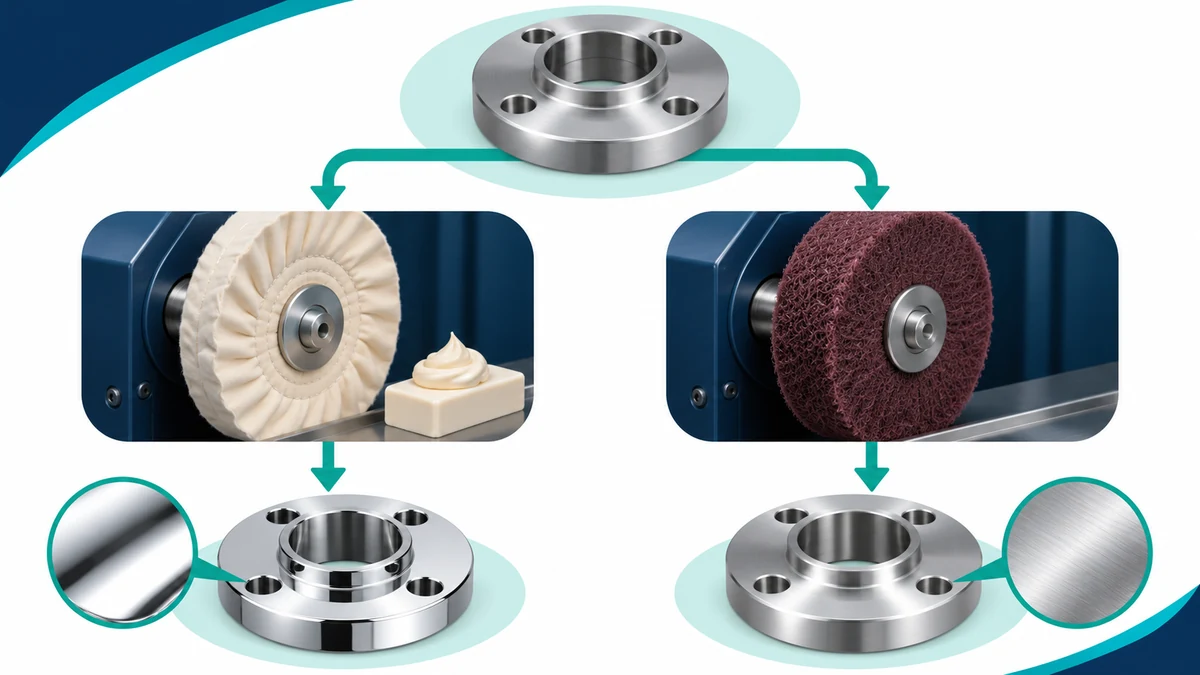
Why do buyers see different definitions of buffing and polishing?
The terms are used in overlapping ways across industries, suppliers, and finishing operations. One source may classify a process by how abrasive is held on a wheel; another may distinguish operations by the intended surface appearance or stage in a finishing sequence. A supplier may use “polishing” as a broad description, while another reserves it for a more specific step. As a result, two quotations using the same word may not describe the same operation.
This variation matters when an importer specifies a cosmetic finish for a metal rack, bracket, or bathroom accessory. If the RFQ requests “polishing” without stating the surface condition or target appearance, the supplier may interpret the scope differently from the buyer. Later disagreement can arise even if both parties used the same term.
This guide explains the terminology variation and proposes a more reliable way to communicate a finishing request. It does not prescribe a wheel, machine, speed, pressure, grit sequence, compound recipe, material removal allowance, or guaranteed finish. Those details depend on the actual part and supplier process. The practical principle is simple: define the surface result and review a reference instead of treating buffing or polishing as a universal grade.
What do the terms commonly describe?
In some technical explanations, buffing is associated with a wheel carrying loose abrasive or compound, while polishing is associated with abrasive material attached or bonded to a backing. Other sources use the terms differently, including as stages that move a surface from one condition toward a more refined or brighter appearance. The definitions are not consistent enough to assume that every supplier follows one taxonomy.
| Description axis | What the buyer may see | What should be confirmed |
|---|---|---|
| Abrasive attachment | Loose compound, attached abrasive, coated abrasive, or another system | What abrasive or carrier is actually used? |
| Operation name | Buffing, polishing, finishing, or supplier-specific stage name | How does this supplier define the term for this part? |
| Starting surface | Formed, ground, brushed, or previously finished surface | What condition is the part in before the operation? |
| Sequence | One operation or several successive stages | Which stages are included in the quoted scope? |
| Target appearance | Satin, brushed, bright, reflective, or another reference | Which approved sample or visual standard controls? |
| Acceptance | Visual review or specified surface criteria | How will the buyer and supplier judge the result? |
These are discussion points, not a normative classification. The same operation name may appear alongside different abrasive media or process sequences. The buyer should request a plain-language description and a sample or visual reference that shows the intended outcome.
Does buffing always come before polishing?
No universal order follows from the terms. Some process descriptions treat buffing and polishing as separate stages; others use one word for a broader finishing operation. A supplier may perform a sequence of operations, but the order and purpose need to be confirmed for the actual part and finish requirement.
A process sequence should be described in relation to the starting surface and target. For example, a hypothetical bracket may have visible forming marks that need to be reduced before the buyer reviews the intended appearance. The supplier can explain the proposed finishing scope and provide a representative sample. This example does not state that a particular buffing or polishing step will remove all marks, achieve a mirror appearance, or preserve a fixed dimension.
If the finish is important, the buyer can ask:
- What is the starting surface condition before finishing?
- Which operations are included in the quotation?
- What does the supplier mean by buffing or polishing in this process?
- Which areas are finished and which are masked or left unchanged?
- What sample, image, or visual standard defines the approved appearance?
- What deviations are acceptable for the buyer’s application?
The answers make the quotation easier to compare. They also reduce reliance on process vocabulary that may mean different things to different parties.
How should a buyer specify a metal finish?
A practical finish specification communicates the outcome and the basis for judging it. It may name a recognized finish where the buyer has one, but a name should be accompanied by a reference or description if ambiguity remains. The buyer can provide a physical sample, an approved color or surface reference, marked product views, and notes about visible areas.
| RFQ or drawing field | Example of useful information | Buyer purpose |
|---|---|---|
| Base part and material | Drawing number, material designation when known | Identifies the component being discussed |
| Starting condition | Existing forming, weld, grinding, or surface state | Helps the supplier assess the requested finishing scope |
| Visible faces | Marked views showing cosmetic areas | Focuses review on surfaces the customer will see |
| Operation description | Supplier explanation of the proposed buffing or polishing stage | Makes the process scope understandable |
| Target appearance | Approved reference sample or agreed visual description | Establishes a common review point |
| Edge and transition areas | Areas requiring particular appearance or protection | Avoids assumptions about inaccessible features |
| Acceptance method | Sample approval or defined visual inspection reference | Clarifies how buyer and supplier will make the decision |
| Control de cambios | Notice and approval for changed media, sequence, or source | Helps keep repeat orders aligned |
This framework does not require a buyer to control every process parameter. A buyer may specify the result and allow a qualified supplier to propose the process, subject to sample approval and any applicable engineering limits. If the geometry or tolerances could be affected by material removal, that risk should be discussed with the responsible engineering reviewer.
What does a sample prove about buffing or polishing?
An approved sample can show the appearance of a specific part made under a specific process at a particular time. It can serve as a reference for visual comparison. It does not automatically reveal every abrasive, wheel, compound, or process parameter used, and it does not prove that all pieces or future batches will be identical.
The sample should be identified with the part number, drawing revision, date, and the areas reviewed. The buyer can mark which faces matter and state what the sample is intended to control. If the supplier later proposes a different finishing route, material, or sequence, the buyer can decide whether a new sample review is needed.
A visual sample also does not establish corrosion performance, coating adhesion, dimensional accuracy, or a guaranteed service life. Those are separate questions requiring their own specifications and evidence. A shiny appearance is not proof that a part has a particular corrosion resistance. Similarly, a brushed appearance is not a complete process description.
For repeat orders, retain the approved reference and the supplier’s written description of the finish scope. If the project allows a range of appearance, define it with examples or acceptance limits rather than relying on a subjective term alone. The goal is to make the visual decision repeatable, not to assume that one word means the same thing everywhere.
How can buyers avoid comparing unlike finishing proposals?
Two suppliers may both quote “polishing” while starting with different part conditions or proposing different operation sequences. One may include weld blending; the other may finish only exposed surfaces. A fair comparison starts by aligning the scope.
Ask each supplier to identify:
- Which component faces and edges are included.
- What starting surface condition is assumed.
- What finishing operations are included in the price.
- Which supplier-defined meaning is attached to “buffing” or “polishing.”
- Whether a sample or visual reference is required before production.
- Whether a change in abrasive system or sequence will be communicated.
- Whether dimensional or edge requirements may be affected and who reviews them.
If one proposal includes additional surface preparation, it may not be directly comparable to a second proposal that names only a final finish. The buyer can request clarification before concluding that one supplier is more efficient or less expensive. Do not infer that a lower quote means fewer operations or a worse outcome without evidence.
What mistakes should buyers avoid?
Assuming one word has a universal process meaning
Supplier terminology varies. Ask for a process description tied to the actual part and finish instead of treating “buffing” or “polishing” as self-explanatory.
Believing buffing is always more or less aggressive
Sources disagree about aggressiveness and stage order. Avoid universal claims about removal rate. Confirm the operation and the desired result with the supplier.
Assuming polishing never removes material
Abrasive finishing can alter a surface, but the amount depends on the process and material. Do not assume dimensional neutrality; review any critical feature with engineering.
Using “mirror finish” without a reference
The phrase can be interpreted differently. Provide a representative sample or a defined appearance reference and identify visible faces.
Treating shine as proof of corrosion resistance
Appearance and corrosion performance are distinct. A bright or reflective surface does not by itself demonstrate corrosion behavior.
Ignoring welds, edges, and hidden transitions
A buyer may approve a broad finish term while overlooking the visible weld area or a difficult transition. Mark critical locations on the drawing or sample.
Copying a supplier’s process recipe into every RFQ
A wheel, speed, pressure, compound, or grit sequence may be specific to a supplier and part. Ask for the scope and result unless the buyer has a justified, controlled process requirement.
How can an OEM factory help communicate a finish?
Koitor Hardware is a family-owned custom metal hardware factory specializing in bathroom and home-storage products. For a confirmed OEM project, buyers can share the drawing, sample, material requirement, visible faces, and desired finish reference. Direct communication can clarify which areas are cosmetic, how a sample will be reviewed, and what packaging is needed to protect the agreed appearance.
Koitor’s approved manufacturing knowledge includes grinding and polishing as processes used in metal hardware production. That does not establish a particular machine, wheel, compound, recipe, guaranteed finish, or cosmetic acceptance result for every project. The process and sample outcome should be confirmed against the actual product and supplier capability.
For product scope, see Fabricación a medida de accesorios de baño. A buyer can share a drawing or physical sample through the contact page to explain the desired appearance and request a project-specific discussion.
Buyer checklist before approving a finish

- Identify the part and drawing revision.
- Mark the visible faces and critical edges.
- Describe the starting surface condition.
- Ask the supplier what it means by buffing or polishing.
- List operations included in the quotation.
- Provide an approved sample or clear appearance reference.
- Identify welds and transitions that need visual review.
- Separate appearance approval from corrosion or performance claims.
- Confirm whether finishing may affect critical dimensions or edges.
- Record the approved sample and supplier process description.
- Require review before a material, sequence, or finishing source changes.
- Avoid specifying process parameters without a project-specific basis.
How should a sample review be documented?
A sample record should identify the part, drawing revision, finish reference, supplier, and date reviewed. The buyer can mark the visible areas and note whether the sample is intended to approve color, gloss, texture, scratch appearance, weld blending, or another defined feature. This prevents a sample approval for one visible property from being interpreted as approval of every process or performance claim.
If multiple samples represent different finishing routes, label them separately and ask the supplier to describe what changed. The review can then compare the actual starting surface, included operations, and resulting appearance. Keep the approved sample or a controlled visual record with the project file, and state how future production will be compared with it. A photograph can aid communication but may not reproduce lighting, color, or surface texture exactly, so use it within the agreed review method.
When the buyer requests a change after approval, document whether the new request changes the target appearance, the operation scope, or both. The supplier may need to review feasibility and any impact on geometry or production. Avoid treating an informal comment such as “make it shinier” as a complete controlled instruction. Translate it into an agreed reference or description and obtain confirmation before the next sample or production run.
How can a buyer distinguish appearance limits from process requirements?
A buyer may care primarily about the visible result, or may require a particular operation for a documented reason. Those are different instructions. If the outcome controls, a reference sample and clear acceptance description may give the supplier room to select a suitable method. If a process is mandatory, the buyer should state why, identify the controlled operation, and define how compliance will be confirmed. Do not make a process name mandatory simply because it appears in a general article.
For example, a project may require the exposed face of a metal accessory to match an approved sample while leaving concealed surfaces outside the cosmetic criteria. The drawing or finish specification can mark those zones. The supplier can then respond with a proposed sequence and clarify whether the scope includes weld blending or edge treatment. This is more precise than applying “polished” to the entire component without distinguishing faces.
The approval should say what remains open. A sample can approve appearance while process details remain supplier-controlled; alternatively, a buyer may approve both the appearance and an operation description. Neither option is universally correct. The project team should decide which parts of the process are critical to repeatability and which can remain within supplier responsibility, then document that boundary.
For repeat orders, the record can specify how the approved sample is stored and identified so production staff do not compare against an unlabelled piece. The reference should remain associated with the current drawing and finish revision, and any replacement sample should be reviewed before it supersedes the prior approval.
How should an approved finish be communicated to production?
Once the buyer approves a reference, the finish description should travel with the current drawing and order revision. Identify the approved sample or controlled image, the visible faces, and any areas excluded from cosmetic review. If the production team receives only the word “polished,” it may not know which sample or operation scope was approved. A short marked-up drawing can connect the finish requirement to specific part surfaces.
For an assembly with several components, describe each piece separately where their starting surfaces or final appearances differ. A bracket, wire basket, cover, and fastener may not receive the same finish operation even when they appear in one product. The buyer should clarify which items are included in the finish price and which are supplied with a standard surface. This prevents a general product-level finish name from being read as an identical operation on every part.
If the supplier recommends a different process to achieve the target appearance, request a sample or explanation before updating the production instruction. The buyer can approve the result while allowing the supplier to control the detailed method, or can make a process requirement explicit when the project has a justified reason. Record the chosen approach and any limitations, such as inaccessible areas or permitted variation, so later reviewers understand what the approval covers.
How can a buyer make a finish comparison repeatable?
A useful sample review controls the conditions that can otherwise make two surfaces look different. Compare parts made from the same specified material and part geometry, prepared to the agreed starting condition, and viewed under consistent lighting and orientation. Clean the samples using an agreed method before visual comparison, because fingerprints, residue, and handling marks can distract from the finish itself. Keep the reference sample identified and protected so future reviewers know which condition was approved.
The comparison record can state the supplier’s meaning for buffing and polishing, the abrasive media or carrier where supplied, the sequence included in the quotation, and the target appearance or measurable characteristic the buyer cares about. It should also name areas that must remain unchanged, such as edges, dimensions, holes, weld zones, or mating surfaces, when those are part of the specification. The parties should not infer material removal limits, surface roughness, corrosion performance, or process capability from a photograph unless the relevant method and evidence support that conclusion.
Because buffing vs polishing usage is not uniform across all suppliers, compare the described operation and approved result rather than relying on a universal order of aggressiveness. If the approved sample is revised, record the reason, date, supplier, and drawing or finish specification revision, then identify which reference controls the next order. This makes an appearance decision more repeatable without treating a sample as proof of every production part or prescribing a process recipe.
Buffing vs polishing should be discussed through the supplier’s defined operation and target finish, not a presumed universal sequence.
Kramer Industries y Red Label Abrasives illustrate why suppliers may use these terms differently.
Preguntas frecuentes
Is buffing always the less aggressive step?
No. Sources and suppliers use the terms differently, and aggressiveness depends on the abrasive system and operation. Confirm what will be done to the actual part.
Do suppliers use polishing to mean the same operation?
Not always. Some use polishing as a broad term, while others identify a distinct stage. Request a plain-language scope and sample reference.
What should accompany a finish name on an RFQ?
Include the starting condition, visible areas, operation scope where known, target appearance, and an approved sample or visual standard when needed.
Does a polished surface guarantee a mirror appearance?
No. The term alone does not define the result. Use an approved reference and identify which faces matter.
Does buffing or polishing guarantee better corrosion resistance?
No. A finish appearance does not itself establish corrosion performance. Any corrosion requirement needs separate specification and evidence.
Clarify the Finish for Your Metal Hardware
Share a drawing or sample and identify visible surfaces so the finish scope and approval reference can be discussed for a confirmed OEM project.
OEM / MARCA BLANCA
Convierte esta guía de abastecimiento en un resumen del producto
Indícanos el producto que deseas, el tamaño, el acabado, la cantidad del pedido y los requisitos de embalaje. Tu equipo recibirá un análisis práctico de la viabilidad de fabricación antes de recibir el presupuesto.
 English
 Español
 Português
 Français
 Deutsch
 العربية