
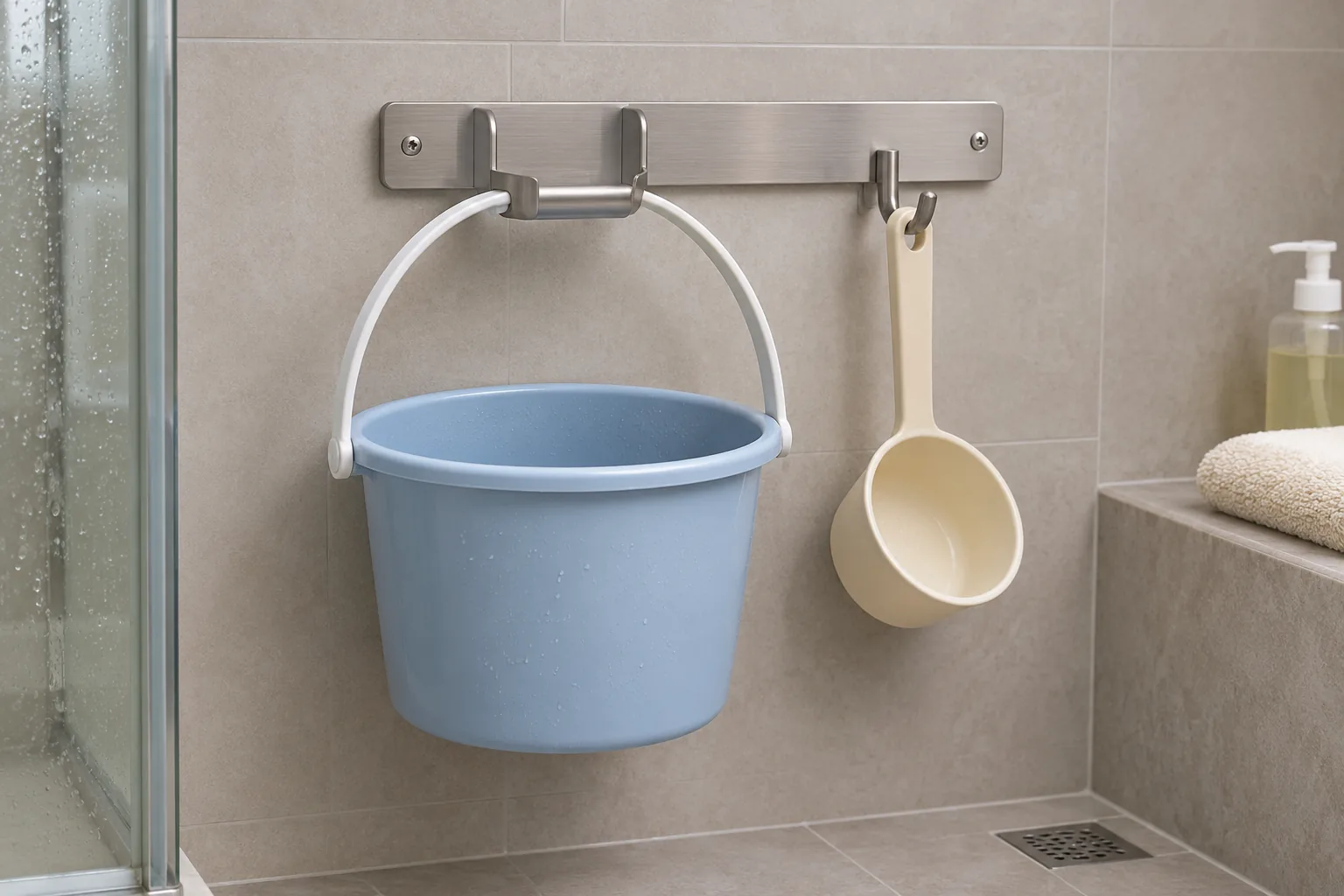
A bath pail dipper holder is a small accessory with two separate interfaces: the pail’s handle or rim and the dipper’s hanging point. Buyers should confirm both fit and shared access. A pail can sit securely while the dipper blocks its handle; a dipper can hang on a hook while its bowl collides with the pail or nearby wall. These interactions are easy to miss if a sample is reviewed one piece at a time.
For assortment planning, identify the actual pail and dipper models, their handles, rims and intended storage orientation. Then assess how the user lifts one item while the other remains in place. Product names and photos rarely define this interaction well enough for an OEM specification. This is a buyer framework for an adjacent bathroom-storage product and does not claim that Koitor currently manufactures pail or dipper holders.
Identify both stored objects and their interfaces
For this decision, record the bath pail dipper holder requirements in the controlled specification and sample review so the approved scope remains clear to purchasing, quality and the supplier.
The bath pail dipper holder specification should also identify the assumptions that remain open and who must confirm them before order release.
Start with samples of the pail and dipper proposed for the assortment. A pail may have a rigid handle, flexible bail, molded grip or a handle that pivots beyond the rim. Record the handle’s cross-section, attachment points, travel and the space it occupies when it rests against the pail. The holder should be checked against both the handle in its hanging position and the motion needed to lift the pail away.
The rim can be as important as the handle. Some pails have a rolled lip, reinforcing bead, pouring spout or molded notch. A holder that supports the rim may need to clear these features. A pail that hangs from its handle needs a different support than one that rests by its rim. Specify which interface is intended and test that interface directly.
For the dipper, identify the handle length, hole or loop, bowl diameter and overall orientation. A hook may fit the loop yet leave the bowl in the path of the pail handle. If the dipper has no hanging hole, the design may need a cradle or a separate clip. Do not assume a generic hook accepts every tool shape.
| Item | Measurements or attributes | Holder review |
|---|---|---|
| Pail handle | Cross-section, pivot path and grip shape | Check support and lifting clearance |
| Pail rim | Lip profile, spout and molded features | Confirm contact and non-interference |
| Pail body | Height, width and taper | Check wall and floor clearance |
| Dipper handle | Length, loop or hole, grip shape | Confirm hook entry and removal |
| Dipper bowl | Width, depth and orientation | Check collision with pail and wall |
| Combined set | Stored order and expected user access | Remove one item while the other stays |
El Yamajitsu pail and dipper holder example illustrates one specific product arrangement. Treat its dimensions and stated compatibility as product-specific. A different pail, handle or dipper may require another opening, spacing or placement. Use actual samples and the current supplier drawing to define the approved interface.
Plan the holder layout around shared access
A single rail with separate supports can keep a pail and dipper in one visual zone. The pail may be suspended from a wider hook or bracket, while the dipper rests on a narrow hook. The layout should account for handle swing, bowl width and the user’s hand. If the two stored items overlap, the user may need to remove one to reach the other.
An arrangement with vertical separation can reduce some overlap but may increase overall height. Consider shower controls, mirrors, shelves and the reach range expected by the buyer. Do not position the pail so its bottom strikes a faucet or its rim blocks another accessory. A drawing should include front and side views with the stored items shown, not only the empty bracket.
A shared base or cradle can support more than one component. It may help keep the set visually organized but can collect water or make cleaning more difficult. If drainage or drying is a product requirement, define the expected water exposure and method of review separately. An open-looking form alone is not evidence of complete drainage or hygiene.
The product may be sold with or without the pail and dipper. This affects the claims and package contents. If the accessories are excluded, the listing should show representative items as examples and state what the buyer must source separately. If included, identify their material, color, dimensions, packaging and responsible supplier. A metal-holder specification does not establish quality or suitability of a third-party pail.
Verify handling, removal and wall clearance
Load the actual pail onto the holder using the intended motion. Does the user place the handle over a hook, rest the rim into a cradle, or slide the body into a support? Repeat the motion with the pail empty and, if the use case requires it, in a defined filled condition. A filled condition should only be used if the product is intended to store or support that state, and any load claim requires its own test plan.
Check whether the handle pivots freely or presses against the wall. A flexible bail may shift as the pail is lifted; a rigid handle may need a wide opening. Observe whether the handle can be accidentally lifted off by a small side movement. These are geometry observations, not universal retention conclusions.
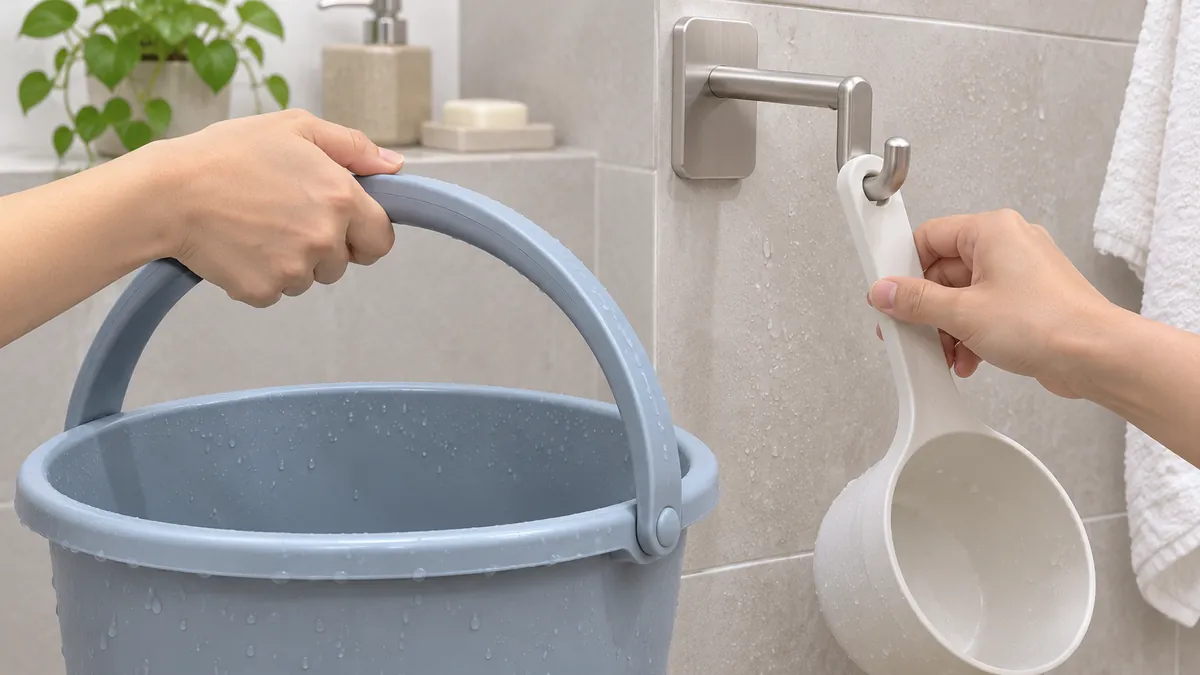
Next, remove the dipper while leaving the pail in place, then remove the pail while leaving the dipper in place. Watch the handle and bowl paths. A collision can appear only during the arc of movement. If the holder is placed in a shower area, consider nearby doors, hoses and the user’s hand path. If it is installed near a tub, check access around the rim and spout.
Confirm wall clearance in the fully loaded state. The pail body may sit close to the wall while its handle projects outward; the dipper bowl may touch tile or a neighboring product. The mounting plate and fasteners also need space, and the design should not be assumed to fit all tile grout patterns or substrates. State the intended mounting method and supplied fixing scope.
Make the sample review reproducible
Keep the pail and dipper identifiers with the sample record. Include measurements or supplier model numbers, the holder drawing revision, mounting location and accessories included. Photograph the empty holder, each item stored independently and the complete set. A single front-view photo will not show the removal path or wall clearance.
A practical review sequence is:
- Compare handle, rim, spout, dipper loop and bowl against the drawing.
- Install the holder with the agreed fixings on a representative substrate.
- Store the pail by the specified interface and verify the intended orientation.
- Hang or place the dipper and check its bowl and handle clearance.
- Remove the dipper without disturbing the pail; then remove the pail without dislodging the dipper.
- Repeat the sequence and note any snagging, rotation, contact or awkward hand position.
- Inspect edges, finish, welds, fasteners and package protection.
- Record accepted models, exclusions, installation scope and changes that trigger a recheck.
This process checks fit and operation for the selected samples. It does not establish a load rating, long-term corrosion resistance, mounting performance for every wall or hygienic suitability. If a buyer needs any of those claims, define the conditions and supporting evidence separately.
Coordinate the assortment and all supplied parts
A pail and dipper can be sold together, as a holder-only product or as part of a wider bathroom assortment. Each choice changes the product page, carton, bill of materials and customer-service answer. Assign clear SKUs to holder, accessory set and any finish variant. Do not use one listing photo to imply that an accessory is included when it is not.
If the buyer is sourcing the pail or dipper from another supplier, name the component owner in the sourcing record and decide who approves dimensional changes. A new pail handle can change the hanging width even when the body volume stays the same. A replacement dipper may have a longer handle or a wider bowl that interferes with the paired item. The holder supplier should receive the approved interface drawing or a physical reference sample, while the importer retains the current accessory SKU and revision. This makes a future substitution reviewable instead of relying on the fact that both products are described as bath accessories.
Also specify the intended storage sequence in the instruction artwork. If the dipper must be placed first and the pail added afterward, show that sequence; if either item can be stored independently, demonstrate both states. Include an empty-state view so customers can see the holder architecture without mistaking the sample accessories for included parts. Consistent images help distributors answer routine fit questions while avoiding claims about components they do not control.
For a mixed assortment, build a compatibility table listing tested pail handles, rim types and dipper formats. If the buyer expects customers to use their own household pail, specify the interface range and illustrate the measurement point. A broad “universal” label should be avoided unless the evidence covers the marketed range.
Review the packing layout with all items present. A loose metal hook can scratch a pail or dipper, and a handle can bend a light bracket if the parts shift. Separate fasteners and protect visible surfaces. Confirm that instructions identify mounting parts, installation steps and the stored orientation.
Where the set is merchandised with a pail and dipper from another supplier, review the packed accessories together before artwork approval. Check that the handle is not compressed into a shape that changes its fit, and that the dipper bowl is protected from rubbing against coated metal. State whether the illustration is a bundled assortment or a suggested pairing. If the buyer later substitutes a pail, update the compatibility record before carrying over the original product-page claim.
Koitor’s documented capability covers custom metal bathroom and home-storage hardware and drawing- or sample-based development within confirmed production scope. It does not establish that Koitor currently makes this pail/dipper category. For a relevant metal bathroom program, review the custom bathroom hardware manufacturer page or share requirements through the contact page to confirm project fit.
Buyer checklist before confirming a paired set
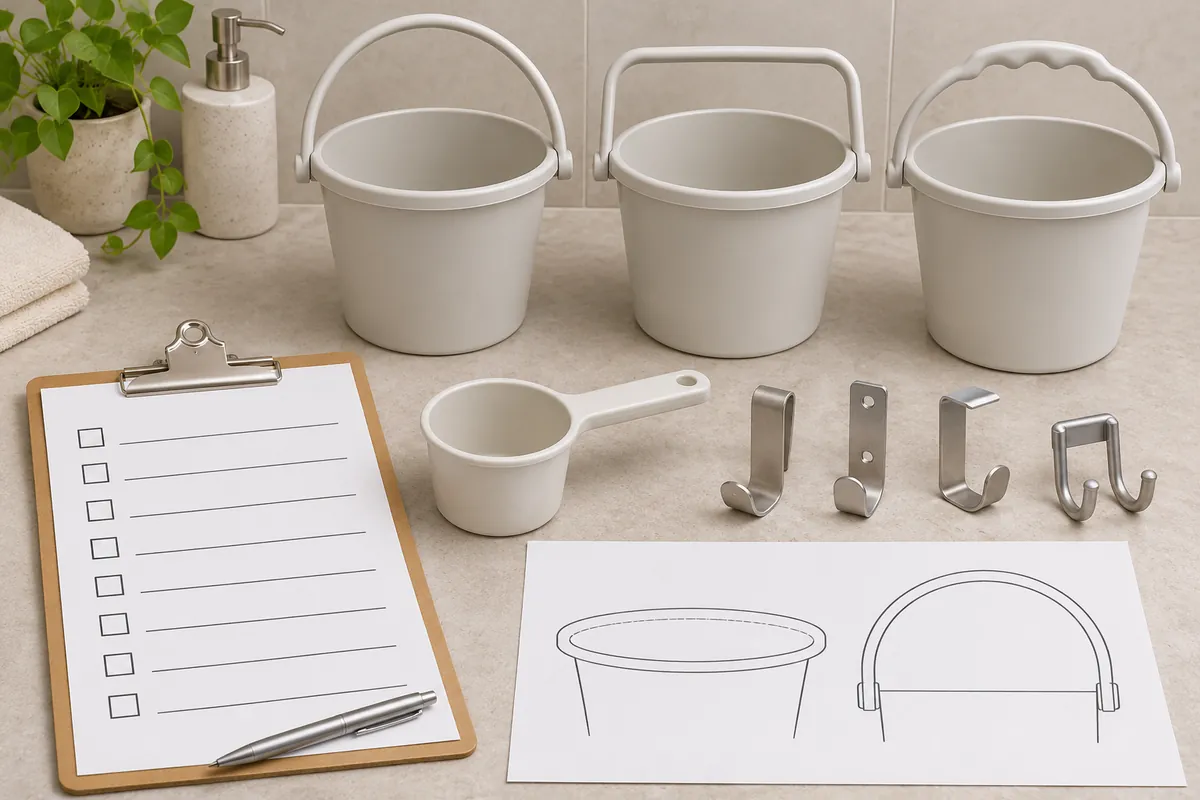
- Name the pail and dipper samples or define their interface dimensions.
- Specify whether the pail hangs by its handle, rests by its rim or uses another support.
- Confirm that the dipper loop or handle matches the separate support.
- Check simultaneous storage and independent removal of each item.
- Review hand access, wall clearance and nearby fixtures.
- State whether accessories are included and identify their supplier.
- Match installation instructions and fixing kit to the intended wall condition.
- Keep load, corrosion and drainage claims tied to separate evidence.
- Record sample revision, compatible models and change triggers.
Preguntas frecuentes
Can a buyer approve the pail holder without the dipper?
The holder can be reviewed alone for basic dimensions, but shared-access claims require both actual items. The dipper’s bowl and handle may obstruct the pail or its removal path.
Should the holder support the pail by its rim or handle?
That depends on the pail construction and product design. Specify the intended support interface and test the representative pail. A rim-supported design should not be assumed to work with every lip.
Does a fit test establish a load capacity?
No. A sample review establishes geometry and selected operation. A load rating requires a defined test condition, installation method, acceptance criteria and evidence.
Can the listing say the holder fits any pail?
Only if the buyer has verified the marketed range and can explain the fit boundary. Otherwise, name tested models or provide a dimensional interface range.
Does this article confirm Koitor produces pail and dipper holders?
No. It gives sourcing checks for an adjacent product and does not add a new Koitor capability claim. Confirm exact scope for a real project.
Analizar un proyecto relevante de herrajes metálicos
Share the product scope, drawings or samples, quantities and requirements relevant to this decision. Koitor can clarify whether a metal hardware project fits its confirmed production scope. The bath pail dipper holder specification should state the intended interface and review conditions.
OEM / MARCA BLANCA
Convierte esta guía de abastecimiento en un resumen del producto
Indícanos el producto que deseas, el tamaño, el acabado, la cantidad del pedido y los requisitos de embalaje. Tu equipo recibirá un análisis práctico de la viabilidad de fabricación antes de recibir el presupuesto.


 English
 Español
 Português
 Français
 Deutsch
 العربية