
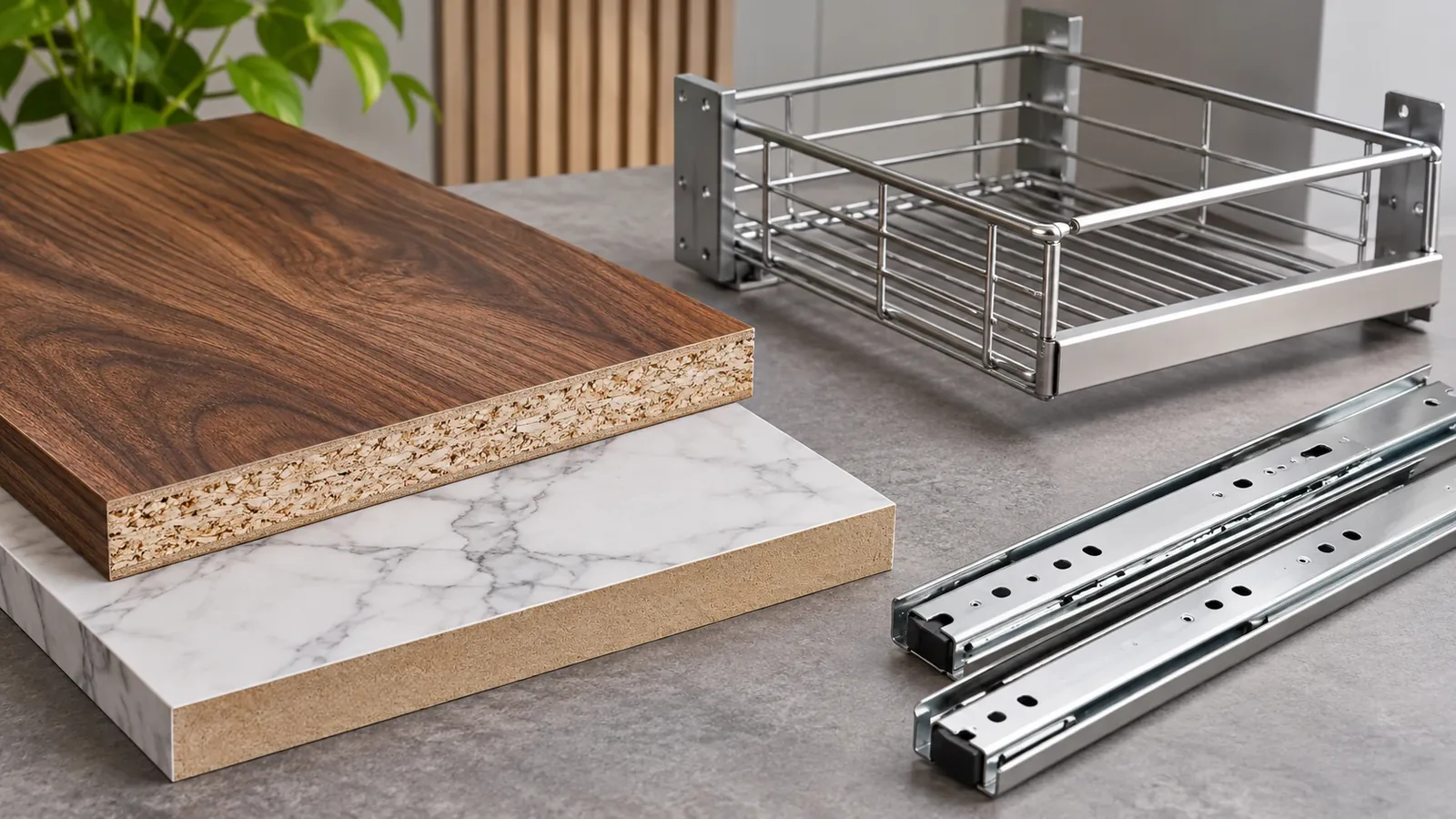
Melamine vs laminate is not a clean comparison of two interchangeable panel cores. “Melamine” can refer to a resin used in a decorative surface system or to shorthand for a melamine-faced product. “Laminate” is a broader word for a layered surface material and is often used for products such as high-pressure laminate (HPL). Thermally fused laminate (TFL) is another decorative surface system. The underlying panel substrate—such as particleboard or MDF—is a separate component. Buyers should identify both the surface system and the core rather than assume a surface name reveals the substrate.
For a metal-and-panel storage product, the surface, core, cut edge and hardware attachment work together. The finish can determine the visible appearance, while the panel core and dimensions influence interfaces specified by the product designer. A surface label does not by itself establish scratch resistance, waterproofing, cost, wear life or compliance. The exact product, construction, supplier data and intended use must support any performance statement.
This guide explains the terminology and provides a purchasing specification map. It does not claim Koitor manufactures wood panels or applies laminate. Confirm the actual panel supplier, substrate, surface construction, edge treatment and metal-hardware interface for each project.
What does melamine mean in a panel discussion?
Melamine is a term associated with a resin used in decorative panel surfaces. A buyer may hear “melamine board” used as shorthand for a panel with a melamine-faced surface, but the phrase does not identify every layer or the substrate underneath. It may hide whether the core is particleboard, MDF or another panel product.
The exact surface construction should be identified from the panel supplier’s product information. A decorative paper layer may be impregnated with resin and fused to a substrate in a manufacturing process; product families and construction details vary. The word “melamine” alone does not establish substrate type, surface thickness, paper pattern, texture, wear rating, moisture behavior or environmental classification.
Some supplier catalogs use “melamine” to refer to a particular faced panel, while others use “TFL” or another product term. The buyer should ask for the exact product code, surface series, core grade, color and texture reference, dimensions, edge treatment and revision. Do not treat a sample’s visual similarity as proof that two products share the same construction.
What does laminate mean?
Laminate generally describes a material made from layers, but the specific product and process need to be named. In panel procurement, HPL is one common surface product; its maker describes a layered construction that can include a decorative layer and other paper layers impregnated with resin and consolidated under pressure. TFL is another system where a decorative paper surface is fused to a substrate. These terms point to distinct product constructions, but performance still depends on the exact grade and use conditions.
“HPL versus TFL” is a narrower product-system comparison than “melamine versus laminate.” Buyers should avoid assuming that “melamine” and TFL are always separate alternatives or that all laminate products share one construction. Ask the supplier whether the term names the resin chemistry, decorative paper, finished surface sheet, or complete faced panel.
A laminated face and its substrate can be sourced or specified separately. The product might combine a decorative surface with MDF or particleboard, but the core remains a distinct specification. A surface material does not automatically determine the core or the attachment method.
Melamine vs laminate: compare surface, system and core
| Specification layer | Typical field to identify | Why it is separate |
|---|---|---|
| Surface terminology | Melamine-faced panel, TFL, HPL or another named system | Common shorthand may refer to different parts of the construction |
| Surface design | Color, pattern, texture, gloss and approved reference | Similar names do not guarantee identical appearance |
| Substrate | MDF, particleboard or exact approved panel grade | A decorative face does not identify the core |
| Dimensiones | Panel thickness, width, length and tolerance | Surface product and core thickness may be documented separately |
| Edge | Exposed, banded, sealed, trimmed or concealed | Edge construction affects appearance and metal-hardware fit |
| Hardware interface | Clip, trim, bracket, fastener or other connection | Surface labels do not approve attachment geometry |
| Evidence | Supplier technical data and approved sample | A product-family name is not a performance result |
The table is a procurement framework, not a universal requirement list. Select only the fields that apply to the design and buyer’s acceptance criteria. Where a property matters, identify the exact test, product and condition used in the supplier’s evidence.
Separate the decorative layer from the panel core
The visible face may dominate an initial sample review, but the substrate remains important to assembly and product records. A melamine-faced particleboard and a melamine-faced MDF panel can present a similar decorative pattern while containing different cores. Likewise, an HPL sheet can be paired with different substrates. A purchase description that says only “white laminate board” may be insufficient if the core, edge or mounting interface affects the order.
When a panel is cut, drilled or edge-finished, the exposed substrate can differ visually from the decorative face. Record how cut edges are handled and whether metal trim covers them. If the edge remains visible, confirm the finish and color reference. If a clip or edge trim grips the panel, verify the actual panel thickness and edge treatment at the grip location; the edge-trim grip range guide covers that particular interface question.
A decorative finish may also change the finished dimension or surface profile. If the hardware drawing locates a hole or clamp from the finished face, define the reference surface and the point where dimensions are taken. Do not assume a panel core dimension equals the final faced-panel dimension. Ask the panel supplier and product designer to identify the controlled measurement.
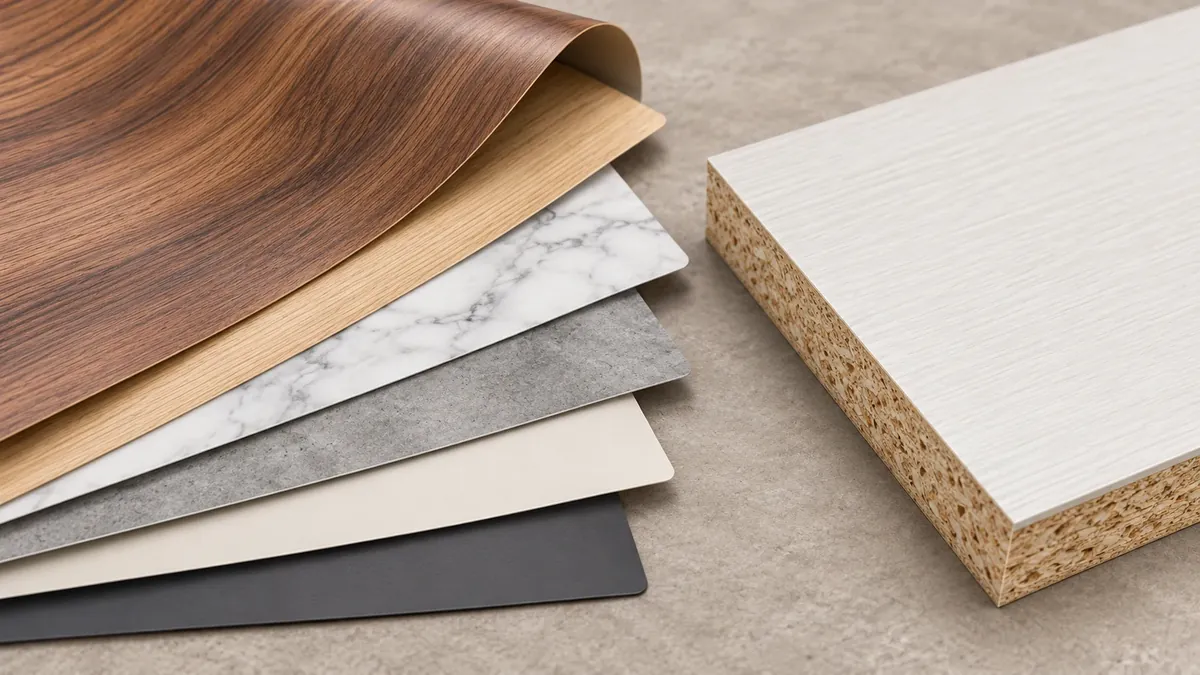
HPL and TFL are system names, not universal performance rankings
HPL and TFL describe different surface product systems. A surface manufacturer can explain its own construction; for example, Wilsonart’s comparison describes HPL and TFL in its product context. That does not establish that every product under either label has identical performance. Specifications, grades, decorative layers, textures and application conditions can vary by maker and product.
Do not infer that HPL is always more durable, expensive, thick or moisture resistant than TFL, or that a TFL surface is always unsuitable for a particular product. These are comparative performance claims that require matched products and evidence. A buyer should ask which properties are stated for the candidate product, how they were tested and whether those conditions align with the intended storage environment.
If the buyer’s use case depends on cleaning, abrasion, heat, moisture, chemical exposure, edge behavior or other characteristics, define that requirement explicitly and request documentation for the exact product. Avoid relying on a general “laminate” name or a sample’s feel to prove a performance level. If the supplier has not confirmed a field, mark it pending.
Specify the panel for metal hardware integration
For a cabinet organizer, wall-mounted storage panel or metal-and-board product, identify how the panel meets the metal component. Is the hardware surface-mounted, clipped over an edge, fastened through a face, inserted into a hole or supported by another component? The actual product drawing should show the interface and critical dimensions. The buyer should not infer the connection from a marketing photograph.
The panel specification should state the exact substrate and face construction, finished thickness, dimensions, edge treatment and sample reference where those details affect the product. The hardware specification should state its part number, finish, mounting features and applicable revision. When one supplier provides the panel and another provides the metal hardware, identify who is responsible for checking the combined fit and who approves changes.
For a custom metal storage basket that integrates with a panel or cabinet environment, the custom metal storage basket manufacturer page describes the relevant metal-product category. The project must still identify the actual panel source and interface. This article makes no claim that Koitor laminates, presses or manufactures MDF or particleboard.
How to evaluate a sample and supplier documents
First identify the sample. Record the supplier, product code, surface name, substrate, thickness, dimensions, color or decor reference and revision. If the supplier has not identified the substrate, record “core not confirmed” rather than inferring from a cut edge. Request the technical sheet or a written identification that matches the sample.
Next inspect the face and edge against the approved visual reference. Check the surface pattern, color, texture and gloss under the agreed conditions. Look for whether the edge is raw, sealed, banded, wrapped or hidden by the hardware. These are visual and dimensional observations; they do not verify chemical composition, certification or long-term performance.
Then assemble the sample with the actual metal part where practical. Confirm that the trim, bracket, clip, screw or other interface fits the defined panel thickness and geometry. Record any dimensional or cosmetic mismatch. If the sample is intended to approve only appearance, do not treat it as approval of an untested structural or environmental property.
Finally compare the supplier documents to the buyer’s order and drawing. Verify that the product description and revision match, and identify any stated grade or test scope. Ask who approves a change to the surface, substrate, edge or source. Keep the accepted sample and document version linked to the order so repeat production can be checked against the same reference.
Common terminology and specification errors
Using melamine and TFL as if each names the whole panel. One term may identify a resin-related surface system, while the substrate is a separate product layer. Ask for the full construction.
Treating laminate as one exact product. The broad word can cover more than one material system. Use the exact type and supplier product code.
Assuming a surface identifies MDF or particleboard. Decorative surface and core are separate. Confirm each independently.
Comparing products by thickness alone. Total faced-panel thickness may include more than the substrate. State the measurement reference and obtain the detailed specification.
Assuming a sample proves the declared core. A surface appearance or edge view is not a complete material verification. Use supplier identification and approved documentation.
Assuming performance from HPL or TFL as a category. Product grades and test conditions vary. Verify any relevant claim on the exact candidate.
Ignoring the edge and attachment. A surface may look correct while the edge or grip dimension does not match the hardware design.
Claiming a factory performs panel processing without confirmation. Metal hardware manufacturing and panel supply are distinct scopes. Name the responsible supplier for each operation.
Create a surface-and-core approval record
A clear record can include:
- Panel supplier and exact product code.
- Core type and grade.
- Surface system name and current product documentation.
- Color, decor, texture, gloss and approved sample ID.
- Finished thickness and dimensional tolerances.
- Edge treatment and exposed locations.
- Metal-hardware mounting or trim interface.
- Intended use conditions and any stated limitations.
- Required evidence and review owner.
- Change control and approval status.
Use separate fields for the core, surface and edge. If the buyer enters “melamine board” in a system field, add the precise core and surface reference in the project specification where required. Do not allow a database shorthand to replace the approved sample or supplier document.
The review should be proportional to the project. A decorative insert may need color and fit approval; a structural panel may require additional engineering evidence. The actual buyer requirement determines the depth. Do not add unsupported test values or universal thresholds just because the article compares material systems.
Is melamine the same as laminate?
Not necessarily. Melamine can refer to resin or shorthand for a faced surface; laminate can describe layered surface materials such as HPL. Confirm the specific system and product.
Is TFL the same as melamine-faced board?
TFL is a named surface system that can use a melamine resin-related decorative layer fused to a substrate. The exact construction and product name should come from the supplier.
Is HPL always better than TFL?
There is no universal ranking supported by the names alone. Compare exact grades and relevant supplier evidence against the application.
Does melamine board always use particleboard?
No. The face terminology does not, by itself, prove the substrate. Confirm the core type and grade separately.
Does a laminate surface make a panel waterproof?
Do not infer that from the label. Verify the exact product, edge condition, installation and supplier limitations for the intended environment.
What should be on a panel purchase specification?
Identify the substrate, surface product, finished dimensions, edge treatment, appearance reference, hardware interface and any required technical evidence.
Ask which layer the supplier is naming
When a supplier says “melamine board,” clarify whether the name refers to a resin family, a decorative paper surface, a finished faced panel or a particular commercial grade. Ask the same question when the supplier says “laminate.” It is not enough to collect two labels and compare them side by side; the buyer needs to understand which physical layer and manufacturing stage each label describes.
A practical request can ask for the product code and a short construction description: surface material, process designation if the supplier provides it, core grade, finished thickness and edge finish. The supplier’s response should connect to a current technical document or approved sample. If a catalog groups several colors under one family, confirm that the selected decor and substrate combination are available under the same specification.
This clarification is particularly useful when the buyer sources panels through a hardware supplier rather than directly from a panel mill. The commercial counterparty may use shorthand while the panel producer uses more specific grade codes. Preserve both labels but identify which is the actual producer’s name for the supplied product. The buyer can then reconcile it with the purchase order and any technical requirements without asking the hardware supplier to make an unsupported material claim.
Control color and visual approval independently from core approval
A sample can pass one review and remain open for another. The buyer may approve the decor and texture while waiting for confirmation of the core; or may confirm the substrate while the color sample remains under review. Record each status separately so a visual approval does not accidentally imply that composition, dimensions or regulatory documentation have also been accepted.
Color and texture should be compared using the buyer’s chosen reference and review conditions. Lighting, sample size, orientation and surrounding metal finishes can affect visual judgment. A small sample may not represent every repeat, edge or grain direction. The responsible design team should define how appearance is approved for the project. Avoid turning a product family’s marketing name into a color tolerance that the supplier never agreed to.
If a panel is used as a visible insert among metal parts, review the combined sample. The metal finish and panel appearance are separate materials but appear together in the finished product. Confirm the approved color references and any adjacent edge detail. This is a visual coordination task; it does not require claiming that Koitor manufactures or finishes the board.
Separate incoming identification from property verification
Incoming inspection can confirm that an order’s labels, dimensions and documents correspond to the approved product. It cannot necessarily verify every hidden property of the panel. The buyer should decide which properties can be checked on receipt, which depend on supplier documentation, and which require a defined test or external verification. The method and sample plan should be proportionate to the actual contract and risk.
A cut-edge inspection may reveal an obvious mismatch between a fibre-like and particle-like core, but hidden layers and resin composition require stronger evidence than appearance. Likewise, a thickness measurement may confirm a dimension under a stated method but says nothing by itself about the surface system or emission class. Do not use one receiving check to make unrelated conclusions.
If a document is missing or the product label differs from the order, place the affected lot into the buyer’s normal review process and request clarification. Record the supplier response and the disposition. Avoid editing the original order record to make a received product appear compliant. A corrected document or approved deviation should remain traceable to the actual material and lot.
Prepare for repeat orders and decor changes
A repeat order may retain the same core while changing color, texture or supplier; another order may keep the surface but substitute the substrate. Track these as separate changes. Specify whether the buyer requires the same producer and grade, or whether an approved alternative is allowed. If an alternative is allowed, define the evidence, sample and approval authority required before purchasing it.
Decor codes can be supplier-specific. A code that looks similar across two catalogs is not proof of the same print, texture or substrate. Keep a dated sample or supplier reference with the product record. If a supplier discontinues a decor, review options against the visible product, available tooling or edge details, hardware interfaces and customer-facing assortment requirements before releasing a replacement.
A changed panel may also affect packaging and transport protection. Edges can be exposed or vulnerable depending on the actual construction and packaging plan. Confirm the approved packing arrangement and carton configuration for the final product rather than assuming an unchanged external size means the same protection is sufficient. Any shipping test or performance claim must follow the project’s agreed requirements and evidence.
Specify the complete panel system
Melamine vs laminate is most useful when it prompts a buyer to name the decorative surface system and panel core separately. TFL and HPL refer to distinct surface constructions in supplier product language, while MDF or particleboard identifies a substrate family. A finished assembly also depends on dimensions, edges, attachment and the project’s approved requirements.
For a metal-and-panel storage program, tie the panel supplier’s product code and sample to the metal hardware drawing and interface. Do not infer manufacturing scope or performance from a surface label. Koitor’s OEM metal hardware scope is described on the home-storage hardware manufacturer page; buyers can Ponte en contacto con Koitor with a specific panel-interface question.

Review a Panel and Hardware Specification
Share the controlled drawing or sample, panel product reference and the specific surface, edge or metal-interface question.
OEM / MARCA BLANCA
Convierte esta guía de abastecimiento en un resumen del producto
Indícanos el producto que deseas, el tamaño, el acabado, la cantidad del pedido y los requisitos de embalaje. Tu equipo recibirá un análisis práctico de la viabilidad de fabricación antes de recibir el presupuesto.



 English
 Español
 Português
 Français
 Deutsch
 العربية