
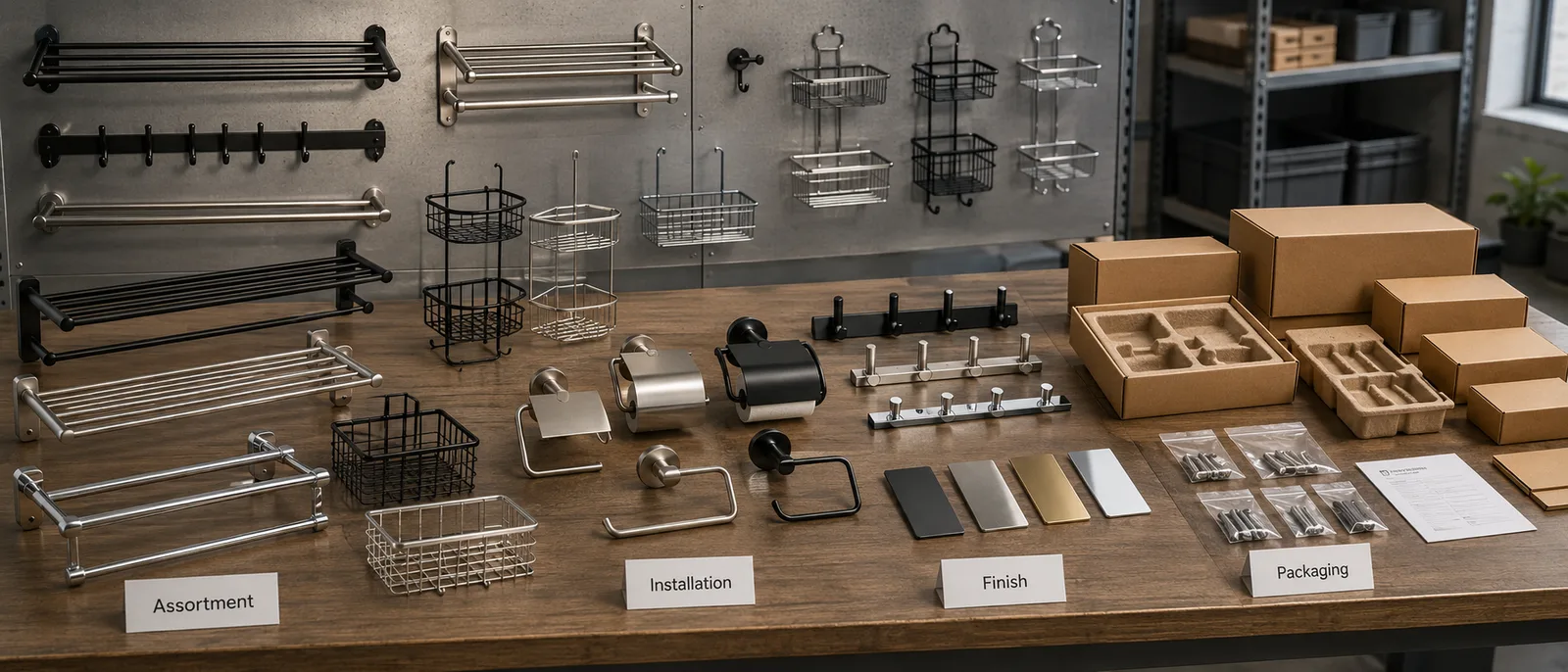
Buyers sourcing bathroom storage hardware for European retailers should evaluate the complete retail offer: assortment role, dimensions, installation method, material and finish, component control, packaging, language versions, buyer-supplied market information and repeat-order consistency. A product should not be approved from appearance alone. The supplier and buyer need one controlled specification covering the item, hardware, instructions, retail pack and master carton before production.
European retail is not one uniform market. Store format, price position, housing conditions, preferred installation methods, languages and packaging expectations vary by country and customer. The buyer remains responsible for identifying applicable legal and retailer requirements. A factory can support product development and packaging preparation, but it should not invent compliance wording or guarantee market acceptance without project-specific evidence.
How Should Retailers Build a Bathroom Hardware Assortment?
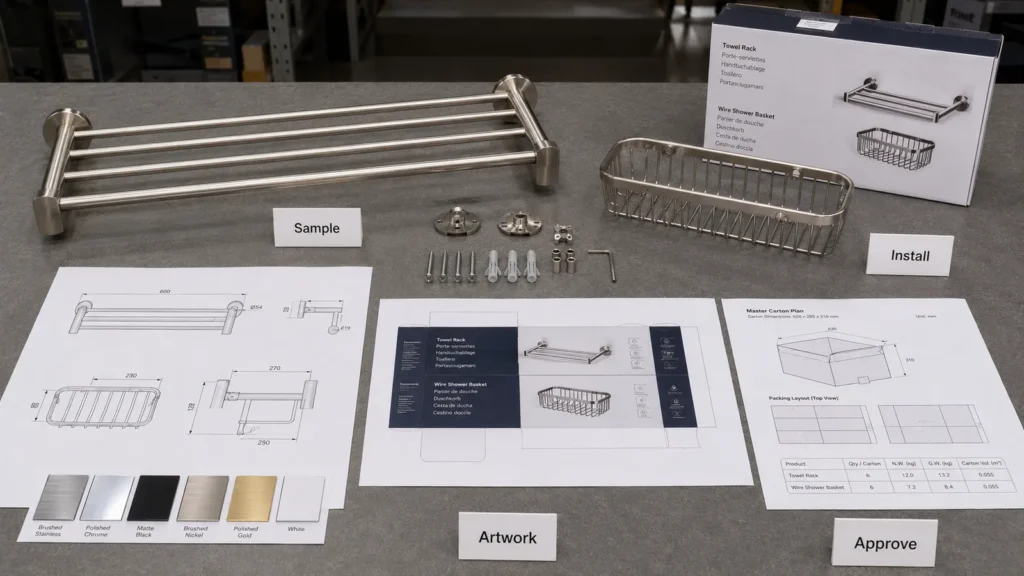
A retailer should build the assortment around clear storage tasks, price levels, installation methods and coordinated finishes. Each SKU needs a role; adding near-identical products can divide volume and create unnecessary packaging, finish and inventory complexity.
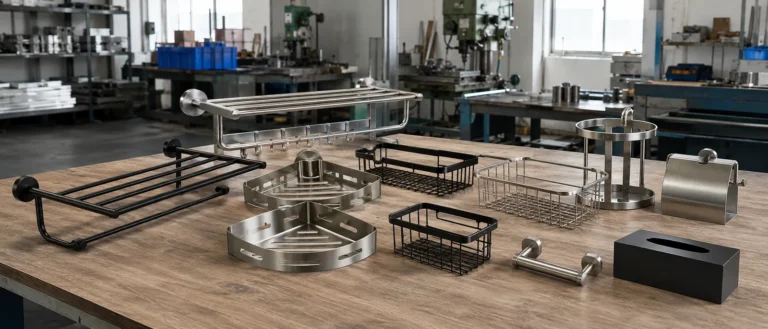
Start with customer problems rather than factory catalogs. Towel racks and bars manage textiles. Shower caddies and corner baskets organize wet-area products. Tissue holders, hook bars and hair dryer holders solve narrower tasks. Multi-tier racks provide larger storage capacity but occupy more visual and physical space.
Define good, better and specialist positions where the category requires them. Differences should be understandable: material, usable capacity, installation system, finish, packaging or coordinated design. A thicker part or heavier product is not automatically better if it adds cost without improving the intended use.
Range architecture can also reduce sourcing complexity. Shared brackets, caps, fasteners, color references and packaging rules may support several products when technically compatible. The buyer should still confirm each model’s fit, stability, instructions and selling configuration.
Retail Assortment Planning Checklist
- Storage task and target room location.
- Target customer, price position and sales channel.
- Wall-mounted, no-drill, freestanding or cabinet installation.
- Usable dimensions and target items.
- Coordinated finish and design family.
- Shared and product-specific components.
- Retail packaging and language versions.
- Trial quantity, launch timing and repeat-order plan.
Which Product Formats Fit Different Retail Needs?
Product format should match the installation environment, customer skill level, storage task and available space. Retail buyers should compare the complete user journey from shelf selection to installation and daily use.
| Product format | Retail use | Buyer advantage | Critical review |
|---|---|---|---|
| Drill-mounted accessory | Permanent installation | Defined bracket connection | Hole spacing, hardware, wall clearance and instructions |
| No-drill accessory | Rental or low-tool installation | Simplified installation proposition | Surface conditions, installation steps and project-specific tests |
| Freestanding rack | Flexible floor or counter storage | No wall installation | Foot contact, wobble, footprint and packaging volume |
| Wire shower basket | Wet-area bottle storage | Drainage and product visibility | Wire spacing, welds, finish coverage and bottle stability |
| Coordinated accessory family | Range merchandising | Consistent visual identity | Color consistency, shared parts and SKU differentiation |
Buyers developing accesorios de baño de marca propia should document how each format is explained on the packaging. Installation claims, compatible surfaces and included hardware must match the approved product and buyer-reviewed information.
How Should Dimensions and Installation Be Reviewed?
Dimensions and installation should be reviewed against real bathrooms, intended contents and the full mounting system. Overall size alone does not confirm usable capacity, wall fit or customer installation experience.
Measure overall width, depth and height, but also show internal basket space, towel-bar clearance, mounting centers, bracket footprint and distance from the wall. For corner products, check the intended wall angle and how the basket meets both surfaces. For multi-tier racks, confirm shelf spacing with target bottles or folded items.
Installation hardware must be treated as part of the SKU. Screw, anchor, mounting plate, cover, adhesive pad or suction component should have a controlled specification and defined package location. Instructions should reflect the actual hardware, not a generic drawing reused across unrelated products.
Project-specific performance requirements need a defined test method and acceptance criteria. Do not rely on phrases such as heavy duty or strong adhesive. The buyer should describe the intended substrate, preparation, loading, duration and evaluation appropriate to its market and retailer process.
A fabricante de accesorios de baño a medida can review bracket access, weld position, clearances and manufacturability before sampling, but final installation requirements should be confirmed by the buyer.
What Material and Finish Questions Matter for Retail?
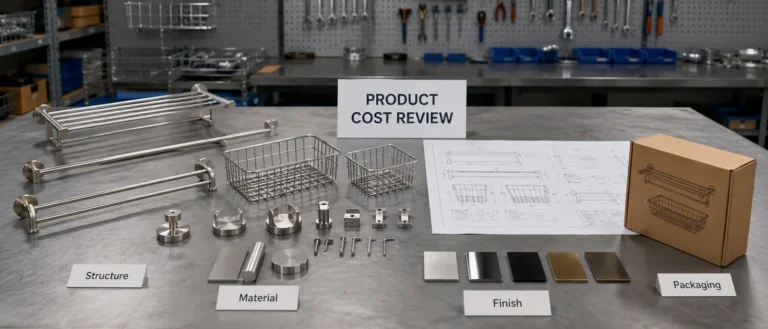
Retail material and finish decisions should balance environment, appearance, assortment position, cleaning expectations, packaging contact and repeat-order control. Buyers should approve physical references rather than relying only on names such as chrome, silver, matte black or stainless.
Powder-coated steel can provide color and texture options. The project should define color direction, gloss or texture, visible surfaces and acceptable appearance around bends and welds. Stainless steel may support a metallic appearance and a different corrosion-resistance strategy, but grade and surface direction still need confirmation.
No finish is universally rust-proof. Corrosion risk depends on material, surface preparation, finish coverage, product geometry, moisture exposure, cleaning and maintenance. Unsupported salt-spray hours or guarantees should not appear in the product page or packaging.
Finish references should be reviewed on representative product geometry. A flat swatch may not show how a color behaves around wire intersections, corners or polished areas. Packaging should also be sampled with the final finish because sleeves, hardware bags and carton movement can create visible rubbing.
Para bathroom storage hardware for European retailers, repeat-order color consistency matters across coordinated SKUs. Record the approved reference, sample revision and finish name, and check whether multiple suppliers or production periods must match one range.
What Makes Bathroom Hardware Retail Ready?
Retail-ready bathroom hardware combines an approved product with correct components, clear buyer-approved information, suitable protection, scannable identification and a master-carton plan. The packaging must support merchandising and logistics without hiding product defects or creating installation confusion.
The buyer should supply or approve brand artwork, barcode, model, language, importer information, warnings and market-specific statements. The factory should not invent legal wording or certification marks. Different countries or retail accounts may require separate artwork versions, so each file needs a clear code and approval record.
Product photographs and diagrams must show the final configuration. If the mounting plate or hardware changes after artwork approval, instructions and component lists should be revised. A generic leaflet can create avoidable returns when it does not match the actual SKU.
Protection should focus on finished surfaces, projecting brackets, wire corners and loose hardware. Review the retail pack and master carton together. Carton quantity, orientation, separators, final dimensions and packed weight should be confirmed after a physical packaging sample.
Retail-Ready Approval Checklist
- Product code, drawing and sample revision match.
- Dimensions and installation hardware are confirmed.
- Finish matches the approved physical reference.
- Every component is counted and restrained.
- Instructions match the product and installation method.
- Buyer-approved languages, barcode and product information are correct.
- Retail packaging protects visible surfaces.
- Master-carton arrangement and packed dimensions are recorded.
- Project-specific tests use agreed criteria.
- Final approval is documented before production.
How Should Buyers Qualify Samples and Repeat Orders?
Buyers should qualify the complete selling sample, then use controlled drawings, finish references, component lists and packaging records for repeat orders. Supplier evaluation should test communication and revision discipline as well as product appearance.
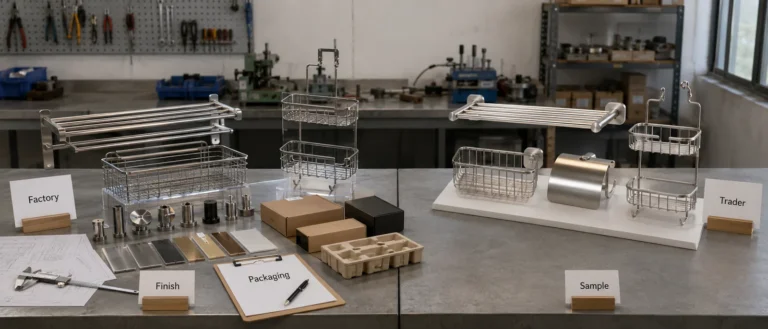
Koitor Hardware’s practical workflow is to review drawings or physical samples, discuss manufacturability, develop a sample and confirm packaging before small-batch production. As a family-owned custom metal hardware factory, Koitor supports bathroom and home storage products with direct factory communication.
Samples usually take 5-7 working days after design and materials are confirmed. Bulk production usually takes 4-6 weeks depending on quantity, complexity, material availability, finish and packaging. MOQ can start from 100 pieces depending on the product. These figures are planning references, not fixed guarantees.
During sample review, install the product, load it according to the agreed project method, inspect alignment and safe edges, compare the finish, count components and pack it. Record every revision with dated photographs and an updated drawing. A sample approved only from photos may not reveal fit, finish texture or installation behavior.
Repeat orders should refer to the approved revision and identify any requested change. Compare key dimensions, finish, hardware and packaging against retained references where practical. If material, component or packaging availability changes, the supplier should raise the issue before substitution.
Supplier qualification should include a documentation test. Ask the factory to return a marked drawing, identify open questions and confirm the quotation basis. A supplier that notices conflicting dimensions or missing hardware before sampling may reduce later ambiguity. Buyers should also check how finish references, approved samples and packaging files are stored for repeat orders.
Para bathroom storage hardware for European retailers, change control is especially important when one product is sold in several language packs or retail accounts. The metal product may remain unchanged while barcode, importer information, instruction language or carton label differs. Each combination should have a clear SKU or packaging code so the correct components are assembled together.
Before a repeat order, issue a short confirmation sheet covering product revision, finish, component list, packaging artwork, quantity and requested delivery basis. Do not assume that an old purchase order communicates every approved detail. If the retailer changes artwork or installation text, verify that the physical product and hardware still match the new instructions.
Buyers should also plan how quality concerns will be reported. Photographs should identify the product code, order, issue location and quantity affected. Dimensional concerns need measurement points and tools; finish concerns need useful lighting and an approved reference. Clear evidence allows the buyer and factory to distinguish an isolated handling issue from a specification or production question.
More practical sourcing guidance is available through Recursos de Koitor.
Preguntas frecuentes
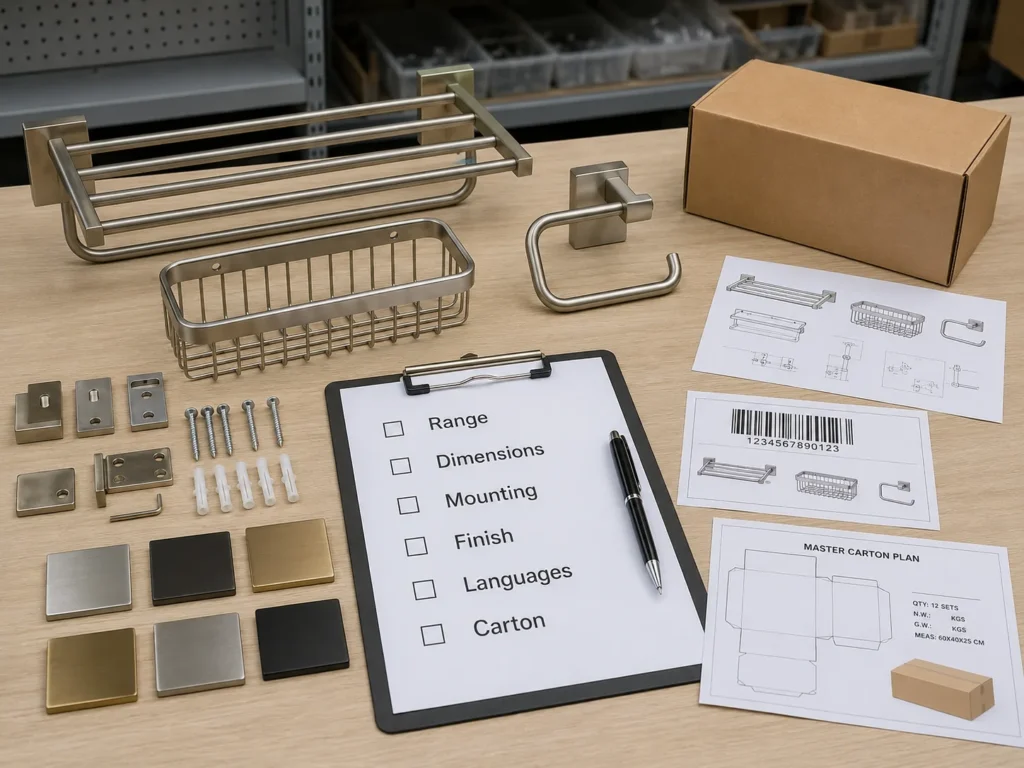
Do bathroom accessories need CE marking?
Requirements depend on the product, claims, installation and target market. The buyer should obtain qualified market-specific advice and should not place certification wording or logos on packaging without a confirmed basis.
How many languages should retail packaging include?
The retailer or importer should define the countries, channels and required languages. Each approved language version should have a separate artwork code to prevent the wrong pack from being used.
Can one finish reference cover an entire bathroom range?
One reference can guide a coordinated range, but appearance may vary with material form, polishing, texture and geometry. Confirm representative samples for key products and record the acceptable reference.
Is a small trial order suitable for a European retail launch?
A small-batch trial can help review product, packaging, logistics and customer response before a larger repeat order. Feasibility and MOQ depend on structure, finish, components and packaging.
What should retailers check before reordering?
Confirm the approved drawing, finish, components, packaging artwork, quantity and delivery basis. Identify any requested change explicitly and ask the supplier to report substitutions before production.
Trabaja con Koitor Hardware
Developing a Bathroom Hardware Range for European Retail?
Send Koitor your assortment brief, drawing or sample, target dimensions, finish, installation method, packaging requirements and expected quantity. Our team can review manufacturability and small-batch options before quotation.
OEM / MARCA BLANCA
Convierte esta guía de abastecimiento en un resumen del producto
Indícanos el producto que deseas, el tamaño, el acabado, la cantidad del pedido y los requisitos de embalaje. Tu equipo recibirá un análisis práctico de la viabilidad de fabricación antes de recibir el presupuesto.
 English
  Español