
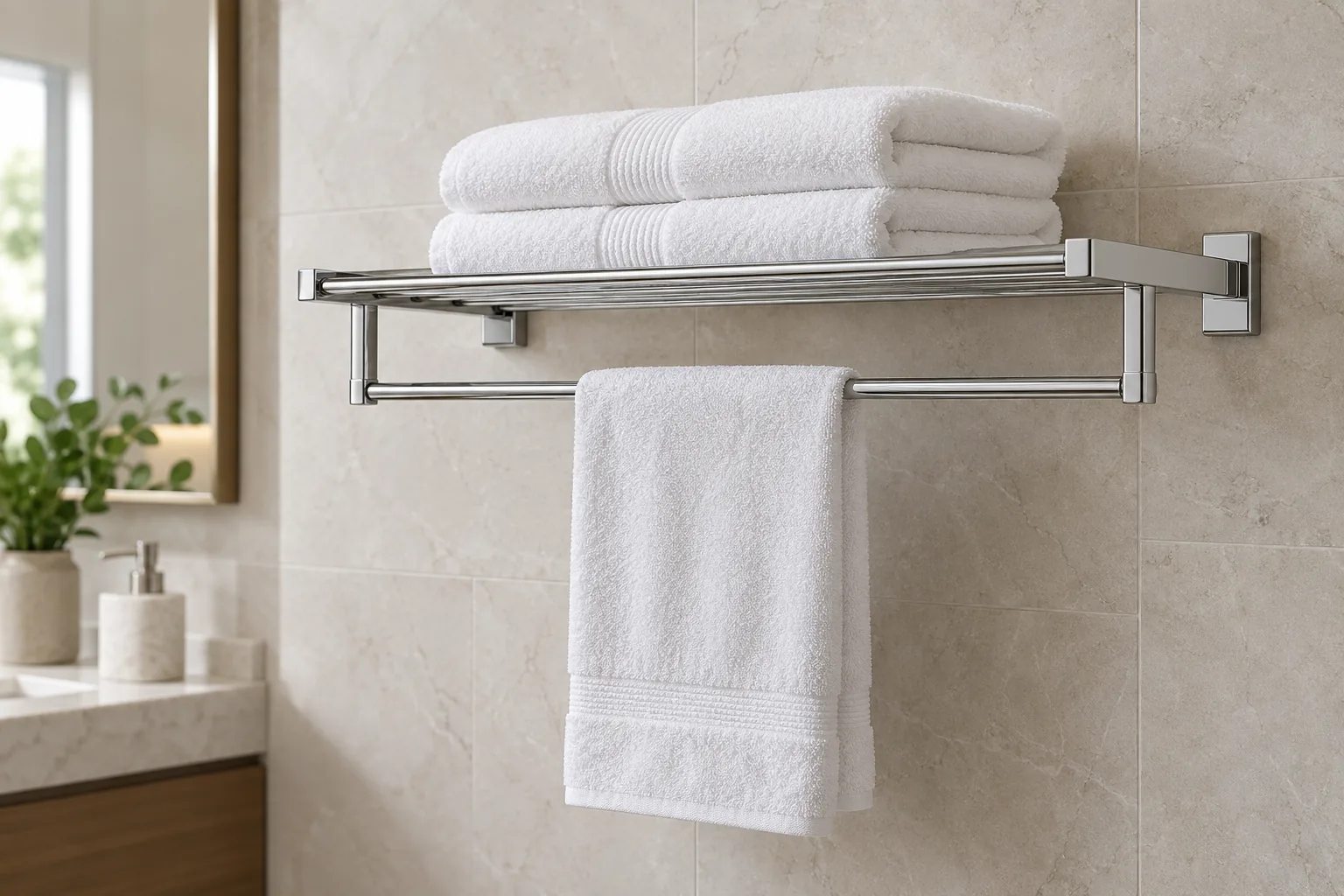
A buyer writing a bathroom towel shelf and bar clearance specification should treat the shelf, hanging bar, mounting brackets, towels and nearby fixtures as one usable envelope. The design is not approved simply because a folded towel fits on the shelf or a hand towel hangs from the bar in isolation; both actions must remain practical in the intended bathroom layout.
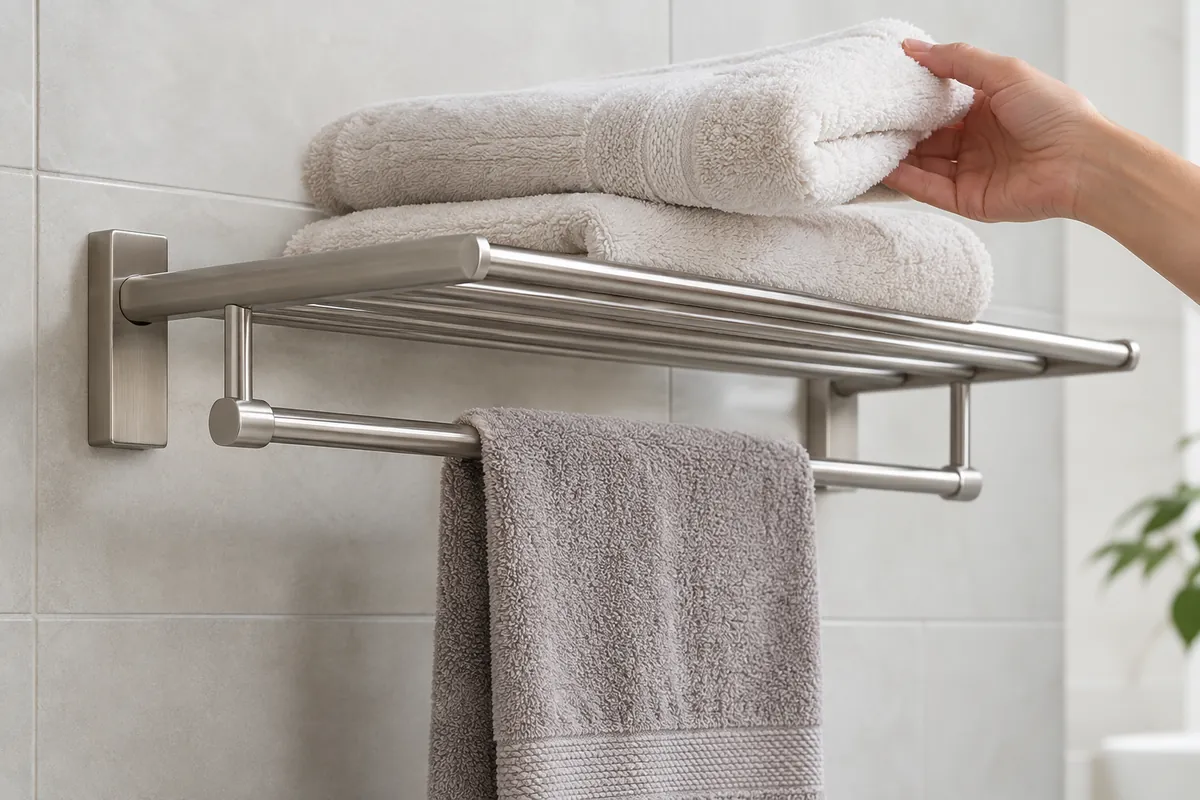
Why can an integrated shelf and bar feel crowded?
Combining a towel shelf with a bar uses one wall zone for two functions. The folded towel needs a usable shelf depth and a front edge that retains it without making removal awkward. The hanging towel needs enough drop and front clearance to hang freely. If the shelf is too deep, it may project into movement space or block nearby fittings. If the bar sits too close beneath it, a towel can brush the shelf or make hand access uncomfortable. These relationships depend on towel thickness and bathroom context, not one universal height.
The product’s mounting arrangement also affects usable space. A compact plate and bracket may keep the unit close to the wall, while a different support structure can increase projection. Buyers should distinguish the shelf envelope from the installed envelope, including the wall plate, fastener cover, bar ends, and any towel that hangs down. A room elevation that shows only the shelf centerline can hide a collision with a mirror edge, shower screen, door swing, basin, or another accessory.
Usage sequence matters. A person may lift the top folded towel from the front, replace a dry towel, or pull a hanging towel sideways. The design should allow those motions without repeatedly disturbing the other stored towels. Decide whether towels will be folded, rolled, stacked, or stored as a combination, then test that arrangement. The shelf and bar should be reviewed together; treating them as separate parts can produce a drawing that technically dimensions both but never checks the real combined access.
Which dimensions belong on the buyer drawing?
Show the overall width, usable shelf depth, shelf front-retention profile, vertical gap to the bar, bar diameter or profile, bracket projection, wall-plate footprint, and end clearances. The drawing should identify measurement datums so the supplier and buyer are discussing the same surfaces. State whether dimensions describe the bare metal product or the installed assembly. Add the nearby fixture envelope and the expected towel orientation where those affect the design.
Towels are soft goods with meaningful variation. Instead of specifying only a folded rectangle, provide representative folded thickness, width and fold style for the target assortment. A fluffy bath towel may behave differently from a thin hand towel. The bar should be checked with the intended hanging towel and its natural fold over the rail. The buyer should also decide whether more than one towel may be hung at once, because that changes access and visual density even if the product’s metal dimensions remain unchanged.
Coordinate height and reach with the project context rather than copy a single internet dimension. The buyer may have an installation datum, such as a finished floor reference or a relationship to a vanity, mirror, or shower enclosure. If the product will serve multiple room layouts, document the intended use envelope and define which conflicts are acceptable. Koitor’s [Fabricación a medida de toalleros de baño](https://koitorhardware.com/custom-bathroom-towel-rack-manufacturer/) information can support the broader product discussion, but a specific integrated configuration still needs drawing-level confirmation.
| Layout choice | Potential benefit | Comprobación del comprador |
|---|---|---|
| Shallower shelf | Reduced projection for compact rooms | Does the folded towel fit and remain retained? |
| Deeper shelf | More space for bulky folds | Does it obstruct fixtures or standing access? |
| Bar close below shelf | Compact combined envelope | Can fingers and hanging fabric move freely? |
| Bar set farther forward | Clearer towel grasping path | Does installed projection remain acceptable? |
How should buyers compare shelf and bar layouts?
A shallow shelf can reduce wall projection and may suit folded hand towels, while a deeper shelf can accept bulkier folds but occupy more space. A narrow bar gap can create a compact silhouette but may limit fingers or towel movement. A wider gap can improve access but increase the overall height of the product. These are not universal good-or-bad choices: the buyer must consider towel format, storage capacity, target room and package size together.
The bar may sit directly below the shelf front edge or be supported by a structure that places it slightly forward. A forward position can make the hanging towel easier to grasp, but it also increases the installed projection and may bring the towel closer to a basin or walkway. A bar tucked closer to the wall may preserve space but could cause a towel to touch the wall or conflict with the shelf underside. Ask the manufacturer to show a side section, not just a front elevation.
Also compare the shelf’s retaining edge. A low lip may preserve a minimal look but provide little control if towels are stacked loosely. A raised edge can retain folded fabric yet make removal more deliberate. Open-wire shelves can allow drainage and visibility but may leave gaps that interact with towel folds. A solid or tray-like shelf has different cleaning and appearance implications. The concept should be selected against the intended use, finish, and maintenance expectations without implying that one style is best for all buyers.
How can a sample review verify real access?
Install the sample using the approved mounting arrangement on a representative surface or a clearly documented fixture board. Place the expected folded towels on the shelf and hang the selected towel on the lower bar. Check whether the front towel can be lifted without catching the bar or dislodging the stack. Then return the towel and repeat from a realistic standing position. These observations should be recorded as project sample feedback, not presented as a universal ergonomic test or performance certification.
Check side-to-side and front-to-back clearances against the room layout. Open nearby doors, swing a shower screen if relevant, and consider where a person stands to reach the shelf. Note whether the towel hangs over a basin, radiator, toilet, or another accessory. A product may be mechanically sound but unsuitable for the intended placement if its bar or hanging fabric crosses a movement path. When the project has multiple installation contexts, review more than one representative layout.
Inspect the finish and joints after handling. Towels can snag on rough edges, projecting welds, or gaps at the bar supports. The sample review should look for smooth contact and coherent alignment, without inventing a pass/fail dimension. If the shelf depth, bracket, or bar position changes, update the drawing and sample approval reference. A photo with a ruler may help communicate a change, but it does not replace a controlled revision and clear acceptance criteria.
What should procurement control through production?
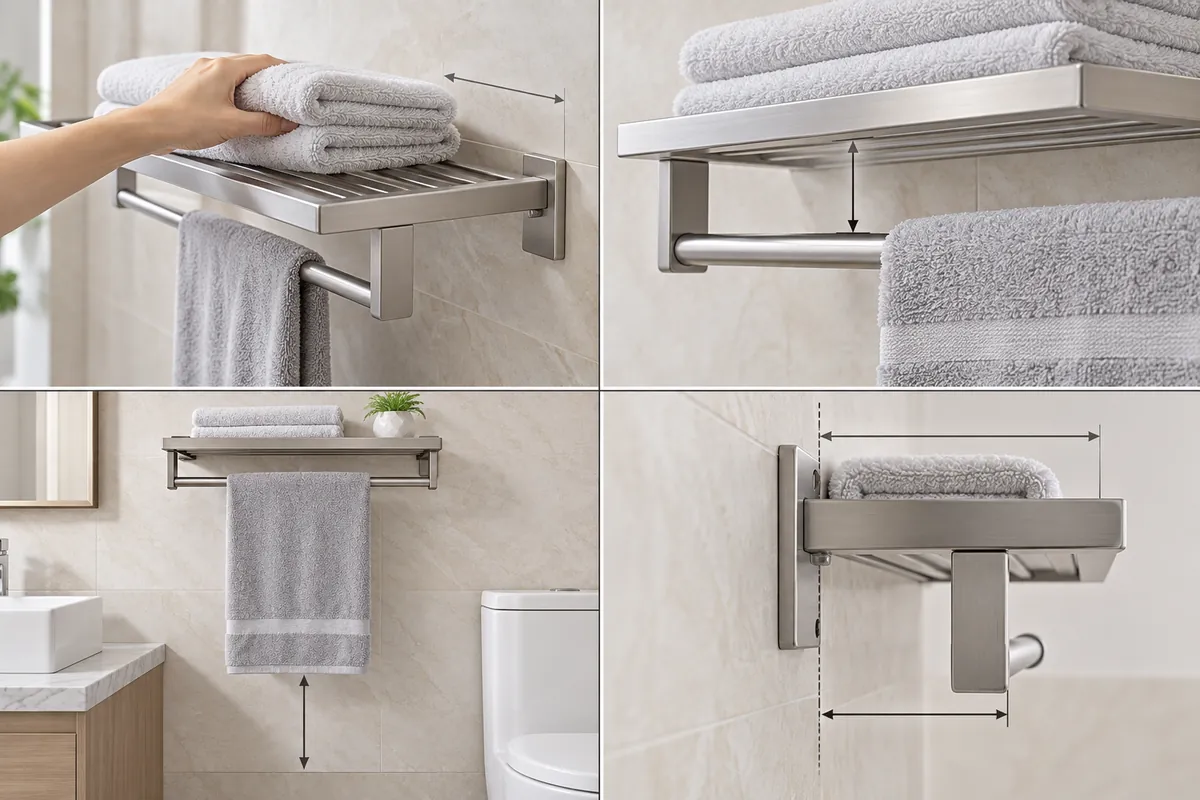
The buyer should identify which geometry drives function: shelf depth, bar separation, wall projection, bracket alignment and the position of the mounting points. Ask the supplier to reference those features in the approved drawing and to explain how the assembled sample is checked after finishing. A decorative finish can alter perceived gaps or contact behavior, and assembly can shift alignment. The review should focus on the final configuration the buyer will receive, not only an unfinished frame.
Packaging should protect the bar, shelf edge and exposed finish from rubbing against each other. If hardware, caps, or assembly parts are packed separately, the packout should make identification straightforward. The instructions need to preserve the approved orientation and mounting datum. A small installation diagram can show the buyer what the drawing calls the top, front, and wall side; this reduces the risk that a correct product is installed in a way that blocks the shelf or bar.
For repeat orders, hold the approved configuration and revision alongside the item code and finish description. If a bar support or wall plate changes, evaluate whether the installed envelope and towel access are affected before accepting the revision. Koitor is a specialized metal hardware manufacturer and can discuss drawing and sample coordination for bathroom accessories, while exact integrated shelf-and-bar production scope should be confirmed for the project. Use the [fabricante de accesorios de baño a medida](https://koitorhardware.com/custom-bathroom-hardware-manufacturer/) page as a starting point for that conversation.
The bathroom towel shelf and bar clearance specification should travel with the room elevation and the sample record, not live only in an email thread. When a buyer changes the towel assortment or moves the product beside a different fixture, the product team can see which clearances were previously reviewed and which need another look. This is especially helpful when a retailer offers one metal design in several widths or finishes. The supplier should identify the approved geometry and the project should name its decision owner. Keep photographs, drawing revisions and installation instructions aligned so that a later production check can distinguish an approved variation from an unintended assembly shift. None of this requires a universal height rule; it makes the buyer’s chosen installation context visible and reviewable. A clear record also prevents an adjacent towel-bar page from being mistaken for approval of the combined shelf-and-bar envelope. Keep the bathroom towel shelf and bar clearance specification tied to the actual folded and hanging towel set and nearby fixture envelope so the next sample review remains comparable.
Before sample approval, record the intended towel types and fold, shelf depth and retaining edge, bar profile and vertical gap, overall projection, mounting plate envelope, and nearby fixture clearances. Mark the installation datum and state whether the dimensions refer to the metal item or the finished wall installation. Identify any acceptable adjustment range and the part of the product that cannot change without renewed approval.
During review, place actual representative towels on both storage zones. Lift the top folded towel, return it, hang and remove the lower towel, and check whether fabric catches on a joint. Review the movement path from a realistic approach angle. Confirm that the unit fits the intended room elevation and that the bar does not send fabric into an unwanted fixture or walking area. Take photographs that show both front and side views, then link them to the drawing revision.
At release, confirm the production-intent finish, assembly, protective packout and installation instructions. State who can approve a change and how the changed drawing or sample is identified. If a repeat order uses a new finish, material form, mounting plate or packaging configuration, decide whether the contact and clearance review must be repeated. A short documented check is more useful than an unqualified claim that all towel shelves fit every bathroom.
Buyer approval checklist
- Towel formats and folded envelopes are identified.
- Shelf depth, front edge, bar gap and installed projection are dimensioned.
- Wall datum and nearby fixtures are included in the layout check.
- Actual towels are used to review both shelf retrieval and bar access.
- Finish, packout, installation instructions and revision control match the approved sample.
Preguntas frecuentes
Is there one correct gap between a towel shelf and bar?
No single value fits every towel, shelf profile, bracket and room. Buyers should define the towel envelope and review the combined sample with the intended installation layout.
Should the bar be directly below the shelf?
It can be, but the side section must show enough room for hands and hanging fabric. A forward offset may improve access while increasing projection, so evaluate both in context.
Can folded towels be used to approve the shelf depth?
Yes, representative folded towels are a useful sample input. Record their approximate envelope and test retrieval rather than relying only on a nominal shelf measurement.
Does this article set installation height?
No. It describes how to define a project datum and check the complete envelope. Installation height depends on the room plan, users, fixtures and buyer requirements.
Does the topic mean Koitor produces this exact combined model?
No. Koitor’s bathroom-hardware knowledge supports the sourcing discussion, but the exact integrated shelf-and-bar configuration must be confirmed for each OEM project.
Koitor is a family-owned custom metal hardware manufacturer focused on practical OEM communication. For adjacent product concepts, confirm exact process scope, specifications and sample expectations with the production team before making a sourcing decision.
Plan a buyer-ready product specification
Share your drawing, target assortment or physical sample so the project team can review the relevant geometry and questions.
OEM / MARCA BLANCA
Convierte esta guía de abastecimiento en un resumen del producto
Indícanos el producto que deseas, el tamaño, el acabado, la cantidad del pedido y los requisitos de embalaje. Tu equipo recibirá un análisis práctico de la viabilidad de fabricación antes de recibir el presupuesto.
 English
  Español
  Português
  Français
  Deutsch
  العربية