
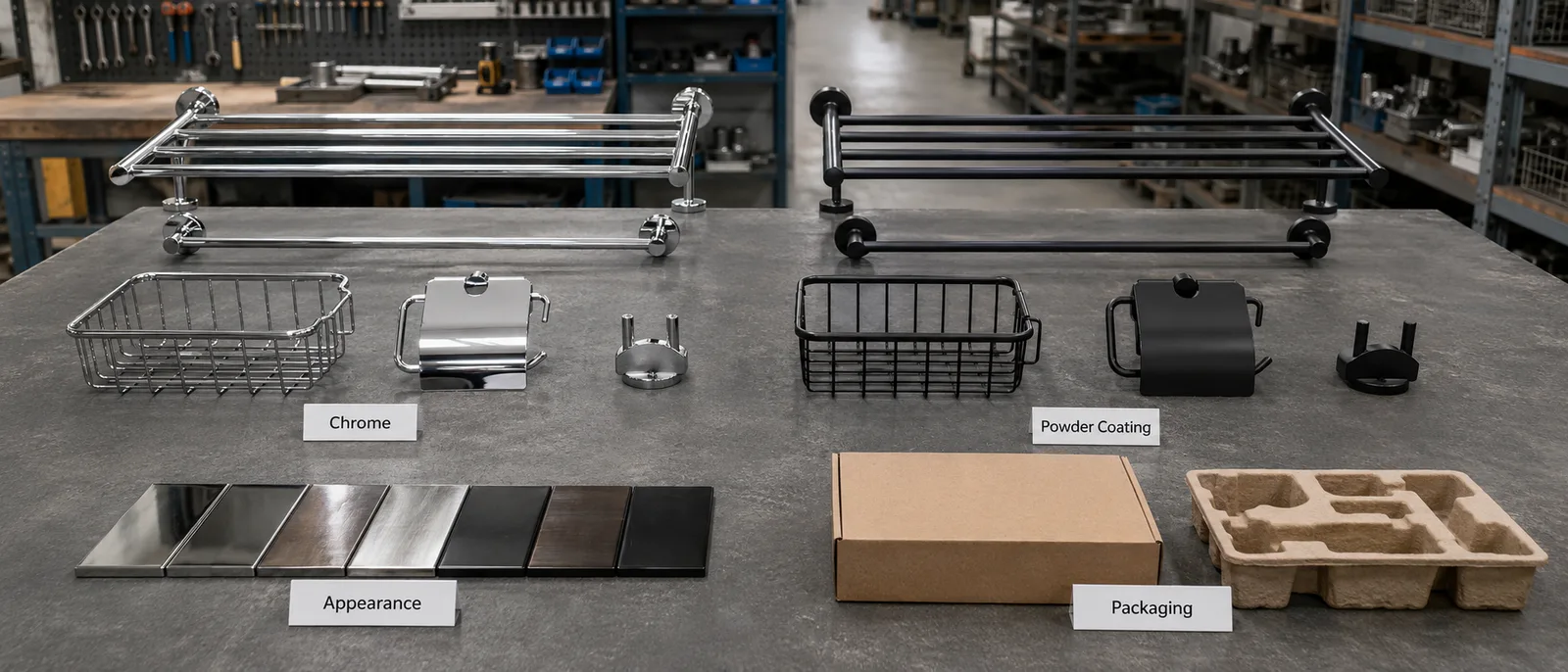
Chrome vs powder coating bathroom hardware is not a simple choice between shiny and colored surfaces. Importers should compare the base material, product geometry, preparation process, appearance target, moisture exposure, color range, order quantity, packaging and quality-control method. Chrome-style plated finishes can support a bright metallic look, while powder coating offers broad color and texture options, but either finish can perform poorly if the structure, preparation or handling is unsuitable.
The best sourcing decision begins with the target market and product range. Buyers should approve physical finish samples on the actual product or representative substrate, define visible surfaces, inspect difficult joints and protect the approved appearance through packing and shipment.
What Is the Main Difference Between Chrome and Powder Coating?
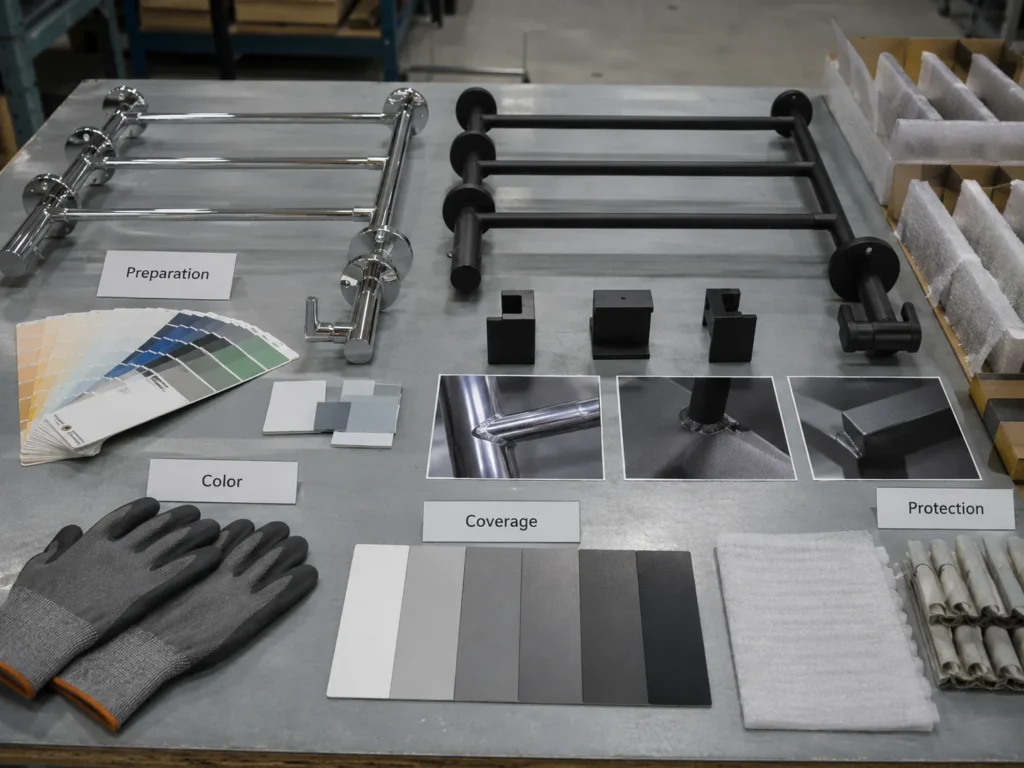
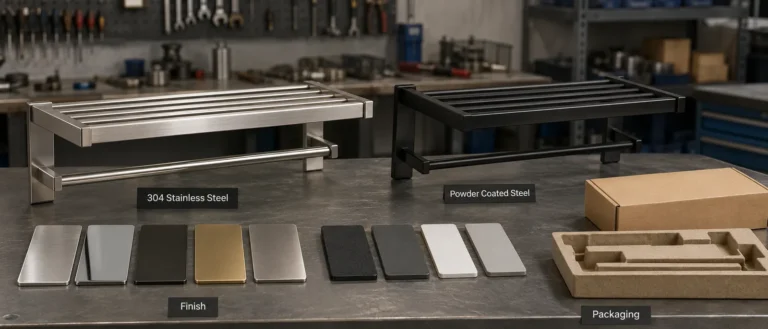
The main difference is how the finish is built and what appearance it creates. Chrome bathroom accessories commonly use a plated metallic finish over a prepared substrate, while powder-coated products use a dry coating that is applied and cured to create a colored protective surface.
A plated chrome appearance is reflective and visually emphasizes smooth preparation, joint cleanup and surface uniformity. Scratches, pits, grinding transitions or uneven underlying surfaces can remain visible because the finish is not intended to hide poor preparation.
Powder coating can offer matte, satin, gloss and textured appearances in many colors. It adds a visible coating layer and can provide useful design flexibility for private-label ranges. Coverage around corners, hooks, weld intersections and recessed areas still needs careful review.
Neither process should be evaluated by finish name alone. The substrate, cleaning, pretreatment, product geometry, finish application, curing or plating control, handling and packaging all influence the final result. A product’s moisture resistance also depends on edges, joints, scratches, trapped water and customer use.
| Buyer factor | Chrome-style plated finish | Powder-coated finish | What to approve |
|---|---|---|---|
| Visual direction | Bright, reflective metallic appearance | Colored matte, satin, gloss or texture | Physical sample under stable lighting |
| Surface preparation visibility | Underlying marks and transitions may be visually obvious | Coating creates a different visual layer but still needs sound preparation | Visible surfaces, weld cleanup and edge condition |
| Color flexibility | Primarily selected for metallic appearance | Broad color and texture options | Color, gloss, texture and range matching |
| Complex geometry | Preparation and plating consistency need review at joints | Coverage and curing need review at recesses and intersections | Hooks, corners, welds and hidden contact points |
| Packaging sensitivity | Reflective surfaces show handling and rubbing marks easily | Coated surfaces can scratch, chip or polish at contact points | Sleeves, separators, hardware bags and carton fit |
| Private-label range use | Works with coordinated metallic bathroom ranges | Supports distinctive brand colors and finishes | Cross-product finish board and approved tolerances |
How Do Appearance and Product Geometry Affect Finish Selection?
Appearance and geometry affect finish selection because reflective and coated surfaces reveal different manufacturing details. Buyers should review the finish on the intended towel rack, shower caddy, basket or tissue holder rather than approving a small flat color chip alone.
Chrome-style surfaces emphasize smoothness and reflection. Tube seams, grinding areas, weld transitions, pits and handling marks can change the visual result. Large flat covers and long straight bars may show different issues from dense wire baskets with many intersections.
Powder-coated surfaces depend on uniform application and curing. Deep corners, closely spaced wires, hook interiors and heavy weld areas can affect coverage. Thick buildup around a fitted joint may change assembly clearance, while insufficient coverage at an edge can create a visible weakness.
Product drainage and contact points matter in bathrooms. Horizontal shelves, closed corners and overlapping brackets can retain moisture. Nested baskets, metal hardware and retail packaging can rub customer-facing surfaces before the product reaches the market.
Mark visible and hidden surfaces on the drawing. A hidden bracket may follow a different appearance rule from a customer-facing rail, but it still needs a suitable finish for the project. Buyers should also define which color or reflection differences are commercially acceptable across a production batch.
For custom structures, Koitor’s Fabricación a medida de accesorios de baño process can review geometry, welding, visible surfaces, finish references and packaging before sampling.
How Should Buyers Evaluate Moisture and Corrosion Risk?
Buyers should evaluate moisture and corrosion risk by considering the complete product, not by treating chrome or powder coating as a universal guarantee. Base material, preparation, finish continuity, edges, welds, scratches, drainage, mounting and maintenance all affect performance.
A plated finish needs a suitable prepared substrate and controlled finish layers. Product geometry can create difficult areas at joints, inside hooks or behind brackets. Damage during assembly or transport may expose local areas and change the product’s behavior.
Powder coating needs sound preparation and continuous coverage appropriate to the design. Edges, weld spatter, sharp transitions and contact points deserve attention. A coating can be damaged by metal hardware, careless assembly or repeated rubbing inside inadequate packaging.
Bathroom exposure varies widely. A towel rack in a ventilated area faces different conditions from a shower basket that receives direct water and holds wet bottles. Cleaning products, standing water, condensation and coastal environments may also influence the risk.
Importers should define the intended use and any project-specific test requirement before quotation. Test methods, sample preparation, mounting, duration and acceptance criteria need written agreement. Do not publish exact salt-spray hours, service-life claims or universal rust-proof language without supporting project evidence.
Good design can help reduce risk. Drainage gaps, open joints where practical, protected contact points and packaging that prevents scratches are part of finish planning. Customer instructions may also address cleaning and care when appropriate.
How Do Customization, MOQ and Cost Differ Between Finishes?
Customization, MOQ and cost differ because the two finish routes use different preparation, processing, color-control and batch-planning requirements. Buyers should request quotations on the same product, substrate, quantity, packaging and quality basis.
Chrome-style finishes may involve more visible preparation work when the product has welds or grinding transitions. Reflective surfaces can require careful handling and protective packing. Complex geometry may increase inspection attention at joints and recessed areas.
Powder coating offers broader color customization, but a custom shade, texture or gloss may have practical batch requirements. Powder sourcing, color change, line setup and approval samples can affect MOQ and timing. Printed packaging may introduce a separate minimum quantity.
Material weight and product design remain important. A finish comparison should not hide differences in tube size, wire diameter, bracket structure or accessories. If two suppliers quote different constructions, the finish price alone is not comparable.
Packaging cost can also differ. Bright chrome bathroom accessories may need sleeves or films that protect reflective areas from fingerprints and rubbing. A powder coated towel rack may need separators around brackets, screws and coated contact points. Hardware bags should not move freely against either finish.
A chrome vs powder coating bathroom hardware cost review should use a decision matrix rather than one unit-price column. Record substrate, preparation, finish specification, inspection level, protective materials, individual box, carton quantity and expected freight basis. This reveals whether a lower quote simply excludes surface preparation or packaging that another supplier included.
Brands should also consider the cost of range consistency. If towel racks, shower caddies and tissue holders use different substrates and factories, matching a plated appearance or powder color may require more samples and approval rounds. A focused first range with shared finish references can reduce coordination work, while each product still needs its own geometry and coverage review.
Koitor Hardware supports small-batch OEM projects, with MOQ starting from around 100 pieces for some products depending on structure, material, finish and packaging. Samples usually take about 5-7 working days after details and materials are confirmed. Bulk production often takes about 4-6 weeks depending on quantity, complexity and approvals.
For towel rack programs, buyers can review Fabricación a medida de toalleros de baño to coordinate dimensions, brackets, finish direction and protective packing.
How Should Finish Samples and Production Quality Be Approved?
Finish samples and production quality should be approved through physical references, controlled lighting, marked visible surfaces and representative batch inspection. A verbal color name or website image is not a sufficient production standard.
Begin with the actual product or a representative component using the intended substrate and preparation. Record the finish process, color or appearance reference, gloss or texture direction, visible surfaces and accepted limitations. Photograph the sample for communication, but retain the physical reference where practical.
Review the sample from normal viewing distance and close range. Inspect straight bars, flat covers, corners, welds, hooks, bracket interfaces and hidden contact areas. Assemble the complete product because fitted parts can scratch or compress the finish.
For a coordinated range, place towel racks, tissue holders, hooks and baskets together. Different substrates and geometries can produce visual variation even when the same finish description is used. Decide whether the range needs a close visual match or only a related finish family.
During a trial order, inspect multiple units from different cartons. Check chrome-style surfaces for consistent reflection, preparation marks, handling damage and local finish differences. Check powder-coated surfaces for color, gloss, texture, coverage, contamination, chips and contact marks.
Record findings by location and quantity. A clear report should identify the item revision, finish reference, affected surface and inspection lighting. This helps the factory distinguish preparation, application, curing, handling and packaging causes.
Changes to substrate, pretreatment, powder, plating route, product geometry or packaging should trigger review. An earlier approval may not remain valid when a key process input changes. Repeat-order records should preserve approved references and component revisions.
Recommended Finish Inspection Sequence
- Confirm product, drawing, material and finish revisions.
- Compare representative units with the physical approved sample.
- Inspect customer-facing surfaces under consistent lighting.
- Review welds, edges, corners, hooks and bracket interfaces.
- Assemble or install representative products with supplied hardware.
- Check scratches, rubbing, fingerprints, chips or packaging contact.
- Inspect inner protection, retail box and master-carton arrangement.
- Record issue type, location, quantity and disposition.
What Should Be on a Bathroom Hardware Finish Checklist?
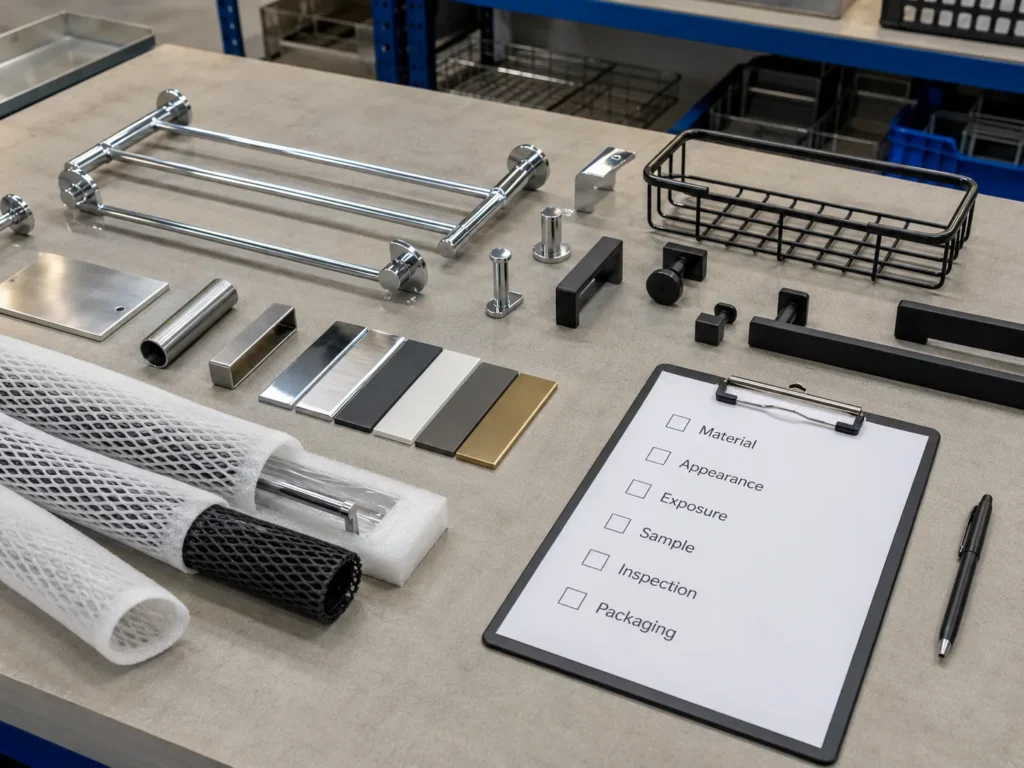
A chrome vs powder coating bathroom hardware checklist should connect market appearance, product geometry, substrate, preparation, bathroom exposure, sample approval, inspection and packaging. Buyers can then compare complete finish systems rather than isolated color names.
- Product category, target market and sales channel
- Chrome-style metallic or powder-coated visual direction
- Base material and product construction
- Customer-facing and hidden surfaces marked on the drawing
- Weld, grinding, polishing and edge-preparation expectations
- Color, gloss, texture or reflection reference
- Hooks, corners, recesses and bracket interfaces
- Direct-water, condensation and ventilation exposure
- Drainage and water-retention details
- Project-specific test and acceptance criteria
- Physical sample on the intended product or substrate
- Cross-product review for coordinated ranges
- Trial-order inspection across representative units
- Protective sleeves, separators and sealed hardware bags
- MOQ, color-batch, sample and production dependencies
Mandatory finish failures should not be hidden by a general supplier score. Exposed substrate, incorrect color, severe preparation defects or damage on customer-facing surfaces need a defined disposition. Minor observations can follow a separate agreed visual standard.
Use the Recursos de abastecimiento de hardware de Koitor for related guidance on materials, welding, packaging and supplier evaluation.
Preguntas frecuentes
Is chrome better than powder coating for bathroom hardware?
Neither is universally better. Chrome-style plating suits reflective metallic ranges, while powder coating supports broader colors and textures. The correct choice depends on substrate, geometry, exposure, target market, cost and quality controls.
Can powder coating match a private-label brand color?
Custom colors may be possible, but powder availability, batch requirements, substrate, texture and gloss affect the result. Approve a physical sample and confirm project-specific MOQ and timing.
Does chrome bathroom hardware resist rust?
Performance depends on substrate, preparation, finish layers, geometry, damage, moisture and care. Buyers should define the intended environment and use project-specific evidence rather than making a universal claim.
Why can the same powder color look different on two products?
Substrate, geometry, application, curing, texture, gloss and lighting can affect appearance. Review coordinated products together using physical samples under consistent lighting.
What should importers send for a finish quotation?
Send product drawings or samples, base material, desired appearance, visible surfaces, expected quantity, target market, exposure, packaging idea and any project-specific test requirements.
Trabaja con Koitor Hardware
Need Help Choosing a Bathroom Hardware Finish?
Send Koitor your drawing, physical sample, target appearance, bathroom exposure, packaging idea and expected quantity. Our team can review product geometry, finish practicality, samples and small-batch production options before quotation.
OEM / MARCA BLANCA
Convierte esta guía de abastecimiento en un resumen del producto
Indícanos el producto que deseas, el tamaño, el acabado, la cantidad del pedido y los requisitos de embalaje. Tu equipo recibirá un análisis práctico de la viabilidad de fabricación antes de recibir el presupuesto.
 English
  Español