Doblado de alambre por CNC frente al doblado manual: el estándar de cero defectos para el inventario de 2025
In the high-stakes arena of global hardware procurement, "tolerance" is not merely a number on a spec sheet—it is the defining metric of profitability. For a category manager sourcing 50,000 units of kitchen wire storage, a cumulative variance of just 2mm is the difference between a streamlined supply chain and a logistical disaster.
At Koitor Hardware, we have fundamentally re-engineered our production floor, transitioning 85% of our core wire forming processes from manual jig-based labor to 3D CNC (Computer Numerical Control) automation. This article serves as a technical white paper for B2B buyers, dissecting the engineering mechanics, cost structures, and quality assurance protocols that make CNC wire bending the imperative choice for 2025 inventory planning.
1. The "Monday Morning" Effect: Anatomy of Manual Failure
To understand the ROI of automation, we must first audit the liabilities of traditional manual labor. In conventional "jig bending," a worker manually pulls steel wire around a fixed metal post. While skilled craftsmanship has its place, it introduces biological variables that are mathematically incompatible with mass production consistency.
The Physiology of Inconsistency
- Torque Variance:Bending a 6mm Q195 steel wire requires significant force. A worker's peak torque application naturally degrades from 9:00 AM to 5:00 PM due to muscle fatigue. This results in "under-bent" angles late in the shift, creating batch disparities.
- Subjective QC:Manual inspection often relies on "go/no-go" gauges. If a wire passes the gauge but sits on the extreme edge of the tolerance limit (+1.5mm), and is welded to another wire at the opposite limit (-1.5mm), the final assembly fails.
2. Inside the Machine: 5-Axis CNC Architecture
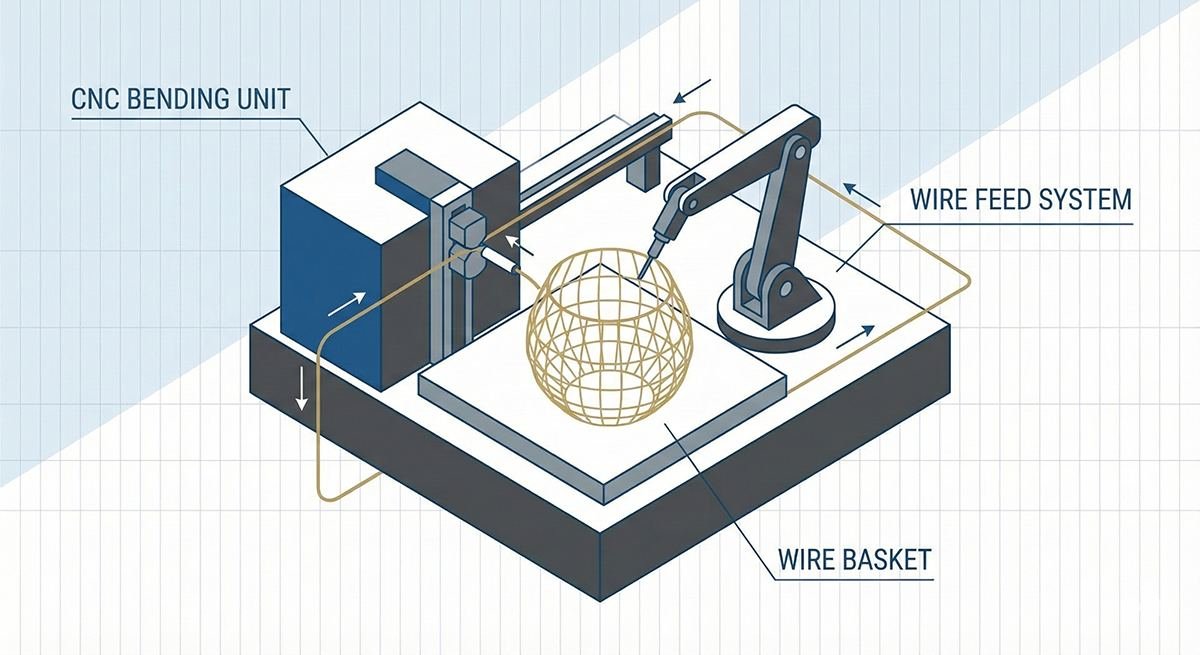
CNC wire bending is a "Soft Tooling" process. Unlike stamping, which relies on expensive, static dies (Hard Tooling), CNC machines operate on dynamic code. At Koitor, our machines utilize a synchronous 5-axis system:
Technical Specifications:
- Feed Mechanism:Servo-electric rollers with 0.01mm resolution (replacing hydraulic systems that fluctuate with oil temperature).
- Bending Head:360-degree rotation allows for unlimited radii generation without changing tools.
- Wire Rotation:The wire itself rotates on the longitudinal axis, enabling true 3D complex geometries.
3. Material Science: Solving the "Springback" Paradox
The single greatest challenge in metal forming is Elastic Recovery(Springback). When steel wire is bent past its yield point, the atomic structure stretches. Upon release, the elastic energy forces the wire to try and return to its original shape.
The Manual Problem:A human worker must "guess" the over-bend required. If the steel batch changes (e.g., tensile strength shifts from 350MPa to 380MPa), the human "muscle memory" fails.
The CNC Solution (Algorithmic Compensation):Koitor’s CNC machines feature real-time resistance feedback. The machine bends, measures the springback via a probe, and re-bends to the precise corrected angle in milliseconds. This ensures that Stainless Steel 304 is bent just as accurately as Carbon Steel.
4. Economic Analysis: Hard Tooling vs. Soft Tooling
| Factor de coste | Manual / Jig Bending | Koitor CNC Automation |
|---|---|---|
| NRE (Non-Recurring Engineering) | High ($500+ for jigs) | Near Zero (Programming) |
| Prototype Lead Time | 5-7 Days | 4-8 Hours |
| Defect Rate (PPM) | 30,000 PPM (3%) | < 1,000 PPM (0.1%) |
5. Case Study: The "Stacking" Crisis
The Client:A major UK kitchenware retailer. The Issue:Previous supplier used manual labor. Variance in the basket rim meant 15% of units would not stack securely, leading to retail display failures.
La solución de Koitor:We reprogrammed the geometry into our 5-axis CNC line. By maintaining a Z-axis tolerance of ±0.2mm, we ensured perfect nesting. The Result:Zero defects. Furthermore, the tighter nesting allowed us to fit 12% more product per shipping container, saving the client $3,500 in ocean freight per shipment.
Conclusion: The 2025 Standard
As we approach 2025, the era of "cheap labor" manufacturing is ending. Sourcing from a factory that relies on manual bending is a risk strategy. At Koitor Hardware, we don't just sell metal wire; we sell engineered precision.
Simon, experto en abastecimiento
¿Estás listo para mejorar tu cadena de suministro?:
Deja de pagar por los defectos. El mercado avanza hacia la precisión. Asóciate con Koitor Hardware para obtener soluciones automatizadas de alambre metálico con altos márgenes de beneficio.
Solicitar el catálogo de 2025Iniciar proyecto OEM
Correo electrónico: simon@koitorhardware.com | Fábrica: Jiangmen, China
Envía a Koitor tu plano, una foto de muestra, una referencia del acabado, la cantidad deseada y el mercado de destino.
OEM / MARCA BLANCA
Convierte esta guía de abastecimiento en un resumen del producto
Indícanos el producto que deseas, el tamaño, el acabado, la cantidad del pedido y los requisitos de embalaje. Tu equipo recibirá un análisis práctico de la viabilidad de fabricación antes de recibir el presupuesto.
 English
  Español
  Português
  Français
  Deutsch
  العربية