
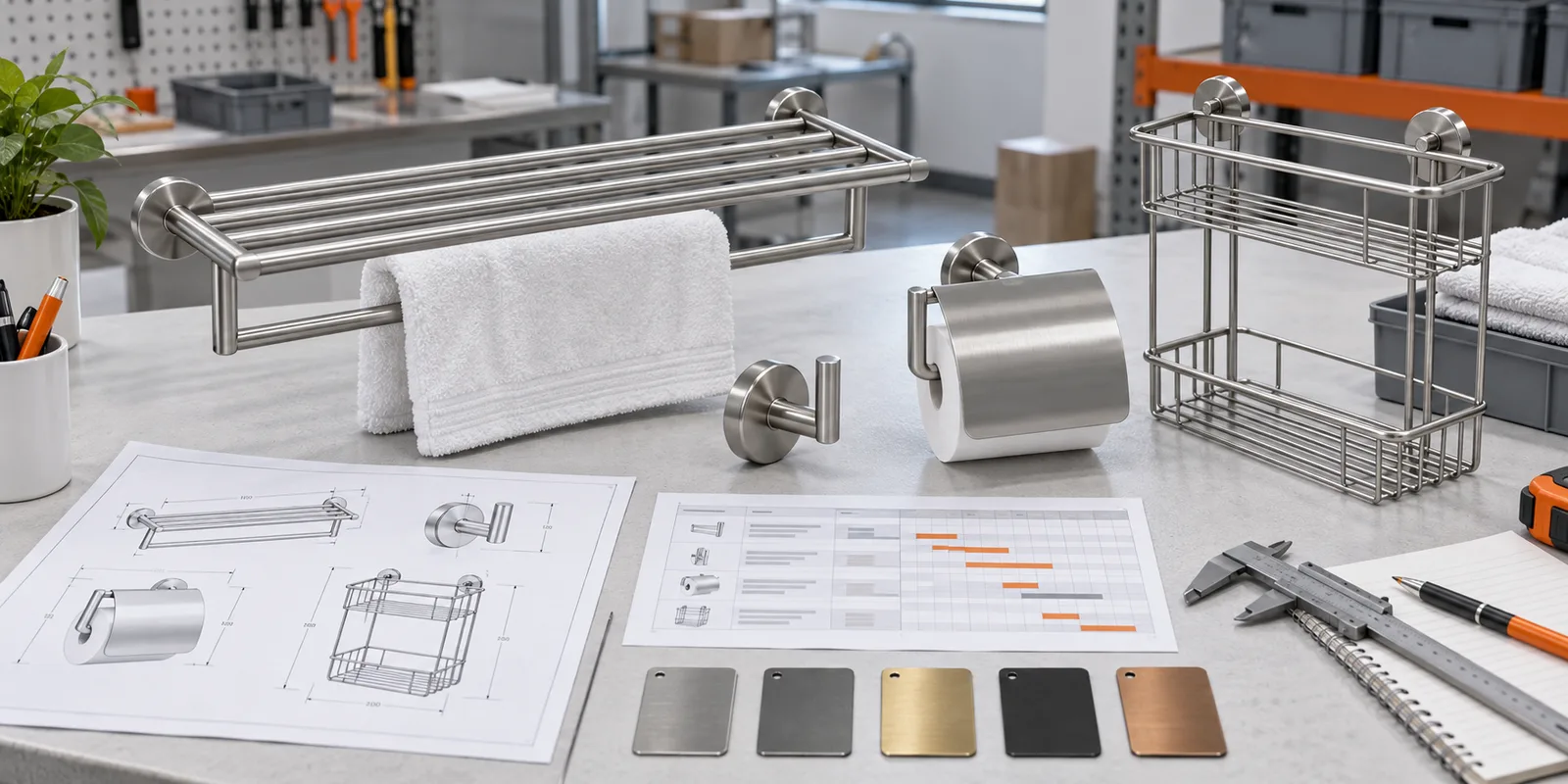
Hotel bathroom hardware OEM sourcing works best when the buyer converts the design concept into a controlled room schedule, product specification, approved sample, packaging rule, inspection plan, and spare-parts list. The supplier should not be asked to interpret a mood board as a production specification. A hotel towel rack, tissue holder, robe hook, shower caddy, and storage basket may look simple, but their mounting interfaces, finishes, wall conditions, and room-by-room quantities must agree before mass production.
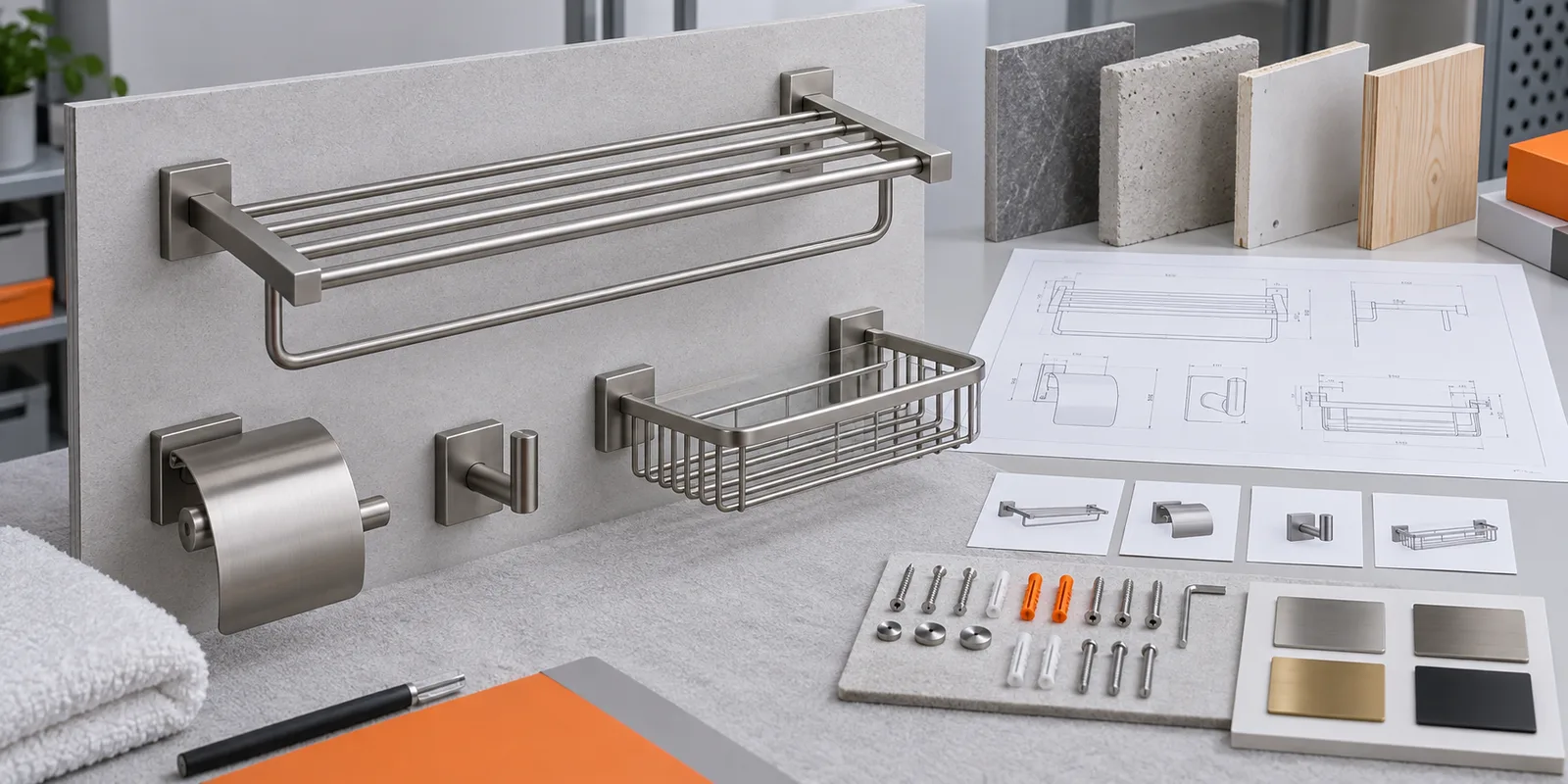
What Should a Hotel Bathroom Hardware OEM Brief Include?
A useful hotel bathroom hardware OEM brief identifies every item, every room type, and every decision that affects production or installation. It should allow the factory, buyer, installer, and project manager to discuss the same product without relying on memory or informal chat messages.
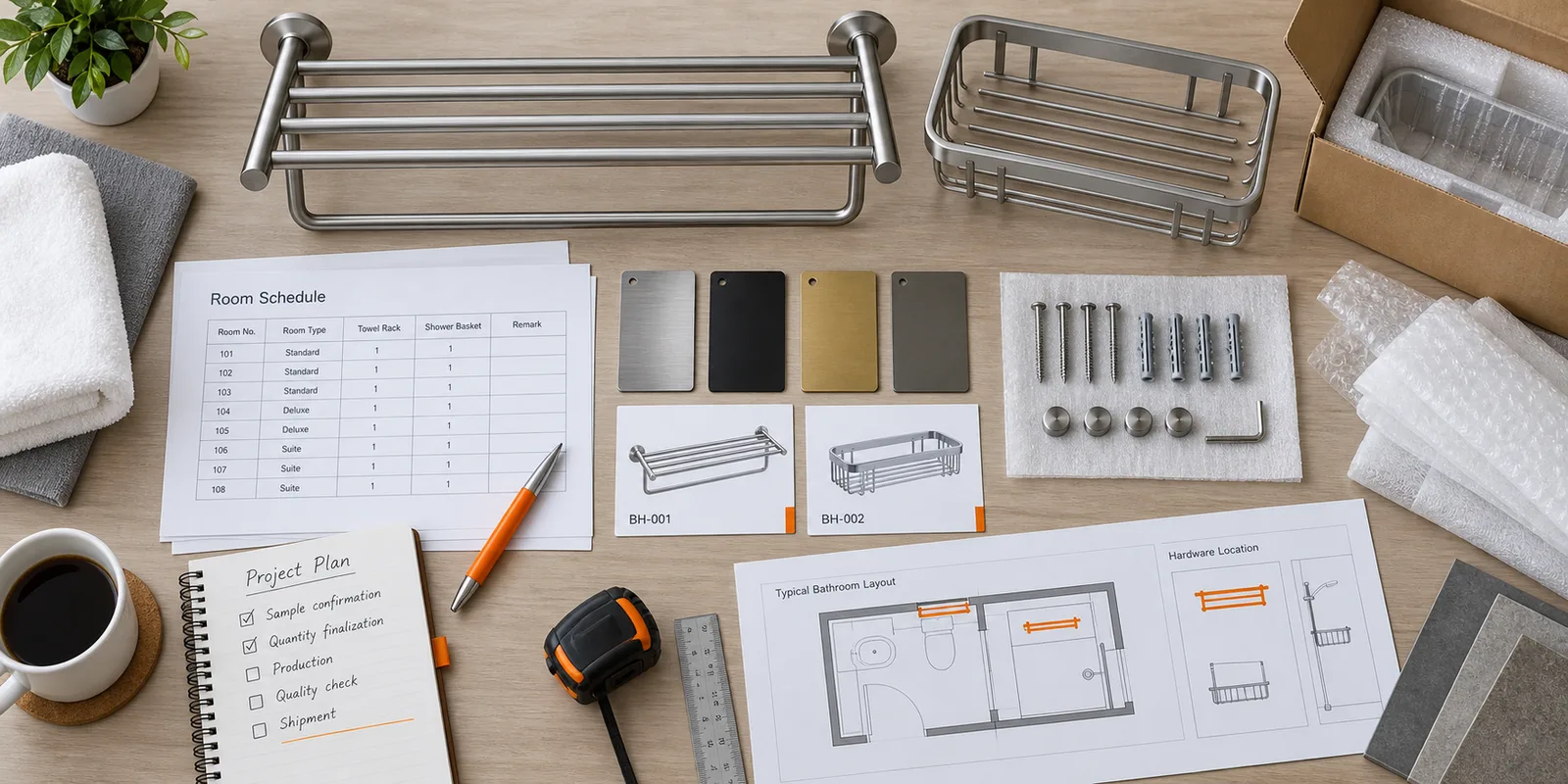
Start with a room schedule. List standard rooms, accessible rooms, suites, public washrooms, spa areas, and staff facilities separately. For each space, state the product code, quantity per room, finish, dimensions, mounting method, handed orientation if relevant, and any packaging or labeling requirement. Then add an allowance for mock-up rooms, site damage, and future replacement.
The product specification should include:
- Overall dimensions and critical mounting-center dimensions.
- Material family and visible surface finish.
- Tube, wire, sheet, or bracket dimensions that affect structure.
- Weld location and the acceptable appearance of visible joints.
- Wall interface, screw type, anchor assumption, and cover plate details.
- Edge treatment, drainage, cleaning access, and contact points.
- Unit packaging, carton identification, and room-set grouping rules.
- Approved drawing revision and approved physical sample reference.
Buyers can discuss drawings, samples, and practical production options with a fabricante de accesorios de baño a medida. A drawing is especially important when the hotel designer wants a coordinated family of accessories rather than independent catalog items.
Define terms in plain language. A “gold finish,” for example, is not a sufficient production instruction. It may refer to different color tones, gloss levels, base materials, and coating processes. A “concealed fixing” also needs the bracket geometry, cover method, screw access, and installation sequence. Clear definitions reduce interpretation gaps between design approval and production.
Why Do Room Schedules and Installation Conditions Matter?
Room schedules control quantities, while installation conditions control whether the selected hardware can actually be fitted. Both are essential because hotels often combine several wall constructions, room layouts, and accessory variants in one project.
A buyer should not calculate only the total number of guestrooms and multiply by one accessory set. Accessible rooms may require different positions or product forms. Suites may use additional rails or shelves. Public areas may have a different finish. Mirror, tile, cabinet, and plumbing positions can also change the available mounting zone.
Ask the project team to provide wall build-up information before freezing the mounting kit. Tile over concrete, tile over masonry, hollow partition, prefabricated bathroom pod, and furniture panel installations do not use the same anchors. The hardware factory can define the product-side hole pattern and supplied screws, but site engineers should confirm the anchor for the actual substrate and local installation requirements.
Create a mounting-interface drawing that shows:
- Hole-center spacing and tolerance.
- Bracket footprint and cover-plate dimensions.
- Required clearance for tools and assembly.
- Product projection from the finished wall.
- Orientation and leveling reference.
- Supplied fasteners and items that the installer must source locally.
For towel storage, review folded towel depth and loading behavior, not just the rail width. A custom towel rack manufacturing discussion may include shelf spacing, front-rail position, tube shape, weld visibility, and installation access. These details affect usability and manufacturing feasibility at the same time.
Room schedules also support traceability. Product codes can appear on drawings, sample labels, purchase orders, cartons, and inspection sheets. When one room type changes, the team can update the affected code instead of issuing ambiguous instructions for “the hotel rack.”
How Should Buyers Compare OEM Supply Options?
Buyers should compare suppliers through project-control capability, not quotation price alone. The strongest option is the supplier that can translate drawings and physical references into controlled samples, repeatable production instructions, practical packaging, and responsive communication.
| Área de evaluación | Basic catalog supply | Project-adapted OEM supply | Buyer verification question |
|---|---|---|---|
| Dimensiones del producto | Existing standard sizes | Dimensions reviewed against room needs | Which dimensions are fixed and which can change? |
| Finalizar | Standard available colors | Approved finish reference for the project | How will the approval sample be retained and compared? |
| Montaje | Generic screw pack | Hole pattern and mounting kit reviewed | What wall substrate is assumed? |
| Product family | Items selected independently | Visual and dimensional coordination | Which details must match across all accessories? |
| Embalaje | Individual generic carton | Item, room-set, or zone identification | How will installers identify products on site? |
| Inspección | General appearance check | Drawing- and sample-based checkpoints | Which dimensions and appearance points are critical? |
| Change control | Informal messages | Revision-controlled drawing and sample | Who approves the final production revision? |
| Spare parts | Ordered after a shortage | Planned with the original order | Which parts are replaceable without removing the full product? |
Catalog supply can be appropriate when the project accepts existing dimensions, finishes, and packaging. Project-adapted OEM supply becomes more valuable when the hotel requires a coordinated appearance, special dimensions, private labeling, room-set packing, or future replacement support.
Koitor Hardware is a family-owned custom metal hardware factory focused on bathroom and home storage hardware. For suitable projects, its flexible small-batch OEM approach can support mock-up samples, trial quantities, drawing or physical-sample review, and direct factory communication. Buyers should still confirm the exact material, finish route, tooling needs, quantity, packaging, and schedule for each project rather than assuming every customization follows the same path.
How Should Samples, Finishes, and Revisions Be Approved?
Sample approval should create a reproducible production reference. A sample is not fully approved until the buyer records what was accepted, which drawing revision it represents, and which characteristics may still change.
Use a staged process. First review the drawing or dimensional proposal. Next confirm a structural sample if geometry, mounting, or weld placement is new. Then review the finish on the actual base material where possible. Finally approve a complete sample with packaging and installation components.
The approval record should include photographs, measurement results, finish reference, packaging arrangement, date, drawing revision, and written disposition. Mark the sample “approved,” “approved with listed changes,” or “rejected.” Avoid a casual “looks good” response because it does not identify the production standard.
Finish approval deserves special care in hospitality bathroom accessories sourcing. Lighting, camera processing, monitor settings, substrate preparation, and gloss can alter perceived color. Compare physical finish references under agreed lighting. Check flat and curved areas, visible weld zones, corners, and contact points. If products in the same room use different base materials or shapes, confirm whether a practical color range is acceptable.
Revision control can be simple:
- Give every drawing a product code and revision letter.
- Record each requested change in a dated list.
- Issue one consolidated revision for confirmation.
- Link the approved sample to that revision.
- Prevent production from using superseded files.
- Record any post-approval change with its cost and schedule effect.
This discipline is particularly useful when hotel owners, designers, procurement teams, and contractors all comment on the same item. The factory needs one authorized decision route. The buyer should nominate who can approve appearance, dimensions, packaging, and commercial changes.
What Production, Inspection, and Packaging Controls Reduce Risk?
Production control should focus on the characteristics that affect installation, appearance, and room consistency. A long generic inspection list is less useful than a short project-specific control plan tied to the approved drawing and sample.
Before production, confirm incoming material dimensions, jigs or fixtures, first-piece measurements, weld locations, surface preparation, finish reference, assembly method, and packaging components. During production, check critical dimensions at defined intervals and separate nonconforming pieces. Before shipment, inspect a representative quantity using an agreed sampling approach and confirm carton counts against the room schedule.
Useful inspection points include:
- Overall width, projection, and mounting-center spacing.
- Product level, symmetry, and fit between components.
- Visible weld appearance and removal of sharp edges or spatter.
- Surface uniformity, exposed base metal, scratches, dents, and contamination.
- Screw, anchor, bracket, cover, and instruction completeness.
- Product-code label, carton marking, and packing-list agreement.
- Protection at corners, contact points, and finished surfaces.
- Trial assembly or installation of selected units.
Packaging should match the route to installation. Individual retail-style cartons may help product protection and identification, but room-set or floor-zone packing can reduce sorting work on site. The project team should decide who opens the cartons, where products are staged, and how partial deliveries are controlled.
Use product codes large enough to be read without opening the carton. Keep finished surfaces from rubbing against fastener bags or other metal parts. Separate left- and right-handed variants clearly. Where cartons contain multiple products, use an accurate contents list and protect each unit independently.
Common sourcing mistakes include approving only rendered images, changing dimensions after finish approval, assuming one anchor suits every wall, mixing drawing revisions in email chains, ordering exactly the calculated room quantity, and leaving carton identification until the final week. Each mistake creates avoidable site decisions.
What Should Be on the Hotel Hardware Buyer Checklist?
The hotel hardware buyer checklist should connect design intent to measurable production and delivery requirements. Use it before quotation, at sample approval, before production, and before shipment.
- ☐ Room schedule separates standard rooms, accessible rooms, suites, and public areas.
- ☐ Every item has a unique product code and quantity.
- ☐ Current drawings show overall and mounting dimensions.
- ☐ Wall substrates and installer responsibilities are recorded.
- ☐ Material and finish references are clearly identified.
- ☐ Visible welds, edges, clearances, and cleaning access are reviewed.
- ☐ Structural and finished samples have written approval records.
- ☐ The approved sample matches the released drawing revision.
- ☐ Production inspection points and acceptance method are agreed.
- ☐ Mounting kits and replacement components are counted separately.
- ☐ Packaging prevents surface-to-metal contact and movement.
- ☐ Carton labels support room, floor, or zone distribution.
- ☐ Spare units and small replacement parts are included.
- ☐ Shipment batches and site storage conditions are planned.
- ☐ One authorized contact controls technical changes.
The checklist should remain attached to the purchase file. When a project repeats at another property, do not assume every requirement is identical. Reconfirm room layouts, wall systems, local installer practice, finish expectation, and packaging route.
For more buyer-focused sourcing guidance, use Koitor Hardware’s Recursos para la adquisición de accesorios de baño as a planning reference. The objective is to make each decision visible before it becomes a production or site issue.
Frequently Asked Questions About Hotel Bathroom Hardware OEM
What information is needed for an initial quotation?
Provide product drawings or reference photos, overall dimensions, expected material and finish, quantity by item, target packaging, project timing, destination market, and any sample requirement. If the specification is incomplete, identify open decisions instead of asking the supplier to guess.
Can a physical sample be used when no drawing exists?
Yes, a physical reference can help communicate structure, proportions, and surface expectations. The factory should still create or confirm a production drawing because the reference may not reveal material thickness, internal brackets, tolerances, or the intended changes.
Should all hotel accessories use exactly the same finish process?
Not necessarily. Different product forms and base materials may require different practical processes. The buyer should approve the visual relationship and define acceptable variation rather than assuming a finish name guarantees an identical result.
How many spare products should a hotel order?
There is no universal percentage. Base the allowance on room count, installation risk, product replaceability, delivery lead time, future renovation plans, and whether small components can be replaced separately. Record full-unit spares and component spares independently.
When should packaging be reviewed?
Review packaging during sample development, not after production. A pack test should confirm surface protection, component separation, carton identification, opening sequence, and compatibility with the planned transport and site-distribution method.
Is a trial order useful for a hotel project?
A trial or mock-up quantity can expose installation, finish, packaging, and communication issues before the main order. Its feasibility depends on product design, tooling, finish process, and quantity, so discuss it early with the manufacturer.
Trabaja con Koitor Hardware
Planning Custom Hardware for a Hotel Bathroom Project?
Send Koitor your room schedule, drawing, physical sample, finish reference, mounting requirements, packaging plan and expected quantity. Our team can review practical customization and small-batch production options before quotation.
OEM / MARCA BLANCA
Convierte esta guía de abastecimiento en un resumen del producto
Indícanos el producto que deseas, el tamaño, el acabado, la cantidad del pedido y los requisitos de embalaje. Tu equipo recibirá un análisis práctico de la viabilidad de fabricación antes de recibir el presupuesto.


 English
  Español
  Português
  Français
  Deutsch
  العربية