
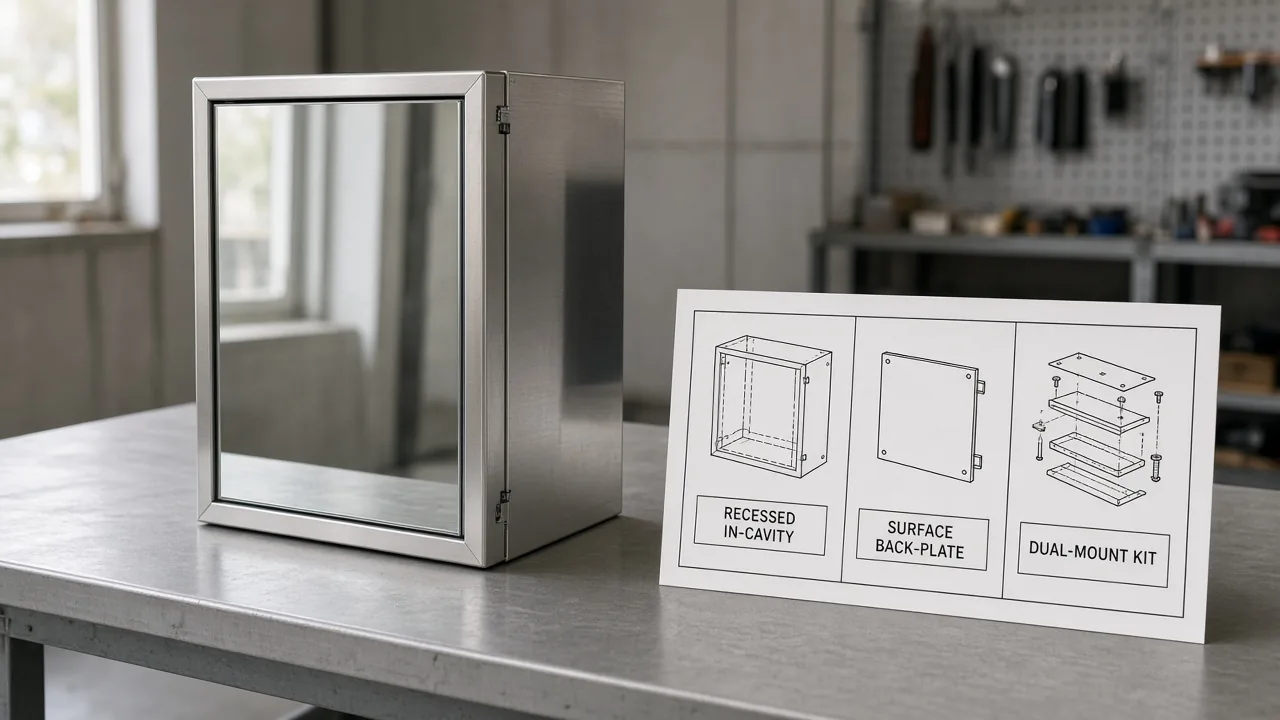
A service sheet can tell a buyer how to remove a medicine cabinet only after the shipped mount architecture and the packed fastener or release map are named. The architecture is a recessed in-cavity fastening system, a surface back-plate, or a dual-mount conversion kit. The map is the hidden screws, the finish caps, any door-off note that belongs to the packed leaflet, and the fasteners that actually ship with that architecture.
Mounting height belongs on the live height-datum file. Overall size versus the wall opening belongs on the live recessed-versus-surface specification file. Replacing only a door assembly, only shelf clips, or only an organizer insert belongs on those neighboring files. None of those decisions is a body-off-the-wall release map, and none should be rewritten as one.
This guide is for importers, distributors, and private-label teams approving service-sheet wording and packed release maps for medicine cabinets treated as an adjacent bathroom-storage line. Koitor Hardware is a family-owned China OEM manufacturer of custom metal bathroom and home storage hardware. Adjacent medicine-cabinet OEM pages already sit in that published library. That fact is not a claim that Koitor currently manufactures a named medicine-cabinet SKU, a glass or mirror cabinet, or an electrical product.
Send the cabinet drawing or install sheet, the intended mount type, the packed fastener map, the market, and any service sentence a replacement program must carry. We can review the wording and the architecture name. We will not issue a removal-time standard, a damage-free guarantee, a wall-repair method, or an electrical disconnect procedure.
What does a how to remove a medicine cabinet file actually freeze?
It freezes the shipped mount architecture and the release map that architecture can support. It does not freeze a hanging height, an overall-versus-opening dimension set, a door-only spare, a shelf-clip fit, or a first-hang of a new recessed cabinet.
Searchers often ask how to remove a medicine cabinet from the wall because they cannot see the screws, or because a forum thread told them to pry the box out of the opening. That demand is real. For an importer, the usable decision is whether a listing or a service sheet may say the cabinet is easy to remove, and which architecture and packed map are being promised.
A recessed cabinet and a surface-mount cabinet do not share a release map, even when the door style matches. A dual-mount conversion kit is a third architecture. If the sheet does not say which of those three shipped, an easy-to-remove line will be applied to the wrong job. This file is not a consumer pry tutorial, and it is not a product listing.
Taking the cabinet body off the wall is not the same job as replacing a door, a hinge, or a shelf clip while the body stays in place. If the packed program is a door-only spare, do not print a body-removal sentence on that carton. If the packed program is a complete cabinet, do not pretend that removing the door finishes the service job.
A first-hang of a recessed cabinet is a different file. That later article, when published, will freeze the packed opening, the flange, and the included mounting parts. This removal file may name the architecture that is already on the wall. It should not become a backdoor install or replace-the-cabinet walkthrough.
A fabricante de accesorios de baño a medida can review whether a service sentence and a packed fastener map stay together. Matching a metal finish or a door style to a collection is not the same as inventing a default mount, a default pry method, or a timed removal standard. If you are screening this adjacent line, bring the intended mount type and the packed map with the drawing.
A published “easy to remove” or “easy to replace” claim is only as complete as the named architecture and the named map. If the photograph shows a surface back-plate and the bag does not, the sheet has already failed, even if the cabinet looks familiar. The same is true of hidden-screw caps, a door-off note, or a conversion kit that belongs to a different mount.
This file can precede a replacement-program RFQ. It should not be turned into a catalog page, a height chart, an opening-size essay, or a first-hang manual. Those jobs already have, or should keep, their own files.
Which mount architecture must be named before any removal sentence?
Name the shipped architecture first: recessed in-cavity, surface back-plate, or dual-mount conversion kit. Do not start with a pry sequence, and do not start with a “where are the screws” guess that has not been tied to the packed map.
A recessed in-cavity architecture fastens the cabinet body inside the wall opening. The sheet should say so, and it should say where those fasteners are reached if that access is part of the packed leaflet. “It sits in the wall” is not a complete architecture line if the fastener path is left unnamed.
A surface back-plate architecture is a different job, even when the door and the finish match a recessed model. The body hangs from, or is fixed through, a plate or a surface frame that stays visible or is reached from the room side. If that plate, those screws, or those cover caps are not in the packed map, a recessed release sentence will be applied to the wrong cabinet, or the other way around.
A dual-mount conversion kit is not “whichever mount the installer prefers.” It is a named kit that may include parts for more than one architecture. The service sheet must say which mount actually shipped, or which conversion parts are in the carton, before any easy-to-remove line is printed. A mixed photograph that shows both a recessed box and a surface plate in the same service panel is how the wrong map is packed for the wrong SKU.
Do not treat “from the wall” as a fourth architecture. It is a location. Search demand for how to remove a medicine cabinet from the wall is coverage of the same body-off-the-wall decision, not a reason to invent a new sequence. The same wall can hold more than one of the three architectures, and each architecture still needs its own map.
If a program uses more than one architecture, keep a separate service sheet for each one, or make the difference unmistakable on a shared sheet. A single leaflet that treats recessed, surface, and dual-mount cabinets as one pry job is not a release map. It is a way to get a field complaint when the screws are not where the leaflet implied.
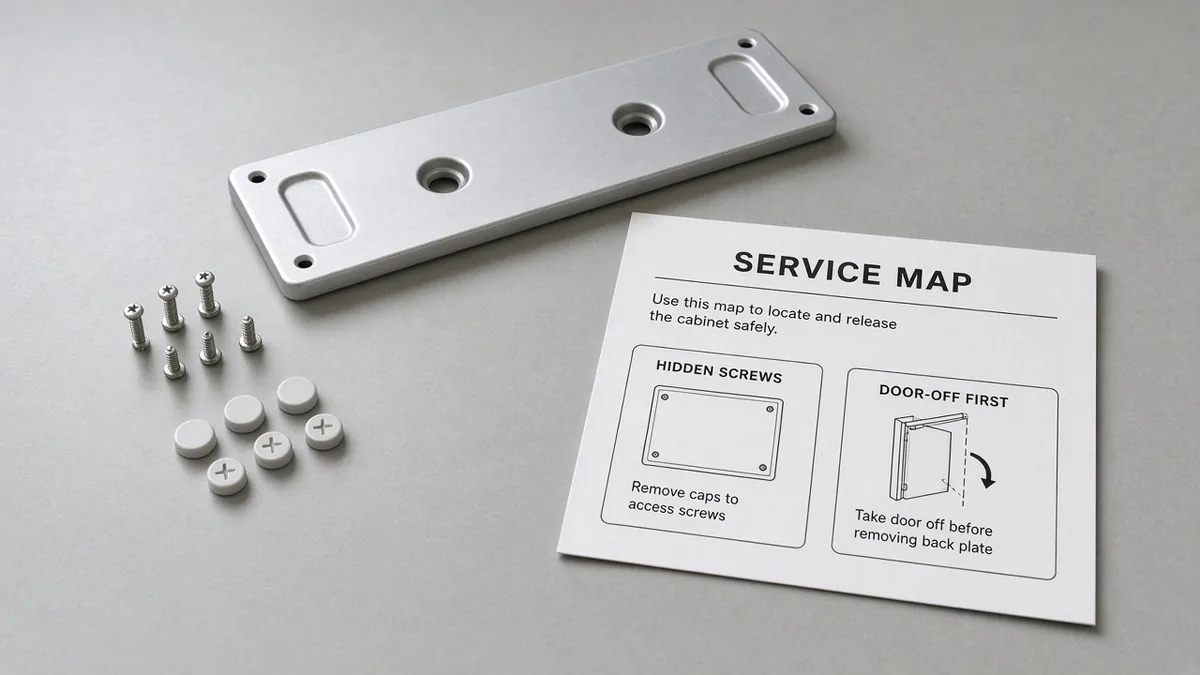
Door-off-first is a packed-leaflet field, not a factory default. Some service sheets tell a technician to take the door off before the body is released, because the door would otherwise block a hidden fastener or add weight. Print that note only if the packed leaflet says so. Do not invent it as a Koitor rule, and do not omit it if the packed leaflet requires it.
Lighted or electrical cabinets are out of scope on this page. If the SKU includes a light, a transformer, or a supply connection, the official lighting or electrical sheet and a qualified trade own that disconnect. This architecture file may say the electrical work is excluded. It should not print a wiring method.
What must the service sheet show, and what may it exclude?
The sheet should show every part and every access path the easy-to-remove sentence assumes. For a body-off-the-wall job, that usually means the fastener locations, any hidden-screw caps, the back-plate or in-cavity hardware that belongs to the named architecture, and a clear statement about whether the door comes off first.
If a hidden fastener is reached only after a finish cap, a filler, or a shelf is removed, name that step as part of the map, or mark the access as documented on the supplier’s current leaflet. Do not leave a buyer to invent a pry point because the cap was not mentioned. Do not invent a tool size, a torque, or a “just pop it off” method to fill a blank.
Exclusions must be written as exclusions. If the carton does not include a conversion plate, say so. If the leaflet does not cover wall-cavity patch, glass handling, or electrical disconnect, say so. A silence that is later read as a promise is how a replacement program inherits work it never priced.
A hardware kit packing inspection checklist is a useful neighbor when you are comparing the bag to the sheet. That checklist does not invent a removal sequence. It only asks whether the named parts were packed. Use it as a completeness check, not as a substitute for the architecture line.
| Architecture or claim | What must be named | What belongs in the packed map | What this row is not |
|---|---|---|---|
| Recessed in-cavity | That the body is fastened inside the wall opening, and how those fasteners are reached if that access is part of the design | In-cavity fasteners, any hidden-screw caps or access notes, matching instructions, and a door-off field if the packed leaflet uses one | A surface-plate sequence copied onto a recessed box, a height chart, or a rough-in first-hang |
| Surface back-plate | That the body is held by a room-side plate or surface frame, including cover caps if they hide the screws | The plate or frame parts that actually ship, visible or capped fasteners, and matching instructions | A recessed in-cavity leaflet, or a frameless vanity-mirror hang tutorial |
| Dual-mount conversion kit | Which mount actually shipped, or which conversion parts are in the carton | Only the conversion and fastening parts that belong to the shipped condition, plus a clear unused-path exclusion | A “use either mount” sentence with no packed list, or a mixed photograph used as the map |
| Door-off first | Whether the packed leaflet requires the door to come off before the body is released | That note, if it is required; or an explicit not-applicable mark if it is not | A factory default invented because a forum thread mentioned it |
| Easy-to-remove or easy-to-replace line | The architecture and the packed map that the sentence is allowed to assume | Nothing beyond that named list | A damage-free promise, a timed removal, a wall-patch method, or a new-cabinet install |
Do not reprint overall versus opening dimensions in this table, and do not reprint a hanging height. Those figures, when a project needs them, belong on the live specification and height files. This map may name the architecture already on the wall. It should not become a second copy of those files.
Do not fill a blank field with a plant default. If a later buyer file names a required fastener or a required access path, the service sheet may repeat that requirement and cite the source. Until such a source exists, keep the field named and leave the value blank.
Why are “where are the screws” threads not a factory pry method?
They are demand evidence. Homeowners and installers ask that question because hidden fasteners are common, and because one brand’s leaflet is not another brand’s leaflet. Quote those threads only as proof that the map must be printed. Do not copy a forum pry sequence, a putty-knife trick, or a “just pull harder” method as a Koitor procedure.
A third-party video or a dealer sheet may be cited as a named-model example if you have checked that the packed map still matches. Label it as a third-party example. It is not a factory standard, not a timed method, and not a damage-free claim. If the packed architecture has changed and the video has not, the citation is already stale.
Brand-navigational phrases, including phrases built around another company’s model name, are not this page’s target. Describe the hardware in architecture and map terms. Do not borrow a competitor’s removal video, or that video’s search volume, as a Koitor standard.
Glass, mirror, and wall-cavity work stay with the project’s qualified trade and with any handling note the supplier already prints. This file may say those tasks are excluded. It should not invent a glass-lift method, a drywall patch, or a “no damage to the tile” guarantee. Those promises cannot be supported from this pack.
The same discipline applies to tools. If the packed leaflet names a driver type or a cap-removal note that belongs to this architecture, the sheet may repeat that note and cite the leaflet. Do not invent a pry bar, a fastener size, or a torque as a factory rule.
Which neighboring files and lighted cabinets stay out of this sentence?
Height stays on the live medicine-cabinet installation-height file. That file freezes the named datum, such as finished floor, vanity, or mirror center, and it tells writers not to treat a general install how-to as the height answer. This removal file may mention that a height figure is out of scope. It should not reprint the datum or invent an inch chart.
Overall size versus the wall opening stays on the Recessed vs Surface Mount Medicine Cabinet: Importer Checks file. That page is a product-specification and RFQ guide for dimensions and for the mounting kit as a line item. It is explicitly not an installation manual, and it is not a removal manual. Do not clone its dimension tables into this service sheet.
A first-hang of a recessed cabinet, including the packed opening, the flange, and the included mounting parts, belongs on the companion first-hang file in this batch once that article is published. Point to it by name. Do not turn this removal map into that hang, and do not use this page as a backdoor “how to replace a medicine cabinet” tutorial.
Door-assembly replacement and shelf-clip replacement are already published as their own buyer guides. Those pages are not in the official lock-copy link list used for this draft, so they are named here in prose only and are not given invented addresses. Keep door-only and clip-only work on those files. Do not fold them into a body-off-the-wall sentence.
Organizer-insert fit stays on the Bathroom Medicine Cabinet Organizer Inserts: SKU Fit Checks for Importers file. An insert can be removed without taking the cabinet body off the wall. If the packed program is an insert, do not print a cabinet-body release map on that carton.
Lighted cabinets stay off this thesis. A searcher who wants to remove a cabinet with lights is asking an electrical question as well as a mount question. Keep the electrical disconnect with the lighting SKU’s own sheet and a licensed electrician. This page may exclude that work in one clear sentence. It should not walk the disconnect.
Hanging a frameless bathroom or vanity mirror is a different product and a different search. Do not borrow that volume, and do not rewrite this cabinet-body file as a mirror-clip hang.
What should be checked before a listing says the cabinet is easy to remove?
Check the architecture line, the packed map, and the exclusions before any easy-to-remove or easy-to-replace sentence is printed. If any of those three is missing, the sentence is not ready, even if the door style photographs well.
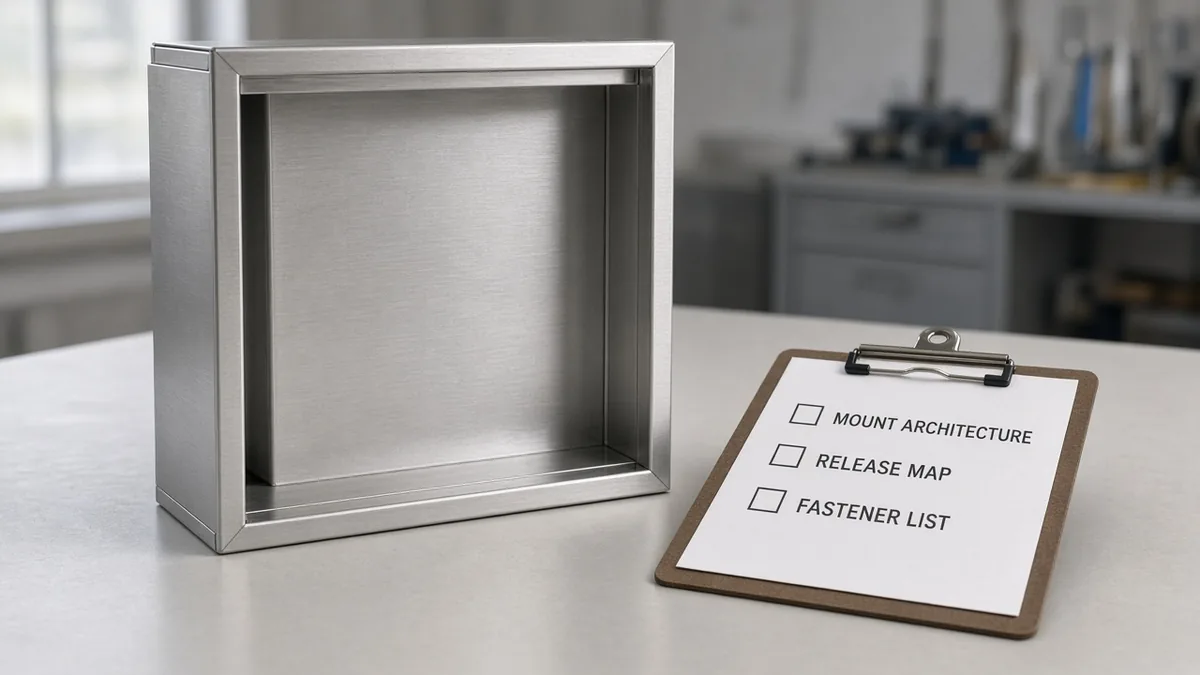
- Name the shipped architecture in plain language: recessed in-cavity, surface back-plate, or dual-mount conversion kit, before any removal sentence is printed.
- Name every part and access path the sentence assumes: fasteners, hidden-screw caps, back-plate or in-cavity hardware, instructions, and a door-off field if the packed leaflet uses one.
- Mark door-off-first as required, not applicable, or documented only on the supplier’s current leaflet; do not leave the field blank, and do not invent it as a factory default.
- If the program can ship more than one architecture, pack a matching map for each SKU, or make the difference unmistakable on a shared sheet.
- Keep hanging height on the live height-datum file; this service file may exclude the figure, but it should not reprint an inch chart.
- Keep overall versus opening dimensions on the live recessed-versus-surface specification file, and do not clone that RFQ into the release map.
- Keep door-assembly and shelf-clip replacement on their own files; do not treat a door-only spare as a body-off-the-wall job.
- Keep organizer-insert fit on the live insert file; an insert can come out while the cabinet body stays in place.
- Exclude lighted or electrical disconnect, wall-cavity patch, and glass or mirror handling, or point those tasks to the official trade and the supplier’s own sheet.
- Do not print a forum pry method, a competitor video, or a “how to replace a medicine cabinet” walkthrough as a Koitor standard, a timed removal, or a damage-free promise.
- Do not invent a fastener size, a torque, a pry tool, a minute-count, or a current named Koitor cabinet SKU.
- Revise the easy-to-remove line whenever the packed list, the architecture, or the packed instructions change.
Translations on a bilingual carton should follow the same named fields. A door-off exclusion that appears only in one language is not an exclusion in the other market. Review both languages against the same packed map before the easy-to-remove line is translated.
Incoming sample checks can use a simple bag-to-sheet comparison: open the box, lay out the parts, and tick the named map. That check is not a timed removal study, and it is not a wall-repair trial. It only asks whether the carton can be believed.
If a later order adds a surface-mount SKU beside a recessed SKU in the same finish, treat that as a new map, not as a sticker change on the same bag. The fasteners, the instructions, and the door-off field may all change. A recessed easy-to-remove sentence left on a surface carton will be believed, and it will be wrong.
The same discipline applies when a hardware-only service program later adds a complete-cabinet offering, or the reverse. The door may look familiar. The packed map is a new map. Reprint the architecture and release fields before the carton reuses an old easy-to-remove line.
Preguntas frecuentes
Can the listing say the cabinet is easy to remove or easy to replace?
Only after the mount architecture and the packed release map are named, and only if the sentence does not go beyond that map. An easy-to-remove line is not a substitute for missing caps, an unnamed architecture, or a door-off note the leaflet requires. This article does not supply a minute-count or a damage-free promise, and it does not make “how to replace a medicine cabinet” the target of the page.
Does “from the wall” need a different service file?
No. From the wall is a location, not an architecture. Name whether the shipped unit is recessed in-cavity, surface back-plate, or a dual-mount conversion kit, then pack the map that belongs to that architecture. How to remove a medicine cabinet from the wall is a real related search, and it is not a fourth architecture.
Should this sheet also tell buyers the hanging height or the wall-opening size?
No. Height sits on the live height-datum file, and overall versus opening dimensions sit on the live recessed-versus-surface specification file. This service file may name the architecture already on the wall. It should not reprint those figures, and it should not treat a nominal opening as the answer to a removal question.
What if the buyer only needs a new door, new shelf clips, or a new organizer insert?
Those are neighboring files, not a body-off-the-wall job. Use the door-assembly, shelf-clip, or organizer-insert file, and do not pack or promise a complete cabinet-body release map unless that is truly the order.
Can a brand video or a forum thread be printed on the service sheet?
Only as a labeled third-party example, and only if you have checked that the packed map still matches. A brand video or a “where are the screws” thread is demand evidence, not a Koitor standard, not a pry method, and not a timed removal.
Does Koitor currently offer a named medicine-cabinet catalog SKU?
This article does not assert a current named production SKU, and it does not claim that Koitor manufactures glass, mirror, or electrical cabinets. Adjacent medicine-cabinet OEM pages already sit in the published library. If you are screening this line, send the intended mount type, packed map, and service-sheet wording for review of wording and kit scope.
Trabaja con Koitor Hardware
Need a medicine-cabinet removal map reviewed?
Send Koitor the cabinet drawing or install sheet, the intended mount type, the packed fastener map, and any service sentence the replacement program must carry. Our team can review the wording and the architecture name, without issuing a removal-time, no-damage, electrical, or wall-repair claim, and without issuing a cabinet SKU. MOQ can start from about 100 pcs depending on the product; samples usually take 5-7 working days after details are confirmed; bulk production usually takes 4-6 weeks depending on the project.
OEM / MARCA BLANCA
Convierte esta guía de abastecimiento en un resumen del producto
Indícanos el producto que deseas, el tamaño, el acabado, la cantidad del pedido y los requisitos de embalaje. Tu equipo recibirá un análisis práctico de la viabilidad de fabricación antes de recibir el presupuesto.
 English
 Español
 Português
 Français
 Deutsch
 العربية