
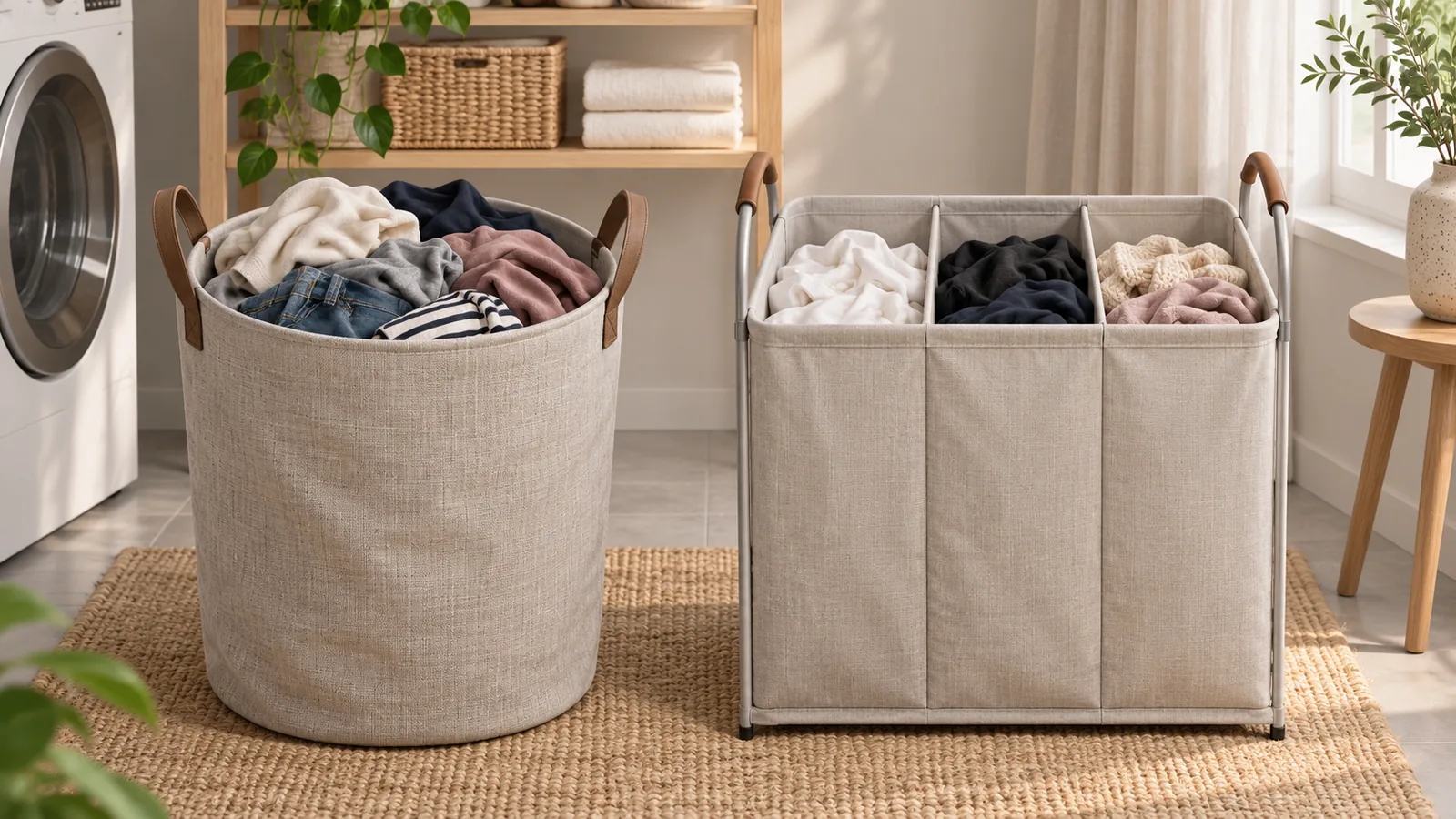
Laundry basket sizes can refer to total nominal volume, the space assigned to separate sorting compartments, or the physical dimensions of a carrying container. These measurements do not directly state kilograms of dry clothing or the number of washing-machine loads the basket holds. Joseph Joseph’s own guide gives examples from its 35-liter, 60-liter, and 90-liter families and lists two- and three-compartment arrangements in its 90-liter family. Those examples describe that maker’s products, not a universal size standard.
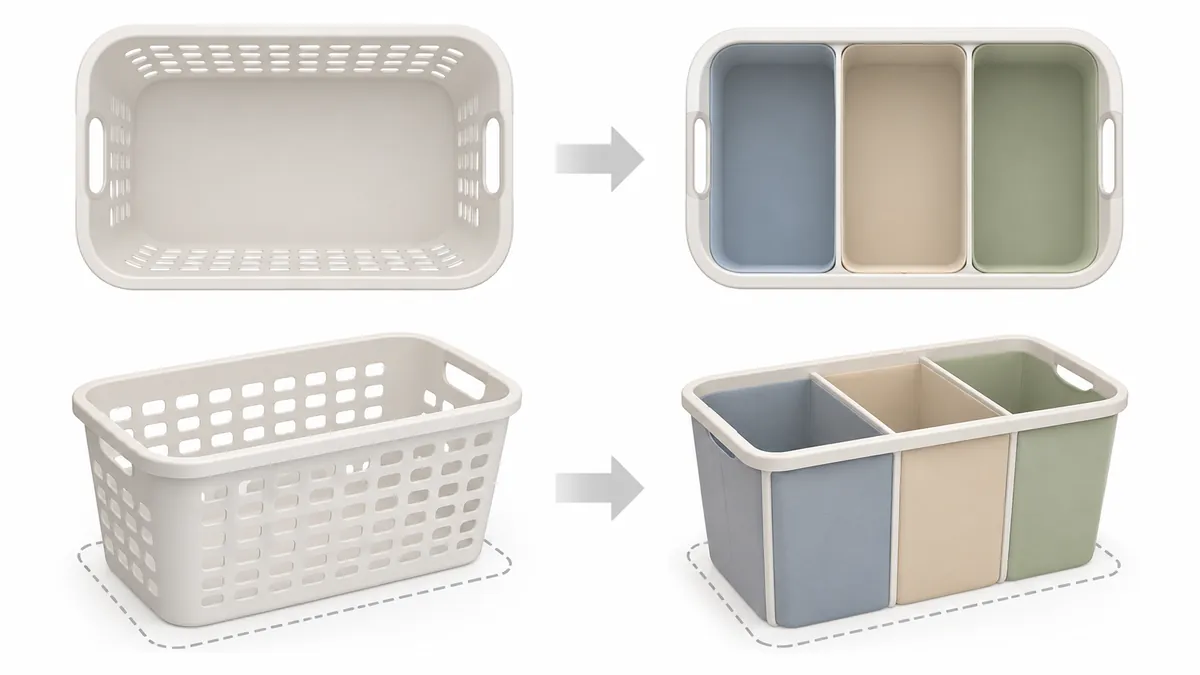
The useful comparison is total capacity versus the amount available for one category of laundry. In an independent hypothetical example, a 90-liter basket divided into two equal usable compartments would allocate 45 liters to each; three equal compartments would allocate 30 liters each. This arithmetic explains the effect of sorting sections. It does not claim that a named product has equal compartments or those exact sub-volumes.
First Identify What the Capacity Label Covers
Before comparing a laundry basket, determine whether its volume describes the whole item or one section. A headline capacity often names the total for a product family. A sorter can divide that total among separate compartments, so the usable space for one category may be smaller than the label suggests. If a listing does not clarify this point, consult the exact model specification rather than assuming that each section holds the headline amount.
The maker and model matter. Joseph Joseph’s guide presents its own examples at 35, 60, and 90 liters and describes two- and three-compartment options in the 90-liter family. These are useful named examples for comparison, but not universal small, medium, and large classes. Do not treat one retailer’s size wording as a standard that every brand follows. Keep the product family and source beside each number in an assortment table.
If a product page gives only a capacity label, ask whether it applies to the complete basket or each removable section. Find out whether the compartments are fixed, removable, or arranged as separate bags. A total volume does not automatically tell a buyer how the interior is divided, whether one section can be removed, or whether the product’s opening is convenient for the intended use.
Avoid estimating usable volume from a product photograph. Perspective hides depth, wall taper, handles, and internal partitions. Likewise, multiplying outside length, width, and height assumes a shape that may not match a tapered or rounded product. Use the maker’s stated capacity convention and exact model dimensions. Where those values are unavailable, mark the field as unknown instead of calculating a seemingly precise capacity from an image.
See How Compartment Count Changes Available Space
A simple allocation example makes the distinction clear. Start with a hypothetical total of 90 liters and assume, only for arithmetic, that the usable interior is split into equal volumes. One undivided section represents 90 liters. Two equal sections produce 90 divided by 2, or 45 liters per section. Three equal sections produce 90 divided by 3, or 30 liters per section.
| Hypothetical total volume | Equal section count | Arithmetic allocation per section | What the calculation does not prove |
|---|---|---|---|
| 90 L | 1 | 90 L | Actual dimensions or usable capacity of a named product |
| 90 L | 2 | 45 L | That a maker’s two sections are equal or each holds 45 L |
| 90 L | 3 | 30 L | A clothing weight or number of wash loads |
This illustration is an authored mathematical example, not a measured drawing of a Joseph Joseph basket. Real compartments can differ in width, depth, shape, and usable volume. A product may have two sections with an intentionally unequal split. Removable containers can have different capacities from the overall housing. Check the manufacturer’s model-specific description before using an allocation assumption in a product comparison.
Partitioning also affects how a user experiences a basket when one category fills first. If the sections are fixed, open space in a lightly used category may not be available to a full category. A single open basket has no built-in separation, while a sorter allocates space to categories. A combined product may offer both separation and removability, but the exact arrangement should be verified on the model rather than inferred from a product-family name.
Keep this sorting question separate from rigid-bin size. A trash can comparison may focus on footprint, rim opening, and liner fit. Laundry sorting asks how total volume is allocated among categories and whether the sections meet the intended organization. Those can share the broad idea of capacity while still answering different user questions.
Keep Liters Separate from Weight and Washer Loads
Liters measure volume. They are not a weight rating, a safe carrying limit, or a count of washing-machine loads. The relation between volume and weight changes with the textiles, how they are folded or gathered, moisture, and how densely they occupy the container. The washing machine’s own capacity and instructions are also separate from a basket’s volume.
Do not turn a 60-liter or 90-liter label into a guaranteed number of kilograms or weekly loads. The research source does not provide a reliable universal conversion for those outcomes, and the article does not repeat the source’s household-size or wash-frequency suggestions. If a buyer needs a carrying limit, the exact maker must provide evidence for the specific model. If the buyer needs to coordinate a load with a washer, use the washer and textile guidance applicable to that use rather than treating basket liters as a substitute.
The same restraint applies to handling claims. A capacity label alone says nothing about handle strength, stability when carried, water resistance, or care. Those topics require product-specific documentation. The size guide cited here supports named volume examples and sorting arrangements; it does not substantiate the performance of every basket or material.
For a commercial assortment, it can be useful to maintain separate fields for total volume, compartment count, per-compartment volume where actually provided, physical dimensions, removable-container format, and any maker-stated carrying information. Leave unsupported fields blank. This helps a category buyer compare products without blending volume, weight, and use claims into one number.
Compare a Sorter with a Carrying Basket
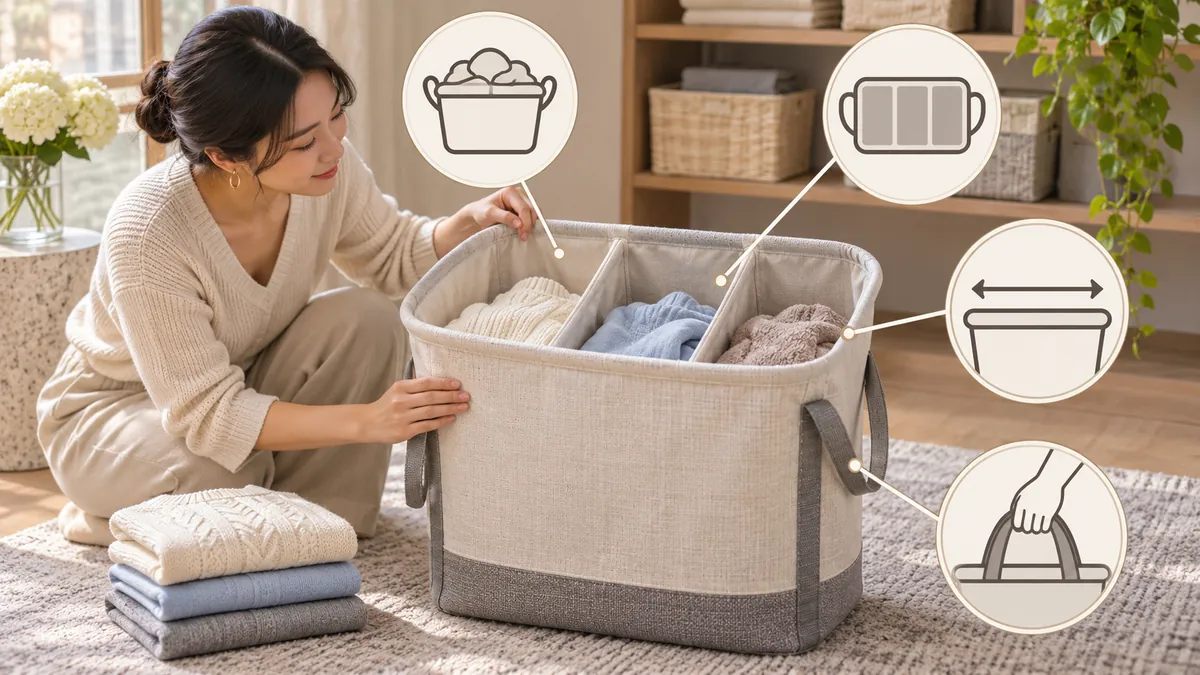
A sorter is organized around separating laundry before it is washed. A carrying basket is organized around moving collected items from one location to another. One product can combine both roles, but the buyer should identify which task the model actually supports. Multiple compartments may assist separation while assigning a smaller portion of the total space to each category. One open container may provide one undivided volume without sorting sections.
When evaluating a combination product, inspect the compartments, opening, and any removable sections on the exact model. Ask whether the capacity refers to the overall frame or removable inserts. If the product uses bags or liners, keep the capacity and handling information attached to that specific item. A general family label is not enough to determine how the contents are divided or transported.
These distinctions matter in assortment planning. A distributor may want to compare single containers, two-way sorters, and three-way sorters. A useful comparison table can record maker, model, total capacity, number of compartments, whether sections are removable, exterior dimensions, and the source of each value. The goal is to compare like with like, not to name an abstract “best size” that ignores the product’s layout and intended location.
Koitor’s approved capabilities concern custom metal bathroom and home-storage hardware. The company’s documented information does not establish textile or plastic laundry-basket production, nor does a general discussion of basket sizing imply such a product range. The commercial path in this article is limited to Koitor’s relevant metal hardware scope. Questions about a named laundry basket’s material, load, or care belong with its responsible maker.
Verify Physical Dimensions for the Intended Location
Capacity and physical fit are different checks. If the basket must fit between a washer and wall, inside a closet, under a counter, or through a doorway, obtain the selected model’s outside width, depth, and height. Confirm whether those dimensions include handles, lids, or any part that projects beyond the main body. A volume number cannot establish that a product fits a room or storage bay.
When comparing laundry basket sizes, use liters for the volume field and record width, depth, and height in separate fields. A product with a large capacity may have a footprint that is unsuitable for the intended location, while a taller or narrower format can occupy a different area. This is a physical-fit comparison, not a claim that a particular shape provides more usable capacity. Use the selected product’s own dimension drawing and do not calculate a volume from external dimensions unless its geometry and the maker’s measurement convention support that calculation.
If the product is a sorter, identify where each compartment opens and whether its shape changes the usable area. A removable bag or container can have its own dimensions distinct from the outer frame. Record these fields separately rather than treating the external product envelope as its usable interior. For a tight space, compare the dimension drawing with the actual measured location and preserve the model code in the record.
When a retailer listing and the maker’s guide disagree, confirm that they describe the same version and model. A retailer might summarize the total capacity while the maker describes compartment count elsewhere. Do not combine the capacity from one model with the dimensions of another. If the discrepancy remains unresolved, ask the manufacturer to identify the current specification before approving the assortment entry.
For a sample review, note the model, configuration, and what was observed. A sample can show its own arrangement and fit in a given location. It does not establish the carrying capacity of all production units or verify a future product revision. Keep a visual sample observation separate from a performance claim and request the maker’s documentation for any limit that matters.
Build a Useful Product Comparison Record
A product comparison record should retain the source and definition behind each number. Consider separate fields for model, maker, total volume, per-section volume if published, compartment count, removability, exterior dimensions, usable interior information, carrying format, and documentation reference. Not every manufacturer will publish every field. An empty field is useful: it tells the buyer what remains to be confirmed.
For example, an entry might say “90 L total, three compartments, maker guide, model confirmation pending.” It should not say “30 L each” unless the maker specifies that allocation or the table clearly labels it as an independent equal-partition calculation. This difference between sourced product data and buyer-created arithmetic protects the comparison from being mistaken for a manufacturer statement.
If the product range changes, update the record with the new model and date rather than overwriting the old value without a trace. Similar product names can describe different interior layouts. If a supplier substitutes a product, recheck the total capacity and the number or arrangement of sections. Retain the prior entry so a later buyer can see which selection was originally reviewed.
This kind of record is especially practical for importers or category managers who evaluate several formats at once. It shows whether the decision is based on volume, sorting, location, handling documentation, or some combination. It also clarifies which questions remain with the product supplier and which are simply internal assortment preferences.
If a buyer is comparing laundry basket sizes for a retail assortment, the comparison can also show which specification details are consistent across suppliers and which remain missing. Keep the findings descriptive: “maker does not publish per-section volume” is a useful observation, not an invitation to estimate a value from an image. A documented gap can be sent as a supplier question before the product is added to a buying plan.
Separate total capacity from per-compartment claims
A product page may state one overall volume and show several compartments without giving a capacity for each compartment. In that situation, record the total and compartment count, then leave the per-section values unspecified. The equal-partition arithmetic in this article is a teaching example only. It is not a replacement for a maker’s dimensional or capacity data.
If per-section capacity matters to the purchase, ask whether the manufacturer measures each container independently or derives a combined figure from the complete assembly. Confirm that the answer applies to the precise model and configuration being considered. A removable bag may have a different usable shape from the surrounding frame, and a fixed internal divider may occupy some space. The headline total alone does not resolve those details.
This distinction is also important when comparing competing products. One listing might give a total product capacity, while another gives a capacity for an individual insert. Putting those values into the same column can make one design look larger without a like-for-like basis. Preserve the label from the source or create separate columns for total and per-section figures. If the source does not say which it means, mark the entry for confirmation rather than interpreting the photograph.
Account for asymmetric layouts
Not every sorter divides its space evenly. A two-section design may allocate more room to one side, or a three-section design may use different widths for the categories its maker intends. The source pack does not provide measured sub-capacities for the named two- and three-compartment 90-liter examples, so this article does not assign those products a 45-liter or 30-liter section. The simple division table assumes equal usable sections solely to demonstrate the arithmetic.
For a real model, inspect the drawing or ask the maker to describe the arrangement. Record compartment count, relative layout if documented, and whether a section can be removed. If the product is displayed as a combination of a frame and bags, confirm whether the listed total belongs to the assembled set or to each bag. Do not assume that a removable component has the same volume as the space it occupies while installed.
An asymmetric layout may be relevant to how a retailer positions a product, but the buyer should not infer its performance or household suitability from section count alone. The same number of compartments can correspond to different dimensions and different intended uses. A catalog matrix can describe what is shown without asserting which category of laundry will fill first or how often a user will wash it.
Record evidence type and model identity
In a buying comparison, attach each capacity and size value to its evidence type. A manufacturer dimension sheet, a maker’s guide, a retailer summary, and a sample observation are not interchangeable. Include the model code and page or drawing reference beside the number. If the model is updated, note the version or date supplied by the manufacturer so that a later reviewer can determine which specification was used.
If two sources appear to disagree, first check whether they refer to the same model and whether one describes total capacity while the other describes an insert. Do not combine a retailer’s capacity label with another model’s dimensions. Ask the responsible manufacturer to confirm the current specification when the difference affects selection. Until resolved, keep the comparison flagged rather than selecting the more favorable figure.
This record is especially useful when the assortment covers several formats. One row may describe a single open carrying container, another a fixed two-section sorter, and another a multi-section product with removable bags. Stating the format alongside total liters allows a reader to understand what the capacity number represents. It also makes a later substitution easier to audit: the replacement model must be checked against the same fields rather than accepted because its headline number looks similar.
Buyer Checklist Before Selecting a Laundry Basket
- Record the exact manufacturer and model, not just a capacity label.
- Confirm whether the stated liters cover the complete basket or an individual compartment.
- Count the sections and verify whether they are fixed or removable.
- Obtain the selected model’s outside dimensions for the intended location.
- Keep liters separate from garment weight, carrying limits, and washer-load counts.
- Request model-specific documentation for any handling or performance claim.
- Compare a sorter and an open carrying basket by their actual functions.
- Keep source, model revision, and capacity convention with the assortment entry.
- If a retailer and maker listing conflict, ask which model and version the value describes.
- Treat equal-compartment arithmetic as an illustration unless the maker confirms the actual layout.
This checklist structures a comparison; it does not promise a fit, load limit, or laundry capacity. The selected manufacturer’s instructions remain the source for model-specific details.
Preguntas frecuentes
What laundry basket size should I choose?
Start with the intended location and whether the product should sort or simply carry laundry. Compare the exact model’s stated total volume, compartment layout, and physical dimensions. Joseph Joseph’s 35-, 60-, and 90-liter examples are that maker’s families, not universal recommendations for a household size.
Does a 90-liter sorter provide 90 liters in every section?
No conclusion like that follows from a total-capacity label. The cited guide describes products in a 90-liter family with two- and three-compartment arrangements. The usable amount in each section depends on that model’s layout. The 45- and 30-liter figures above are hypothetical equal divisions only.
Do liters tell me how many kilograms of clothes the basket holds?
No. Volume and weight are different measures. Textile type and how contents are placed affect their relationship. Use the selected maker’s stated load information if a carrying limit matters.
Can I convert liters into washer loads?
There is no universal wash-load count from basket volume alone. Basket layout, textile mix, and the washer’s capacity are separate factors. Follow the relevant product and washer information.
Is a laundry sorter the same as a carrying basket?
Not always. A sorter divides items into categories, while a carrying basket is intended to move collected laundry. Some products combine these functions; inspect the exact model and removable-container arrangement.
For broader laundry-room assortment planning, see the existing importer guide. It covers assortment decisions rather than assigning a universal basket capacity or load rating.
Source note: Size examples are limited to Joseph Joseph’s own guide, https://us.josephjoseph.com/blogs/news/laundry-basket-size-guide. The figures describe its product families and should not be generalized to all manufacturers.
Trabaja con Koitor Hardware
Planning a Custom Metal Storage Hardware Order?
Share your metal storage hardware drawing or sample, target quantities, finish, and packaging requirements. Koitor can discuss its documented bathroom and home-storage hardware scope and the information needed for a practical quotation.
OEM / MARCA BLANCA
Convierte esta guía de abastecimiento en un resumen del producto
Indícanos el producto que deseas, el tamaño, el acabado, la cantidad del pedido y los requisitos de embalaje. Tu equipo recibirá un análisis práctico de la viabilidad de fabricación antes de recibir el presupuesto.


 English
 Español
 Português
 Français
 Deutsch
 العربية