
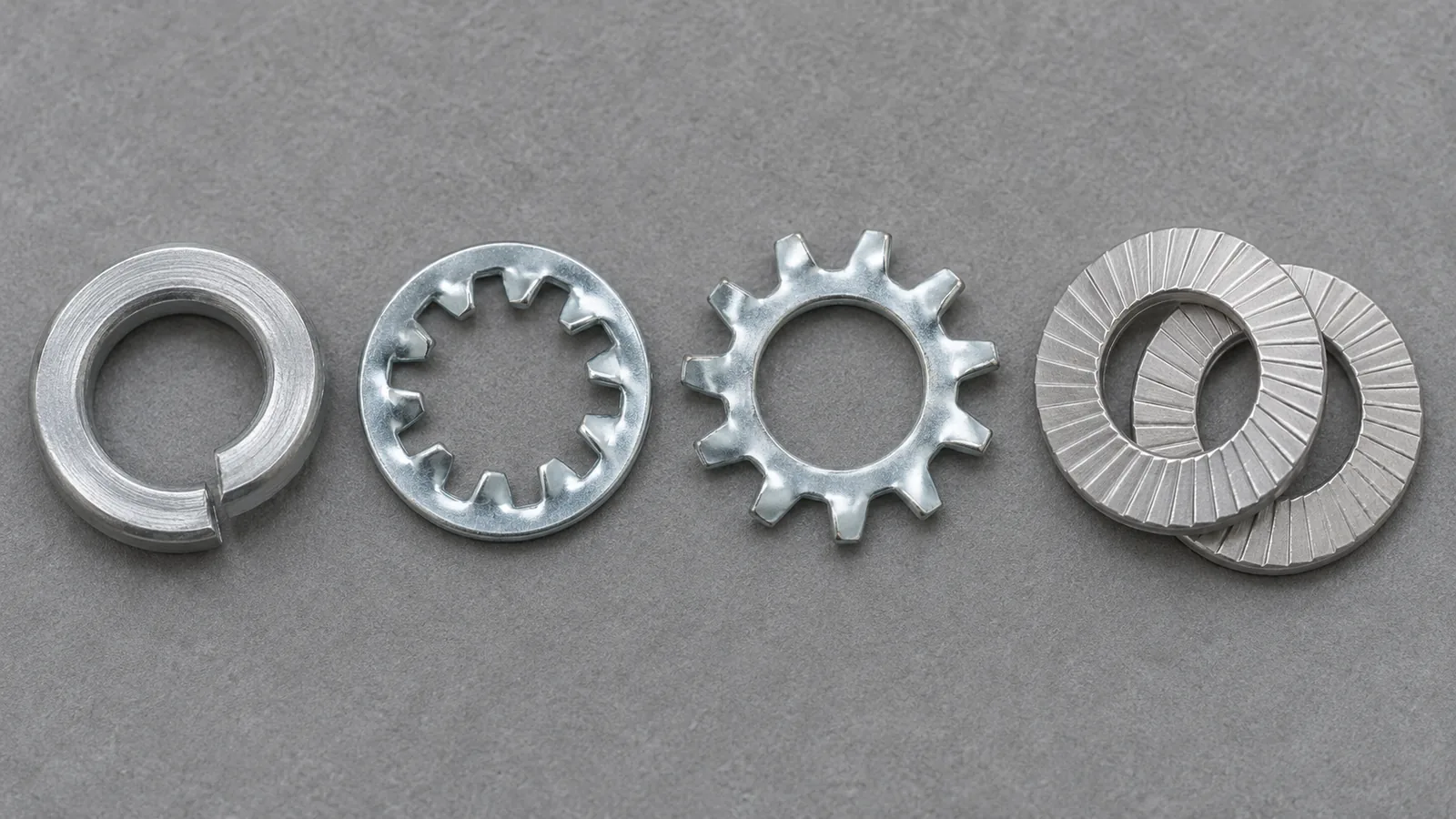
Lock washer types are most useful to a buyer when they are identified by their actual geometry and contact surfaces, not by an assumption that every design prevents a joint from loosening. Common examples include split or helical rings, internal-tooth washers, external-tooth washers, combined internal-and-external tooth washers, and paired wedge-style products. Before adding one to a bathroom or home-storage hardware bill of materials, confirm the washer’s exact part, the mating surfaces, the bolt and bearing area, and the product supplier’s instructions. A washer label is a starting point for identification, not proof of joint performance.
What problem do lock washer types help hardware buyers solve?
An importer may see a washer in a drawing, sample or kit photo without a named part number. The item may be called a locking washer, toothed washer, serrated washer, spring washer or simply a washer. Different suppliers use category labels in different ways, so a purchasing line based only on a broad name can leave the actual shape and interface open to interpretation.
That uncertainty matters in a metal bathroom accessory or storage product because the washer sits between other specified parts. It may bear against a screw head, a mounting plate, a bracket, a coated surface or a bought-in component. Its inner and outer edges, thickness, surface treatment and free shape affect how it contacts those parts. If the supplier substitutes a different form, it can change clearances, assembly feel, surface marking or the stack height. Whether that substitution is acceptable depends on the design and the joint; a similar photo does not establish interchangeability.
This guide is an identification and purchasing aid. It does not claim that a washer guarantees a joint against vibration, loosening, fatigue, corrosion or electrical interruption. A washer that is sold as a “lock” washer still has to be evaluated within the actual joint design and product instructions. Washer performance depends on the complete assembly, including the fastener, clamped parts, contact surfaces, assembly method and application conditions. No universal ranking among washer families is appropriate from the names alone.
The buyer’s practical goal is to capture the independent attributes that determine what is being ordered. A BOM can state the washer family, internal and external diameter, thickness, material or finish where defined, supplier part number, mating bolt, bearing surfaces and revision. A drawing should show the geometry needed to make the part unambiguous. If a supplier’s proprietary washer is required, include the maker and item number rather than replacing it with a generic family name.
How should buyers identify common lock washer types?
Start by looking at the washer’s shape before it is installed. A split or helical ring has a break in the ring and an offset or spring-like form. An internal-tooth washer has teeth projecting into the center opening. An external-tooth washer has teeth around its outer edge. A combined-tooth form has both inward and outward projections. A paired wedge design consists of two matched washers with shaped faces that are intended to interact as a pair. The exact catalogue may classify these shapes as locking, spring, serrated or wedge products.
| Common form | What a buyer can identify visually | What the label does not establish | Helpful evidence to request |
|---|---|---|---|
| Split or helical ring | A split ring with an offset section or formed spring shape. | It does not prove a universal anti-loosening effect for every joint. | Supplier drawing, dimensions, material, finish and specified application. |
| Internal-tooth washer | Serrations project toward the center opening. | Tooth count alone does not prove compatibility or performance. | Mating bolt/head geometry and bearing-surface details. |
| External-tooth washer | Teeth extend around the washer’s outside diameter. | The outer teeth do not prove suitability for a coated or cosmetic surface. | Contact footprint, clearance and finish protection requirements. |
| Combined internal-and-external tooth washer | Both inside and outside edges have tooth features. | Similar-looking types may differ in dimensions and product-specific use. | Exact catalogue item, drawing and allowed mating surfaces. |
| Paired wedge-style washer | Two components are supplied and oriented as a matched pair. | One half alone is not equivalent to the specified pair. | Pair identification, orientation instructions and joint-specific supplier data. |
The visual check should be followed by part identification. A washer with teeth can be an internal-tooth design, an external-tooth design, a combined-tooth design or a product that a supplier groups under a different commercial term. The item’s outline is only one attribute; the exact inner diameter, outer diameter, thickness, tooth form, material and finish can distinguish catalogue variants that look similar in a small photograph.
El Knapp washer categories guide illustrates common washer forms and their classification. The guide is useful for vocabulary and visual recognition, but its broader comparative strength or grip claims should not be treated as a universal engineering result. The Growermetal product page for internal-and-external toothed washers describes a particular geometry and its bearing contacts. That product description supports checking how a specific washer meets the joint; it does not approve every serrated washer for every material or assembly.

What should importers check before choosing a washer?
The first step is to identify the joint. Is the washer part of an assembly bolt, a mounting bracket, a product cover or a separate installation kit? Is the buyer reproducing an approved sample or creating a new design? If the washer appears only in a photograph, request a drawing, sample or supplier part number before assigning a family. Do not infer that an unlabelled washer is a standard item simply because its shape looks familiar.
The second step is to establish the mating stack. Record the fastener head or nut, washer, mounting plate, bracket, surface coating, spacer and any other clamped layers. A washer’s inner opening must fit the fastener, while its outside diameter and thickness must fit the available bearing area and surrounding clearances. If the head seat is recessed or the plate has a slot, the washer may have a different contact pattern from one used on a flat plate. The sample should be reviewed in the complete assembly rather than in isolation.
Next, confirm the component drawing and procurement data. The exact dimensional tolerances and material requirements should be supplied by the responsible fastener manufacturer or the project’s engineering specification. A common name such as “M6 lock washer” may not define the outside diameter, thickness, tooth style, hardness, coating or permitted load. Do not invent those requirements or copy a value from another supplier’s catalogue.
The contact surface deserves specific attention. Teeth may bear on a part or surface differently depending on the washer’s orientation and the materials in the stack. A coated or polished face might be cosmetic. A soft gasket, insulating layer or thin sheet may change the interface. Before selecting a toothed form, ask the supplier whether the intended bearing surface is within the product’s described use. If surface marking or electrical continuity matters, that requirement needs its own evidence and review; the presence of serrations alone does not prove either result.
Buyers should also confirm assembly instructions. Some products may require a specific orientation or paired components; other designs have no orientation note. The supplier’s instruction should identify any required direction, pair matching or replacement restriction. Avoid generalizing an instruction from one washer family to all products with a similar name. A part that is flipped, omitted or paired with a different washer can create a different assembly from the reviewed sample.
For a sourcing record, document at least:
- The exact manufacturer and catalogue number, or the controlled buyer drawing.
- The washer family and a drawing or clear identification image.
- The inner diameter, outer diameter and thickness needed to distinguish the item.
- The specified material and finish, if the project defines them.
- The matching screw, bolt, nut or other fastener part number.
- The parts and finishes that touch the washer on both sides.
- Any orientation, pairing, assembly or replacement instruction from the supplier.
- The sample approval reference and the production revision it controls.
- Any application-specific test evidence requested by the buyer.
These fields are useful because washer changes may not be visible after assembly. If the washer is hidden under a cap or cover, a receiving inspector may not be able to identify it from the finished product. That makes the BOM, component packaging and assembly record important. Buyers can ask for lot or SKU identification that connects the washer to the product version. No particular inspection plan is implied here; the importing company should set acceptance criteria with its supplier based on the project.
How do materials, structure and finish affect the washer interface?
Material and surface treatment are part-specific purchasing fields, not details to infer from color or magnet response. Two bright metal washers may have different substrates or finishes, while a dark washer may reflect a coating, oxidation or another product treatment. Ask for the supplier’s part description or material record when the project requires a defined composition. A visual check can identify appearance differences but cannot confirm alloy or coating chemistry.
Washer geometry changes how the component occupies space and touches adjacent parts. A larger outside diameter can alter bearing coverage; a thicker profile changes the stack height; teeth can alter how contact is distributed. A paired product needs both components to be present and oriented according to its instructions. These observations help frame a drawing review, but do not predict strength, preload, fatigue or vibration behavior without suitable joint-specific analysis and evidence.
Finish can be relevant to appearance, corrosion exposure, friction and electrical behavior, but a broad finish name does not prove a performance level. If a buyer’s product uses a powder-coated mounting plate, polished tube, stainless panel or plated fastener, the interfaces should be reviewed as an assembly. A coating can change local dimensions and contact. A serration can leave a mark on a visible surface. A buyer should define which faces are cosmetic and which contact marks are acceptable on the approved sample.
For corrosion-related requirements, do not read a washer’s appearance as proof that it will resist the application environment. Specify the intended exposure, cleaning, moisture and adjacent materials, then request evidence from the responsible fastener supplier if the project needs it. A corrosion test result from one washer cannot automatically be transferred to another part, finish or complete bathroom accessory. Likewise, a “stainless” label alone is not a full surface specification.
Quality control should follow the feature that actually matters. If the buyer’s drawing controls the dimensions, check the supplier’s dimensional documentation or sample. If the concern is correct family and orientation, check the part outline and the assembly instruction. If appearance matters, inspect the finish and contact surfaces under agreed sample conditions. If application performance matters, request relevant test evidence and evaluation for the complete joint. These checks answer different questions; passing one does not substitute for another.
The catalogue page from Bossard’s specific internally and externally serrated washer lists the material, finish and hardness for that catalogue item. Those values belong to that specific part. They are not universal minimums for every combined-tooth washer, and they are not a specification for Koitor products. If a buyer needs any such property, it should appear in the chosen supplier’s data for the exact part number.
What sourcing mistakes should buyers avoid?
The first mistake is treating the word “lock” as a performance guarantee. Product family names describe how suppliers categorize a part; they do not prove that a joint will stay tight under all conditions. Ask which exact product is proposed, what its maker says it is intended for, and what evidence applies to the actual assembly. A generic “prevents loosening” sentence is not a substitute for an application-specific engineering review.
The second mistake is selecting a washer by photo alone. Product images may hide thickness, tooth shape, inner diameter or whether the product consists of one piece or a matched pair. A close-up can also make a washer appear larger or smaller than it is. Require a drawing or sample with the relevant dimensions and identify the catalogue item. If the product is custom, define the controlled geometry and acceptance method.
The third mistake is changing only one component in a tested or approved stack. A washer with a different thickness or contact surface can affect how a bolt seats or how the parts meet. If the fastener supplier proposes a substitution, request the exact part number and compare its data with the approved assembly. Record who has approved the change. Do not assume that every washer with the same nominal hole diameter is a direct replacement.
The fourth mistake is assuming tooth direction, paired orientation or reuse from memory. A paired wedge washer is not the same as a single toothed ring. Some part instructions may define which face contacts a component; another design may not. Follow the actual supplier’s sheet and keep the paired parts together in the kit if required. If the instructions are missing, resolve the ambiguity with the component maker before production.
The fifth mistake is allowing washer details to disappear from the quotation. A quote may state a product price but omit the washer material, finish, supplier or packaging. That makes later substitution hard to detect. The buyer should list critical bought-in components or approve the supplier’s BOM before placing the order. Packaging and label references can help identify the parts when several SKUs share similar-looking fasteners.
The sixth mistake is applying an unrelated performance value. Hardness, torque, load, vibration or corrosion figures may be specific to a part, test method, mating surface and installation procedure. Do not combine values across different catalogue products to create a new guarantee. If an application requires a verified result, define the test condition with the responsible supplier and keep the evidence tied to the exact configuration.
Finally, do not use a washer category as a substitute for the complete joint design. A visible serration does not establish that the washer is appropriate for a thin coated plate, that a screw is properly engaged, or that an electrical path is continuous. The whole assembly and project requirement must be reviewed. The washer contributes one interface; it does not solve every fastener, material or inspection question by itself.
How can a small-batch OEM factory help clarify washer requirements?
A small-batch OEM factory can help connect the bought-in washer to the product drawing, metal parts and packaging plan. Koitor Hardware is a family-owned custom metal hardware factory focused on bathroom and home-storage hardware. Its approved scope includes reviewing drawings or samples, discussing metal plate and bracket details, coordinating assembly questions, and preparing packaging for a project. Koitor is not represented as a washer manufacturer, fastener heat-treatment supplier, vibration laboratory or electrical testing facility.
When the washer is part of an accessory kit, the OEM discussion should separate responsibilities. The buyer and fixing supplier select the specific washer and support any required technical claim. The hardware factory reviews how the proposed part interacts with its metal product, where it sits, whether the mounting interface can be assembled and how the components are identified and packed. Any unresolved question about performance or the washer material belongs with the responsible fastener supplier or an appropriate engineering review.
For a sample, include the exact washer and mating fastener rather than a visually similar substitute. Review the component in the assembled towel rack, bracket or storage product. Check whether the washer is accessible after assembly, whether it sits under the intended surface, whether the cover closes, and whether the agreed finish remains acceptable. If inspection cannot see the washer once the product is closed, retain the sample or controlled part record as the reference for later production checks.
Small-batch customization can be useful when the buyer is testing a product assortment or private-label design. A drawing or physical sample helps Koitor evaluate product structure and manufacturing questions before quotation. MOQ can start from 100 pieces depending on the product, finish and packaging. Sample and bulk production timing also depends on the confirmed scope, materials and order quantity; confirm the actual schedule for the project instead of relying on a general estimate.
Buyers developing bathroom products can learn about Fabricación a medida de accesorios de baño y Hardware OEM para almacenamiento doméstico. Share the product drawing, current washer part number, fastener and finish references, packaging requirements and any buyer-defined performance needs through the Página de contacto de Koitor so the factory scope and supplier questions can be separated clearly.
What should a washer specification or RFQ include?
A useful RFQ captures the part and its role in the assembly. It should identify the washer family and supplier item, the fastener it mates with, the two bearing surfaces, the drawing reference and any specified material or finish. If the buyer requires a particular supplier’s instruction or a test report, attach the exact revision. If the buyer has no defined product performance requirement, do not imply one in the quote request.
- Product name, SKU and sample revision.
- Washer drawing or exact supplier catalogue number.
- Required dimensions and material/finish fields, where applicable.
- Mating screw, bolt or nut reference and the complete stack order.
- Visible or cosmetic contact surfaces and acceptable marks.
- Assembly orientation, pair matching or installation note from the supplier.
- Bag, compartment or SKU identification for packaging.
- Substitution approval process and record owner.
- Project-specific evidence or evaluation requirements, if any.
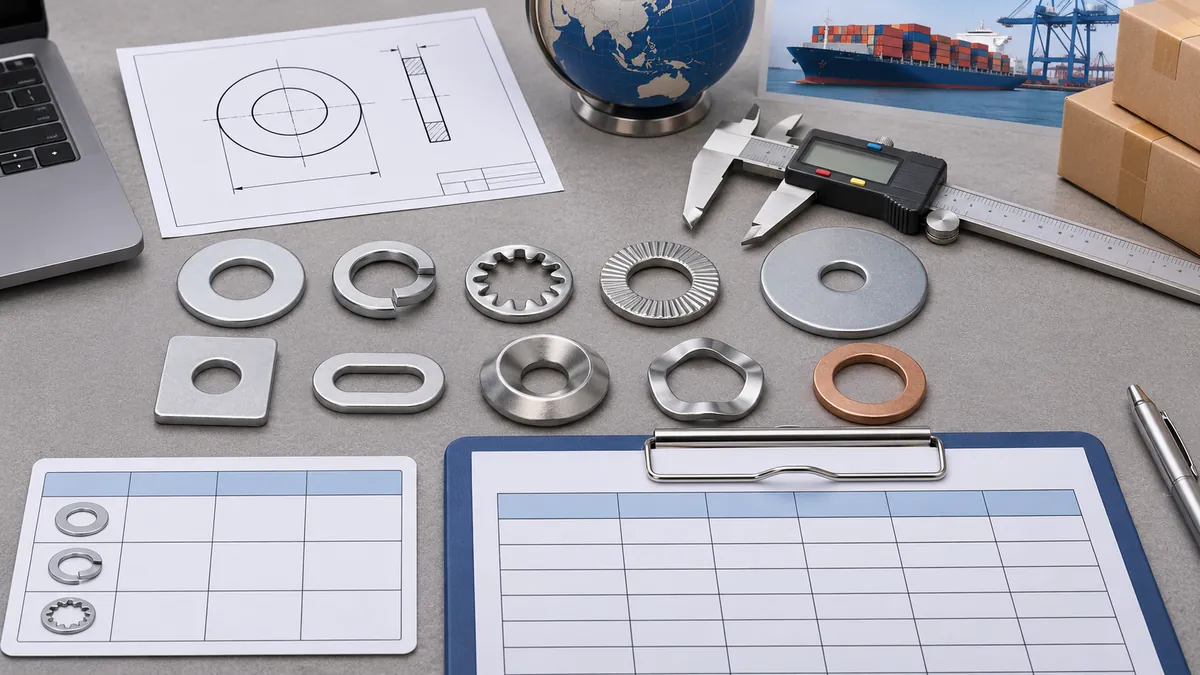
This information keeps the buyer’s request practical without forcing a material, hardness or test threshold that has not been established. The exact values should come from the approved drawing, product requirement or fastener manufacturer. A buyer who has not selected a washer yet can ask the supplier to propose a part and provide its documentation, then review that proposal against the metal assembly before sample approval.
Preguntas frecuentes
What are the most common lock washer types?
Common catalogue forms include split or helical rings, internal-tooth washers, external-tooth washers, combined internal-and-external tooth washers and paired wedge-style designs. Supplier terminology varies, so verify the actual part drawing and part number before ordering.
Does a toothed washer always prevent a screw from loosening?
No. Tooth geometry alone does not prove how an assembled joint will behave. The fastener, clamped parts, contact surfaces, assembly method and use conditions all matter. Use product-specific evidence for any performance requirement.
Are internal-tooth and external-tooth washers interchangeable?
Not automatically. Their contact geometry and envelope differ, and a given assembly may have different head clearance, bearing surfaces or cosmetic constraints. Compare the supplier drawings and the complete joint before approving a substitution.
Is a wedge washer supplied as one component?
Some wedge-style designs are supplied as a matched pair. Follow the exact product instructions and keep paired components together if the supplier requires it. Do not substitute one half for a complete specified pair.
Can a buyer identify washer material by appearance?
Appearance can help distinguish visible shapes or finishes, but it does not confirm material chemistry or a performance property. Request the exact supplier item and material information when the project requires it.
Need to Clarify a Fastener in Your Hardware Assembly?
Share the product drawing, washer and fastener references, finish details and packaging plan. Koitor can review the metal product interface and small-batch OEM scope while the fastener supplier confirms component-specific data.
OEM / MARCA BLANCA
Convierte esta guía de abastecimiento en un resumen del producto
Indícanos el producto que deseas, el tamaño, el acabado, la cantidad del pedido y los requisitos de embalaje. Tu equipo recibirá un análisis práctico de la viabilidad de fabricación antes de recibir el presupuesto.
 English
 Español
 Português
 Français
 Deutsch
 العربية