
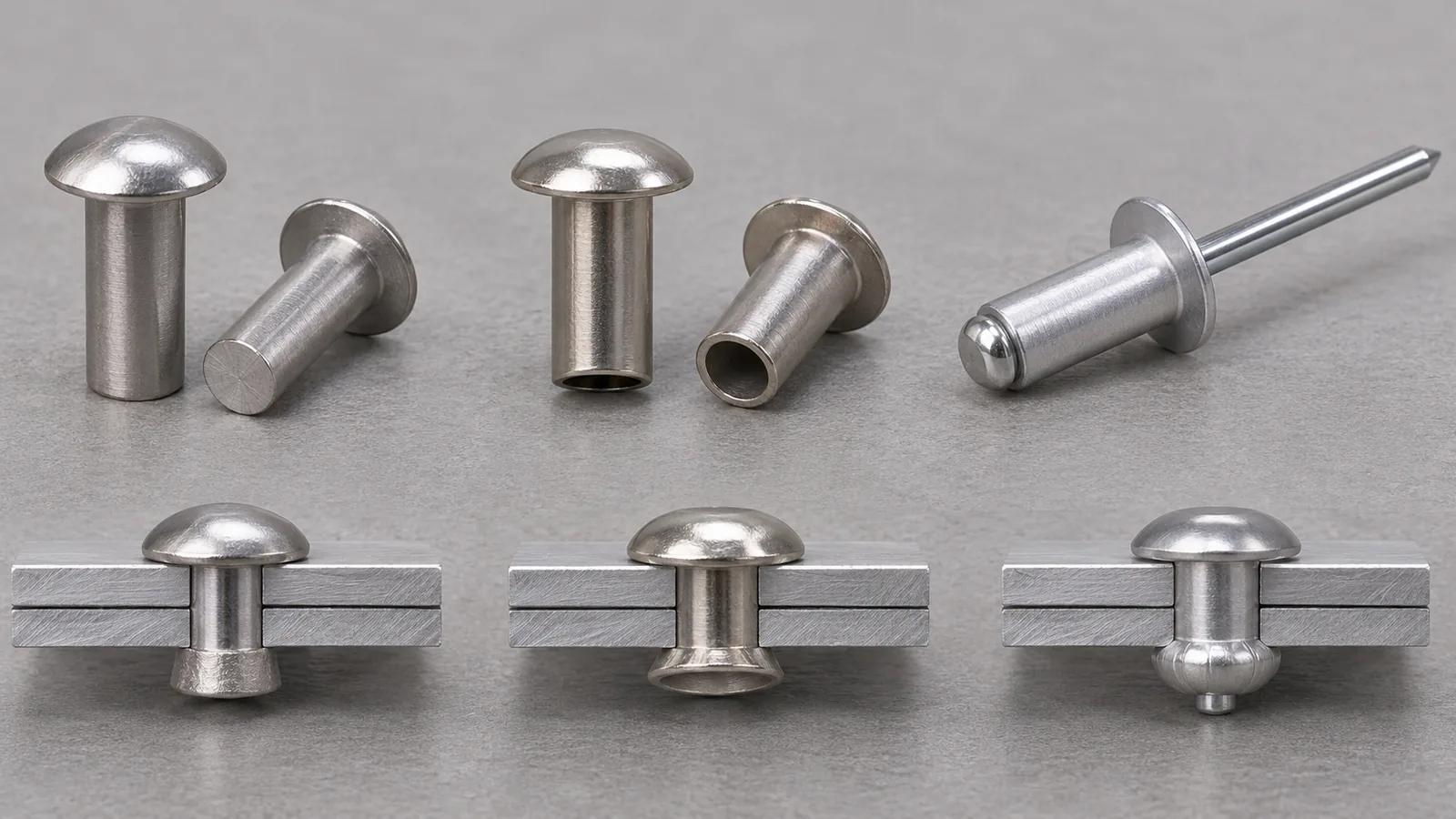
Types of rivets are best compared by their construction and setting method, then described separately by head form and material. Common families include solid rivets, tubular and semi-tubular rivets, blind rivets, expanding rivets, and threaded blind-installed inserts such as rivet nuts. The family affects which side of an assembly must be reachable and what tooling or component information the buyer needs. A fastener name or head shape does not by itself establish strength, sealing, material compatibility or suitability for the finished product.
What problem do types of rivets help hardware buyers solve?
Rivets are used to join components where a buyer may want a permanent or semi-permanent mechanical connection. In a bathroom or home-storage product, a purchased fastener can appear in a bracket, hinge-like component, mounting plate, thin panel or assembled accessory. A buyer may receive a photo that shows only the visible head. Without a drawing or part number, that view may not reveal whether the rivet is solid, tubular, semi-tubular, blind-set, or actually a threaded insert.
That ambiguity can create sourcing and assembly problems. One rivet family may require access to both sides of the joint; another may be set from one side with a compatible tool. A replacement that looks similar may have a different body, mandrel, grip range, head, material or installation route. A purchasing description such as “stainless rivet” or “flat-head rivet” leaves several critical questions unanswered.
The first buyer task is to identify the fastener family and its role. Is the rivet intended to clamp two parts permanently? Does it create a threaded point for a later screw? Does it need to remain serviceable? Is the connection rigid or intended to pivot? What is the actual layer stack? These are different design questions. The fastener description should not collapse them into one label.
Rivet classification is not perfectly uniform across supplier catalogues. Some sources group hollow, tubular and semi-tubular forms differently. A source can provide useful vocabulary, but the buyer should still request the exact maker’s drawing, component number and installation instruction. A family list is not an exhaustive international standard, and it is not a substitute for the selected supplier’s product data.
This guide focuses on buyer identification, RFQ fields and assembly access. It does not approve rivets for aircraft, vehicle frames, structural safety hardware, high-load supports or other regulated applications. No numeric grip limit, load rating, edge distance, material strength or installation standard is claimed. If a safety-critical requirement exists, the responsible engineer and fastener manufacturer must select and verify the exact joint under the applicable project requirements.
How do common rivet families differ in construction and setting access?
Solid rivets are one-piece fasteners with a formed head and a shank that passes through the joint. The opposite end is formed during setting to retain the stack. The buyer should therefore verify the joint access and the supplier’s forming method; a solid rivet name does not describe the head, material, diameter or permissible application by itself.
Tubular rivets have a hollow section that is formed during installation. Semi-tubular designs have a partial hollow at the end that is intended to deform in a particular way when set. The terms “hollow,” “tubular” and “semi-tubular” may be organized differently between catalogues, so use the drawing or sample to resolve the exact form. The important procurement question is what the body looks like, how the tail is designed to form, and what tooling and part thickness the maker specifies.
Blind rivets are commonly supplied as a rivet body with a mandrel. A compatible tool pulls the mandrel to deform the body and create a joint; the tool is applied from one side of the assembly. “Blind” describes an installation-access approach, not a guarantee that the fastener can be installed without checking the space behind the joined layers. The selected product, body length, stack and tool still need to match its maker’s instructions. Variants such as open-end, closed-end, structural or multi-grip have product-specific meanings; do not infer sealing, mandrel retention, strength or universal grip from the label alone.
Rivet nuts and rivet studs are different from conventional rivets that join a stack through a formed tail. A blind-installed rivet nut creates an internal thread in a thin-walled part so that another screw can be used later. A rivet stud provides a projecting threaded feature. They may be grouped with special or blind fasteners in catalogues, but their purpose is a threaded interface. The Böllhoff product overview distinguishes those threaded insert forms from conventional joining rivets. Do not substitute one merely because both are installed from one side.
| Family or label | Visible construction cue | Access question | What the buyer still needs to identify |
|---|---|---|---|
| Solid rivet | Solid shank and a head; the opposite tail is formed during setting. | Can the assembly and tool reach the setting side? | Exact shank, head, material, stack and installation process. |
| Tubular rivet | Hollow body section. | How does the specified tool form the tube end in this stack? | Drawing, body geometry, mating layers and supplier instructions. |
| Semi-tubular rivet | Partial hollow at the forming end. | Is the intended forming access available? | Exact family definition, material, dimensions and joint purpose. |
| Blind rivet | Body and mandrel are supplied as an assembly. | Is tool access available from the specified setting side, and does the product fit the stack? | Exact maker variant, body, mandrel, grip information and compatible tool. |
| Rivet nut or stud | Threaded insert or projecting threaded feature. | Can the insert be set into the wall thickness and later accept the intended screw? | Thread, insert drawing, setting tool, substrate and service requirement. |
El Würth technical riveting chapter organizes several construction families and discusses installation approaches. It is a supplier technical reference, not a universal classification that replaces every product drawing. The Knapp rivet overview also provides useful vocabulary for identifying types. Numeric limits, broad material-performance verdicts and application promises from individual sources should not be generalized to an unselected part.

What should buyers identify before requesting a rivet quotation?
Begin with a drawing, physical sample or a reliable supplier reference. A photograph can show the visible head, but it may not show the shank, hollow body, mandrel, formed tail or thread on the far side. If the only information is an image, ask the current supplier to identify the part number and provide a drawing. Do not write a replacement specification from a cropped photo.
Next, define the joint’s purpose. A permanent sheet connection differs from a threaded insert for a later service screw, and both differ from a connection designed to pivot. The expected movement, product maintenance plan and assembly sequence influence the appropriate family. If the buyer is replacing a fastener in an existing product, record whether the original component is intended to be removed, whether the joined parts can be separated, and what replacement instructions exist.
Record the complete material stack: each sheet or bracket, total thickness, hole geometry, visible and hidden faces, and any coating or finish. The exact fastening product may specify its own installation range or tool requirements. Use that source for the actual part instead of transferring a number from another maker. A narrow stack or an inaccessible far side can eliminate some options; it does not by itself identify the correct alternative.
Separate head style from construction. Flat, round, pan, countersunk, large-flange or other head labels describe a visible shape or bearing geometry. They do not tell the buyer whether the rivet is solid, tubular or blind. A countersunk blind rivet and a countersunk solid rivet can share a head description while using different bodies and setting access. Specify both attributes when the project cares about each.
Separate material from rivet family as well. A steel, aluminum, stainless or other material designation is a separate field from the body construction and head. If the assembly uses mixed metals, moisture, a coated face or a cosmetic surface, discuss compatibility and finish with the responsible component suppliers. A material name alone does not guarantee corrosion resistance or a particular joint result. The selected fastener’s documentation should establish whatever project-specific properties are required.
Useful RFQ fields include:
- Fastener family and exact maker part number.
- Product drawing or controlled sample reference.
- Head type, body construction and relevant dimensions.
- Material and finish requirements, if established by the buyer.
- Joined materials, layer order and total stack thickness.
- Hole diameter, location and edge geometry from the product drawing.
- Tool access from one side or both sides and any assembly obstruction.
- Whether the joint is permanent, threaded for later service or intended to move.
- Supplier-defined installation or grip information for that exact part.
- Required inspection evidence and the approved revision level.
- Kit packaging, part identification and any installation sheet.
Do not force a universal number into the RFQ if the design team has not defined it. For example, the relevant opening, stack range and edge requirements should be taken from the exact product instruction or approved engineering specification. This article intentionally does not provide a general-size table because a generic number could be applied to an incompatible rivet family or stack.
The buyer should also identify who supplies the tool, who sets the fastener, who controls the component change and who verifies the installed joint. An assembly supplier may package a bought-in rivet without manufacturing it. A tooling provider may be responsible for a setting tool, while the final product company approves the design. Record those roles in the quotation or production checklist so the project does not assume that a fastener seller and an accessory factory share the same responsibilities.
How do head form, material and access affect the finished assembly?
Head geometry affects the visible face and how the rivet bears against a component. A broad flange may cover more surface around a hole than a smaller head; a countersunk head requires a matching seat if the design intends it to sit flush. These descriptions are geometrical, not a performance ranking. The drawing should show the intended head and seat rather than rely on a product image or a generic head-style word.
The other side matters too. For a solid, tubular or semi-tubular rivet, the formed tail is part of the finished joint. For a blind rivet, the body and mandrel interact during setting. For a threaded rivet nut, a later screw engages the insert’s thread. Those are different end conditions. A drawing review should include the side that may be hidden after assembly, and the sample review should compare both visible and reverse faces where access is possible.
Product construction can also determine whether the assembly can be completed in the planned order. If a rivet must be set before a bracket or cover blocks the tool path, the assembly sequence should state that. If only one side is reachable in the finished product, confirm that the chosen fastener family can be installed with the specified tool and stack. “Blind” does not remove the need to verify access, the part, the tool and the maker’s instructions.
Finish and appearance are especially relevant when a head is visible on a polished or coated product. A different head, flange size or setting operation can change the visible footprint. Burrs, scratches, distortion, coating damage or gaps should be evaluated against a defined sample and buyer acceptance criteria, not against a universal claim that every installed rivet looks a certain way. If the product has a cosmetic face, identify it in the drawing and show the approved sample orientation.
Material selection should remain conditional on the stack, environment, forming process and product need. A supplier’s material catalogue can describe its product, but the buyer must not infer that one metal is always stronger, more corrosion resistant or lower cost in every geometry. Likewise, a rivet material does not establish the properties of the assembled bracket. For a mixed-metal joint, request supplier guidance for the actual materials and application; do not rely on color as identification.
Inspection should focus on observable and documented characteristics. A receiving inspection might verify the fastener family, dimensions or part marking if the project defines those checks. An in-process check may examine whether the fastener is present, whether the correct side was set and whether the visible head is seated consistently against the drawing. If a functional test is required, identify the tested configuration, method and acceptance criteria. No test method or result is implied here for a particular product.
The package should protect and identify fasteners. Small rivets can be mixed between SKUs or lost from an open pouch. Separate bags, labeled compartments, part numbers and assembly sheets can help keep the correct component connected to the correct product. If a rivet is a bought-in item, preserve the supplier designation on the internal BOM or receiving record. Do not leave the production team to distinguish two similar parts only by their finish or head profile.
What sourcing mistakes should buyers avoid?
The first mistake is treating “blind” as a complete specification. It indicates a setting approach from one side for a product family, but the body, mandrel, grip, tool and installation instructions still matter. An assembly may have a product-specific variant. The buyer should request the exact supplier record rather than assume every blind rivet can fit every stack.
The second mistake is treating the head as the rivet type. “Countersunk” or “large flange” describes a head form, not necessarily the body construction. “Stainless” or “aluminum” names a material, not the setting method. Keep family, head, material and application as separate fields so a supplier cannot resolve one by substituting another.
The third mistake is confusing a rivet nut with a conventional joining rivet. A rivet nut creates a thread for another fastener; it does not automatically replace the product’s original rivet joint. The expected screw, service access, insert setting and material stack must be reviewed. The exact manufacturer’s drawing should make clear what component the buyer is purchasing.
The fourth mistake is assuming that every tubular family has the same label or forming geometry. Product catalogues may group tubular and semi-tubular designs differently. Request a cross-section or component drawing if the family term is ambiguous. Use the supplier’s exact part number as the purchasing anchor.
The fifth mistake is making a blanket performance claim from a family name. A rivet type does not prove that a joint is watertight, vibration resistant, structural, sealed or suitable for a specified load. Those results require evidence that corresponds to the exact fastener, material stack, installation and application. Do not copy a product-specific claim from a different supplier into a generic article or a Koitor quotation.
The sixth mistake is ignoring access and assembly order. A fastener may be compatible with the material stack but impossible to install after the product is assembled. Check the tool envelope, the side from which the tool operates, nearby brackets and any finished cover. Record the sequence on the drawing or assembly instruction before approving the sample.
The seventh mistake is approving a similar-looking replacement without checking the approved sample. A substitute can alter the head, body, material, installation tool, opening or visible face. Treat a fastener change as a product change when it affects the approved configuration. Request a revised component record and review the finished assembly again.
How can an OEM factory help, and what belongs in the rivet RFQ?
A small-batch OEM factory can help a buyer connect a fastener choice to the metal part drawing, product assembly and packaging plan. Koitor Hardware is a family-owned custom metal hardware factory specializing in bathroom and home storage hardware. Its approved work includes discussing buyer drawings or samples, metal product structure, finish, basic assembly and packaging preparation. The exact fastener, rivet-setting operation, tool, material and performance evidence should be confirmed with the supplier responsible for those components and processes.
For a custom towel rack bracket, storage basket interface or tissue-holder assembly, provide the drawing and mark the fastener locations, cosmetic faces and intended installation sequence. If the rivet is already selected, include the exact part number and supplier instructions. If it is not selected, identify the unresolved constraints: one-side access, joined materials, desired serviceability, appearance, tool ownership and project requirements. The factory can then flag where the accessory geometry or assembly sequence needs discussion without making an unsupported fastener-performance claim.
During sampling, review the purchased rivet alongside the actual sheet or bracket. Confirm the head location, clearance, visibility, tool path and finishing sequence. If the rivet must be installed before polishing or coating, state that sequence. If a cover conceals the joint, document the hidden fastener identity and the approval sample. If a supplier proposes an alternate rivet, check the revised drawing and part information rather than accepting the substitution based on a similar finish.
For an RFQ, send:
- Product drawing or physical sample with fastener locations.
- Exact rivet type or a supplier proposal with drawing and part number.
- Joined material stack, thickness and any finish on the contact faces.
- Required setting-side access and the available tool envelope.
- Head appearance, flushness or other drawing-defined interface details.
- Whether the joint is permanent, serviceable, threaded or intended to pivot.
- Supplier installation instructions and any project-specific evidence.
- Packaging, labeling and SKU separation expectations.
- Target quantity, sample request, logo and private-label packaging details.
If the product is at an early stage, Koitor can review a drawing or sample and discuss practical OEM options. MOQ can start from 100 pieces depending on product structure, materials, finish and packaging; sample and bulk schedules depend on the confirmed project. These are planning ranges, not guarantees. Confirm the quotation, sample plan and party responsible for each purchased component before production.
Buyers can review Fabricación a medida de accesorios de baño o Hardware OEM para almacenamiento doméstico for the metal product scope. To discuss a specific drawing, sample or packaging plan, use the contact page. Do not describe the finished assembly as tested or rated unless the responsible party supplies evidence for the actual configuration.
What should a buyer checklist include?
- [ ] Fastener family is supported by a drawing, sample or exact supplier part number.
- [ ] Head shape, body construction and material are recorded separately.
- [ ] Joined layer stack and access from each side are clear.
- [ ] Tool and assembly sequence are confirmed with the responsible supplier.
- [ ] Joint purpose is stated: permanent, threaded for later service, or moving.
- [ ] Hole and edge geometry follow the approved design or supplier instruction.
- [ ] Cosmetic and hidden faces are identified for sample inspection.
- [ ] Any required performance evidence is tied to the actual fastener and stack.
- [ ] Packaging keeps similar fasteners identified by SKU and revision.
- [ ] Substitutions require review before bulk production.
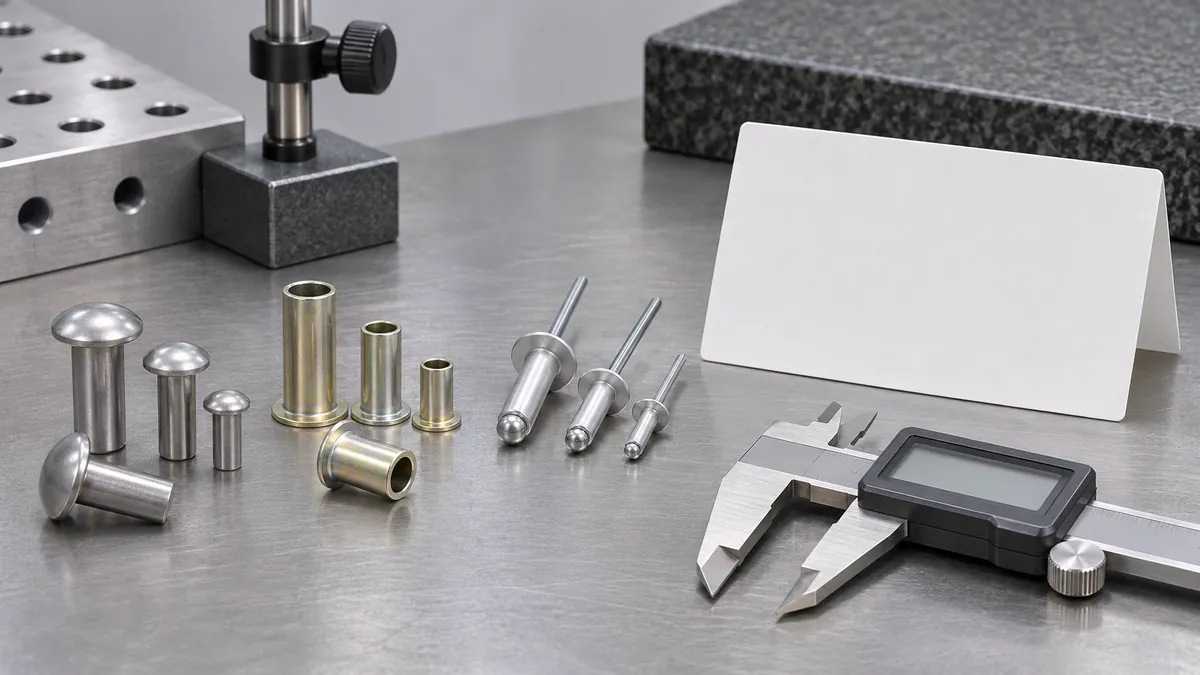
Preguntas frecuentes
What are the main types of rivets?
Commonly discussed families include solid, tubular, semi-tubular and blind rivets. Rivet nuts and rivet studs are threaded blind-installed inserts with a different purpose. Supplier terminology can vary, so identify the specific construction from a drawing or product number.
Is a countersunk fastener necessarily a blind rivet?
No. Countersunk describes a head form. The rivet body could belong to a different construction family. Specify head style and rivet family as separate properties.
Does blind installation mean there is no access requirement behind the panel?
No. The setting tool is applied from one side for a compatible blind-rivet product, but the selected fastener still has product-specific stack and clearance requirements. Follow the maker’s instructions for the exact part.
Is a rivet nut interchangeable with a regular rivet?
No. A rivet nut creates a threaded point for a later screw, while a conventional rivet joins components through its set body. They serve different joint functions and should not be substituted without design review.
Can a rivet family name prove a joint’s load or sealing performance?
No. Those properties depend on the exact fastener, stack, installation and application. Request relevant evidence from the responsible supplier or qualified engineering party.
Need to Review a Riveted Hardware Assembly?
Share the product drawing, rivet reference, joined-material stack, tool-access constraints and packaging plan. Koitor can discuss the metal product interface and small-batch OEM scope while the fastener supplier confirms part-specific setting information.
OEM / MARCA BLANCA
Convierte esta guía de abastecimiento en un resumen del producto
Indícanos el producto que deseas, el tamaño, el acabado, la cantidad del pedido y los requisitos de embalaje. Tu equipo recibirá un análisis práctico de la viabilidad de fabricación antes de recibir el presupuesto.
 English
 Español
 Português
 Français
 Deutsch
 العربية