

Commercial soap dispenser soap compatibility depends on the exact pump or valve, the soap formulation, the fill method, and the dispenser configuration being approved together. A stainless or other metal housing does not establish that its internal mechanism will dispense every liquid, foam, sanitizer, or refill sold under the same broad category name. Buyers should identify the precise model, pump revision, refill source and intended product use, then follow the maker’s instructions and limits for that configuration.
This matters to importers and hospitality distributors because a buyer may source the visible metal shell from one supplier, the pump from another, and the consumable from a third. Each component can be individually plausible while the combined product remains unreviewed. A pump marketed for “soap” may have a specified viscosity or formulation range, and a foam unit may require a different mechanism from a liquid unit. Package wording such as “universal” should be checked against the actual model information rather than treated as proof.
For a B2B specification, commercial soap dispenser soap compatibility should name the pump, refill and housing revisions reviewed together.
This guide focuses on manual bulk-fill products with a metal housing and a purchased pump or valve. Automatic units, electrical controls, sanitizer use, healthcare claims, installation details, and consumer repair are outside the core scope unless a qualified supplier specifically confirms them. The task here is product and sample approval, not creating a new pump, testing chemical safety, or promising a dispensing result.
What does commercial soap dispenser soap compatibility mean?
Compatibility is a documented match between a specified dispenser configuration and a specified consumable under the conditions the maker identifies. It is not inferred from the housing material, the pump’s appearance, or a generic label saying “liquid soap.” The buyer should record the dispenser model and revision, the pump or valve identity, refill product and supplier, fill method, and the conditions under which the pairing was reviewed.
The internal mechanism determines the type of product it is designed to handle. A manual liquid pump and a foam pump may differ in their intended fluid characteristics and operating arrangement. A brand’s product family can include both types even when the external housing style appears similar. The buyer should not assume that a component can be swapped because its thread, collar, or exterior shape looks similar. The mechanism supplier’s current data and instructions govern the specific configuration.
Manufacturer examples show why a named compatibility range matters. American Specialties lists its ASI0345 manual liquid unit with a specific viscosity range of 100–3500 cP and a pH range of 5.5–8.5. A separate ASI0357 manual foam model lists 1–100 cP and the same stated pH range. Those numbers describe those maker models only. They are not general limits for all liquid or foam dispensers, and they are not Koitor specifications. See the ASI0345 product page y el ASI0357 product page for their respective model-specific statements.
Hokwang’s FAQ likewise explains that soap compatibility depends on the model and pump configuration, and that foam use requires a dedicated mechanism for the relevant configuration. Its selected sanitizer-compatible arrangements do not prove that every model accepts sanitizer. Review the Hokwang FAQ as supplier guidance for its products, not a universal rule. A dated Bobrick data sheet offers a further product-specific example of a valve and formulation restriction; it should not be generalized to another dispenser or treated as current policy without checking the model documentation. The Bobrick 2018 data sheet is historical context only.
A useful buyer definition is therefore: “This dispenser model and pump revision were reviewed with this named soap product and fill method against the maker’s current compatibility information.” If one of those inputs changes, the old approval may not cover the new pairing. A similar metal body or supplier logo is not a substitute for the exact model record.
What should the RFQ specify about the pump and refill?
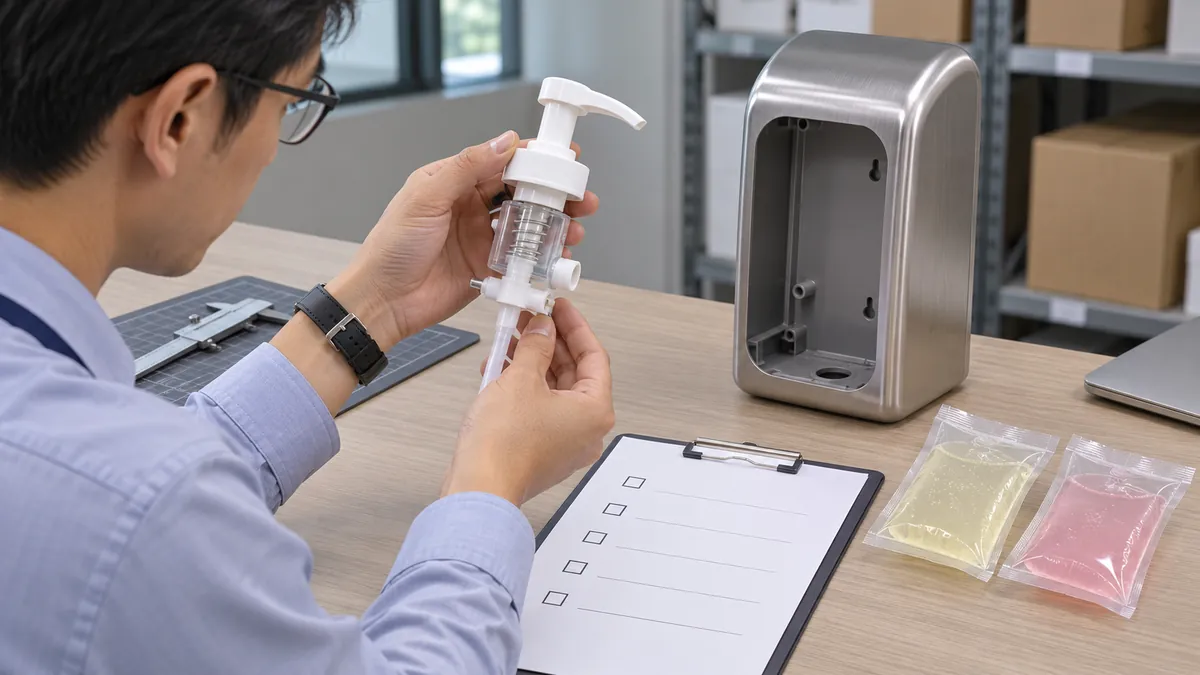
An RFQ should identify the complete configuration being quoted. Start with the dispenser format: manual, bulk-fill, wall-mounted, countertop, recessed, or another model-specific arrangement. Name the external housing and visible finish if these matter to the SKU. Then identify the pump or valve that will be installed, including the maker, model, revision, and any compatible reservoir or fill cap. If the pump is bought in, clarify who selects it, who supplies its instructions, who confirms compatibility, and who is responsible for a production-intent assembled sample.
Describe the intended soap using the information available from its supplier. Record brand or product line, specific refill or formula reference, liquid or foam designation, and any stated viscosity or pH range. Do not invent these values if the supplier does not provide them. A marketing phrase such as “gentle liquid soap” does not replace technical information requested by the dispenser maker. If the end customer may choose among multiple soaps, determine whether the SKU is intended for a defined product, a bounded set of validated formulations, or a broader compatibility claim that requires more evidence.
Ask the pump maker to identify its current compatibility limits and the basis for those limits. Does a stated viscosity range apply to all versions or only a particular valve? Does the product require a specific fill method, reservoir, nozzle or orientation? Are there excluded substances or conditions? Is the information a product specification, a recommendation, or a marketing statement? The buyer should preserve the source document and date rather than copy a range into a spreadsheet without context.
Specify whether the delivered item includes the pump, refill container, reservoir, key, mounting hardware, instruction sheet, or any other component. Some dispensers are sold as a metal shell with a separate mechanism; others as a complete assembled unit. If the quotation covers only the enclosure, do not compare it to a complete model without adjusting the scope. A bill of materials or quote clarification should name the responsible source for each purchased part.
The RFQ can use this table to clarify the configuration:
| Campo «Solicitud de presupuesto» | Buyer information to provide | Supplier response to request |
|---|---|---|
| Housing model | SKU, finish and drawing revision | Confirm offered body and revision |
| Pump or valve | Maker, model, revision if known | Confirm exact component supplied |
| Soap product | Supplier, SKU or representative actual sample | Confirm whether the model information covers it |
| Fluid information | Values provided by the soap supplier | Identify required limits or missing data |
| Fill arrangement | Bulk-fill, bottle, cartridge or other model-specific method | Provide current loading and filling instructions |
| Use orientation | Countertop, wall, recessed or other intended setup | Confirm the configuration is supported |
| Included parts | Pump, reservoir, fixing kit, keys and instructions | List what is included and what is separate |
| Control de cambios | Supplier, formula, pump or housing changes | Explain notification and reapproval triggers |
The table is an RFQ aid, not a universal product specification. If the pump supplier gives model-specific values, preserve them with their units and source. If the soap maker cannot provide a needed fluid characteristic, identify that uncertainty and ask the mechanism maker whether it can still evaluate a sample. Do not let the metal enclosure purchase conceal an unresolved pump or soap question.
How should buyers review a production-intent sample?
Review a complete sample with the actual pump and the intended refill, using the supplier’s current instructions. A display-only sample with no mechanism cannot answer pump compatibility. A pump tested with a convenient substitute soap does not establish the specified refill pairing. If the buyer approves a sample that does not contain every intended part, write down what the sample did and did not cover.
Begin by verifying identities. Check the pump model and revision against the quote, the metal housing against the drawing, and the soap container against the supplier’s reference. Confirm how the soap is added and how the unit is primed or prepared if the maker provides such steps. Do not improvise a priming sequence or alter the pump. If instructions are missing, request them before evaluating the sample.
Observe the sample under a defined, repeatable sequence appropriate to the manufacturer’s directions. Record the soap reference, pump model, housing revision, installation orientation, refill or fill state, and the action taken. Note what was observed, such as whether the pump returned to its normal position, whether product appeared at the outlet, or whether the buyer encountered a leak or blockage during the bounded review. These are observations tied to one sample and setup, not proof of long-term reliability, hygiene, user satisfaction, or suitability for every soap.
Do not devise an arbitrary number of cycles and treat it as a recognized test unless the buyer or qualified supplier has established that method. A limited sample check can identify questions, but it does not provide a statistically valid production guarantee. If a repeatability or endurance claim is important, define the required evidence with the responsible pump manufacturer or laboratory. Do not alter springs, seals, tubing, or valves to make an unmatched combination appear acceptable.
For commercial programs, examine the user and service sequence as well as the initial operation. Can the correct refill be identified? Is the reservoir accessible as the maker intends? Are cleaning or replacement instructions available? Can the maintenance team distinguish a liquid model from a foam model? These questions do not create a universal sanitation standard; they help the buyer confirm that the selected configuration and documentation fit the intended channel. Where workplace, healthcare, or chemical rules may apply, route them to the proper compliance reviewer.
Record exceptions without diagnosing beyond the evidence. “Pump did not dispense with sample X after the stated preparation sequence” is more actionable than “pump defective” if the test did not isolate cause. The issue could involve the refill, mechanism, assembly, orientation, or preparation. Ask the responsible suppliers to review the evidence and advise whether another sample or qualified test is appropriate. Do not assume that a different pump is the correct remedy before the cause and scope are understood.

How do buyers separate compatibility evidence from product claims?
A supplier statement should be reported with its scope. If a manufacturer lists a model-specific viscosity range, cite the model and the current source. Do not write that all metal soap dispensers accept that range. If a maker says that one configuration is suitable for a selected sanitizer, do not imply that other configurations accept sanitizer or that the product is approved for medical use. Product names, category names, and photographs do not establish chemical resistance, hygiene outcomes, or regulatory compliance.
Separate fit and operation from safety or health claims. A pump may physically dispense a sample in a short review, but that does not prove long-term material compatibility, shelf life, microbial safety, chemical suitability, or performance in every temperature and use condition. Those questions require evidence from the relevant material, formulation, and intended use. The buyer should ask qualified suppliers or compliance specialists what documentation is appropriate for the claim.
Create a claim-to-evidence table before approving packaging or a distributor data sheet:
| Proposed statement | Evidence question | Appropriate reviewer |
|---|---|---|
| “For liquid soap” | Which exact models and fluid limits are stated? | Pump or finished-product maker |
| “For foam soap” | Is the mechanism specifically configured for foam? | Pump maker |
| “Compatible with sanitizer” | Which formulation, concentration, and material configuration are covered? | Responsible technical and compliance specialists |
| “One pump fits all refills” | Is there evidence for every named refill and model? | Product owner and pump maker |
| “Easy to clean” | What exact cleaning steps are documented for the model? | Finished-product maker |
| “Commercial grade” | What defined specification or evidence supports the phrase? | Brand and compliance reviewer |
If the evidence supports only a narrower statement, use the narrower statement. If it supports a model and a specific soap SKU, identify them. If the buyer has only a prototype sample, label the observation as sample review rather than a certified performance result. Avoid “universal,” “guaranteed,” “works with all,” “maintenance-free,” or hygiene language unless the responsible party has evidence for the precise product and conditions.
Record whether the evidence is a manufacturer specification, a product page, an informal supplier email, an observed sample, a laboratory result, or a regulatory document. Those sources do not carry the same scope. A product page may be useful to identify an item but may not provide a complete test report. An email may clarify the supplier’s answer but should be linked to the model and date. A sample trial may show what happened once but cannot establish a population-wide failure or success rate.
What changes should trigger another review?
Compatibility should follow the approved pump, soap and housing revisions. A change in any one may alter the pairing or the evidence. Typical triggers include a new soap supplier, new formula or product reference, change from liquid to foam, pump substitution, valve revision, reservoir change, a different fill arrangement, altered outlet, new housing design, different assembly, or change in the installation orientation. Whether a specific change requires a full re-evaluation depends on the maker’s instructions and the buyer’s requirements. Record the rationale either way.
A change matrix can help teams route questions:
| Proposed change | First question | Posible reseña |
|---|---|---|
| New pump model | Are its limits and mounting interface the same? | Check current data and assembled fit |
| New soap formula | Does the pump maker’s stated range cover it? | Obtain supplier data and maker guidance |
| Liquid to foam | Is the mechanism configured for the new product type? | Treat as a new configuration unless maker confirms otherwise |
| New housing or finish | Does the change affect reservoir space, contact materials, assembly or access? | Review impacted drawing and sample |
| New reservoir or fill method | Do the maker instructions and pump tube or valve still apply? | Confirm the complete setup |
| New marketing claim | What specific evidence supports the wording? | Route to product and compliance review |
Do not rely only on a shared product family name. A manufacturer may offer multiple pump options, reservoirs, valves, or finish variants under a similar external style. Ask how revisions are identified and whether the model number changes when the pump is updated. Keep a dated record of the approved combination. If the supplier cannot confirm whether the component changed, mark the status as unknown and resolve it before treating the former approval as current.
Change control also matters when the refill is chosen by the end customer rather than bundled. In that case, identify the supported range and publish only the maker’s confirmed limits. If the product is sold with one named refill, record the soap SKU as part of the bill of materials and product data. If the refill is not included, state that clearly so buyers do not confuse an illustrative image or sample with the contents of the package.
If a supplier proposes an alternative component to manage cost or availability, do not accept it solely because its mounting dimensions appear similar. Compare the technical limits, materials, fill method, included parts, and actual sample. If there is no evidence that the replacement is compatible with the chosen formula, keep it as a proposed change pending review. Update the product record, package copy, and spare-part list where the change affects those materials.
What should the approval record contain?
A buyer’s approval record should describe the paired configuration in enough detail to reproduce the review. Include dispenser SKU and drawing revision, pump or valve maker and model, soap supplier and product reference, any available fluid data, fill and preparation instructions, orientation, sample date, reviewer, observations, unresolved issues, and the decision. Attach the supplier documents used and record their dates. If any value is missing, mark it as not supplied rather than inferring it.
A concise approval sheet can include:
- Product and housing identity.
- Pump, valve, and reservoir identity.
- Actual soap sample or source reference.
- Manufacturer’s stated compatibility limits and source.
- Fill method and current instructions.
- Sample setup and orientation.
- Observed operation and exceptions.
- Items not evaluated, including long-term or regulatory questions.
- Change triggers and reapproval owner.
- Approved wording for the buyer’s product data, if any.
The record should state whether approval covers appearance, dimensions, component completeness, the observed sample operation, or a broader claim supported by evidence. A sample can pass visual review while its soap compatibility remains unresolved. A component can fit physically but still lack confirmation for the intended formulation. Do not use one broad “approved” mark if the review covered only some aspects.
For a distributed supply chain, assign responsibility explicitly. The pump supplier should provide its component information. The soap supplier should provide relevant product information. The metal housing source should confirm the body and assembly scope it controls. The importer or brand owner should decide the target market, final claims, and product release. In projects where one party coordinates the complete finished product, identify that party and the evidence it has reviewed. Keep any compliance or chemical assessment with the qualified responsible team.
No Koitor-specific soap pump, liquid or foam mechanism, formulation range, or commercial dispenser test has been verified for this article. Koitor’s metal bathroom and home-storage manufacturing scope does not establish that it produces a pump, seals, reservoirs, or complete soap dispenser. Buyers interested in a custom metal enclosure or related hardware should first confirm product fit and component responsibility with the supplier. The useful sourcing discussion begins with a drawing, actual pump reference, intended soap, finish expectation, quantity split, and who owns the compatibility decision.
Preguntas frecuentes
Can any liquid soap work in a manual dispenser?
No universal answer applies. Check the exact model’s current instructions and stated limits against the named soap product. Broad category labels do not prove a compatible pairing.
Is a metal housing enough to establish compatibility?
No. The pump, valve, reservoir, fill arrangement, formulation, and orientation may all matter. The visible shell does not define the internal mechanism.
Can a foam pump be used with liquid soap?
Do not assume so. A foam configuration may use a dedicated mechanism. Confirm with the manufacturer for the exact model and refill.
Do the ASI viscosity ranges apply to every dispenser?
No. The published ranges in this article are specific to two named ASI models. Use current data for the actual product being purchased.
Does one successful sample prove long-term compatibility?
No. It documents an observation under the review conditions. Longer-term, chemical, hygiene, and regulatory claims need separately defined evidence.
Sources and scope
- ASI0345 manual liquid dispenser y ASI0357 manual foam dispenser — model-specific published ranges.
- Hokwang model compatibility FAQ — supplier-specific guidance on pump and soap configuration.
- Bobrick 2018 data sheet — historical model-specific example, not a current universal specification.
- No Koitor pump manufacture, formulation test, certification, health claim, or customer case is asserted.
Discuss a Custom Metal Storage Hardware Concept
Send a drawing or sample, the intended application, finish reference and quantity split. Koitor can first confirm whether the product and process fit its current bathroom and home storage hardware scope.
OEM / MARCA BLANCA
Convierte esta guía de abastecimiento en un resumen del producto
Indícanos el producto que deseas, el tamaño, el acabado, la cantidad del pedido y los requisitos de embalaje. Tu equipo recibirá un análisis práctico de la viabilidad de fabricación antes de recibir el presupuesto.


 English
 Español
 Português
 Français
 Deutsch
 العربية