


Importers who treat pantone powder coat matching as a last-minute “close enough” note inherit color rejects that look like coating defects but are really uncontrolled color systems. A Pantone number on a print fan deck is not a powder formula, a light-booth protocol, or a substrate-backed gold sample. This article freezes buyer and OEM language for color CTQs on powder-coated bathroom and kitchen wire hardware—delta-E limits, illuminants, gloss coupling, master retention, and lot release—so RFQ and IQC teams can accept or reject with the same words.
It deliberately differs from humid-bathroom powder pillars that explain pretreatment, DFT, and Faraday-cage risk, and from powder-science overviews that map thickness and defect families. Those pages remain the process neighbors. This page is the color-matching RFQ layer: how to convert a Pantone intent into inspectable powder acceptance language without rewriting the coating process story. Photos are generic visual aids. Koitor Hardware supports wire bathroom and kitchen storage programs from Jiangmen, China, with practical finish-spec language for private-label teams.
In this guide
- Why Pantone Powder Coat Matching Breaks Without Frozen Specs
- How to Freeze Pantone Powder Coat Matching CTQs
- 9 Essential Checks for Pantone Powder Coat Matching
- Accept, Rework, or Reject: Color Disposition Rules
- RFQ Checklist Language for Color, Gloss, and Gold Samples
- Preguntas frecuentes
- Send Your Spec
Why Pantone Powder Coat Matching Breaks Without Frozen Specs
Most failed pantone powder coat matching programs share one pattern: the buyer sends a Pantone code, the factory sprays a “similar” powder, and first mass is judged under office LEDs or phone photos.
Pantone graphics systems were built for ink on paper. Powder on steel wire has different opacity, texture, and gloss. Without a substrate-backed master and a named illuminant, “match” becomes an opinion.
When pantone powder coat matching is only a purchase note, suppliers optimize for cheapest powder that looks near the fan deck under warehouse light. Retail returns cite “wrong color” while IQC has no delta-E rule.
Bathroom and kitchen wire SKUs amplify the problem. Thin wires, Faraday cage pockets, and matte textures shift perceived hue even when the powder lot is nominally correct.
Neighbor process posts cover humid-room powder durability and thickness/pretreatment science. Use them for coating integrity. Use this page when the dispute is color identity versus a Pantone intent.
Buyers who freeze pantone powder coat matching early cut sample loops. One rejected container of “almost right” matte black costs more than a booth protocol and a locked gold sample.
How to Freeze Pantone Powder Coat Matching CTQs
Start every pantone powder coat matching RFQ with four locked fields: Pantone code and guide edition, substrate and texture, illuminant/observer (commonly D65 / 10°), and max CIEDE2000 delta-E versus gold.
Add gloss window in GU at a stated angle for matte or satin. Color and gloss couple; a “right L*a*b*” with wrong gloss still fails shelves.
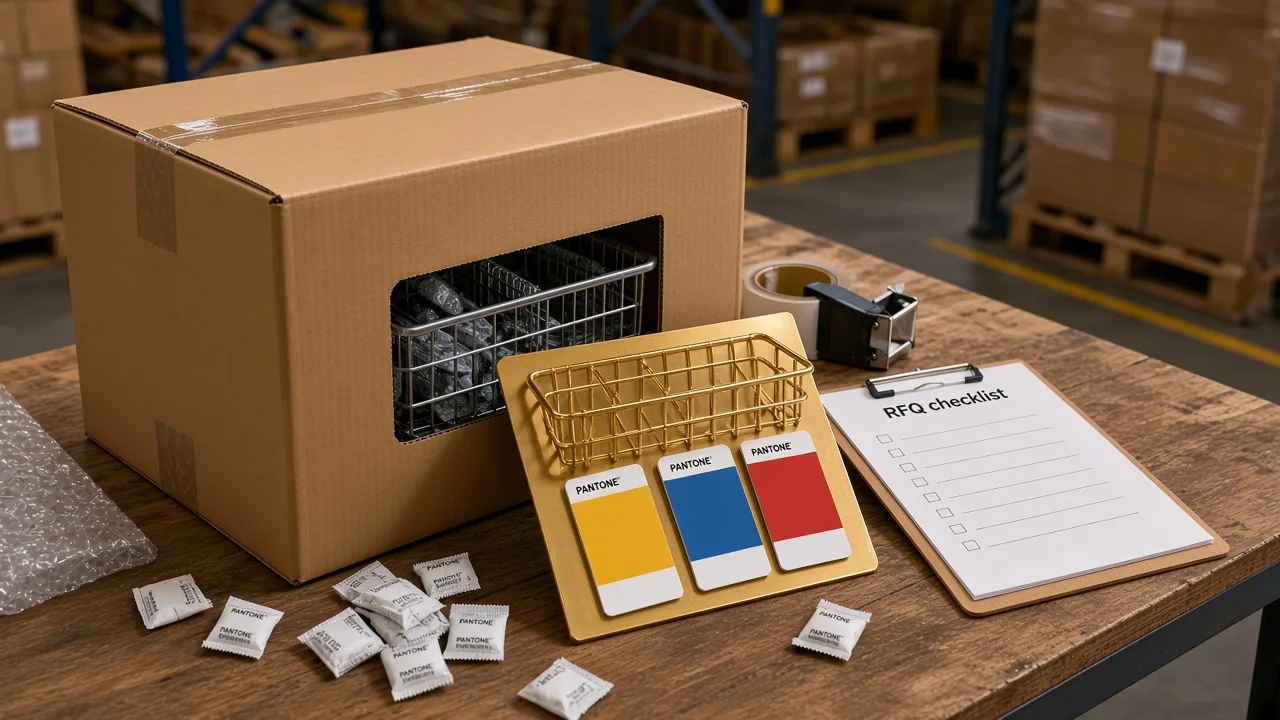
Master hierarchy: Pantone chip = intent; coated steel coupon = working master; production gold = lot-release reference. Do not match the fan deck every lot without gold.
For pantone powder coat matching on wire goods, measure flat coupons that share pretreatment and cure, then visually check actual wire geometry under the same booth.
Record powder supplier, product code, lot, and bake profile with every approved master. Drift often tracks reformulation, not spraying alone.
Reference official Pantone tools for naming intent: the Pantone Color Finder y el Formula Guide coated/uncoated set. They do not replace a coated gold sample.
9 Essential Checks for Pantone Powder Coat Matching
Use these nine checks as the spine of any pantone powder coat matching IQC plan.
Reject vague “Pantone black.” Require exact code, coated/uncoated note, and steel-wire substrate. First gate of pantone powder coat matching.
State D65 and observer. Ban mixed office lighting for final visual. Dirty booths shift neutrals.
Name aperture and specular mode for textured mats. Calibrate daily. Uncalibrated devices create fake fails.
Critical brand colors often use ΔE00 ≤ 1.0–1.5; utility neutrals ≤ 2.0. Write the number. Cite ASTM D2244 color-difference language.
Matte programs need GU limits at 60° or 85°. Glossy “correct hue” fails matte merchandising.
Pass instrument on coupon, then inspect rims and Faraday zones. Pantone Powder Coat Matching fails often appear only on thin wires.
Require powder COA, lot, and bake profile. Block silent powder swaps.
Keep sealed gold coupons with retention dates. Photograph booth setup for dispute packs.
When sets mix chrome accents and powder parts, freeze relative warmth so shelves look coherent.
Disposition language turns this color-matching program from debate into dock decisions.
Accept when ΔE00 and gloss sit inside windows, wire visual matches gold, and powder lot matches the approved code.
Rework only when adhesion remains sound and salvage rules were pre-agreed. Do not recoat endlessly hoping hue drifts into window.
Reject when ΔE00 exceeds the hard limit, gloss is outside window, powder lot is unapproved, or booth visual shows metameric fail.
Separate color reject from corrosion or adhesion reject. Force that split on the IQC sheet.
Document every disposition with instrument printouts, booth photos, and gold sample ID for this color-matching program disputes.
Paste this skeleton into your next this color-matching program RFQ annex and fill blanks.
Color intent: Pantone ______ (edition ______, coated/uncoated ______). Working master ______. Production gold ______. Illuminant D65 / 10°. Max ΔE00 ______. Gloss ______ GU at ______°. Powder code ______. Bake ______.
For durability and thickness, point suppliers to humid bathroom powder coating controls y powder coating science on thickness and pretreatment. Keep color annex separate.
For visual defect names on powder shower goods, use powder coated shower caddy coating defects—not as a substitute for ΔE windows.
Close RFQ flow: Pantone intent → coated coupon → PPAP gold → first-article this color-matching program report → mass lot release.
Accept, Rework, or Reject: Color Disposition Rules
RFQ Checklist Language for Color, Gloss, and Gold Samples
Practical multi-market note: when this color-matching program must support EU and US shelves, freeze one gold and one illuminant as the hard gate; treat other store lighting as advisory.
Add metamerism checks for neutrals if the largest retailer uses warm LED after the D65 hard gate.
Label every gold coupon with Pantone code, powder lot, bake date, gloss, and ΔE00 to prior master. Orphan samples destroy this color-matching program within two seasons.
Refuse phone-photo approvals. Require booth photos with illuminant label in frame for remote confirmation.
Couple color CTQs to adhesion language elsewhere in the PO for matte black wet-room SKUs.
Segregate powder hoppers by brand color family. Cross-contamination is a silent this color-matching program killer.
First-article packages need L*a*b*, ΔE00, gloss, powder COA, bake chart, booth photos, and signed disposition.
Reject “digital Pantone only” for production release. Screens are not coated steel.
Run a three-lot capability study before locking gold for a new powder vendor on this color-matching program.
Do not open ΔE windows to compensate for bad store LEDs; fix merchandising notes instead.
Spec PE bags so abrasion haze is not blamed on this color-matching program.
Carton spot color and powder color need separate tolerances when both carry brand hue.
Reserve calendar time for color FA before marketing photography freezes the wrong memory of this color-matching program.
Re-identify discontinued Pantone codes with current chips and re-cut gold samples.
Freeze relative ΔE across soft white, matte black, and warm gray families so sets stay harmonious under this color-matching program.
Track color PPM separately from weld PPM on supplier scorecards.
If travel is impossible, overnight coupons to a third-party lab under the named illuminant for this color-matching program confirmation.
Any powder reformulation, primer change, or bake edit triggers re-FA before mass.
Auditors should see physical gold, last three ΔE reports, booth logs, and powder lot maps for this color-matching program.
Dual-source factories must share the same gold and ΔE window or shelves will mismatch.
Write change-control so chemistry, tooling, or bake edits cannot ship without a signed first-article pack.
Keep a sealed master and a working reference; replace working references on a calendar before they scuff into false fails.
Train inspectors with photo boards of borderline cases so two shifts grade the same way on Monday and Friday.
Separate cosmetic AQL language from method CTQs on the disposition sheet so teams do not waive the wrong gate.
Dual-source programs must exchange physical masters and gauges, not only PDF drawings, before the second plant ships.
Private-label programs need brand-owned masters, not supplier-owned ones, so factory switches do not orphan the standard.
State rework limits: how many re-bakes are allowed before substrate temper or adhesion risk voids the lot.
Map Pantone intent to powder chemistry class early; polyester, epoxy-polyester, and polyurethane behave differently outdoors.
Keep instrument serial and calibration due dates on every lot sheet so audits can prove method continuity.
Freeze the illuminant, observer, and aperture on the purchase annex so lab-to-lab ΔE stops floating between D65 and cool-white retail lamps. Keep owners named on the same page as the numeric CTQ.
Require coated masters on the same substrate and mesh as production; paper Pantone chips are navigation aids, not release gauges. Keep owners named on the same page as the numeric CTQ.
State metallic effect and flake orientation rules when the code implies effect powder; solid ΔE alone will not catch flop shifts. Keep owners named on the same page as the numeric CTQ.
Bake profile windows belong next to color CTQs because under-cure shifts both gloss and perceived hue on chrome-adjacent wire. Keep owners named on the same page as the numeric CTQ.
Keep a humidity log for the color booth; condensation on masters creates temporary darkening that fails honest lots. Keep owners named on the same page as the numeric CTQ.
Separate customer marketing names from Pantone codes on drawings so “champagne” does not silently change between seasons. Keep owners named on the same page as the numeric CTQ.
Ask suppliers for lot-retained chips sealed with desiccant; open-air office chips yellow and create false CAPA loops. Keep owners named on the same page as the numeric CTQ.
Gloss units at a stated angle must sit beside ΔE, or buyers will reject correct hue for matte variance. Keep owners named on the same page as the numeric CTQ.
Document whether edge wire and flat plate share one powder or two; edge build often reads darker under the same code. Keep owners named on the same page as the numeric CTQ.
Gold-sample photos under mixed LED are not substitutes for instrument readings against the sealed master. Keep owners named on the same page as the numeric CTQ.
Change-control must cover pigment batch swaps even when the Pantone code stays printed the same on the carton. Keep owners named on the same page as the numeric CTQ.
Train sourcing to reject fan-deck-only approvals; the deck ages and the production chemistry does not match paper. Keep owners named on the same page as the numeric CTQ.
When dual plants coat, exchange physical masters quarterly and re-baseline ΔE before peak season launches. Keep owners named on the same page as the numeric CTQ.
IFU notes should warn against abrasive cleaners that burnish matte powders into gloss islands that look like color drift. Keep owners named on the same page as the numeric CTQ.
Receiving should photograph fails next to the master under the frozen booth recipe before opening a supplier claim. Keep owners named on the same page as the numeric CTQ.
Scorecards that mix weld scrap with color scrap hide whether the booth or the press needs capital. Keep owners named on the same page as the numeric CTQ.
Private-label programs need brand-owned masters, not supplier-owned ones, so factory switches do not orphan the standard. Keep owners named on the same page as the numeric CTQ.
State rework limits: how many re-bakes are allowed before substrate temper or adhesion risk voids the lot. Keep owners named on the same page as the numeric CTQ.
Map Pantone intent to powder chemistry class early; polyester, epoxy-polyester, and polyurethane behave differently outdoors. Keep owners named on the same page as the numeric CTQ.
Keep instrument serial and calibration due dates on every lot record so audits can prove method continuity. Keep owners named on the same page as the numeric CTQ.
Freeze the illuminant, observer, and aperture on the purchase annex so lab-to-lab ΔE stops floating between D65 and cool-white retail lamps. Keep owners named on the same page as the numeric CTQ.
Require coated masters on the same substrate and mesh as production; paper Pantone chips are navigation aids, not release gauges. Keep owners named on the same page as the numeric CTQ.
State metallic effect and flake orientation rules when the code implies effect powder; solid ΔE alone will not catch flop shifts. Keep owners named on the same page as the numeric CTQ.
Bake profile windows belong next to color CTQs because under-cure shifts both gloss and perceived hue on chrome-adjacent wire. Keep owners named on the same page as the numeric CTQ.
FAQ: Pantone Powder Coat Matching
Can I approve color from a Pantone fan deck alone?
No. Fan decks are intent. Freeze a coated gold sample for this color-matching program lot release.
What delta-E should bathroom wire programs use?
Brand-critical neutrals often ΔE00 ≤ 1.0–1.5; utility ≤ 2.0. Write your number.
Why does the same powder look different on thin wire?
Opacity, Faraday cage, and gloss texture change perceived color. Require coupon + wire visual.
Is Pantone the same as RAL for powder?
Different systems. Keep Pantone intent and translate through coated masters.
Do I need ASTM D2244 in every PO?
Cite it for shared color-difference vocabulary with your ΔE00 limit and instrument setup.
Send Your Pantone Powder Coat Matching Spec for Review
If you are freezing this color-matching program for a private-label wire program, send the Pantone code, target gloss, and substrate notes. We can help turn them into IQC-ready language before mass PO.
Contact Koitor Hardware via the contact page or email simon@koitorhardware.com. Factory support is based in Jiangmen, China. Photos are generic aids.
OEM / MARCA BLANCA
Convierte esta guía de abastecimiento en un resumen del producto
Indícanos el producto que deseas, el tamaño, el acabado, la cantidad del pedido y los requisitos de embalaje. Tu equipo recibirá un análisis práctico de la viabilidad de fabricación antes de recibir el presupuesto.
 English
 Español
 Português
 Français
 Deutsch
 العربية