

Shaving brush stand compatibility should be approved tool by tool. For a buyer, shaving brush stand compatibility means checking the brush support and razor cradle separately before approving the pair. A razor sitting in its cradle does not show that a brush hangs at the intended height, clears the base, or contacts the support at a permitted part of its handle. Buyers should name the exact brush and razor models, inspect the actual support points, and review the pair together in the intended stand. “Universal” is not a substitute for a model list or a documented sample review.
This matters when an importer develops a coordinated grooming set. The stand may be sold alone, paired with separately sourced tools, or included with a brush and razor as a bundle. Each choice creates different compatibility and product-copy responsibilities. A stand-only SKU still needs clear limits if its listing names compatible tools. A bundle needs evidence that both tools fit, not just that the stand looks balanced in a photograph. The buyer should also make clear whether the tools pictured are included in the sale.
Maker documentation offers a useful example of why the interfaces should remain separate. Mühle’s guide distinguishes compatible razor, brush and paired-set combinations by model series, and notes that some combinations may move or may not be a perfect fit. Its product page also names eligible series and states that the tools are not included. These are statements about the named maker’s products. They are not a universal compatibility standard, a Koitor capability statement, or evidence that every third-party brush or razor fits. One product-page reviewer reported that a larger brush did not have enough height even though the razor fit; that is an anecdotal observation, not a measured defect rate or a claim about all such brushes.
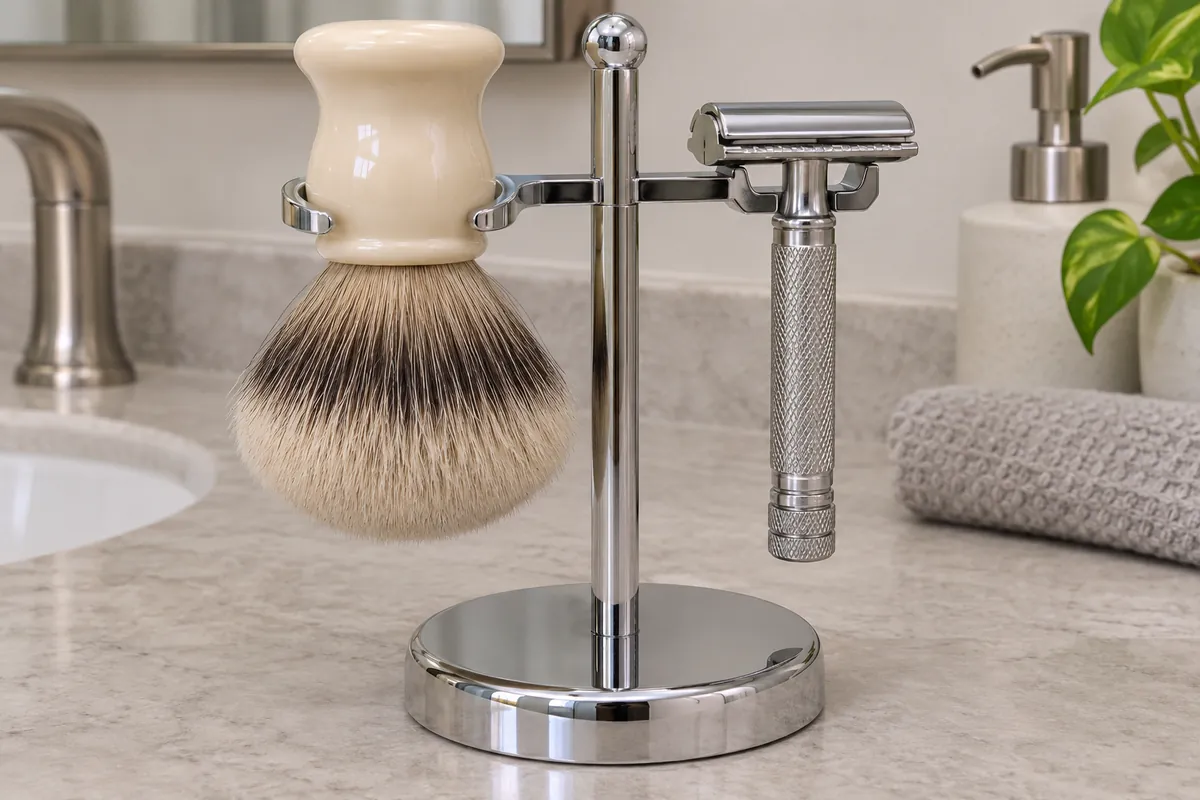
Why is a paired grooming stand more than a two-hole design?
A brush and a razor are different tools with different shapes, contact areas and intended orientations. A razor may be supported by its handle, neck, head, or a feature that the razor maker identifies for storage. A brush may hang from a handle opening or rest in a support whose inner diameter differs from the handle’s widest point. The nominal knot diameter describes the brush’s bristle bundle at the knot; it does not automatically describe the diameter or shape at which the stand contacts the handle.
The complete brush envelope also changes with the chosen model. A long handle may project farther below a hanger. A bulbous or tapered handle may contact a ring at a different height from a straight one. A brush may have a decorative collar or transition that is wider than the shaft. Buyers should observe the actual tool in the supplier-approved orientation rather than assuming that the visible brush opening alone decides fit.
The razor interface is separate. Different models may have distinct handle profiles, head shapes, neck dimensions and weight distribution. Existing razor-holder advice often focuses on a specific cradle or mounting format. It should not be copied wholesale into a paired-stand specification. Koitor’s custom bathroom hardware manufacturer page describes the broader bathroom accessory manufacturing scope. This guide focuses on the separate buyer decision of approving both tools in a shared grooming stand.
There may also be a third interface: the stand and the surface on which it rests or mounts. A freestanding base, a wall-mounted frame and a suction-mounted holder create different constraints. Do not assume that a compatibility statement for one mounting architecture applies to another. Review the precise stand model and setup that the buyer intends to source. If the stand is shown beside a bowl, counter, shower wall or cabinet, that context should not imply a mounting or environment claim that has not been checked.
Which brush dimensions and contact points should buyers record?
Begin with the brush maker’s exact model and current product information. Record the maker, model or series, revision when available, total length, handle form and intended orientation. If the supplier provides dimensions, note their source and whether they refer to the handle, knot, head or overall brush. A dimension copied from a different series or reseller listing may describe another revision. When a drawing is not available, request a physical sample rather than inferring the contact area from a photograph.
Next, identify where the stand is supposed to touch the brush. Is it held by a ring, fork, hook, open slot or another support? Does the support contact the handle or a feature specified by the brush maker? Note the brush’s position when suspended, including the distance between its lowest point and the base or nearby surface. The purpose is not to prescribe one universal clearance; the purpose is to confirm that the actual brush sits as intended without unintended contact.
Avoid hanging a brush by its bristles unless its maker explicitly says that the chosen arrangement is appropriate. The source evidence in this topic does not establish a universal care rule or a drying benefit. The buyer should obtain the brush maker’s instructions for storage and orientation. If those instructions do not address a proposed contact point, ask before approving it. The stand supplier should not be expected to infer care guidance for a tool it did not make.
An observation sheet can distinguish geometry from assumption:
| Record item | What to capture | Por qué es importante |
|---|---|---|
| Brush identity | Maker, exact model and revision where available | Avoids broad series assumptions |
| Published dimensions | Figure, units and source document | Keeps measurements tied to their reference |
| Intended contact | Ring, fork, handle, hook or named support | Shows what actually carries or locates the brush |
| Handle profile | Taper, collar, transition or other observed shape | Helps explain where contact occurs |
| Occupied length | Brush position below its support | Reveals possible contact with the stand base |
| Orientation | Maker-approved or supplier-documented position | Keeps compatibility claims within instructions |
| Review status | Exact stand and brush samples assessed | Separates checked pairs from unreviewed ones |
Do not invent an acceptable opening, clearance, tilt or load threshold. The correct acceptance basis comes from the buyer’s intended products, supplier drawings and maker instructions. A visible gap in one sample can be recorded, but it does not establish a general minimum for every brush. If the customer-facing claim depends on a numeric dimension, source it from the product’s controlled specification and specify what feature the measurement represents.
How should buyers review the razor separately?
Treat the razor as its own model-specific fit check. Record the maker and exact model, the stand’s intended contact area, the handle direction and any part of the razor that must remain clear. Observe whether the tool settles into the designed cradle or rests against a location that the razor maker identifies as suitable. Do not assume a razor fits because its handle diameter appears similar to another model.
The reviewed combination should be recorded as a pairing: this razor model with this stand revision and this support position. If a product family has several razors, create a separate row for each one. If the stand supplier provides an eligible model list, preserve the list and its date, then compare it with the importer’s assortment. A supplier’s list is useful evidence but should not be silently extended to unnamed third-party models.
Avoid relying on a visual balance test as a load or stability assessment. A razor may appear to sit in place during a short desk review, but that observation does not establish behavior under vibration, accidental contact, wet conditions or long-term use. If the buyer has a required performance or safety claim, define an appropriate evaluation with the responsible product supplier. This article makes no load, tip-resistance or durability claim.
A brushed finish, plated appearance or heavy base also does not prove that the stand is made from a particular metal or has a specified corrosion performance. The cited Mühle material description is maker-specific and does not reveal every base-metal or process detail. Buyers should request the exact material and finish declarations needed for the market and application, and verify those declarations through the supplier documentation. Do not infer composition from color, shine or a retail product title.
What changes when the brush and razor are sold as a set?
Selling a coordinated set increases the value of checking both tools together, but it does not necessarily mean the tool maker or stand maker supplies all components. The importer should identify each item’s supplier, SKU and revision, then confirm which party controls the compatibility statement and customer-facing instructions. If the stand is supplied separately from the brush and razor, the bundle owner must make sure that the parts selected for a set match the approved combination.
Distinguish “stand included” from “tools included” in product content, photography captions and packaging. Mühle’s listed stand example explicitly says that the brush and razor are not included. That is a product-specific disclosure, but it illustrates why buyers should prevent imagery from creating an unintended bundle expectation. For a private-label set, the buyer should state what is in the carton and ensure the product images represent the order configuration.
Build a compatibility matrix before expanding the assortment:
| Stand revision | Brush model | Razor model | Brush position reviewed | Razor position reviewed | Pair status |
|---|---|---|---|---|---|
| Exact supplier reference | Named model and source | Named model and source | Record support and clearance observations | Record cradle and handle observations | Approved, rejected or pending |
| Exact supplier reference | Named model and source | Alternate named model | Record separately | Record separately | Do not infer from first pairing |
| Proposed new brush | Exact identity required | Existing approved razor | Pending until sampled | Recheck if stand changes | Unreviewed |
| Proposed new razor | Existing approved brush | Exact identity required | Recheck if stand changes | Pending until sampled | Unreviewed |
Use plain status language. “Approved” should refer only to the exact configuration that was reviewed. “Pending” means the buyer lacks a sample or information. “Not compatible” should be reserved for an assessed combination that fails the buyer’s stated criteria. “Universal” should not be used simply because one or two sample tools happen to fit.

How should buyers handle a model that almost fits?
A near fit deserves documentation and a decision, not a forced adjustment. If a brush touches the base or sits at an unintended angle, record the exact model and observed point of contact. If the razor fits while the brush does not, keep those outcomes separate; do not summarize the whole set as compatible. Ask the stand supplier whether the observed position follows its design intent, and ask the tool maker whether the contact location and orientation are acceptable.
Do not bend a metal frame, enlarge an opening or add an unapproved spacer to make a sample appear to fit. Such changes may affect finish, geometry, contact or serviceability, and they would create a new configuration requiring its own review. Likewise, do not sand or alter a brush handle, razor or decorative component based on an assumption. If a design adjustment is considered, document its owner, drawing revision and approval responsibility. No modification tolerance or repair procedure is established by the evidence reviewed here.
One user review of a Mühle stand reported insufficient height for some larger brushes while the razor position worked. The report is a qualitative signal that separate interfaces can produce separate outcomes. It does not provide dimensions, a controlled test or a representative failure rate. Buyers should not turn it into a broad claim about Mühle or all larger brushes. Its practical value is as a prompt to test the brush’s actual occupied length and base clearance when a paired stand is selected.
If no physical reference is available, do not use a guessed model category as a substitute. “Large brush” or “standard razor” can mean different things across suppliers. Request the exact model or a dimensioned drawing. If only a product-family name is known, mark the fit as provisional and keep the listing from implying an approved combination until the uncertainty is resolved.
What should change control cover after approval?
Compatibility can be affected by a change to the brush, razor, stand, finish build or purchased component. A different handle mold or profile, a new stand opening, an altered support location, a revised base, or a different assembly method may warrant another review. The buyer should define which changes require supplier notice and who decides whether a new sample is needed. This does not mean every process adjustment automatically changes fit; the supplier and buyer should assess the actual impact.
Keep a retained reference sample, drawing or controlled photograph set according to the buyer’s document process. Link it to the stand and tools by SKU and revision. The record should state what was physically assessed and what was accepted only from supplier documentation. If a compatible-model list changes, record who approved the addition and what evidence was considered. A web page can change; retain a dated source copy or reference for the version used in the decision.
Separate product compatibility from care, hygiene and lifespan claims. The Mühle guide’s compatibility content does not independently prove a health outcome, antimicrobial effect, mold prevention, a drying rate or a service life. User reviews about corrosion or stability are not technical verification. If a buyer wants a claim in any of those areas, obtain suitable current evidence for the exact stand, tool and use condition. Otherwise, leave the claim out.
For a stand-only listing, name only the compatible models the supplier has documented and the buyer has accepted. For a bundled listing, state which tools are included and keep imagery consistent with the carton. For a set that offers optional brush or razor upgrades, treat each option as a distinct pairing. The matrix can be maintained as the assortment grows, so that one successful pairing does not silently become a universal claim.
The assortment owner should also decide how the information will reach customer service and replenishment teams. A compatibility matrix is useful only if its model names align with the labels, product pages and internal item master. If a buyer uses shortened retail names while the stand supplier uses series names, map them explicitly and retain the exact manufacturer reference in the record. Avoid an unqualified “fits all” field in a product database when the evidence is a finite list. A future replacement brush or razor can change the contact geometry even if the retail family name remains familiar.
When a supplier proposes an alternate tool because of availability or a cost change, treat that as a new candidate pairing. Confirm the tool identity and revision, request its current dimensions or sample, and compare it to the approved support. Do not assume that a replacement handle uses the same mold or that a visually similar model has an identical collar. The buyer may decide that a change is acceptable, but the basis should be recorded: physical review, current maker documentation, or a limited provisional assessment. Keeping those evidence types distinct helps prevent a purchasing substitution from becoming an unsupported public compatibility claim.
For a set with multiple packaging configurations, identify the contents at the carton level. One version might contain a stand alone; another may include a brush and razor sourced from different makers. The approved assortment code should resolve to the correct contents, instructions and product images. If tools are not included, avoid photography or captions that imply they are part of the sale. If they are included, the exact models in the image should match the approved bill of materials. These are catalog-control measures, not evidence that the set provides a particular grooming, drying or hygiene outcome.
An importer may also want to preserve exclusions. If one brush family is too long for the available space, record that model as excluded rather than deleting it from the record. A known exclusion prevents a later sales team from adding it to a compatibility list because it shares a brand or a nominal handle dimension. The exclusion should be tied to the observed reason and the exact stand revision. If the stand later changes, reassess it rather than automatically carrying either the approval or the exclusion forward.
A practical sample-approval sequence
Use a repeatable sequence so that the buyer’s decision can be reproduced after a supplier change. First, collect the exact stand, brush and razor identifiers, plus current product information from their makers. Second, confirm whether the stand is freestanding or mounted and place it in the intended setup. Third, assess the brush support and occupied space without relying on knot diameter as a proxy. Fourth, assess the razor cradle as its own interface. Fifth, place both tools together and check that one does not interfere with the other or the stand. Sixth, record the result, open questions, exclusions and evidence source. Finally, approve only the combinations the buyer actually reviewed.
This sequence is deliberately an approval framework rather than a product test protocol. The source documents do not specify a common force, duration, tilt, clearance or number of repetitions for all stands. A buyer can define additional criteria for a particular program, but those criteria should be agreed with the responsible supplier and connected to the intended claim. A short fit review can answer a fit question; it cannot prove corrosion resistance, load capacity, long-term stability, safe use or a biological outcome.
Questions buyers should resolve before ordering
Does a razor fitting mean the brush will fit? No. The razor cradle and brush support are distinct interfaces. Check and record each exact tool model separately, then inspect the paired set.
Is brush knot diameter the right measurement for the stand? Not necessarily. Knot diameter describes the bristle bundle, while the stand may contact a handle, collar or another part. Use the measurement that corresponds to the actual contact point and its source.
Can a manufacturer’s “universal” label replace a model matrix? It can be included as the maker’s own description, but it does not define every third-party combination. Buyers should preserve the maker’s named compatibility list and avoid extending it without evidence.
Should a brush hang by its bristles? Follow the brush maker’s instructions. This guide does not establish a universal storage orientation or care benefit.
If only one tool has a fit issue, can the set still be approved? The buyer can decide how to merchandise it, but should record the outcomes separately and avoid implying that both tools fit. A partial result is not full paired compatibility.
Do product reviews prove that a stand is unstable or too short? A review reports one user’s experience. It can identify a question to check, but it does not supply a controlled measurement or establish a general defect.
What if the tools are not included? State that clearly in the offer and ensure photographs, captions and packaging do not imply otherwise. If tools are included in a private-label bundle, approve those exact models with the stand.
A disciplined compatibility decision begins with exact product identities and ends with a bounded claim. Record the brush contact point and occupied length, review the razor cradle separately, inspect both tools in the same stand, and preserve any model-specific exclusions. Keep each approved combination tied to its revisions and source evidence. This method helps importers build a coherent set while avoiding assumptions based on appearance, generic size labels or a single successful sample. Add the phrase shaving brush stand compatibility to the internal model matrix only when the named brush and razor pair has actually been reviewed.
Trabaja con Koitor Hardware
Planning a Metal Bathroom Accessory?
Share the intended drawing and paired-tool references for a scope review. Koitor’s general bathroom hardware manufacturing experience does not establish a current grooming-stand or shaving-tool product.
OEM / MARCA BLANCA
Convierte esta guía de abastecimiento en un resumen del producto
Indícanos el producto que deseas, el tamaño, el acabado, la cantidad del pedido y los requisitos de embalaje. Tu equipo recibirá un análisis práctico de la viabilidad de fabricación antes de recibir el presupuesto.


 English
 Español
 Português
 Français
 Deutsch
 العربية