
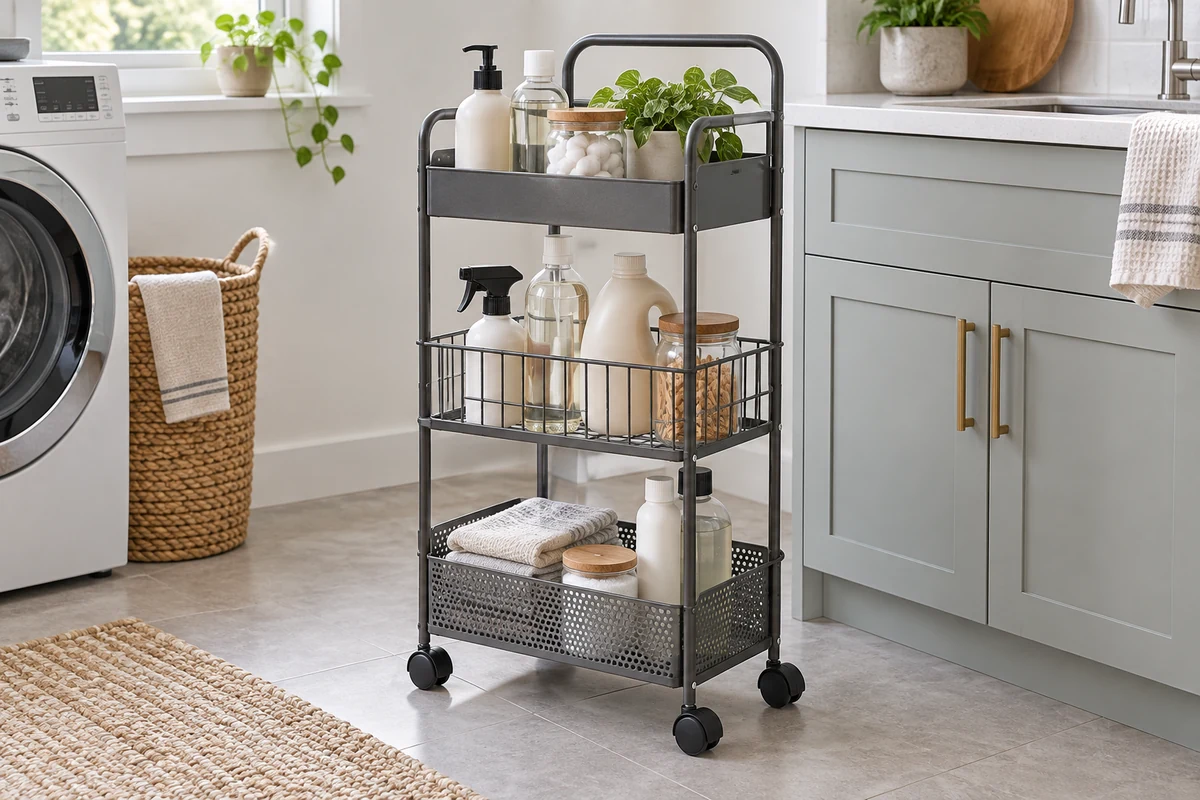
A slim storage cart should be specified by its usable space at each tier, not only by its outside width. A bottle or jar may fit one shelf but collide with a lower rail, guard, handle or the next tier above it. For an OEM buyer, the key review combines the container envelope, internal shelf footprint, clear height, side-guard height and access opening, then checks those relationships on the fully assembled cart.
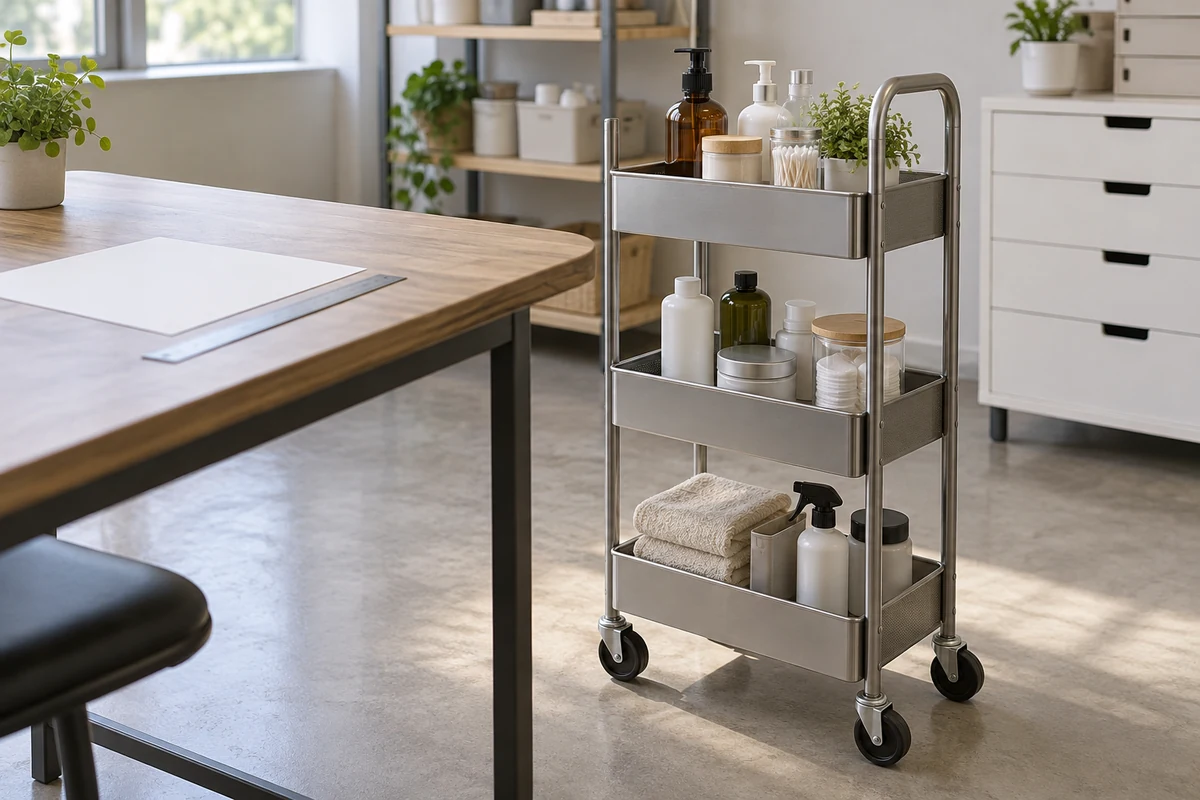
This guide helps importers and private-label product teams turn a narrow-cart concept into a measurable assortment and sample review. It does not claim that Koitor currently manufactures this exact cart, makes casters or has validated movement or tip-over performance. The images are conceptual illustrations, not Koitor product references.
Why is outside cart width not enough?
External width describes the space the cart occupies beside a cabinet or appliance. It does not reveal the usable width between frame posts, the internal depth, the obstruction created by guards or the height available under the tier above. A product described as fitting a narrow gap may still not fit a buyer’s intended bottle assortment.
Yamazaki’s published Tower Rolling Slim Storage Cart illustrates the distinction: its product page lists external dimensions separately from internal dimensions for each of three shelves, and separately identifies guard heights by tier. The manufacturer also describes bottles, jars and laundry items among intended storage examples. These details support a tier-by-tier buyer question; they do not establish a universal bottle fit, dynamic-retention rating or performance level for other carts. See Yamazaki’s product dimensions and configuration.
The useful commercial question is not simply “How narrow is the cart?” It is “Which named containers fit on which tier, with what clearance and loading orientation, while the cart remains usable in its intended location?” This framing reduces ambiguity in an RFQ and avoids a broad compatibility promise based on a single external measurement.
What should the buyer measure on each container?
Build the target assortment before fixing shelf geometry. Record the largest and smallest bottles or jars expected, their body width or diameter, total height, base shape, shoulder or cap projections, handles and any other feature that changes the envelope. For tapered, oval or handled containers, one diameter may not describe the space they require. Note the intended orientation and whether containers are expected to be removed from above or from the side.
Where the assortment is not final, classify examples as required, preferred or out of scope. A supplier can then explain which configurations are included in the proposed sample. Do not ask a factory to infer every product sold under a retailer’s label from a volume claim or category name. If the actual container cannot be supplied, use a controlled drawing or a physical envelope sample and mark the result provisional until the finished item is checked.
| Buyer input | Qué grabar | Why it matters to tier fit |
|---|---|---|
| Container body | Maximum width/depth, height and taper | Determines the usable footprint and clearance to neighboring items |
| Base | Shape, width and any narrow foot or ring | Affects how the container rests on a wire or sheet shelf |
| Cap and handle | Height, projection, loop or grip location | May interfere with an upper shelf, post or guard |
| Intended tier | Preferred location and loaded orientation | Each tier may have a different clear height and guard arrangement |
| Container weight | Empty and intended filled condition, if relevant | Helps define a project-specific engineering review without assuming a rating |
| Removal route | Lift, slide or side access expected | Shows whether the guard or handle obstructs routine access |
Keep nominal volume as a product attribute, not a substitute for outside dimensions. Two containers of similar capacity can have different body widths and heights. A heavy glass jar and a light plastic bottle may share a footprint but place different demands on the cart. If weight is relevant, define the intended loading and ask the responsible supplier or engineer to specify the applicable evaluation method and limits.
How should shelf footprint and clear height be compared?
For each tier, compare the usable shelf area with the largest intended base and the lateral room needed to place and remove the container. Usable area may be smaller than the outside shelf size because of uprights, bent edges, basket walls, fasteners or a handle connection. A buyer should ask the supplier to identify which boundaries are included in the stated internal dimensions.
Clear height is the opening between the loaded shelf surface and the underside or obstruction above it. It is not always the same as the visible distance between tier centerlines. A tall jar may fit on the bottom shelf but not on the top; a cap or pump head can be the limiting feature. Review one drawing for the assembled cart with the intended shelves, top board, frame and handle in place.
The tier matrix should show the actual position rather than a single overall capacity. Mark which container families fit on each tier, how many can be placed side by side, and whether the proposed arrangement prevents access to another item. If the product includes an open top surface, do not treat it as equivalent to a guarded basket shelf. Make clear whether accessories, liners or a top board are part of the quoted configuration.
What does side-guard height do—and not prove?
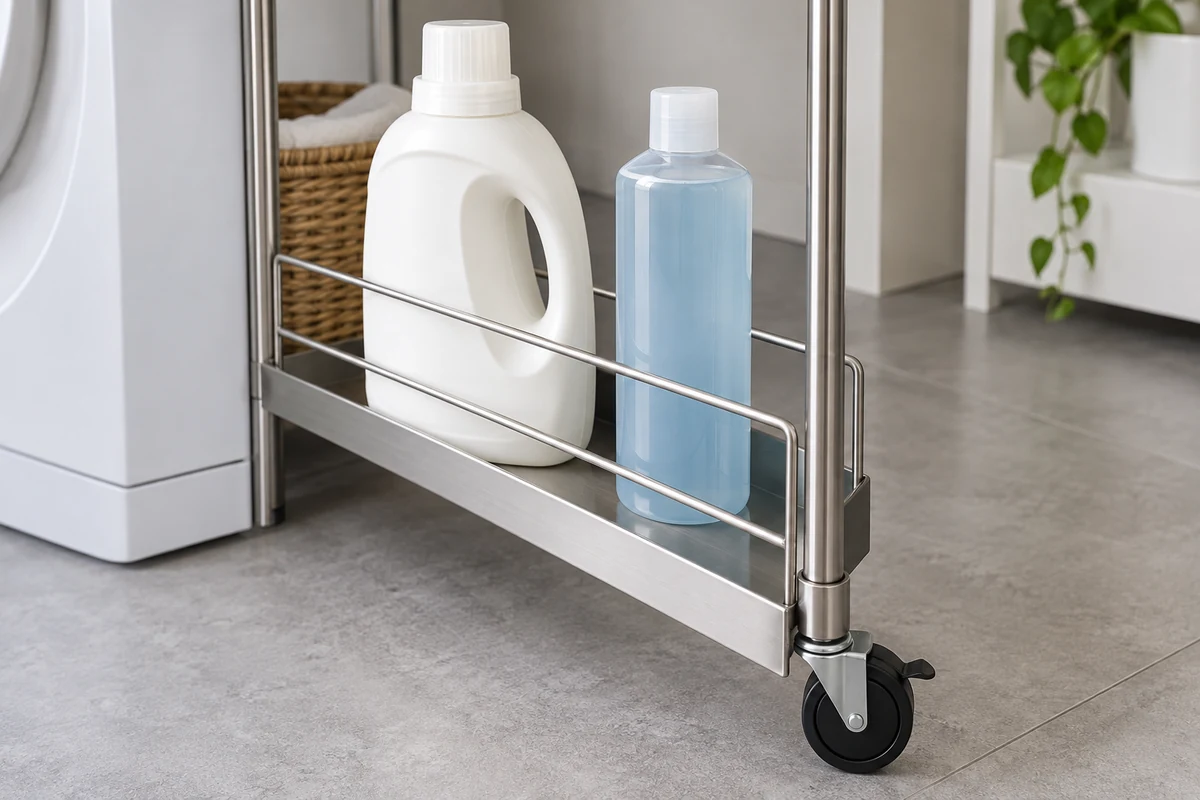
A guard may help define the shelf boundary and influence the way a container is retained during the intended use. Its usefulness depends on the container’s center of mass, body shape, gap geometry, shelf surface, cart movement and how the user handles it. A taller guard is not automatically better: it can obstruct retrieval, reduce the opening or make it harder to see and access lower items.
Compare guard height to the container body and the portion that could move toward an open side. Also note the openings between bars or between the guard and frame, the height of any solid panel, and the location of the pull handle. The review should distinguish side containment from overall cart stability. A guard measurement alone does not prove resistance to spills, tipping, sudden stops or any other dynamic condition.
If the cart is expected to move while loaded, the buyer should describe the surface, route, turning space, thresholds and expected contents. The product supplier or a qualified evaluator should define any movement or stability test and acceptance criteria for that use case. Avoid borrowing results from a different cart design or using an empty sample to make a loaded-use promise.
How should the assembled sample be checked?
Review a fully assembled cart with the intended frame, shelf construction, guards, handle, casters and fasteners. A detached basket or a frame-only sample cannot show the final clearance between tiers or the way a handle affects access. Identify the sample and drawing revision before the review begins.
Load the representative bottles and jars on the tiers assigned in the buyer’s matrix. Try the expected placement and removal route. Record contact with uprights, rails or neighboring containers; note whether a handle projects into the usable area; and check that the guard does not make the intended contents awkward to reach. If the cart is specified to roll, observe movement only under the agreed conditions and record what was actually tested. Do not infer a universal load capacity, long-term durability or anti-tip guarantee from a brief sample review.
Check the intended storage location as well. Measure the gap where the cart will be parked, including baseboards, cabinet pulls, appliance edges and other protrusions. The external envelope plus caster and handle projections determine whether the cart can be inserted and retrieved. A product may meet the narrow-width target on paper while its handle or caster swivel requires extra side clearance.
| Review point | Record during sample approval | Keep the conclusion limited to |
|---|---|---|
| Tier footprint | Container IDs, tier, orientation and interference | The tested assortment and configuration |
| Clear height | Tallest item on each assigned tier and overhead clearance | The assembled drawing revision reviewed |
| Guard and access | Guard geometry and whether items can be placed/retrieved as intended | Observed fit, not dynamic containment claims |
| Handle and route | Projection, approach and surrounding storage gap | The layout and route represented by the mock-up |
| Casters and movement | Caster configuration, surface and movement condition, if requested | Only the defined sample observation |
| Montaje | Fasteners, shelf seating and visible misalignment | The actual sample and documented assembly sequence |
Use photographs from the side and above to preserve the tier relationships. A photo is supporting evidence rather than a replacement for the drawing or measurement record. Keep accepted drawings, the BOM, carton configuration and sample observations together so a later order can be compared to the approved version.
What belongs in a slim-cart RFQ?
Send the supplier a drawing or a dimensional brief that separates external cart envelope from usable tier dimensions. For each slim storage cart variant, include the intended width of the storage gap, internal shelf footprint, clear height by tier, guard arrangement, handle location, caster type if known, finish, packaging and required accessories. Attach the bottle/jar matrix and identify the specific samples the supplier should use.
Ask for an assembly drawing with dimensions that matter to fit: usable width and depth, tier heights, guard height and gaps, frame-post positions, handle/caster projections and any removable shelf or tray. The drawing should identify which dimensions are nominal and which interfaces need buyer approval. If a design is still conceptual, request a marked-up proposal showing the supplier’s assumptions and open questions before committing to the tool, sample or order.
Confirm component responsibility. The metal-frame supplier may manufacture or assemble some parts and source casters from another supplier. Identify who approves the caster specification, who confirms the handle and frame interface, and who records substitutions. Koitor can discuss metal storage frames and OEM scope based on drawings and samples, but the exact cart product, caster sourcing and validated movement performance require project-specific confirmation.
Which changes require renewed fit approval?
Treat changes to the assortment, shelf geometry or accessories as potential interface changes. A revised bottle with a larger handle may no longer clear a post; a new handle can reduce the internal opening; a thicker shelf edge can change usable width; and a caster substitution can alter the cart’s parked or moving envelope. Before production release, agree which changes require a revised drawing or representative sample.
| Change | Possible interface affected | Buyer follow-up |
|---|---|---|
| New bottle or jar family | Footprint, clear height, guard opening or neighboring space | Add its envelope and sample to the tier matrix |
| Different tier spacing | Vertical clearance and container assignment | Request an updated assembled drawing and fit review |
| Revised guard or side panel | Access opening, containment boundary and usable width | Check placement and retrieval with target containers |
| Handle relocation | Cart envelope and hand access | Recheck the installation gap and removal path |
| Caster or fastener substitution | Frame interface, overall height or movement behavior | Identify the part revision and decide whether reapproval is needed |
| Packaging change | Cart assembly, scratch protection or shipped configuration | Review the pack-out sample and instructions |
Record accepted part revisions and exclusions clearly. Do not assume that a visually similar component will preserve fit or movement. When a mismatch appears, document the cart revision, container ID, tier and observed condition, then ask the responsible supplier to evaluate the change.
What can Koitor contribute to the sourcing discussion?
Koitor Hardware is a family-owned custom metal hardware factory focused on bathroom and home-storage hardware. Its drawing- and sample-based OEM communication can support discussions about metal frame geometry, fabrication interfaces, finish and assembly inputs within confirmed project scope. This adjacent product guide does not establish current production of slim rolling carts, caster manufacture or validated cart safety and mobility performance.
To assess a project, share the target tier matrix, container drawings or physical samples, intended installation gap, material/finish requirements, caster responsibilities and packaging plan. A home-storage OEM discussion can help clarify possible metal-part scope; buyers can also contact Koitor about a project. Any product-specific load, movement or stability criteria must be defined and supported separately.
Preguntas frecuentes
Does the narrowest outside width tell buyers which bottles fit?
No. Outside width describes the cart envelope. The usable shelf width, depth, tier clear height, guard and handle positions determine whether a particular bottle can be placed and removed. Review the actual container envelope against the assembled product.
Is a taller side guard always better?
Not necessarily. Guard geometry may affect how items are retained, but it can also obstruct placement or retrieval. Define the container and intended use, then check the complete configuration. Height alone does not establish a dynamic safety or retention result.
Can one capacity statement cover all three tiers?
Only if the product’s stated capacity is supported for the defined configuration, and it still does not describe item-by-item fit. Buyers should specify the intended assortment by tier and confirm relevant dimensions and loading conditions.
Should buyers approve with photographs?
Photographs help record visible fit, but they do not replace the assembled drawing, sample IDs or measurement record. Use side and top views alongside the buyer’s defined acceptance criteria.
Does a rolling sample prove it will remain stable on every floor?
No. A sample observation applies only to the cart configuration, loading and surface represented. A broader movement or stability claim needs suitable product-specific methods and evidence.
What should change control include?
Record the accepted cart and container revisions, tier assignments, excluded items, component suppliers and which changes require another review. This makes repeat orders easier to compare with the approved configuration.
Discuss a Metal Storage Cart Concept With Koitor
Share the target cart envelope, tier-by-tier container matrix, drawings or samples, caster scope and packaging requirements. Confirm the exact manufacturing scope and any product-specific movement criteria for your project.
OEM / MARCA BLANCA
Convierte esta guía de abastecimiento en un resumen del producto
Indícanos el producto que deseas, el tamaño, el acabado, la cantidad del pedido y los requisitos de embalaje. Tu equipo recibirá un análisis práctico de la viabilidad de fabricación antes de recibir el presupuesto.



 English
 Español
 Português
 Français
 Deutsch
 العربية