
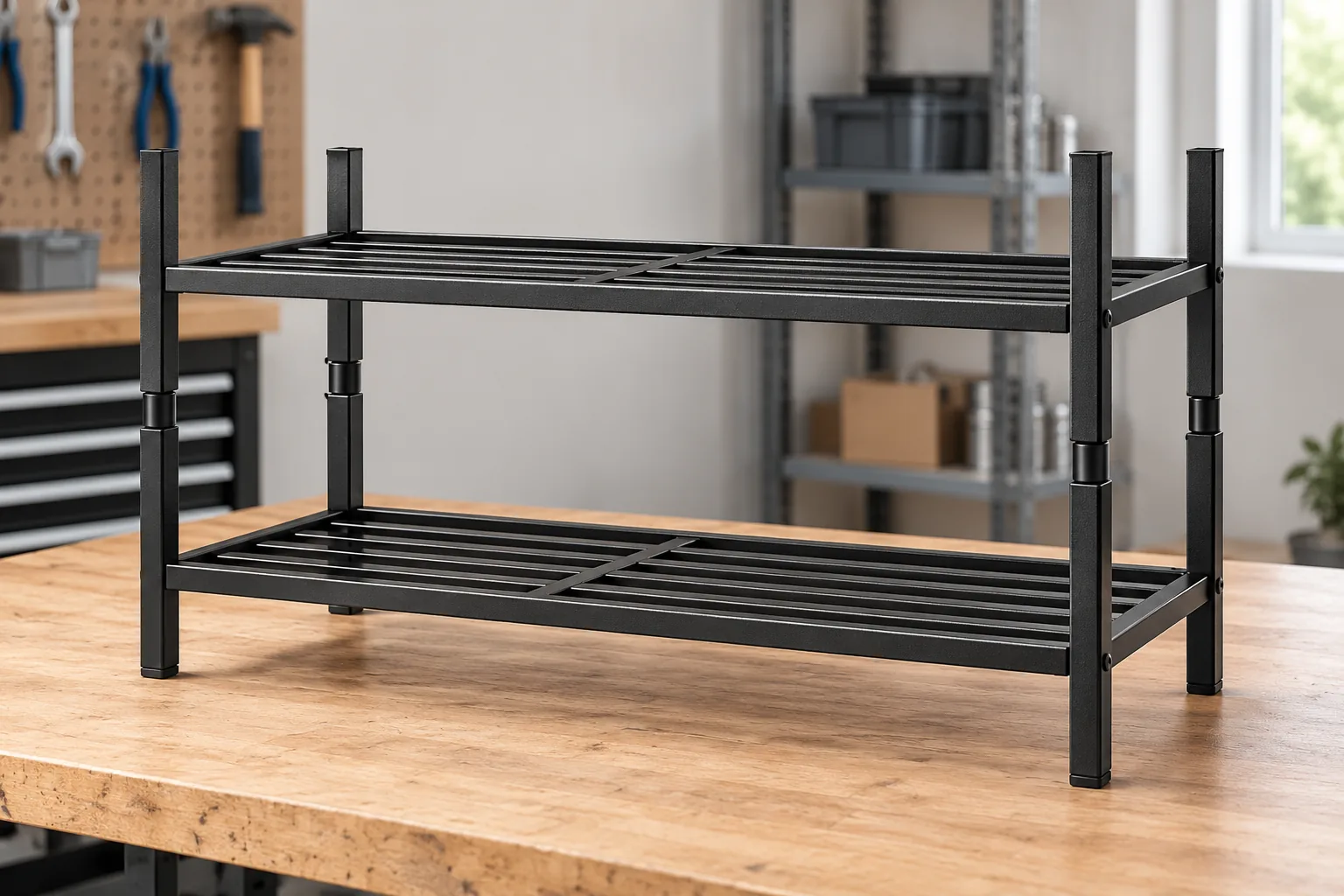
Stackable shoe rack connector compatibility is model-specific: the pin, dowel or connector must match the rack’s mating features, revision and approved assembly orientation. A buyer should not assume that parts which look similar—or that fit one frame—will work with another rack. Before quotation and sample approval, identify the rack model and revision, connector type and quantity, mating dimensions, stacking sequence, and replacement-part route. Then check the exact components together in a production-intent assembly.
That distinction matters to importers and private-label teams managing modular products. A missing pin can make a rack difficult to stack; a connector chosen from a different kit may not seat fully in the intended holes. Width-adjustable rails can also have an orientation that matters to a particular manufacturer’s assembly instructions. The goal is not to find a universal pin. It is to make one defined rack-and-connector configuration repeatable across samples, cartons and replenishment orders.
Why does connector compatibility need a model-level check?
Because a stacking connector is part of a specific interface, not a generic accessory. Its dimensions, shape, insertion depth, mating hole and location all need to correspond to the rack model being assembled. A connector can look close to another one yet differ enough to seat loosely, stop short or fail to align with the next frame.
Manufacturer product information illustrates why buyers should keep compatibility claims narrow. Seville Classics sells a four-piece stacking-pin set with a stated diameter and length and lists the compatible shoe-rack model numbers. That list is meaningful for those identified models; it does not establish compatibility with other brands or with every visually similar rack. Likewise, a TRINITY shoe-rack manual describes its own dowel holes, expandable rods and assembly sequence. The two examples should not be combined into a cross-brand specification.
For a buyer, the practical question is therefore: “Which connector set is approved for this rack model and revision?” not “What size pin fits shoe racks?” Record the answer against the commercial SKU, drawing revision and order configuration. When a product family has several widths, finishes or frame generations, explicitly state which ones share the connector. If commonality has not been tested and approved, keep the parts mapped separately.
Which rack and connector details belong in the specification?
Identify both sides of the joint. A connector specification alone is incomplete if the mating frame or hole pattern is unspecified. The buyer’s drawing or component schedule should identify the rack family, frame revision, connector part number, material or finish where relevant, quantity per assembled unit and the location where each piece is used. For stackable shoe rack connector compatibility, record both mating features under one approved model and revision.
At minimum, have the supplier document the interface dimensions needed to reproduce the fit: connector outside dimensions and effective insertion length; mating hole or socket dimensions; hole position from a clear datum; and any shoulder, stop or retention feature. The actual dimensions depend on the design. Do not copy values from a competing model or from a retail replacement pin unless that part is confirmed for the selected rack.
| Specification field | Qué grabar | Why it matters to the buyer |
|---|---|---|
| Rack identity | SKU, model family and drawing revision | Keeps a compatibility statement tied to the intended frame |
| Connector identity | Part number or controlled component code | Helps separate similar-looking but different pieces |
| Mating interface | Hole/socket geometry, location and datum | Makes alignment and seating review repeatable |
| Quantity | Pieces per rack, per stack interface and per carton | Reduces missing-part and replenishment ambiguity |
| Orientation | Which end, face or adjustable-rail direction is up | Preserves the manufacturer-approved assembly sequence |
| Revision status | Effective date and superseded part references | Prevents old and new components being mixed without approval |
| Replacement route | Order code, service part, or spare-kit definition | Gives the distributor a clear path when parts are lost |
Para un custom metal storage rack program, buyers can include this interface schedule alongside the assembly drawing and packaging specification. It does not imply that Koitor currently manufactures the cited shoe-rack examples or a particular molded or metal connector; it is a practical way to define buyer-supplied product requirements.
How should the stacking orientation be documented?
Show the order of assembly and the orientation of every part that affects the joint. A line drawing should identify the lower frame, upper frame, connector position and any direction-sensitive rail or side frame. If the rack expands or adjusts in width, state which end or feature must face the same direction when units are stacked—if the product’s approved instructions require it.
The TRINITY manual provides a model-specific example: it directs users to place dowels into the lower frame’s dowel holes, stack the next rack so the dowels seat in the matching holes, and keep expandable rods identically oriented with the small ends aligned. This is a useful reminder that “the pin fits” is not the whole assembly check. Orientation and the relationship between telescoping members may be part of that model’s stacking method. It is not a universal instruction for other racks.
Use an exploded view or numbered assembly sequence when a text-only instruction could be misread. Show the connector at its actual location, the parts it mates with, and the order of assembly. A small diagram can distinguish a connector used between two racks from a foot, shelf support or wall fastener. Use clear item codes that match the bill of materials, bag label and replacement-part list. Avoid relying on color alone to distinguish parts because finish lots, lighting and accessibility needs can make color an unreliable control.
If the product can be configured at several widths, identify whether the connector and stack sequence are valid at all permitted widths or only a defined setting. A drawing should make the approved range explicit. Where the answer is unknown, the specification should say “configuration to be confirmed by sample” rather than implying compatibility across the full adjustment range.
How can buyers prevent missing or mismatched spare connectors?
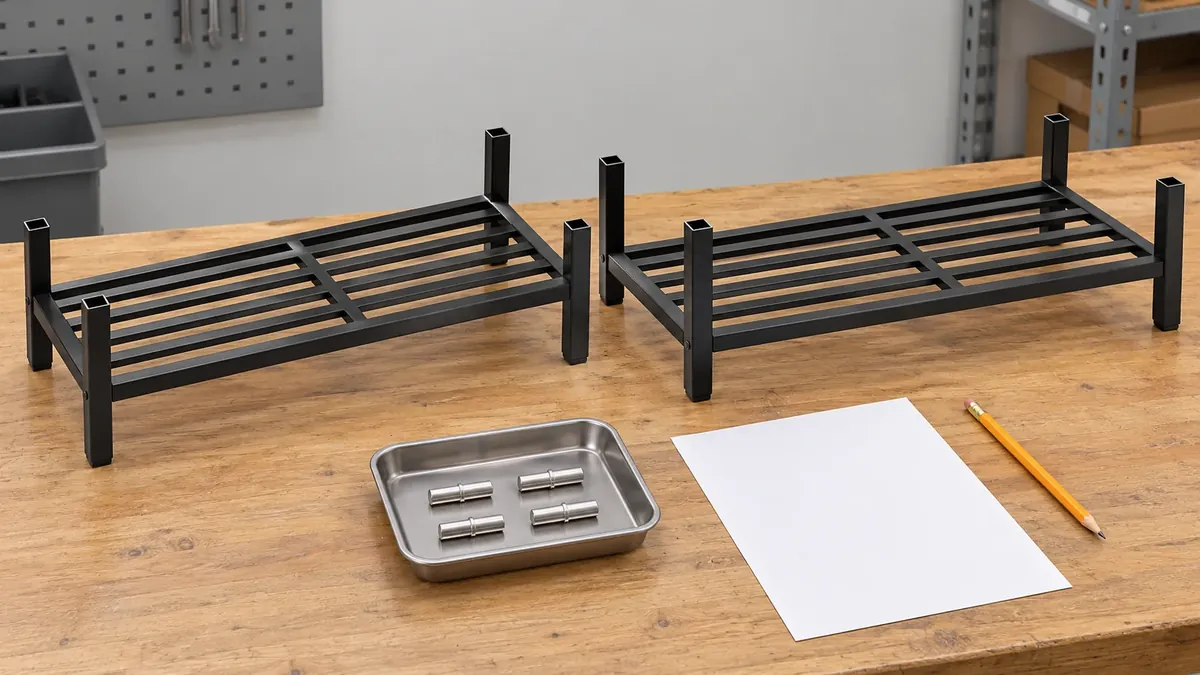
Treat small connectors as controlled kit contents. Define the number per rack, number per stack joint, spare allowance if required, and the bag or compartment where they are packed. Then make the packing list, carton artwork, parts diagram and purchase-order description use the same part identity. A set that is correct in the engineering drawing can still create a service problem if the replacement kit or packing list uses an ambiguous name such as “small pin.”
The TRINITY manual separates a parts list from a service-parts list and gives a replacement part number for its dowel. Seville’s replacement set lists the rack models it fits. These product-specific examples show two useful practices: make components identifiable and publish the relationship between a spare and its compatible product. They do not prove that every supplier offers spare parts indefinitely or that a buyer can substitute one brand’s part for another.
For an OEM or private-label order, agree whether connectors ship preinstalled, loose in a labeled bag, or as a separate replacement kit. State whether the quoted quantity covers one rack, a two-rack pack or one stacking interface. For mixed-SKU cartons, keep the model-to-kit mapping visible so a warehouse picker cannot place a pin set with the wrong frame variant. Confirm whether any spare quantity is included in each carton or supplied as a separate service pack; do not infer it from a product photo.
Incoming inspection can verify carton count, part identity and a sample fit, but the check should be documented. It cannot establish lifetime fit or universal interchangeability. For distributors, an easily searchable spare-part code may reduce support friction, while clear model references help prevent incorrect replacements from being shipped.
What should a production-intent sample review include?
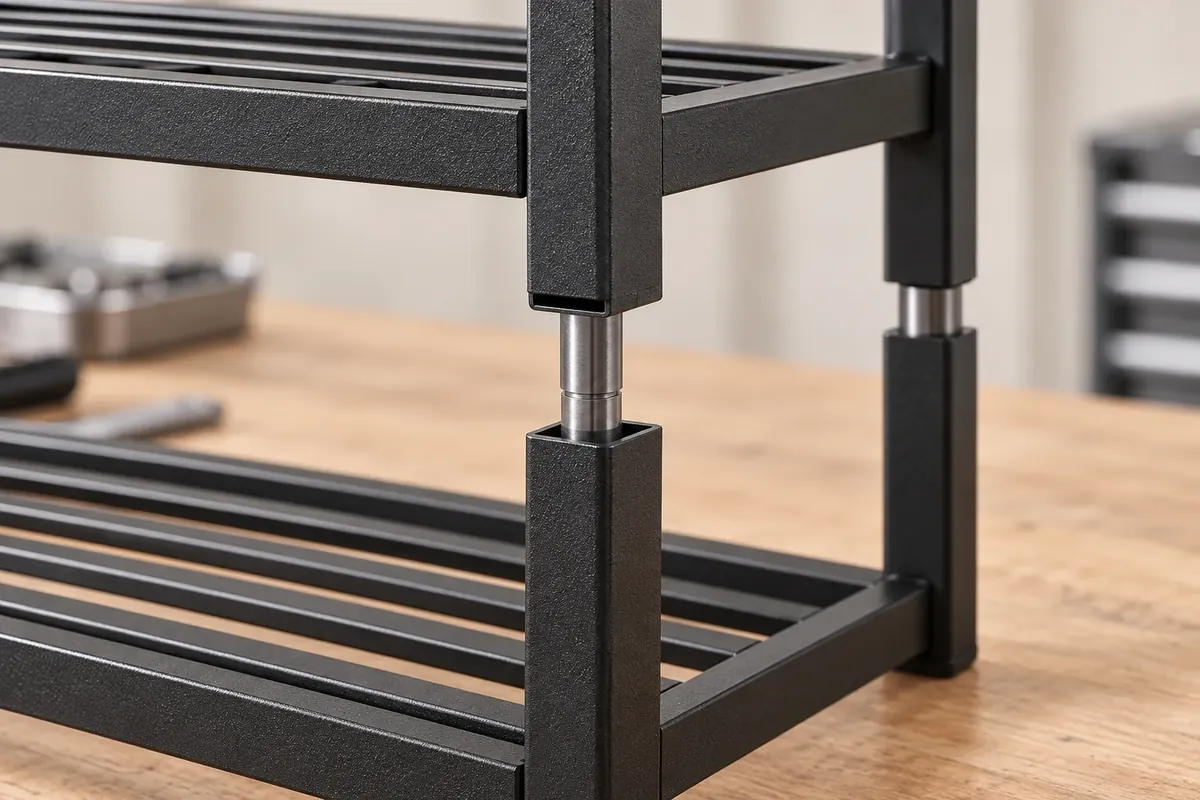
Review the actual rack revision and connector kit together, not two components approved in isolation. Select samples from the intended production configuration, follow the supplier’s assembly sequence, and check that each connector enters and seats in the correct mating feature without forcing or unauthorized modification. Confirm that the stacked frame aligns as intended and that all listed components are present. Treat stackable shoe rack connector compatibility as an assembly check that includes the approved replacement kit and carton count.
Record which connector, rack revision, width setting and assembly orientation were reviewed. Photograph the joint from enough angles to show the connector location and seating. If the joint is hidden after assembly, take a photo before completing the next step as well as a finished view. Keep the images linked to the sample approval record rather than using a generic product image as evidence of compatibility.
This sample review is a fit and completeness check for the agreed configuration. It is not a structural load test, safety certification or proof that an unlisted model will fit. If buyers need a stacking load limit, stability requirement or regulatory assessment, those must be separately specified and supported by the correct test or technical evidence. Do not derive a rating from a pin diameter, a successful hand assembly or a competitor’s manual.
When must a connector sample be reviewed again?
Repeat the compatibility review when a change could affect the interface or assembly. Examples include a revised rack frame, a changed hole or socket position, a different connector supplier, a coating or plating change that alters the fit, a revised adjustable-rail direction, or a change in the number of connectors per kit. A packaging change also warrants a completeness check if it changes how small parts are bagged or assigned to mixed-SKU cartons.
Use a simple change-control table with old and new revision, affected SKUs, connector code, reason for change, sample requirement and approval status. Identify whether the change is documentary only or affects fit. If there is no approved engineering basis for carrying over the previous result, request a new sample. Keep superseded components clearly separated so an old connector cannot be mistaken for current stock.
Buyers should also define how suppliers will notify them before substituting a component or changing a connector source. A purchase order may refer to a drawing revision and approved sample; a replenishment process should preserve that link. This gives purchasing and quality teams a common reference without assuming the supplier’s internal process or making unsupported promises about traceability.
What should buyers include in an RFQ or approval checklist?
Make the connector decision auditable by attaching the required interface information to the RFQ. Ask suppliers to quote against the rack model, connector set, mating frame revision, intended stacking sequence and packaging configuration—not only the general product category. If the buyer has a physical sample but no drawing, identify it with controlled photos and request dimensioned confirmation before approving production.
- List each rack SKU, frame revision and permitted width or configuration.
- Show the connector code, quantity per rack and quantity per stack interface.
- Identify mating holes or sockets and the dimensions needed to verify fit.
- Add an orientation diagram and the approved assembly sequence.
- State how connectors are bagged, labeled and packed for each carton or kit.
- Define whether replacement parts are included, separately orderable or not yet confirmed.
- Review a production-intent sample and record fit, seating, alignment and part count.
- Require review when the rack, connector, finish, source or packing method changes.
This checklist supports a sourcing and sample-approval decision; it does not assign a load rating or certify the stacked product. For a broader project discussion, buyers can contact Koitor about OEM home-storage hardware enquiries and share their own drawing, sample or specification. Current manufacture of this exact product configuration must be confirmed separately.
Preguntas frecuentes
Are shoe-rack stacking pins universal?
No. Compatibility depends on the specific rack design and its mating features. Use a manufacturer’s model list or an approved fit check for the selected rack and connector revision; appearance alone is not enough.
Can buyers use a pin set from another rack brand if the diameter looks similar?
Not without confirming the complete interface. Diameter alone does not establish insertion length, retention, hole position, seating depth or approved orientation. Verify the model and assembly together, and do not force or modify a substitute part.
How many connectors should one order include?
Use the bill of materials for the exact rack and stacking arrangement. Specify pieces per rack, pieces per stacking interface, and any separately agreed spares. Manuals and replacement kits are model-specific, so do not copy quantities from another product.
What proves that a replacement connector is correct?
A controlled part identity tied to the rack model and revision, supported by dimensional or manufacturer compatibility information and an assembled fit check. A product photograph or a successful fit on a different model does not prove compatibility.
Does a sample fit prove the stacked rack’s load capacity?
No. A hand-assembled sample confirms only the reviewed interface fit and assembly for that configuration. Load capacity requires a separately defined method, conditions and supporting evidence.
Reference examples: Seville Classics’ model-listed stacking pin connector set y el TRINITY expandable shoe-rack manual and service-parts list. Each source applies to its named products only; neither supports cross-brand interchangeability.
Review a Modular Rack Interface Before Ordering
Share the rack drawing, connector list, approved assembly sequence and packing plan. Koitor can review confirmed metal-rack requirements for a home-storage hardware project; product-specific manufacturing scope is confirmed separately.
OEM / MARCA BLANCA
Convierte esta guía de abastecimiento en un resumen del producto
Indícanos el producto que deseas, el tamaño, el acabado, la cantidad del pedido y los requisitos de embalaje. Tu equipo recibirá un análisis práctico de la viabilidad de fabricación antes de recibir el presupuesto.
 English
 Español
 Português
 Français
 Deutsch
 العربية