
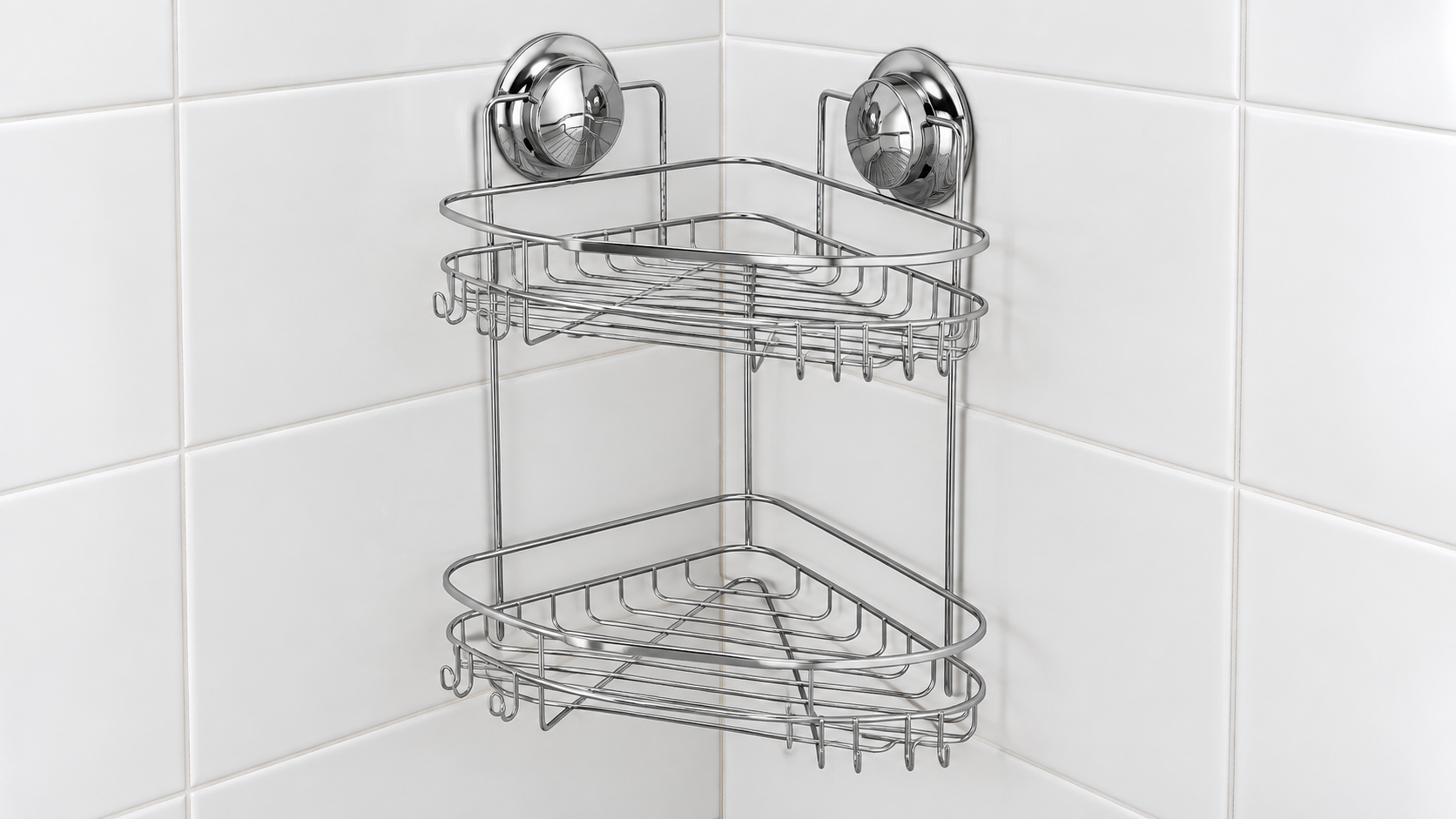
A suction cup corner shower shelf manufacturer should be assessed on corner geometry, shelf structure, drainage, tier alignment, suction-mount spacing, finish, installation assumptions and packaging. The buyer is sourcing a complete wall-mounted storage system, not only a triangular wire basket. A reliable OEM process starts with a controlled drawing and representative wall-corner samples, then confirms the assembled product and packed unit before production.
Corner products are especially sensitive to geometry. A shelf can look triangular in a catalogue image yet sit poorly in a real 90-degree corner if the back edges, mount positions or frame alignment are not controlled. Overseas importers and private-label teams should define which dimensions affect wall fit, bottle clearance and user access instead of relying on nominal product width alone.
What Should Buyers Define Before Requesting a Corner Shelf Quote?
Start with the intended configuration: single tier, two tier or another buyer-approved layout. State the approximate product envelope, number of suction mounts, shelf depth, front opening, rail height, distance between tiers and any hooks or accessory holders. For a two-tier shelf, define whether both baskets share the same footprint and how the vertical supports connect them.
The drawing should identify the wall-corner datum. A practical datum may be the theoretical intersection of two flat wall planes, with left and right back edges measured from that point. This gives the factory a clearer reference than measuring from a decorative front curve. Define the expected included angle and whether the design has clearance to avoid interference with grout or corner sealant.
Specify the wire or flat-bar construction, material direction, visible finish and cosmetic zones. For a wire shelf, identify the drainage-wire pattern, spacing, perimeter frame and front retaining rail. For a basket that carries taller bottles, rail height and usable internal depth may matter more than outside dimensions.
Wall-surface assumptions must remain conditional. Smooth glazed tile and glass can support a different review method from textured tile, porous stone, grout joints or uneven corners. Buyers should identify representative smooth surfaces and document cleaning and installation steps. Do not request or publish a universal wall or load statement without an agreed test method and evidence.
De Koitor’s Fabricación de organizadores de ducha a medida page is a relevant product-family reference for discussing drawings, samples, metal construction and private-label development.
Which Corner Shelf Structures Should OEM Buyers Compare?
Structure should be compared against storage needs, cleaning access, pack size and the intended price position. More tiers can add capacity, but they also add alignment, packaging and installation decisions.
| Estructura | Potential advantage | Buyer approval point |
|---|---|---|
| Single-tier triangular shelf | Compact format and simpler installation | Corner fit, usable depth and front rail height |
| Two-tier connected shelf | More vertical storage in one product | Tier spacing, frame squareness and support alignment |
| Wire drainage base | Open structure for water release and cleaning | Wire spacing, bottle support and weld condition |
| Flat-bar perimeter | Broader visual edge and structured appearance | Bend consistency, corner radius and finish quality |
| Shelf with accessory hooks | Adds hanging positions below the basket | Hook spacing, hand clearance and packing protection |
A vacuum suction corner caddy OEM program should define the complete bill of materials. Identify the metal frame, every suction cup, locating base, decorative cover, connector, protective part and packaging component. Quotations are difficult to compare when one includes the full mounting system and another assumes that the buyer supplies part of it.
Single-tier products simplify vertical alignment but still require careful corner fit. The left and right back edges should approach the two wall planes without forcing the basket to twist. The front rail should follow the intended profile and remain visually level when the mounts are installed at their specified positions.
Two-tier products introduce a stack of tolerances. If the upper and lower shelves are formed separately, small differences can accumulate through the vertical supports. Buyers should specify tier spacing from stable datums and check whether the top and bottom frames remain parallel. A shelf that is visually twisted on the inspection table is unlikely to improve after installation.
Accessory hooks should be treated as functional features, not decoration. Confirm the hook opening, spacing, orientation and clearance below the shelf. If hooks are welded near the front rail, review heat marks, grinding and finish appearance in the visible zone.
How Should Corner Geometry and Suction-Mount Positions Be Controlled?
Corner geometry should be checked with a simple 90-degree reference and representative tile coupons. The purpose is not to claim that every building corner is exact. The purpose is to confirm that the manufactured frame follows the approved design and has the intended clearance for normal installation review.
Use stable measurement points. The theoretical rear corner, outer front edge, shelf plane and suction-cover centers are clearer datums than random wire intersections. The drawing should show left and right depth, front width, mount center positions and the relationship between mounts and shelf planes.
For two suction units, center distance and height alignment matter. If the mounts sit on different wall planes, each connector must extend to its intended base without pulling the rack out of shape. A fixture can hold the product against a corner reference while the mount positions are checked. The buyer can request evidence of this control without dictating the factory’s fixture design.
The metal connection around each round cover must remain plausible and repeatable. Wire paths should enter the approved locating features without colliding with the center connector. The cover should hide the internal connection in the finished view while remaining correctly oriented. Similar-looking cups or covers should not be substituted after approval without checking mating details.
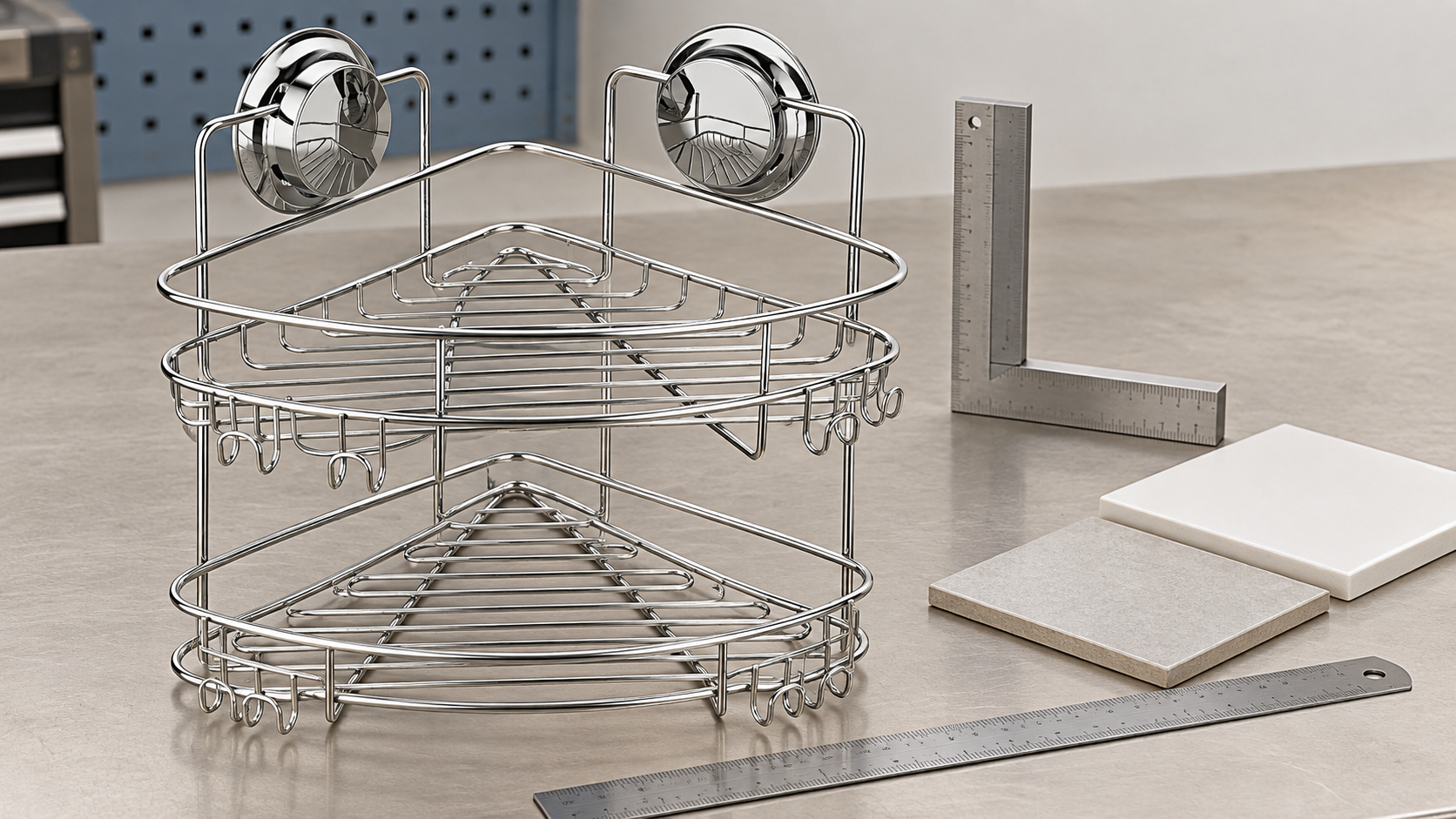
A no drill corner shelf supplier should explain what the product drawing controls and what the installation instructions assume. If performance claims are required, the buyer and factory should agree on surface condition, preparation, installation, load distribution and observation period. Appearance alone is not evidence of a universal result.
What Should the Approval Sample and Factory Review Cover?
The approval sample should represent the intended frame, suction components, finish, accessory set and packaging. Early samples can identify corner-fit or bottle-clearance issues, but final approval should use production-intent components and a documented drawing revision.
- Confirm the drawing, bill of materials and target shelf configuration.
- Place the frame against a controlled corner reference and check both rear edges.
- Measure shelf depth, front width, rail height and tier spacing.
- Review drainage-wire spacing with representative bottle and container bases.
- Check vertical supports, shelf parallelism and mount-center positions.
- Inspect welds, wire ends, edges and visible finish under consistent lighting.
- Assemble the suction units and install the product on agreed smooth surfaces.
- Review access, cleaning, removal, reinstallation and the complete retail pack.
Factory capability should match the actual process route. A wire corner shelf can require cutting, forming, fixture loading, welding, grinding or polishing, surface finishing, assembly and packaging preparation. Ask where first-piece inspection occurs, how corner geometry is held during joining and how the factory prevents finished baskets from rubbing during handling.
Drainage design should be reviewed as a balance. Wide gaps may release water and reduce material, but small containers can sit unevenly. Tight spacing can support more package shapes but adds wire and more joints. Use representative bottles, soap containers or buyer-defined gauge blocks to review support rather than relying on a visual impression.
Koitor Hardware is a family-owned custom metal hardware factory specializing in bathroom and home storage hardware. Koitor can review drawings or physical samples, discuss manufacturability and support flexible small-batch OEM development. MOQ can start from 100 pieces for some products, while the practical order quantity and schedule depend on confirmed structure, mounting components, finish and packaging.
Buyers comparing suction with other mounting families can also review Koitor’s no-drill bathroom accessories page. Suction, adhesive and other systems should remain clearly separated in the specification and product artwork.
Which Quality and Packaging Checks Reduce Sourcing Risk?
Quality inspection should follow the points that affect corner fit, storage function, appearance and installation. Incoming checks can confirm the correct suction parts. First-piece checks can verify frame geometry and mount positions. In-process review can focus on forming, joining and finishing. Final inspection can confirm assembly, accessory completeness and packaging condition.
Use this buyer checklist before releasing a private label suction bathroom shelf order:
- ☐ Single-tier or multi-tier configuration matches the latest drawing.
- ☐ Left and right wall-side depths are measured from a defined corner datum.
- ☐ Shelf width, usable depth, rail height and tier spacing are approved.
- ☐ Drainage wires support the intended container bases.
- ☐ Vertical supports and shelves remain aligned on the inspection fixture.
- ☐ Suction-mount centers and orientations match the approved sample.
- ☐ The bill of materials identifies cups, bases, covers and connectors.
- ☐ Finish color and cosmetic zones match an approved reference.
- ☐ Installation instructions state surface assumptions and preparation.
- ☐ Packaging separates chrome surfaces and protects rubber contact faces.
- ☐ Artwork, accessories, pack quantity and carton orientation are confirmed.
- ☐ Any structural or component change requires reapproval.
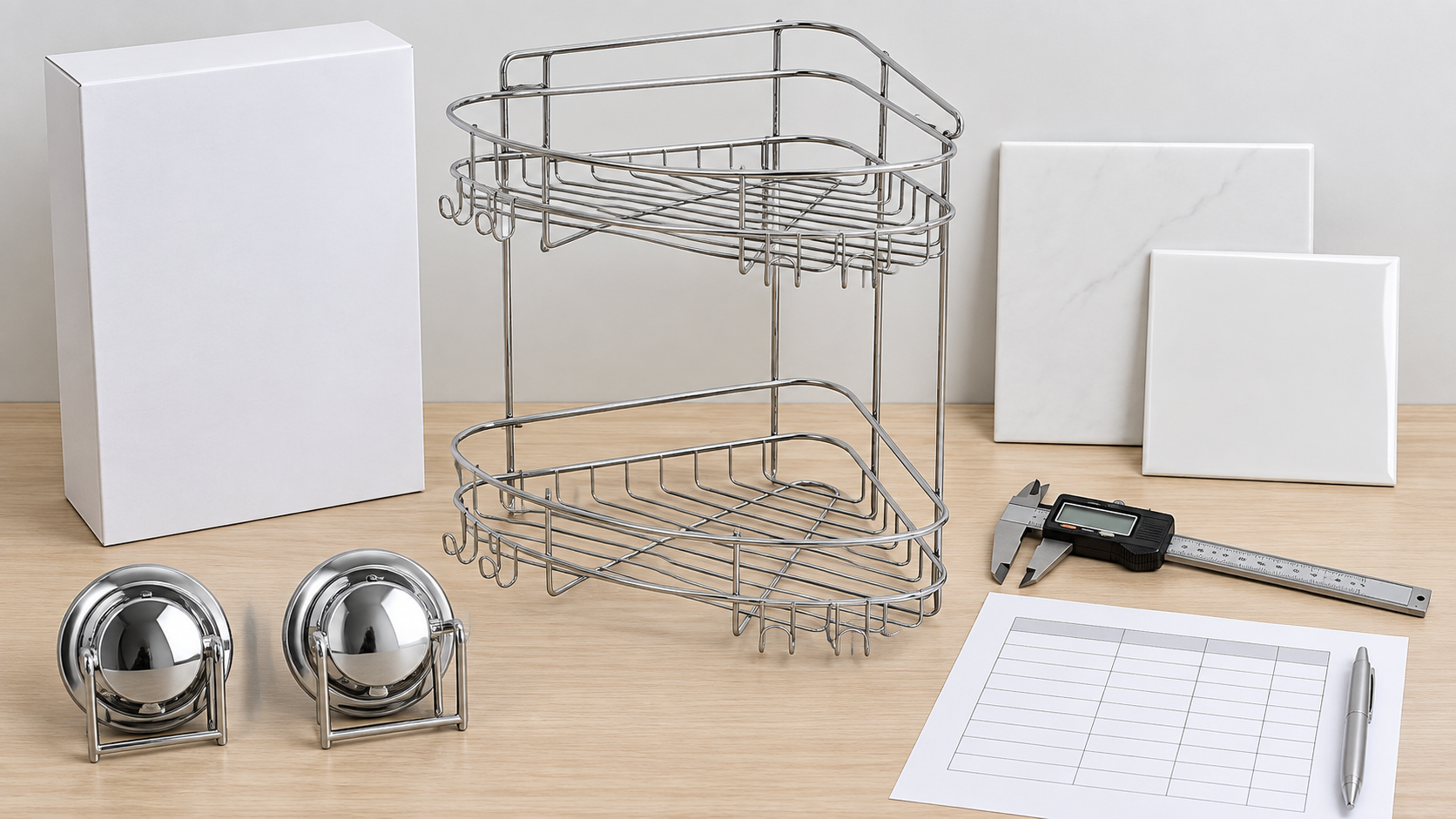
Packaging must protect a three-dimensional frame. Nested baskets can reduce volume, but direct metal contact can scratch polished surfaces or lock hooks together. Spacers, sleeves or controlled nesting positions may be needed. Suction components should not be crushed under the frame, and the rubber working face should remain clean.
Common mistakes include checking only overall width, ignoring the actual corner angle, allowing tiers to accumulate misalignment, placing suction centers where the frame must be forced, approving drainage without representative containers and using product photos as the only specification. Another mistake is assuming that a two-tier model is simply two single shelves joined together without additional alignment control.
Quotation comparisons should separate the metal frame, mounting assemblies, finish, sample charge, tooling or fixture assumptions, retail packaging and delivery basis. Ask each supplier to state assumptions and alternatives. A lower unit price can represent a different component set, thinner packaging or fewer inspection steps.
For repeat orders, compare the new bill of materials, drawing revision, finish reference and pack specification with the previous approved versions. Purchased suction components can change while looking similar in photographs. Document any approved substitution and repeat the checks affected by that change.
Before order release, ask the suction cup corner shower shelf manufacturer to return a signed or otherwise controlled list of open points. The list should cover corner datum, tier spacing, mount-center positions, finish sample, accessory count and packing assumptions. Resolve each point in the drawing, bill of materials or packaging specification instead of leaving decisions scattered across messages. For repeat production, keep the approved physical sample and photographs of the packed configuration. Shipment feedback should be recorded by production lot so the buyer can distinguish an isolated handling issue from a recurring geometry, finish or packaging problem.
Preguntas frecuentes
What should buyers send to a suction cup corner shower shelf manufacturer?
Send a dimensioned drawing or physical sample, tier configuration, corner datum, shelf dimensions, mount positions, material and finish direction, target quantity, packaging format and approval requirements.
Does every bathroom corner measure exactly 90 degrees?
No. A controlled 90-degree reference helps verify the manufactured product, while real installations may include grout, sealant or wall variation. Buyers should define expected clearance and representative surfaces.
Which dimensions are most important for a two-tier corner shelf?
Wall-side depths, front width, usable shelf depth, rail height, tier spacing, shelf parallelism and suction-mount center positions usually have the strongest effect on fit and use.
How should drainage spacing be approved?
Review wire spacing with representative container bases or buyer-defined gauges. The approved pattern should balance support, drainage, cleaning and manufacturing practicality.
Can Koitor develop a corner shelf from a physical sample?
Koitor can review a buyer drawing or physical sample within its supported manufacturing scope. Missing dimensions, material, finish, mounting and packaging requirements should be documented before final approval.
Trabaja con Koitor Hardware
Planning a Custom Suction Corner Shower Shelf?
Send Koitor your drawing, sample, corner-fit requirements, shelf dimensions, mounting concept, finish, packaging idea and expected quantity. The team can review manufacturability, alignment controls and a practical small-batch OEM route before quotation.
OEM / MARCA BLANCA
Convierte esta guía de abastecimiento en un resumen del producto
Indícanos el producto que deseas, el tamaño, el acabado, la cantidad del pedido y los requisitos de embalaje. Tu equipo recibirá un análisis práctico de la viabilidad de fabricación antes de recibir el presupuesto.
 English
  Español
  Português
  Français
  Deutsch
  العربية