

Types of metal casting are easier to compare when buyers separate three different questions: whether the mold is reused or destroyed, how a pattern and any core create the part geometry, and how molten metal is moved into the cavity. These are related decisions, but they are not a single list of mutually exclusive categories. A buyer evaluating a cast component should first describe the part, alloy requirement, geometry, surface and tolerance needs, production context, and downstream finishing. A foundry can then propose a route with its assumptions and evidence.
What do the types of metal casting classify?
The phrase “types of metal casting” can refer to a process family, a mold material, a filling method, or even the geometry of a casting operation. A short list such as “sand, die, investment” is useful as a starting point, but it can blur different axes. Sand and investment casting generally refer to expendable mold approaches; die casting describes a reusable metal die filled under pressure; centrifugal casting refers to a method that uses rotation to distribute metal in an appropriate geometry. To compare proposals consistently, buyers should separate these dimensions.
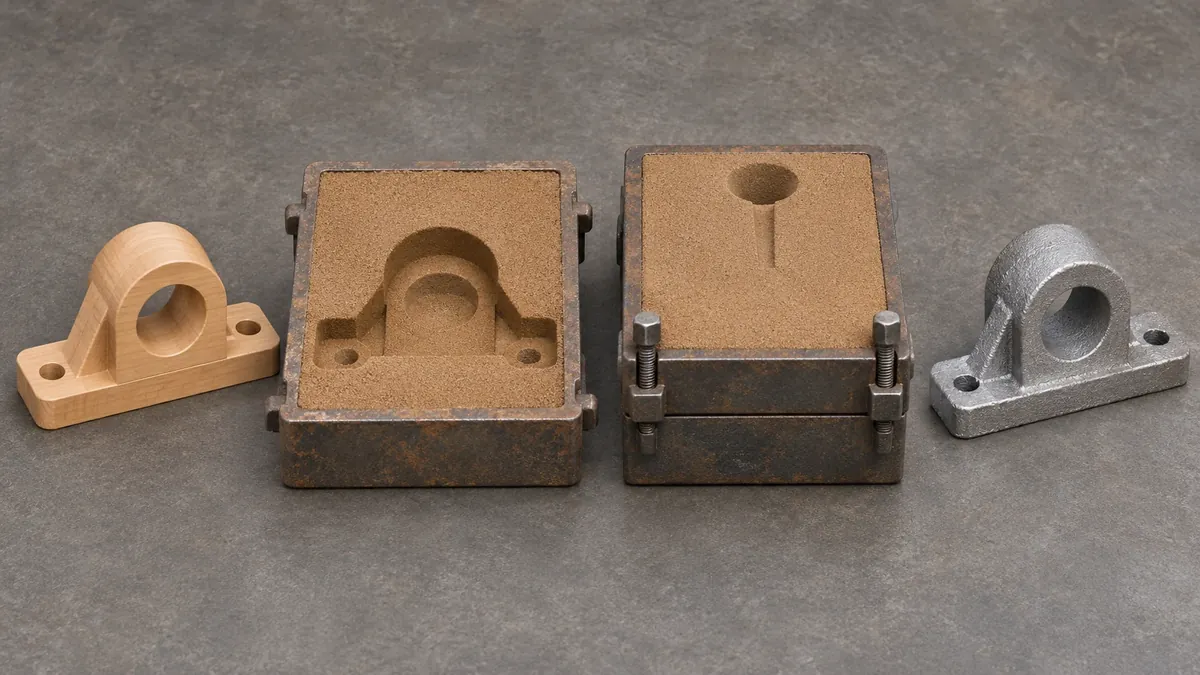
A casting mold provides the cavity that gives the solidified metal its shape. A pattern helps form that cavity and is not necessarily the same thing as the mold. A core may create an internal opening or passage. The mold may be expendable or reusable, and the metal may enter under gravity or through a pressure-assisted approach. A particular process may combine an expendable mold with a reusable pattern, or a reusable mold with an expendable core. Therefore, “reusable versus expendable” is a good first classification but not a complete process description.
The right framework begins with the buyer’s design and acceptance context. A decorative zinc alloy knob, a larger ferrous bracket, and a hollow part with a complex internal passage do not present the same route-selection question. This article explains general process categories; it does not recommend an alloy or establish that a particular supplier can make a specific geometry. Actual suitability depends on the product drawing, alloy, tooling, foundry capability, quantity, inspection plan, and finishing steps.
| Comparison axis | Pregunta del comprador | Examples of what belongs on that axis |
|---|---|---|
| Mold life | Is the mold destroyed or reused after a casting? | Sand or investment molds; permanent metal molds |
| Pattern and core | How is the cavity formed, and how are internal features created? | Reusable pattern, expendable core, permanent core |
| Filling force | What moves the metal into the cavity? | Gravity, pressure, vacuum, or rotation in an appropriate process |
| Geometry and finish | What does the part need to look like and fit? | Wall form, internal openings, surface condition, machining allowance |
| Production route | What operations follow casting? | Gate removal, machining, deburring, polishing, plating or coating |
A useful quotation should name the proposed process more precisely than “cast metal.” It should also identify any tooling, core, secondary machining, cosmetic finishing, and inspection assumptions that affect the buyer’s decision.
How do reusable and expendable molds differ?
A reusable mold is designed to produce multiple castings before it needs replacement or major repair. A metal mold used for gravity or pressure-fed casting is one example. An expendable mold is broken or otherwise consumed to release a casting, as in sand or investment casting. The distinction helps a buyer understand tooling, part-release, and process design questions, but it does not automatically tell the buyer which route will cost less or make a better part.
Reusable molds must tolerate the process conditions and be designed so the part can be released. Their tooling can include moving halves, cores, ejectors, cooling arrangements, and parting features. The design must account for the intended alloy and its interaction with the mold. Where the process uses pressure to fill a permanent die, the die and injection system form part of a controlled manufacturing route. Do not conclude from the word “die casting” alone that a particular thin wall, surface, dimensional range, or alloy is feasible. Request the foundry’s review of the actual drawing and design constraints.
Expendable molds are discarded after producing the casting. Sand casting uses a mold made from sand-based material, while investment casting commonly uses a sacrificial pattern and a shell mold. These processes can support geometry that would be difficult to release from a simple reusable mold, but that broad observation is not a guarantee of a specific tolerance or surface finish. The process, material, pattern, core, foundry controls, and finishing plan still matter.
The mold-life categories also contain exceptions. A semi-permanent route may use a reusable outer mold and an expendable core. A buyer who asks only “Is the tooling permanent?” may miss the fact that an internal feature depends on a core that is removed after pouring. A hollow part, mounting pocket, or enclosed passage makes this distinction relevant. A process description should therefore identify both the main mold and any core strategy.
| Mold approach | What is generally reused | What may be consumed or replaced | Buyer follow-up |
|---|---|---|---|
| Expendable sand mold | Pattern may be used again, subject to its design and condition | Mold and some cores | Ask how the pattern, core, and cavity are defined for this part |
| Investment route | Pattern-making tooling may be reused to make patterns | Pattern and ceramic shell are consumed per casting | Ask how the pattern route and post-cast finishing affect the drawing |
| Permanent mold | Metal mold is reused within its intended process life | Cores or wear components may vary by design | Ask how part release, core removal and tooling maintenance are addressed |
| Semi-permanent mold | Main metal mold is reused | Selected cores may be expendable | Identify which surfaces are formed by the metal mold and which by the core |
| Pressure die route | Die is reused for repeated cycles | Wear items may need maintenance or replacement | Ask for a route proposal tied to the actual alloy, geometry and planned finish |
Reliance Foundry’s overview describes reusable and expendable mold families and notes that alloy, complexity, tolerance, and surface needs affect process selection. Treat those explanations as general process education rather than a guarantee for any particular supplier or component.
Why must buyers separate patterns and cores from mold type?
A pattern is a physical or digital means of defining the casting cavity; it is not automatically the finished casting or the production mold. In many sand-mold routes, the pattern leaves its shape in mold material and is then removed before the cavity is filled. A core is placed in the cavity to create an internal void or passage. The details depend on the specific process. Buyers should understand these terms because the pattern and core strategy often carries the key design constraints.
Consider a hypothetical cast mounting support with a central opening. The outside shape may be formed by a two-part mold, while the hole might require a core. If the parting line crosses a visible face, finishing and inspection questions arise. If a core is required, buyers should ask how it is positioned, retained, and removed; whether a core print or opening is needed; and which surfaces are defined by the core. These questions do not imply a defect. They help the supplier explain the geometry and likely inspection points.
Designers often use a casting route to create an integrated shape, but a pattern does not eliminate shrinkage, draft, machining, wall-thickness, or release considerations. The foundry must interpret the drawing in light of its chosen route. The buyer should specify which features are critical for fit or function and which surfaces are cosmetic. If a dimension is to be machined after casting, state that clearly. A cast surface should not be presumed to meet the same finish as a machined or polished surface.
For product-development communication, the buyer can submit a STEP model plus a controlled drawing or dimensioned PDF. Mark internal openings, threaded or machined interfaces, mounting faces, and cosmetic zones. Ask the supplier to return a process proposal showing parting direction, core use, gates or feeders where appropriate, and post-cast operations at a level useful for approval. The proposal should be reviewed by people qualified for that product and process, rather than copied as an unverified template.
What major casting methods should a buyer recognize?
A buyer does not need to memorize every foundry method, but should know enough to compare a supplier’s process description. The methods below are broad categories, not a ranked list. Several are used for particular geometry or material situations, and the names alone do not prove suitability.
Sand casting
Sand casting uses a mold made from sand-based materials. The mold is generally expendable, while the pattern may be reused. This makes the method useful to discuss when the part needs a larger or more rugged shape or when the mold strategy and production context make an expendable route appropriate. However, sand-cast surfaces can require more finishing, and dimensional controls must be reviewed against the drawing. Do not infer a final surface appearance from the phrase “sand cast.”
Shell molding
Shell molding is related to sand-based casting but uses a resin-bonded shell around a pattern surface. It is often described as a way to create a more controlled mold surface than a basic sand mold. The process details and outcome remain supplier- and part-dependent. A buyer should ask what dimensions are produced as-cast, which are machined, and what surface the supplied sample actually represents.
Investment casting
Investment casting uses a sacrificial pattern and a shell mold that is removed after casting. The pattern is consumed, while some pattern-making tools may be reused. The route can create complex shapes, but buyers should avoid assuming that all features will be at final size or that no machining is needed. Ask for a part-specific drawing review and costed breakdown of finishing operations.
Permanent-mold and semi-permanent-mold casting
Permanent molds are reusable, typically metal molds. Semi-permanent routes combine a reusable mold with expendable cores for some internal features. The route needs a geometry that can be filled and the part released, and its detailed limits depend on alloy, design, tooling and foundry process. Ask the supplier to identify which surfaces are formed against the metal mold and which are formed by cores or other features.
Die casting
Die casting uses a reusable die and an injection system to force molten metal into the cavity under pressure. The die design, alloy and machine route are part of the proposal. The method can be relevant to certain repeated production needs, but a buyer should not infer universal precision, surface quality, cycle time or per-part economics from its name. Confirm actual tolerances, flash or parting features, secondary machining, surface preparation and tooling responsibilities in the quotation.
Centrifugal casting
In centrifugal casting, rotation helps distribute the liquid metal along a mold surface. The geometry must be compatible with the rotation axis; cylindrical or circular shapes are typical examples in general descriptions. That does not make every tube or ring a centrifugal-casting candidate. Ask the foundry to explain the proposed method and how it relates to the shape, wall and functional requirements.
Pressure-assisted and vacuum methods
Pressure-assisted approaches use a force other than gravity to influence filling. Vacuum, gas pressure, or other mechanical arrangements may be used in specialized routes. These names can refer to distinct methods, so request the supplier’s exact process description. Do not assume all “pressure casting” refers to die casting or that one process’s claimed outcomes apply to another.
Continuous casting
Continuous casting produces semi-finished stock such as slabs, blooms, billets or simpler sections that can be processed further. It is generally a raw-material route rather than a direct way to form a detailed consumer hardware component. The term may arise during a material conversation, so distinguish between the production of the starting stock and the later forming or machining of the final part.
When a finished die-cast component shows porosity or a blister during coating, the buyer should separate defect evidence from assumptions about the process; Koitor’s zinc die-cast porosity and blister acceptance guide covers that narrower inspection question.
How should the casting route be compared with a part drawing?
The first decision is whether the casting route can produce the required shape with an acceptable combination of tooling, finishing and verification. A supplier should not be asked only for a unit price based on a rendering. Provide enough information for the foundry to evaluate the actual geometry and return assumptions that can be checked.
A route-review matrix can make supplier responses comparable:
| Buyer requirement | Evidence or clarification to request | Por qué es importante |
|---|---|---|
| Alloy and material condition | Exact alloy designation proposed and supporting product documentation | The casting method and downstream use depend on the actual material |
| Critical dimensions | As-cast versus machined dimensions, datum strategy and tolerance proposal | Avoids assuming every dimension comes directly from the mold |
| Internal features | Core use, core material where relevant, support and removal concept | Internal geometry may depend on a separate mold element |
| Parting and gates | Approximate locations and any visible witness features | Helps review cosmetic and assembly surfaces |
| Acabado superficial | As-cast appearance, cleanup, machining, polishing and coating plan | “Smooth” is not a measurable acceptance requirement |
| Tooling ownership | Tool design, cost, maintenance responsibility and change control | Defines who approves and maintains production tooling |
| Aprobación de la muestra | Sample route, drawing revision and inspection records | Makes sample approval traceable to the production proposal |
| Production changes | Notification and re-approval trigger | Preserves process and design consistency across orders |
During a design review, mark functional faces, assembly interfaces, cosmetic surfaces, and locations that will be hidden after installation. State which features can be machined and which must remain as cast. If the supplier proposes a draft change, gate relocation, or local wall adjustment, ask for a marked-up drawing and explain how the change affects fit and appearance.
The buyer should also separate manufacturing evidence from marketing language. “High precision,” “excellent surface,” or “near net shape” needs a defined reference: which dimension, what tolerance, at which stage, measured by what method, and on which sample. Avoid accepting a process name as proof of product performance. If a supplier offers a sample, record whether it represents production tooling, a temporary prototype, or a different route.
For a zinc die-cast bathroom accessory, common buyer concerns may include parting lines, gate marks, surface preparation and plating or coating. A new casting-method article should not duplicate issue-specific inspection pages.
What mistakes should buyers avoid when sourcing cast parts?
Buyers can make a sound comparison by avoiding shortcuts that confuse mold type, production method, and finished-part requirements. The same process label can conceal important differences in tooling, core strategy, secondary work and evidence. Ask the foundry to make those distinctions explicit.
Common mistakes include:
- Treating process names as equivalent. Sand, investment, pressure die, and centrifugal casting differ in mold design and filling route.
- Assuming a reusable mold automatically lowers total cost. Tooling, maintenance, material, production volume, cycle losses, finishing and inspection all affect the commercial comparison.
- Assuming a process name guarantees tolerances. A drawing needs feature-specific tolerances and an as-cast/machined distinction.
- Ignoring cores. A complex opening may rely on a core that has a separate location, support and removal plan.
- Requesting only a unit price. Ask what is included: tooling, samples, machining, gate removal, surface treatment, inspection and packaging.
- Approving an unrepresentative sample. A hand-finished sample, prototype tool or different alloy may not represent the proposed production route.
- Using vague cosmetic language. Mark the visible faces and define acceptable parting lines, gates, pits, flash and finishing.
- Assuming casting is the right process because a competitor uses it. Confirm the geometry and requirements for your own part.
- Treating an informational source as supplier proof. A general process article cannot validate a particular foundry’s capability.
A buyer checklist before requesting a quotation:
- Attach the current drawing and 3D model, with revision identifiers.
- Identify alloy requirements, wall features, critical dimensions and assembly interfaces.
- Mark cosmetic surfaces and hidden areas.
- Ask the supplier to describe the proposed mold, pattern, core and filling method.
- Separate as-cast surfaces from machined or finished features.
- Request tooling cost, ownership, maintenance and modification assumptions.
- Define the sample route and the criteria for sample approval.
- State inspection evidence and who is responsible for each record.
- Confirm any coating or plating requirements and the relevant downstream supplier.
- Set change-notification and re-approval expectations.
Koitor Hardware is a family-owned custom metal hardware factory focused on bathroom and home-storage products. A project discussion can review a buyer’s drawing or sample and clarify whether the requested scope fits approved manufacturing capabilities. It should not be represented as a foundry service unless the specific supplier arrangement and project facts establish that role. For zinc die-cast parts, process, plating, and final cosmetic acceptance may involve separate responsible suppliers; identify who owns each step before placing the order.
What should a quotation and sample approval record contain?
A quotation record should let a buyer understand what was proposed and how to compare it later. It should capture the part number and drawing revision, material and alloy, the named casting route, tooling assumptions, any cores, expected machining, finishing and inspection. The quote should make clear whether the supplier is pricing a prototype, a production tool, a first sample, or ongoing production. These distinctions matter even if the part looks similar in a rendering.
The sample-approval record should identify the sample by date and revision. It should note whether the sample was made with production-intent tooling and whether the actual alloy, foundry route, machining, and finish match the intended shipment. If a sample differs, list the differences and decide whether they are acceptable for the current approval. A photo can document appearance from a particular view, but it cannot replace a dimensional report or material record where those are required.
For repeat orders, connect the approved sample to the process and finishing information that formed the basis of acceptance. If the foundry changes a mold, core, gate, alloy source, or finishing step, the buyer should decide whether the change requires notice and re-approval. A control plan need not be complicated; it needs to identify the responsible owner, the change trigger, and the evidence to review.
The buyer should also maintain document boundaries. Keep the current drawing, purchase specification, sample record, and packaging requirements accessible to the people responsible for sourcing and quality. Avoid emailing an old drawing revision as a convenient reference without stating that it is obsolete. If an approved change is made, update the controlled record and identify the previous revision so that it is not accidentally reused.
Frequently asked questions about types of metal casting
What is the difference between sand casting and die casting?
Sand casting generally uses an expendable sand-based mold. Die casting uses a reusable die and a pressure injection system. The actual route, material and part limits must be confirmed with a foundry against the drawing.
Is investment casting a reusable-mold process?
The shell mold and pattern used for an individual investment casting are consumed, although tooling used to make patterns may be reusable. Ask the supplier to explain the tooling and per-part pattern route for the specific part.
Does die casting always have better surface finish than sand casting?
That cannot be concluded from the process names alone. Surface depends on the alloy, die or mold condition, process controls, part geometry and finishing. Define the required appearance and inspect a representative sample.
What does a casting core do?
A core forms an internal space or feature that the main mold cavity does not create by itself. The design needs to account for core placement, support, removal and inspection.
Should a buyer select the casting method before sending an RFQ?
A buyer should state the part requirements and any known constraints, but can ask the supplier to propose a suitable route. Compare the proposal’s assumptions and evidence rather than selecting by a process label alone.
Can a cast part be used without machining?
Sometimes a design may use as-cast features, while others require machining for fit, thread, datum or surface requirements. The drawing should identify which surfaces and dimensions are machined and how they are inspected.

Sources
- Reliance Foundry: 11 Metal Casting Methods — general descriptions of reusable and expendable molds, cores, surface considerations, and example casting methods.
Discuss a Cast Hardware Project
Share your controlled drawing or sample, alloy requirement, critical features, and finish expectations. Koitor Hardware can review the bathroom or home-storage hardware project scope within its approved manufacturing role.
OEM / MARCA BLANCA
Convierte esta guía de abastecimiento en un resumen del producto
Indícanos el producto que deseas, el tamaño, el acabado, la cantidad del pedido y los requisitos de embalaje. Tu equipo recibirá un análisis práctico de la viabilidad de fabricación antes de recibir el presupuesto.


 English
 Español
 Português
 Français
 Deutsch
 العربية