
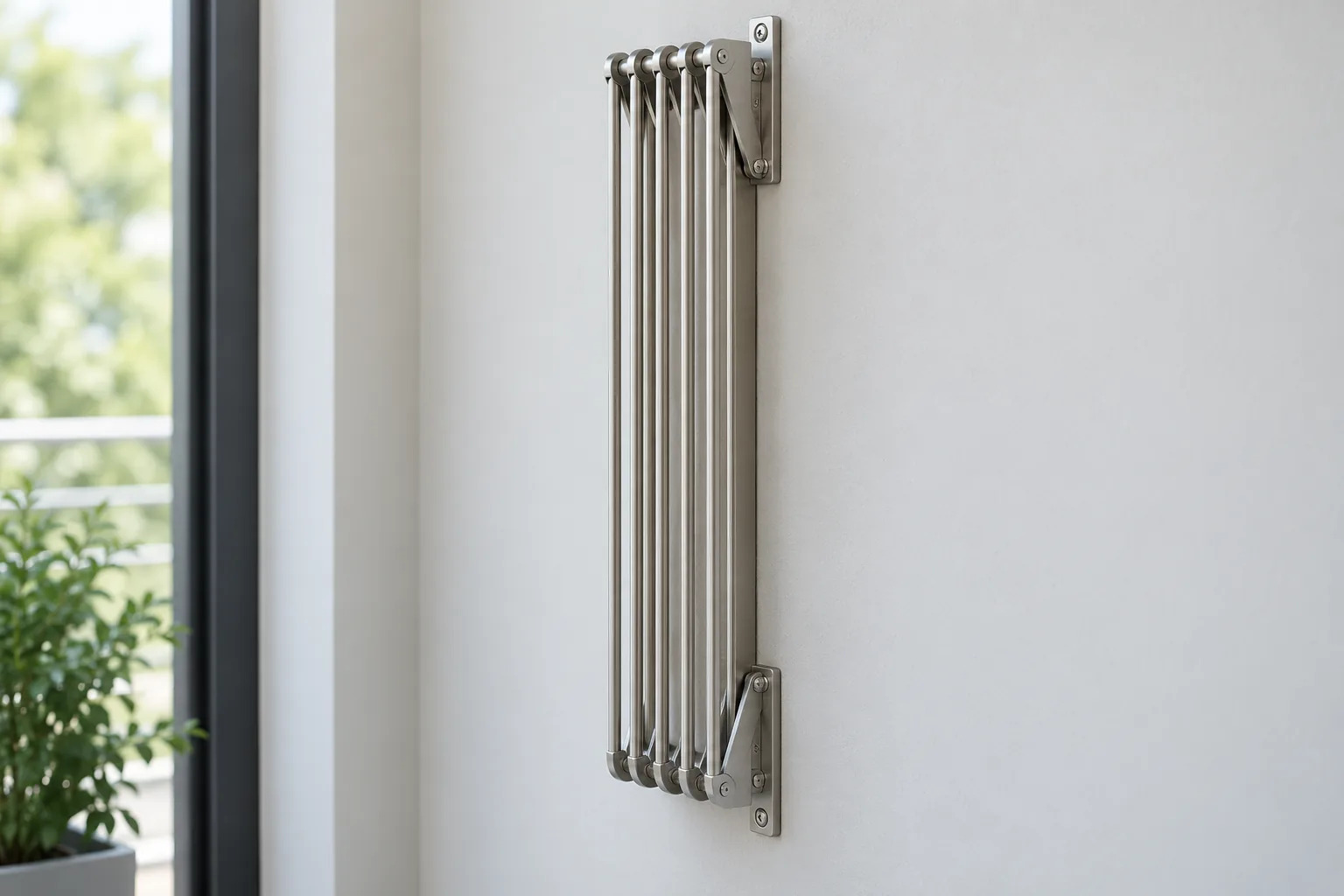
Buyers searching for “wall mounted drying rack projection stowed” need a defined closed envelope—not just the statement that a product folds away. Specify the rack’s projection from the mounting plane when closed, its full wall footprint, the path and space required during deployment, and any separate cover or storage-box envelope. Then check the intended sample against the buyer’s wall, nearby doors and access route.
A folded wall dryer can take up less room than an open one, but “folds flat” does not identify how far the closed assembly projects, how wide it remains, or what space is needed to open and remove it. For OEM and private-label sourcing, those are drawing and sample-approval questions. The phrase “wall mounted drying rack projection stowed” is treated here as a buyer’s search expression for one part of the closed-state specification, not as a universal dimension or product standard.
What does wall mounted drying rack projection stowed mean?
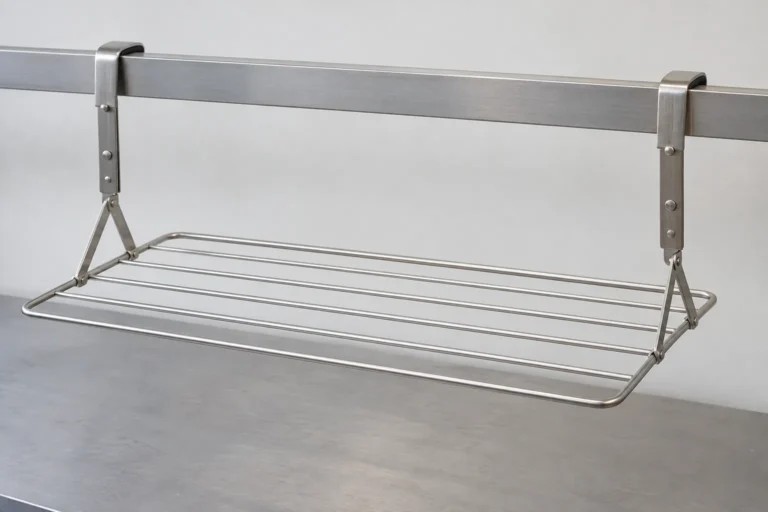
In a buyer specification, “wall mounted drying rack projection stowed” should identify the furthest point of the complete product from the mounting plane while the rack is in its intended closed position. The measurement should include parts that remain attached—such as a cover, housing, latch or handle—when those are part of the chosen configuration.
Projection is only one measure of the closed envelope. A closed assembly may have modest depth but still occupy a large vertical or horizontal wall area. A cover or box can protect the folded rack while changing the outside envelope. A mounting plate, hinge or frame may also remain visible outside the cover. Buyers should therefore name the selected product variant and record the full envelope rather than infer it from a product name or a photograph.
Define the reference surfaces before comparing quotations:
- El mounting plane is the wall or representative panel against which the product is fixed.
- El closed projection is the greatest perpendicular distance from that plane to the outermost attached part.
- El closed footprint is the full width and height occupied on the wall while stowed.
- El deployment sweep is the space the moving parts pass through while opening and closing.
- El service/access zone is the clearance needed for a user to reach the latch, handle or moving assembly.
These definitions help two suppliers measure the same product in the same state. They also keep a listing claim such as “compact when folded” from being mistaken for an installation envelope. If a buyer needs a maximum projection, wall footprint or opening clearance, each should appear as a separate requirement on the drawing.
How should buyers define the closed, deploying and open envelopes?
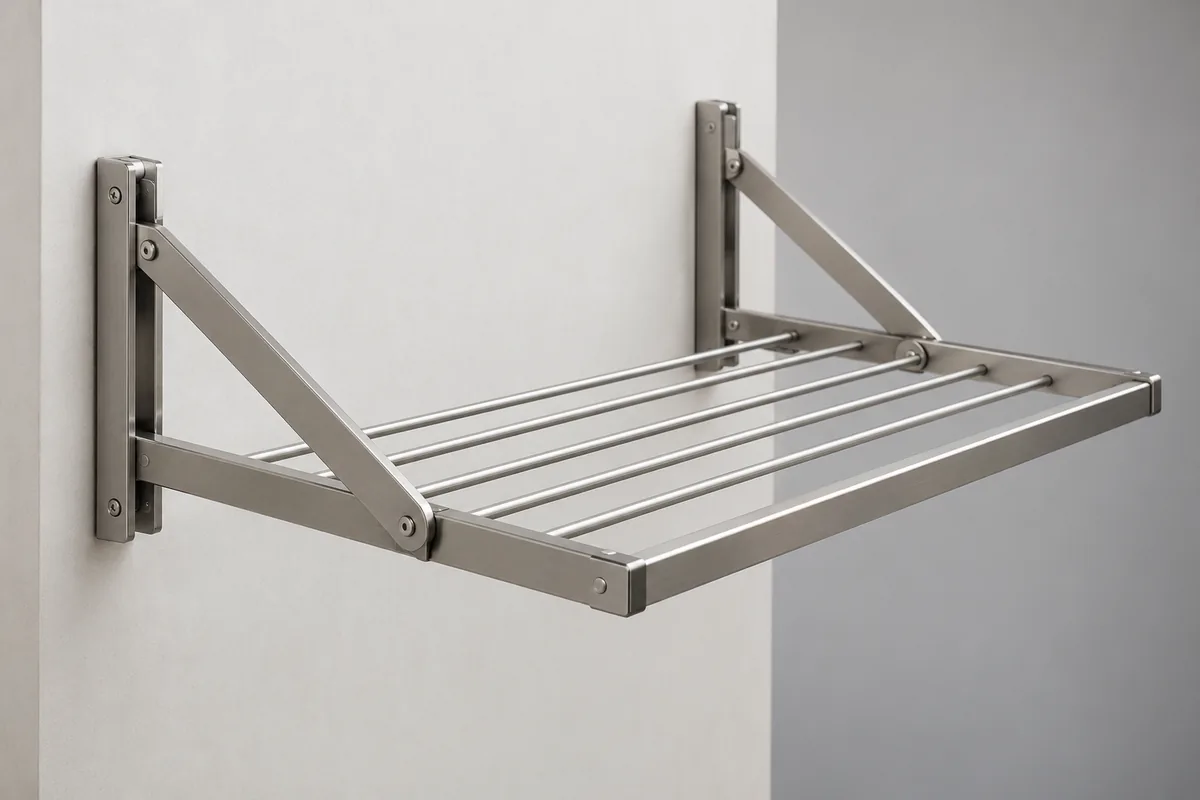
Record three distinct states: closed, moving and fully deployed. The closed state captures the product’s footprint and projection after it has been stowed. The deploying state captures the sweep of arms, frames or lines while moving between positions. The open state captures the space occupied during use, including any front or side projection from the wall.
A single side-view dimension cannot represent all three states. A folding frame may have a shallow closed profile but swing through a wide arc. A rotary or multi-arm assembly may occupy a different wall footprint when deployed than a simple hinged bar. If a cover is present, it can affect both the closed package and the opening path. The drawing should show the actual mechanism selected for the project, not a generic “folding rack” silhouette.
Use a dimensioned side view and front view, and add a top view when the product projects into a passage or room. Mark the mounting plane, wall contact area, outermost stowed point, furthest deployed point and any obstruction-sensitive path. If the mechanism has multiple approved positions, identify which are included in the intended product claim.
During sourcing, ask the supplier to state whether each dimension describes the bare rack, the rack with its protection cover, or the rack inside a storage box. These configurations are not automatically interchangeable. The relevant statement is not “this family folds away,” but “this exact configuration occupies the recorded envelope in the defined state.” Do not treat line length or nominal drying capacity as a substitute for stowed dimensions.
Why must a cover or storage box be measured as a separate variant?
A cover and a storage box can serve similar broad purposes—concealing or protecting a folded product—but their structures and external dimensions may differ. A buyer should not carry one variant’s closed envelope into another variant’s product listing or carton plan without checking the actual assembly.
Brabantia’s current WallFix product information describes a 24-metre wall dryer with a protection cover and says the dryer folds away against the wall when not in use. The same product page separately presents a WallFix version with a storage box. These are model-specific examples of why “fold-away” and “with cover” do not, by themselves, define the complete outside envelope. See the Brabantia WallFix product information. Its details should not be transferred to another design or supplier.
For an OEM program, make the variant explicit in the bill of materials and drawing package. Identify which parts remain installed when the rack is closed, whether the buyer’s packaging includes a separate protective component, and which dimensions apply before and after that component is fitted. If the cover can be removed by the user, clarify whether the buyer’s storage claim refers to the covered or uncovered state.
Check operating access too. A cover that contains the stowed product may require hand clearance to release or open it. A storage box may occupy a different wall area or require a particular opening direction. These points should be verified against the approved design and instructions, not assumed from the general word “cover.” If a supplier proposes a different enclosure or bracket during development, treat it as a configuration change and recheck the envelope.
How can the deployment sweep and nearby clearance be checked?
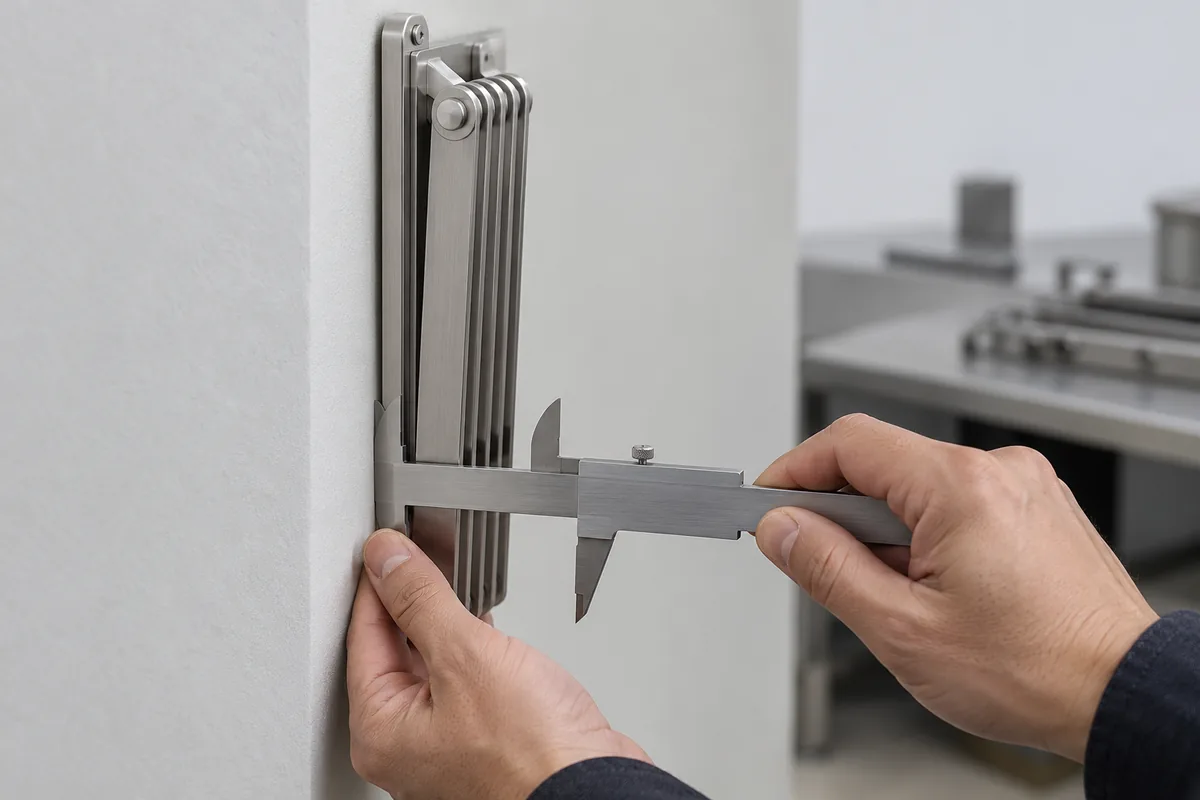
Place the assembled sample on a representative mounting panel or use a controlled fixture that reproduces the intended mounting plane. Verify the closed footprint first, then operate the rack through its intended motion while observing the full sweep. Check for contact with nearby doors, cabinets, passageways or adjacent products that the buyer has identified in the installation context.
An outline on a drawing is useful, but a physical sample reveals how the movement feels and where the mechanism actually travels. Do not force the assembly past its intended stop. Record whether a door or adjacent surface blocks the handle, whether the user can reach the opening point, and whether the rack can be returned to the stowed position without striking the surrounding area.
A practical review can follow this order:
- Confirm the mounting plane and wall area match the approved drawing.
- Measure the complete closed width, height and projection, including the chosen cover or box.
- Mark the outer path of every moving part during opening and closing.
- Identify nearby obstructions and verify the intended access route.
- Check the full open position and the movement back to storage.
- Photograph the closed, intermediate and open states with the sample identity visible in the project record.
- Record which configurations were accepted and which remain outside the approval scope.
This is a fit and clearance review, not a load, durability or cycle-life test. If the project needs a separate operating-cycle or strength requirement, define the method and acceptance criteria independently. A rack that opens once on a sample wall does not establish lifetime performance or a universal installation claim.
What should a closed-envelope clearance schedule include?
A clearance schedule translates the buyer’s installation and storage requirements into measurements the supplier can review. Keep the recorded state and configuration beside every value; a dimension without a state label is easy to misread.
| Schedule item | State or reference | Buyer should record |
|---|---|---|
| Mounting plane | Installed / sample fixture | Wall or panel datum and fixing position |
| Closed projection | Fully stowed | Furthest attached point from the mounting plane |
| Closed footprint | Fully stowed | Maximum width and height, including enclosure |
| Deployment sweep | Moving | Path of arms, frame or other moving parts |
| Open envelope | Fully deployed | Maximum projection and wall footprint in use position |
| Cover or box | Selected variant | Whether included, removable or separately installed |
| Access zone | Opening and closing | Space needed to reach and operate the mechanism |
| Pruebas de aprobación | Defined sample and revision | Drawing revision, photos, configuration and decision owner |
The schedule can be short; its purpose is to make assumptions visible. If a retailer supplies a maximum closed depth, state which components are included in that measurement. If a distributor needs a clear passage beside the mounted unit, note the related wall and doorway conditions. If the product is sold in cover and box versions, maintain a separate row or drawing revision for each.
Avoid combining all needs in a single phrase such as “folds flat.” That wording might mean the rack sits close to a wall, folds into a housing or simply reduces its open width. Ask for an actual closed-state drawing and an assembled sample if the dimensions control product selection, listing claims or installation guidance.
What should the RFQ and drawing package tell the supplier?
Give the supplier the intended wall or fixture context, the closed and open states the buyer needs to approve, and the version of the product being quoted. A useful request includes:
- A product drawing with front, side and—where needed—top views.
- The mounting plane, fixing points and any buyer-defined wall envelope.
- Separate closed, deploying and open-state dimensions.
- The named cover, box or enclosure variant and its included components.
- Nearby doors, trim or passage constraints that matter to the intended use.
- Which configurations need sample review and which are excluded.
- Any retailer or distributor wording the buyer expects the finished instructions to support.
- Drawing revision, sample identifier and approval owner.
Ask suppliers to list assumptions before they quote. If the product variant is not fixed, the quote may describe a bare rack while the buyer expects a covered model. If “projection” lacks a datum, two offers may not be comparable. A simple dimensioned drawing or physical reference can resolve those questions earlier than a late change to the sample or packaging.
Koitor’s approved scope supports custom metal hardware review from drawings or samples and discussion of forming, assembly, finish and packaging when those processes fit the confirmed project. Current manufacture of a WallFix-type laundry dryer or its proprietary mechanism is not confirmed. Buyers can review the broader OEM home storage hardware scope and confirm whether a specific project fits Koitor’s current capability before treating the topic as a product offer.
How should sample approval and changes be documented?
Tie the closed-envelope approval to a specific sample and drawing revision. Save photos of the closed, intermediate and open positions, note whether the cover or box was included, and record the mounting fixture or wall sample used. The approved note should state what the sample demonstrates and which product claims it supports.
When a design changes, compare the affected parts with the clearance schedule. A revised hinge position, arm length, frame, mounting plate, latch or enclosure can alter the stowed projection or movement path. A packaging-only change may leave the installed envelope unchanged, but it can alter how the product arrives or how the enclosure is assembled. Have the responsible buyer and supplier decide which checks need repeating under the project’s change-control process.
Keep in-scope and out-of-scope configurations distinct. If the initial approval covered the bare rack but a new version adds a cover, update the drawing and review the covered state. If the buyer extends a compatibility claim to another wall or installation arrangement, confirm that the product instructions and evidence support the new scope. Do not treat a successful fit on one panel as proof for every building surface or installation condition.
For a private-label launch, store the schedule with the approved product specification and the packaging artwork review. This gives sourcing, product, and customer-support teams the same interpretation of the folded size and the space required to operate the product. It also helps suppliers understand which geometry must remain controlled between sample and repeat order.
Preguntas frecuentes
Is “folds away” enough information for a product listing?
No. It describes a function, not the full envelope. A buyer should confirm closed projection, wall footprint, deployment sweep and any cover or box dimensions for the named configuration.
What should the phrase “wall mounted drying rack projection stowed” refer to?
It should refer to the outermost closed projection from a defined mounting plane, with attached components included. Record width and height separately because projection does not describe the whole closed footprint.
Does the product page for one wall dryer define a standard folded size?
No. Brabantia’s product page describes its own WallFix cover model and separately lists a storage-box option. That model-specific information does not establish a standard for other designs.
Should buyers review the closed position only?
No. Opening and closing can require more clearance than the final stowed state. Review the movement path and full open envelope on the intended mounting fixture.
Does a sample that folds closed prove long-term mechanism performance?
No. A fit review documents the sample’s envelope and movement in the observed configuration. It does not establish cycle life, strength or service life without a separate agreed test.
Trabaja con Koitor Hardware
Discuss a Custom Metal Home-Storage Project
Send Koitor a drawing or sample, intended mounting context, closed/open clearance requirements, finish and packaging notes. We can review the confirmed metal-hardware scope and discuss manufacturability before quotation; wall-mounted dryer capability is subject to project review.
OEM / MARCA BLANCA
Convierte esta guía de abastecimiento en un resumen del producto
Indícanos el producto que deseas, el tamaño, el acabado, la cantidad del pedido y los requisitos de embalaje. Tu equipo recibirá un análisis práctico de la viabilidad de fabricación antes de recibir el presupuesto.
 English
 Español
 Português
 Français
 Deutsch
 العربية