
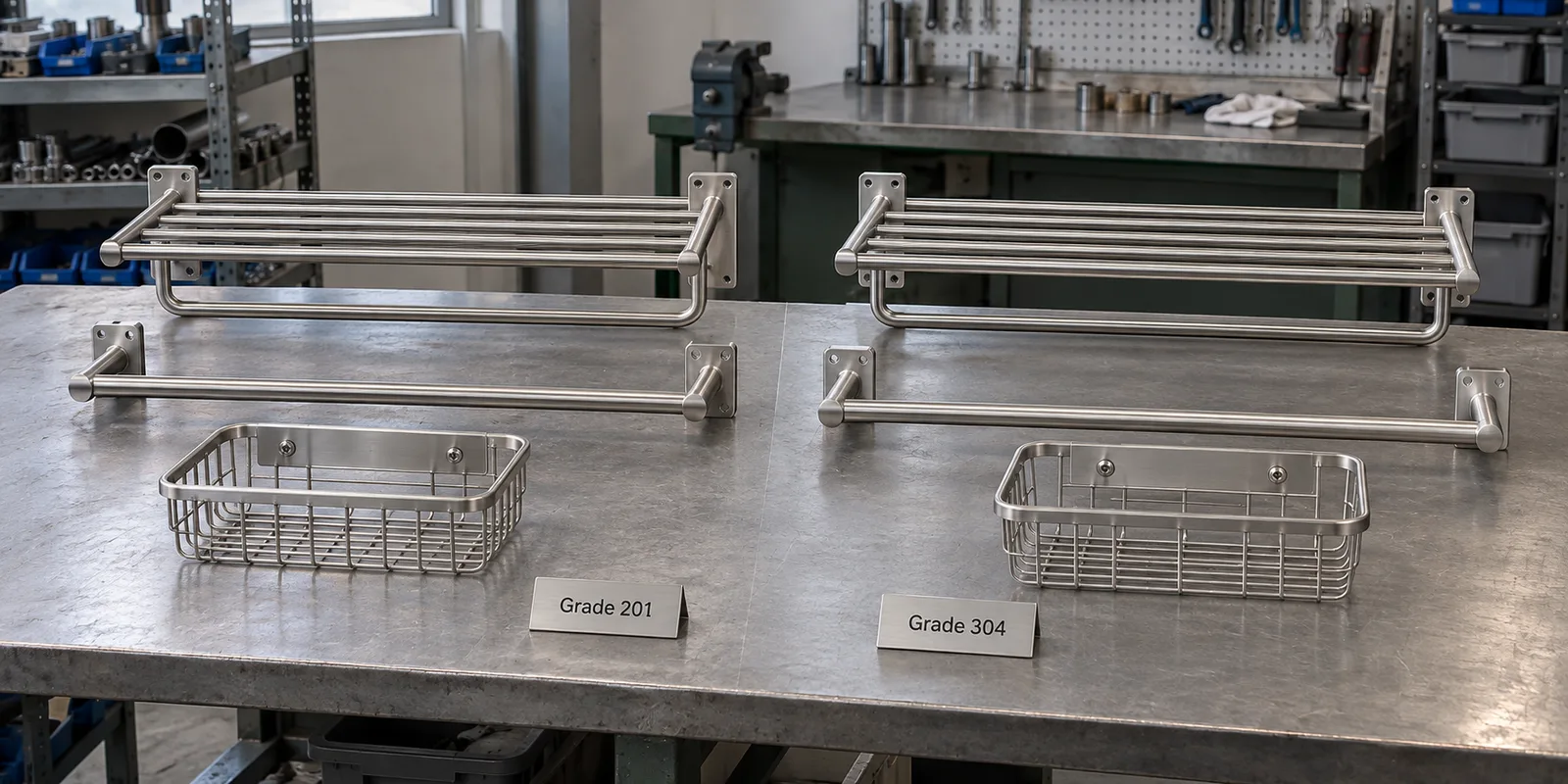
201 vs 304 stainless steel bathroom accessories should be compared by the actual use environment, exposed surfaces, product structure, finish and buyer documentation rather than price alone. Grade 304 is generally the safer starting point when corrosion resistance is a major concern, while grade 201 may be considered for selected cost-sensitive products in less demanding conditions after sample evaluation. Neither grade should be described as completely rust-proof. Before ordering, buyers should confirm the grade, review a finished sample and define how material identity will be recorded.
What is the practical difference between 201 and 304 stainless steel?
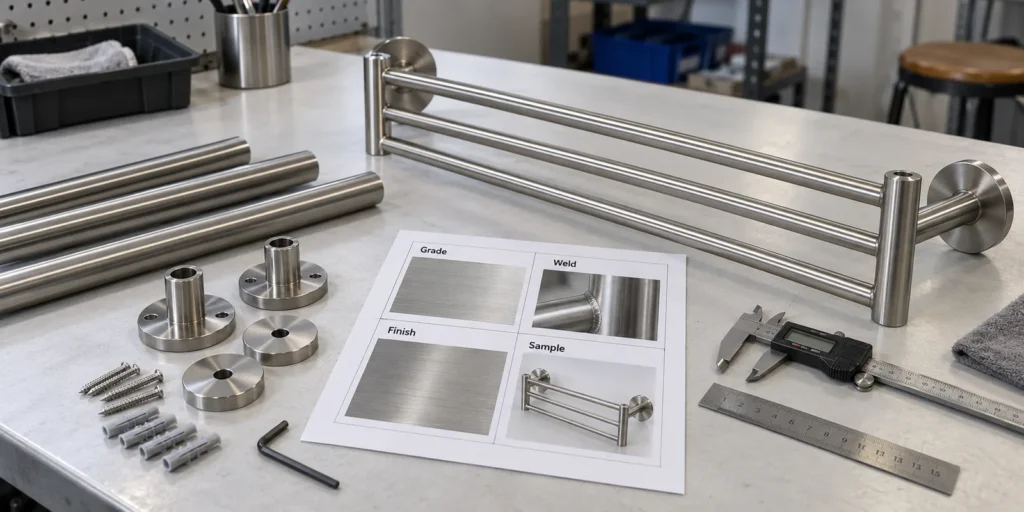
The practical difference is that the two grades use different alloy compositions, which affects corrosion behavior, forming, welding, cost and material identification. The grade name is therefore a purchasing specification, not simply a visual description.
Both 201 and 304 belong to the austenitic stainless steel family. However, 200-series stainless steels generally replace part of the nickel used in 300-series grades with manganese and nitrogen. Grade 304 is the familiar chromium-nickel stainless steel used across many fabricated products. The exact material must still be checked against the agreed specification and supplier documents.
World Stainless explains that austenitic stainless steels use chromium together with nickel or manganese to stabilize their structure. Its grade overview also notes that some low-nickel and low-chromium 200-series materials have less corrosion resistance than grade 304. Buyers can review this neutral background in the World Stainless guide to stainless steel categories and grades.
This does not mean every bathroom product must use 304. It means the buyer should connect material selection to the product’s expected moisture, cleaning, contact and maintenance conditions. A tissue holder in a relatively dry location, a towel rack near a shower and a shower caddy exposed to frequent water are different applications even when all three are sold as bathroom accessories.
Cost also needs context. A lower material quotation is useful only when the finished product still meets the buyer’s appearance, fabrication and use requirements. Material savings may be reduced if the product needs a more complex finish, extra handling or repeated sample corrections.
When should buyers consider 201 or 304 for bathroom hardware?
Buyers should normally consider 304 for products with more frequent moisture exposure or where a conservative material choice supports the product brief. Grade 201 may be evaluated for selected indoor products with lower exposure when cost is important and the buyer accepts the confirmed material and finish strategy.
| Buyer consideration | 201 stainless steel | 304 stainless steel | What to confirm |
|---|---|---|---|
| Typical sourcing position | Cost-sensitive option for selected products | Common general-purpose stainless option | Product application and target price level |
| Moisture exposure | Needs careful review in bathroom conditions | Generally preferred when corrosion resistance has higher priority | Distance from water, ventilation and cleaning routine |
| Surface appearance | Can be polished or finished, subject to sample approval | Can be polished or finished, subject to sample approval | Gloss, brushing direction, color and acceptable variation |
| Fabrication | Structure and welding process should be sampled | Structure and welding process should be sampled | Bends, weld areas, grinding and heat tint control |
| Material verification | Grade should be documented; appearance alone is insufficient | Grade should be documented; appearance alone is insufficient | Purchase specification, records and agreed verification method |
| Commercial comparison | May reduce raw-material cost in a suitable design | Usually carries a higher material cost | Compare the complete finished specification, not metal price alone |
A 201 stainless towel rack can be commercially reasonable only when the buyer has defined where it will be used and how it will be finished and maintained. The same conclusion cannot automatically be applied to a shower basket that remains wet or collects residue around closely spaced wires and welds.
A 304 stainless towel rack may give the buyer more margin for bathroom exposure, but the grade does not correct poor drainage, rough weld finishing or contamination introduced during processing. Product design and manufacturing control remain part of the result.
For a range containing several products, buyers do not always need one material rule for every item. A structured range review can identify which products have direct water exposure, which are installed in drier zones and which need a common marketing position. Any mixed-material strategy should be clearly documented so purchasing, packaging and inspection teams do not confuse models.
Why can stainless bathroom accessories still show rust or staining?
Stainless bathroom accessories can show staining when grade selection, surface condition, fabrication residues, trapped moisture or cleaning exposure are not adequately controlled. Stainless steel relies on a protective passive surface, but it is not immune to every environment or every manufacturing problem.
Water can remain around welds, joints, mounting plates and horizontal surfaces. Soap residue and cleaning chemicals may also collect in these areas. A product that drains and dries easily has a different exposure pattern from a deep basket corner or a concealed bracket that stays damp.
Fabrication matters because cutting, welding, grinding and polishing change the surface. Weld discoloration, rough transitions and embedded contamination should be reviewed during sample development. A buyer should not assume that specifying 304 automatically makes every fabricated area equivalent to an untouched sheet or tube surface.
Contact with carbon-steel tools, dust or storage surfaces can leave foreign particles on stainless steel. Those particles may later create visible rust marks that are mistaken for proof that the entire product is the wrong grade. Investigate material records, process handling and the affected location rather than reaching a conclusion from one photograph.
Cleaning instructions also matter. Strong or unsuitable cleaners, abrasive pads and residues left on the product can affect appearance. Buyers should align care wording with the target market and product finish. Do not promise that a product will never rust, and do not write unsupported maintenance guarantees on packaging.
Installation conditions vary. A coastal home, a poorly ventilated bathroom and a dry interior washroom do not create the same risk. If a project involves unusually demanding exposure, buyers should obtain appropriate technical advice and arrange project-specific evaluation instead of relying on a generic grade comparison.
How should buyers verify stainless steel grade and surface finish?
Buyers should verify grade through an agreed material specification, purchasing records and an appropriate verification plan. Visual appearance and a simple magnet check are not sufficient on their own to distinguish 201 from 304 reliably.
Begin the request for quotation with a clear grade designation for every metal component. State whether the requirement applies to the main tube, wire, bracket, fastener and decorative cover. A product can contain several components, so the phrase “stainless steel product” may not define the complete construction.
Ask the supplier how incoming material is identified and how records are connected to the production order. The level of documentation should match the commercial risk and buyer requirement. If independent material analysis is needed, agree who arranges it, what method will be used, how samples are selected and what acceptance rule applies before production.
A handheld material analyzer may be useful in an agreed inspection plan, but buyers should understand the method’s scope and interpretation. Do not turn an instrument screenshot into a blanket certification claim. The product specification and acceptance process should identify the grade and components being checked.
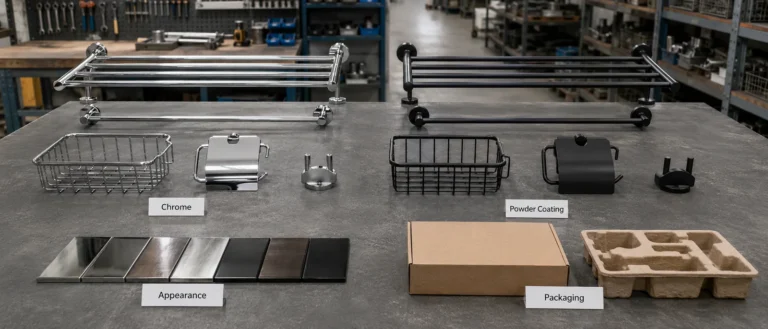
Review finish separately from grade. Confirm whether the visible surface is polished, brushed, plated, coated or otherwise treated. Specify the viewing direction, acceptable color range and treatment of welds and edges through drawings, photographs or an approved physical sample. Two products made from the same grade can look different because of polishing sequence and surface handling.
Pour Fabrication sur mesure de porte-serviettes de salle de bains, buyers should connect the material callout with tube dimensions, bracket construction, weld locations and finishing requirements. This makes supplier quotations easier to compare and reduces the chance that one offer includes a different structure under the same general product description.
What should be checked on samples before bulk production?
A finished sample should confirm material identity, structure, appearance, assembly, mounting and packaging before bulk production. The sample is most useful when buyers record exactly what it represents and which evaluations remain outstanding.
First, compare the sample with the current drawing or specification. Measure the agreed critical dimensions and confirm wire or tube size, component count, mounting hole positions and accessory contents. Note any temporary sample detail that will change in production.
Second, inspect fabrication areas under consistent lighting. Look at weld position, grinding transitions, sharp edges, gaps, distortion and visible heat effects. Operate moving or removable parts where applicable. For a multi-tier rack, check alignment and whether the product sits or mounts as intended.
Third, review surface appearance from normal viewing distance and close range. Compare brushing direction, gloss and color across connected parts. Check concealed areas as well as the front face, especially where water or residue may collect. Record approved appearance with photographs, but retain a physical reference when practical.
Fourth, assemble and install the sample using the intended accessories and instructions. Confirm that brackets, screws, anchors, covers and labels correspond to the product. Structural or load expectations should be evaluated under project-specific conditions agreed by the buyer; do not substitute an informal demonstration for a defined test.
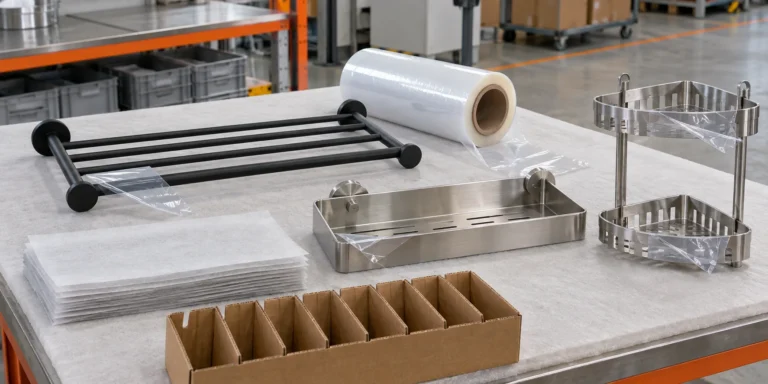
Fifth, review packaging contact points. Stainless surfaces can be marked by loose hardware, abrasive card edges or movement in transit. Use protective sleeves, separators or accessory bags where the approved package requires them, and check that packaging materials do not trap unnecessary moisture during storage.
Koitor Hardware usually develops samples in about 5–7 working days after design and materials are confirmed, depending on the project. Treat that as planning guidance rather than a guaranteed deadline. A revised structure, uncommon material size or special finish can change the sample sequence.
How should importers compare quotations for 201 vs 304 stainless steel bathroom accessories?
Importers should compare quotations only after suppliers are pricing the same grade, component structure, dimensions, finish, packaging and inspection scope. A price difference is not meaningful when one supplier has interpreted “stainless steel” differently from another.
Prepare one revision-controlled request for quotation and send the same package to each supplier. Include the product drawing or reference sample, grade by component, surface finish, expected order quantity, packaging method, target market and required documentation. Mark any point that remains open so suppliers can state assumptions.
Ask for cost-impact alternatives in separate lines. For example, request one quotation for the confirmed 304 construction and one for a technically feasible 201 version if the product application permits evaluation. Do not accept a silent material substitution made only to reach a target price.
Clarify whether fasteners, wall plates and decorative covers use the same grade as the main product. Confirm whether polishing, welding, assembly, individual protection and retail packaging are included. Compare lead time and minimum quantity together with price.
At Koitor, MOQ can start from 100 pieces depending on product structure, material, finish and packaging. Bulk production usually takes around 4–6 weeks depending on quantity, complexity, material availability, finish and packing. These ranges should be confirmed for the individual quotation.
Document the selected option after sample approval. The purchase order should reference the current drawing, material requirement, finish sample and packaging version. This prevents an approved 304 stainless towel rack sample from being followed by a purchase order that says only “stainless towel rack.”
Buyers preparing broader product specifications can also use the bathroom hardware sourcing resources to review related questions about welding, finish, samples, packaging and quality inspection.
Buyer checklist before approving a stainless steel bathroom accessory
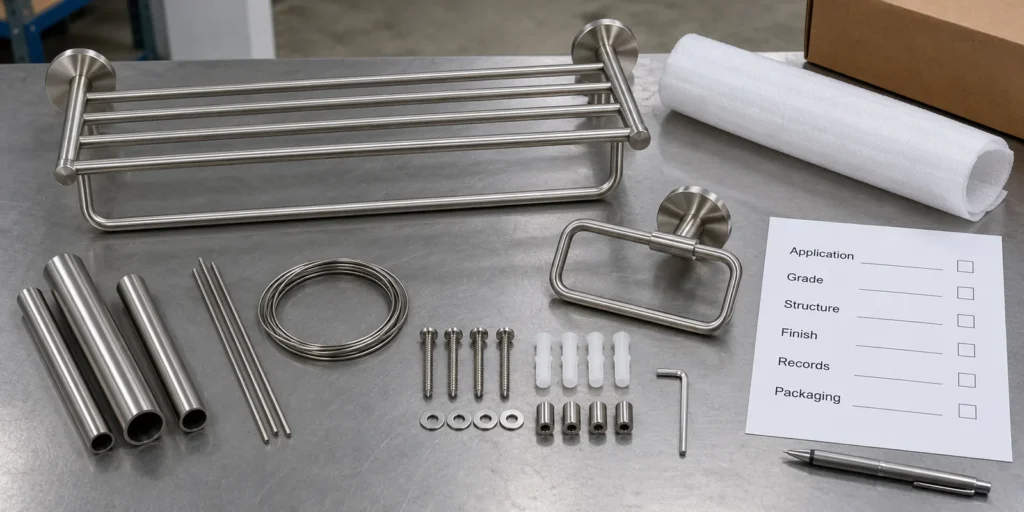
A complete approval checklist should connect material grade with product application and the finished item. Use the following points in the RFQ, sample review and purchase-order handover.
- Utilisation : identify whether the product is a towel rack, tissue holder, shower caddy, corner basket or another bathroom accessory.
- Exposure: describe likely water contact, ventilation, cleaning and installation conditions.
- Grade by component: specify the main tube or wire, brackets, covers and fasteners instead of using one vague material label.
- Structure : confirm dimensions, wall thickness or wire diameter where relevant, mounting arrangement and weld locations.
- Surface finish: define polish or brushing direction, appearance reference and treatment of welds and edges.
- Material records: agree which purchasing or production records are required and how they relate to the order.
- Vérification : define any project-specific material check, sample selection and acceptance process before ordering.
- Sample: approve a finished sample and record its drawing, material, finish and packaging revisions.
- Conditionnement : protect visible surfaces and contain mounting accessories so they cannot scratch the product.
- Commercial terms: compare MOQ, sample scope, lead time and the complete finished-product price.
- Purchase order: reference the approved specification rather than describing the item only as stainless steel.
This checklist turns 201 vs 304 stainless steel bathroom accessories from a label-based debate into a controlled sourcing decision. The goal is not to select the most expensive grade automatically; it is to make the material, environment, process and buyer expectation agree.
Frequently asked questions about 201 and 304 bathroom hardware
These answers address common B2B questions about grade choice, verification and product development. Final decisions should still follow the specific product and market requirements.
Is 304 stainless steel always necessary for bathroom accessories?
No. The appropriate grade depends on moisture exposure, product structure, finish, expected care and the buyer’s commercial position. Grade 304 is often the more conservative starting point where corrosion resistance is important, while 201 may be evaluated for selected lower-exposure applications.
Is 201 stainless steel rust-proof?
No stainless steel should be sold as completely rust-proof. Grade 201 can show staining or corrosion depending on its composition, fabrication, surface condition and environment. Buyers should approve the grade and finished sample for the intended application.
Can a magnet identify 201 and 304 stainless steel?
Not reliably by itself. Austenitic stainless steels can show changes in magnetic response after cold working, and a simple magnet does not provide a complete grade analysis. Use specifications, traceable records and an agreed verification method.
Does 304 solve welding and finishing problems?
No. Grade 304 still needs suitable cutting, welding, grinding, polishing and handling. Rough welds, poor drainage or surface contamination can affect appearance and performance regardless of the grade name.
Can one bathroom collection mix 201 and 304 products?
It can, if each material choice is deliberate and clearly documented. Review exposure and positioning for every model, identify grade by SKU and ensure packaging, purchasing and inspection records do not confuse the products.
What should buyers send for a stainless bathroom hardware quotation?
Send a drawing or physical sample, dimensions, grade by component, surface finish, target quantity, packaging requirements, installation accessories and target use environment. State any documentation or verification requirement before the supplier prices the project.
Discuss stainless steel bathroom hardware with Koitor
Koitor Hardware is a family-owned custom metal hardware factory specializing in bathroom and home storage hardware. For a custom towel rack, shower caddy, basket or tissue holder, the production team can review drawings or physical samples, material options, welding areas, finish, packaging and small-batch feasibility before quotation.
Compare Stainless Steel Options for Your Bathroom Hardware
Send Koitor your drawing or sample, intended use, material preference, finish requirement, packaging idea and expected quantity. We can review the structure and practical material options before sample development and quotation.
Fabrication pour compte de tiers / Marque de distributeur
Transformez ce guide d'approvisionnement en cahier des charges
Indiquez-nous le produit souhaité, ses dimensions, sa finition, la quantité commandée et vos exigences en matière d'emballage. Votre équipe recevra une analyse pratique de la faisabilité de la fabrication avant l'établissement du devis.
 English
  Español
  Português
  Français
  Deutsch
  العربية