

A freestanding towel rack looks simple in a product photograph: a base, an upright and one or more arms. For an importer, however, the sellable product has to work as a spatial system. The bar arrangement must accommodate the intended towels, the base must fit the planned floor area, the assembled rack must match the approved sample, and the packed parts and instructions must correspond to the product that arrives.
A freestanding towel rack buyer specification should therefore describe the actual buyer decision: what towel formats should fit, how they will hang, what space the stand may occupy, which configuration is being approved, and how changes will be recorded. A broad product name or reference photo is not enough to communicate those choices. This guide is for RFQ and sample control; it does not assign a universal stability threshold, load rating or drying-time claim. Any product performance requirement should be agreed and supported for the specific design and intended use.
What should the freestanding towel rack buyer specification define?
Begin with the assortment and use case. A rack intended for a compact guest bathroom may prioritize a smaller footprint, while a family bathroom or hospitality project may call for more usable hanging positions. These are different design priorities. Record the target channel, room context, expected towel types, finish and packaging format, and whether the design is a new private-label model or a revision of an existing reference.
Identify the product by SKU, revision and sample date. Link it to a drawing or controlled dimension sheet, material/finish reference, bill of materials, assembly instruction and carton plan. Use one naming system across the quote, sample feedback, order and packaging. If several sizes share a design, list each separately and state which dimensions or components vary. A range name such as “three-bar rack” does not distinguish arm length, arm height, base shape or finish.
Separate the main dimensions into usable product envelope and shipping envelope. For the assembled rack, record overall height, maximum width or projection, base dimensions and the position of each bar. For the packed product, record which components are detached, carton dimensions and the hardware/instruction configuration. A change to the base or arm arrangement may affect both the floor footprint and how the product fits in the carton.
| Buyer record | Capture | Decision it supports |
|---|---|---|
| Model identity | SKU, variant, revision and intended market | Prevents sample and order mismatch |
| Towel envelope | Towel size/type and expected placement | Makes “fits a towel” testable for the target assortment |
| Product envelope | Overall dimensions, arm positions and base footprint | Confirms the rack fits the room plan |
| Assembly and pack | Parts, fasteners, instructions and carton | Ensures the approved product can be supplied as a complete kit |
How do buyers translate towel fit into bar spacing?
Do not specify spacing as an isolated number without explaining the towel arrangement it is meant to support. A towel draped over a single arm uses space differently from a folded towel, a hand towel or two overlapping towels. The useful question is whether the intended towel can hang in the intended position without colliding with a neighboring arm, the upright, the wall or another towel.
Choose representative towels or define an agreed envelope for review. Record their approximate width and length, whether they are folded, and where each is placed. On the sample, check the free space between arms, the clear reach of each arm, and whether towels can be put on and removed without repeatedly catching on adjacent bars. If the rack has staggered arms, confirm that the sequence of heights and projections matches the expected use, rather than just counting the bars.
Towel fabric, thickness and folding habits vary. A buyer should not imply that one spacing guarantees faster drying or universal fit. Consumer guides and individual product instructions can help identify dimensions shoppers may compare, but the buyer’s own target assortment should define what the sample must accommodate. If a listing gives a towel capacity or size, treat it as model-specific unless the method and conditions are stated.
Review both loaded and unloaded appearance. A towel that hides the base or hangs near the floor may be undesirable even when the arm technically holds it. Check access to the rack from the intended side and whether the product will be placed beside a tub, shower, vanity or wall. This is a usability review, not a stability test.

Which floor dimensions and clearances matter?
The base footprint is the area occupied at floor level; the rack’s overall envelope is larger because the arms project outward. Capture both. A stand may technically fit in a bathroom corner yet interfere with a door swing, drawer, shower screen, toilet or circulation path. Ask the buyer or project team to confirm the space available at the intended location, including the direction from which towels will be reached.
For the sample, measure the maximum base width and depth, overall height and maximum arm projection. If the base is round, specify its diameter; if it is rectangular or shaped, show its full outline and orientation. Define where the upright sits relative to the base and how each arm projects. These details make the product footprint understandable in a planogram or room layout. Model-specific dimensions from retail listings or manuals are examples only and should never be copied as a universal standard.
Check whether the base contacts the floor evenly on a suitable level surface, whether any feet or pads are included, and whether the finish or exposed underside could mark the intended flooring. If leveling features are part of the design, identify their locations and adjustment range. Do not assume that a large or heavy-looking base proves stability. Stability depends on the complete geometry, joints, materials, assembly and use conditions; request evidence against the buyer’s chosen test and acceptance criteria when such a claim is required.
What should the sample review verify?
The sample should be reviewed as a complete configuration, not as a photograph of the frame alone. Confirm that the delivered version matches the named SKU and revision. Compare major dimensions with the drawing, check arm heights and projection, review the finish on visible surfaces and inspect the relationship between upright, arms, base and any joints. Record observations with measurements when a dimension matters; a picture alone may not show scale or tolerance.
Assemble the sample using the intended fasteners and instructions. Confirm that parts are identifiable, connections can be reached in the stated sequence, and the assembled rack matches the reference. Note misalignment, missing hardware, confusing orientation or exposed contact points as specific questions for the supplier. These are sample observations, not proof of a batch-wide defect. If a component or finish changes after approval, ask which parts of the review need to be repeated.
Where a buyer requires a load or stability claim, agree the complete test setup, loading method, surface, configuration, duration or repetitions, acceptance criteria and responsible test party before production. A base measurement, a visual inspection or one informal handling check cannot establish a load rating. The exact evidence should correspond to the model and revision that will be sold.
The approved record should identify the reference sample, date, drawing revision, dimensions checked, open issues and approval status. If the team approves with a deviation, write down the deviation and its disposition. “Looks fine” is not a clear change-control record when a different arm position, base, finish or fastener is later quoted.
How should materials, finish and joints be specified?
Name the specified material and finish only when they are known and approved for the project. Do not infer grade from appearance or a supplier’s generic product family. Record the finish color or physical reference, texture or gloss expectation where relevant, and which faces are cosmetic. For a multi-part rack, note whether the base, upright and arms should match visually and how the buyer will compare them.
Identify the visible connection approach and the assembly details the buyer needs to approve: welded or mechanically joined parts, removable arms, threaded connections, caps, collars or other features. Which joint is suitable depends on the design, material and finish. A product photo may conceal the connection. Ask for a drawing, sample underside view or assembly diagram when the joint affects appearance, packing or serviceability.
If a buyer changes from one finish to another, or changes the base material, arm section or connection, review whether the same dimensions, appearance reference and test evidence still apply. Do not assume the supplier can simply “match the sample” if the new version uses a different material or process. Record the approved reference and any proposed substitution explicitly.
What belongs in the flat-pack and packaging check?
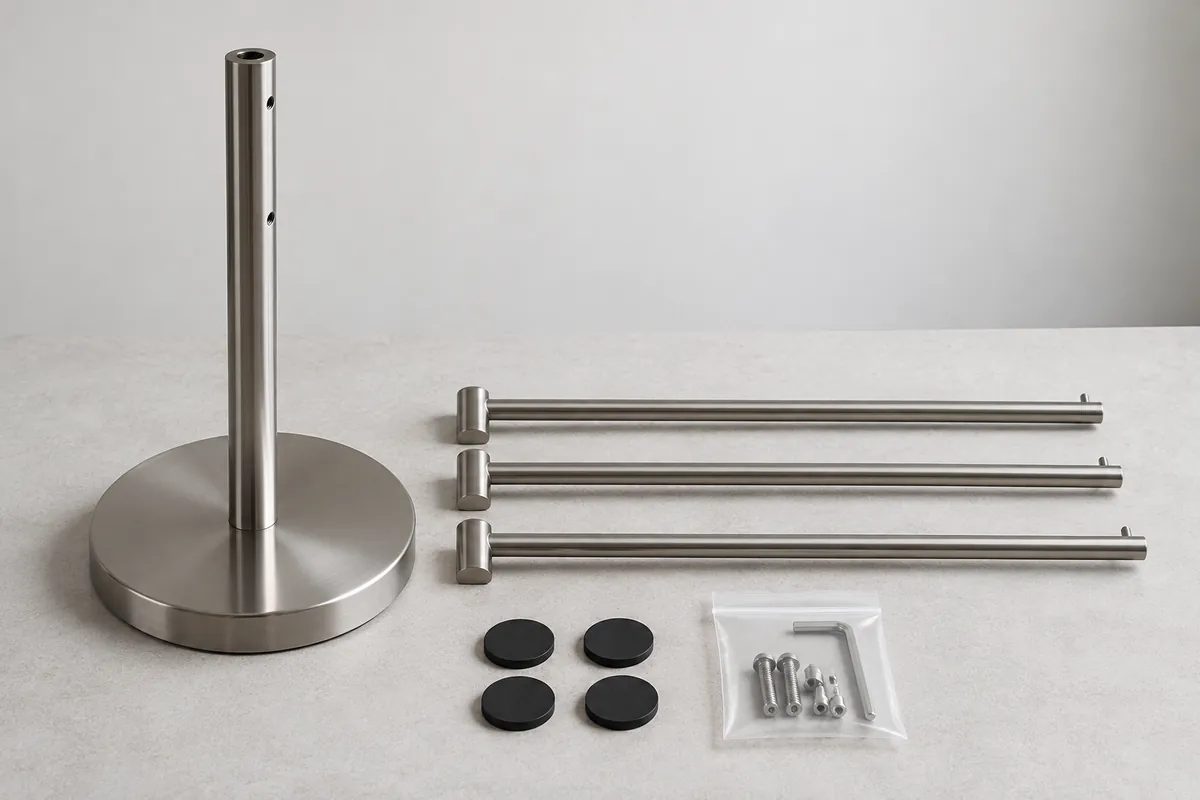
The buyer should decide whether the product ships assembled or in components. For a knock-down version, list the base, upright, arms, feet, fasteners, tools if included, protective materials and instruction sheet. Match the parts list to the actual sample and to the assembly diagram. If left/right arms or different fastener lengths are used, make their identification clear enough to reduce packing and assembly confusion.
Check how finished surfaces are separated in the package. Arms or base parts that can rub together may need individual protection or a more controlled arrangement, depending on the material, finish, route and packaging design. Review a packed sample: are loose fasteners contained; can the user find the parts; are exposed ends protected; does the carton keep components from moving excessively? A carton that uses less space is not automatically better if assembly parts arrive damaged or the pack becomes difficult to load.
Record the agreed carton dimensions, pack count, marks, label and artwork revision. If the buyer’s distribution plan calls for a package test, define the applicable method and acceptance criteria with the responsible packaging or testing team. Passing one test under one setup does not guarantee that all transport handling will cause no damage. A packaging change should trigger a review when it changes restraint, cushioning, orientation or the product’s packed configuration.
What should be agreed before the purchase order?
Before ordering, connect the quoted model to the approved sample and controlled specification. Identify the finish, material, arm configuration, base, feet, hardware, instructions, carton and any performance evidence required by the buyer. Confirm which elements are fixed and which may be changed only with written approval. If the supplier is proposing an alternate part, ask for a revised drawing or record that clearly shows the change.
For a private-label range, confirm the SKU mapping across sizes and finishes. Each combination may require its own identification, artwork or packing details. State who supplies branded labels and instructions, who approves artwork, and how corrections are versioned. The product must be recognizable to the receiving team even if multiple near-identical racks share a carton program.
Use a repeat-order check. Before a reorder, compare the current purchase specification against the latest approved revision and ask whether any changes are proposed in material, dimensions, joints, finish, fasteners or packing. If no change is intended, record that the existing revision is being repeated. That small confirmation helps prevent a stale drawing or obsolete carton from silently becoming the next production reference.
A concise sample-approval checklist
- Does the sample correspond to a named SKU, revision and finish reference?
- Are overall dimensions, arm positions and base footprint recorded?
- Have representative towels been placed in the intended arrangement?
- Can towels be placed and removed without unwanted interference?
- Does the stand fit the planned floor area and access direction?
- Are joints, fasteners, feet and visible surfaces consistent with the approved design?
- Does assembly follow the supplied instruction and parts list?
- Are all parts, labels, carton and artwork tied to a revision?
- Are load, stability or other product claims supported by agreed, configuration-specific evidence?
- Are change approval and reorder checks defined?
For the importer, the purpose of a freestanding towel rack buyer specification is to make fit and approval repeatable: define the intended towels, measure the product envelope, examine the base and complete sample, and lock down the packed version. It gives the buyer and supplier a shared document without pretending that a single dimension or generic product listing predicts every bathroom or product outcome.
For a related project, share the drawing or physical reference sample with Koitor. The custom bathroom towel-rack manufacturer page covers supplier-intent questions, while this article focuses on the buyer’s freestanding product dimensions and sample approval.
Prepare a Freestanding Rack Sample Review
Share the target towel sizes, room footprint, preferred arm arrangement and sample questions. Keep the required product features separate from points still open for review.
Fabrication pour compte de tiers / Marque de distributeur
Transformez ce guide d'approvisionnement en cahier des charges
Indiquez-nous le produit souhaité, ses dimensions, sa finition, la quantité commandée et vos exigences en matière d'emballage. Votre équipe recevra une analyse pratique de la faisabilité de la fabrication avant l'établissement du devis.
 English
 Español
 Português
 Français
 Deutsch
 العربية