

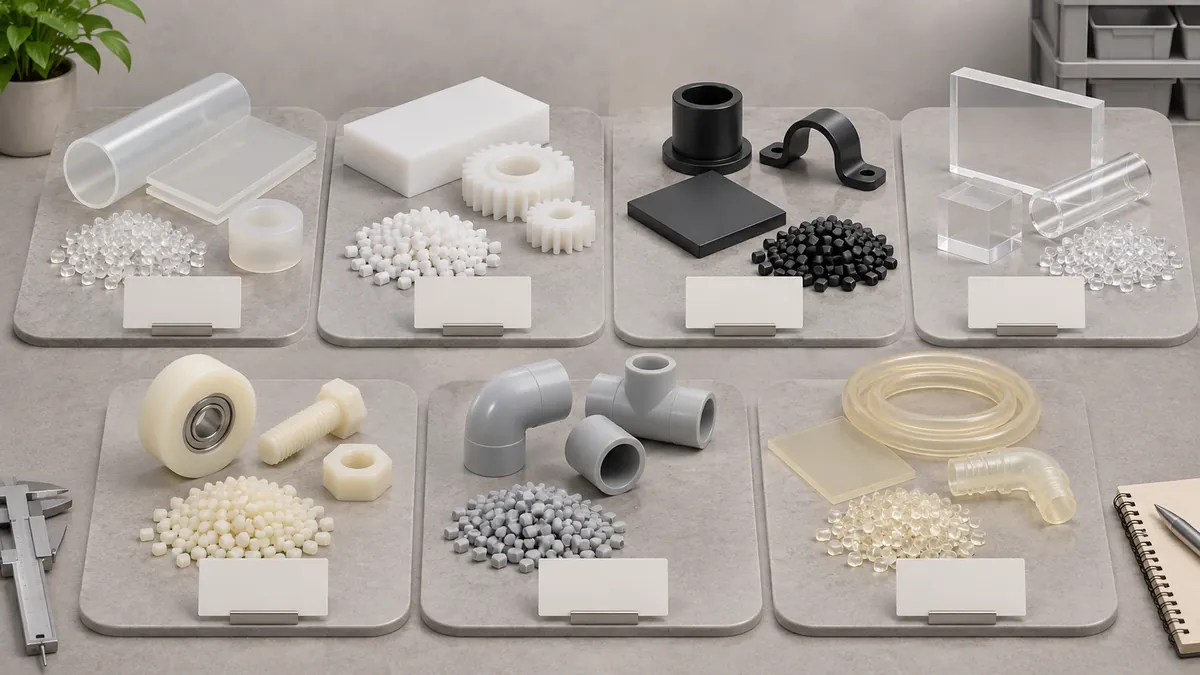
The 7 types of plastics list is a resin identification grouping, not a complete catalog of polymers and not a ranking of safety, strength, recyclability, or quality. The groups commonly associate code 1 with PET, 2 with HDPE, 3 with PVC, 4 with LDPE, 5 with PP, 6 with PS, and 7 with other resins. The code helps identify a broad resin family; it does not fully describe a compound or finished product.
For an importer buying bathroom or home-storage hardware, this distinction matters when a plastic pad, cap, insert, packaging item, or accessory is part of a product. The code on a package should not be treated as proof that a local collection program accepts the item or that the finished component meets a particular performance or regulatory requirement. Specify the exact part, material information, application, and evidence needed.
7 types of plastics: what the groups identify
The 7 types of plastics are a way to identify the broad resin category associated with a marked item. ASTM International’s public description of D7611/D7611M states that resin identification is intended to identify resin type and distinguishes this purpose from a recycling code. The system does not mean that every article with a particular number is collected, accepted, or recycled in every locality.
| Group | Common resin-family association | What a buyer should remember |
|---|---|---|
| 1 | PET or PETE: polyethylene terephthalate | A family identifier; the finished product still has its own form and use requirements. |
| 2 | HDPE: high-density polyethylene | Does not specify additives, grade, colorant, or finished-part performance. |
| 3 | PVC: polyvinyl chloride | The family label does not establish formulation or suitability for a specific use. |
| 4 | LDPE: low-density polyethylene | Do not confuse the resin-family label with a complete material specification. |
| 5 | PP: polypropylene | Compound, reinforcement, color, and processing details may remain unknown. |
| 6 | PS: polystyrene | The code does not mean that every PS article is expanded foam. |
| 7 | Other resins or combinations outside groups 1–6 | It is a broad residual group, not one specific polymer. |
These associations are a basic orientation. The grouping is not a material grade chart, and it does not contain enough information to compare two components for load, impact, temperature, chemical exposure, aging, or fit. It also should not be used to infer that all items in a group share one recycling pathway.
The seven resin identification groups
Group 1: PET or PETE
Group 1 is commonly associated with polyethylene terephthalate. The identification can help a user distinguish the broad resin family, but it does not tell a hardware buyer the exact grade, additives, colorants, wall thickness, manufacturing process, or mechanical properties of a separate component. Packaging, molded parts, and films may use different specifications even if the family label is related.
If a supplier offers a PET component, ask for the exact product specification and application evidence needed. Do not assume that a resin code on retail packaging applies to every part inside the package or to an assembly that combines several materials.
Group 2: HDPE
Group 2 is commonly associated with high-density polyethylene. A buyer should not turn the abbreviation into a universal claim about strength, durability, chemical resistance, or suitability for a particular bathroom environment. Actual performance depends on the grade or compound, part design, manufacturing process, and use conditions.
For a bought-in cap, insert, or packaging part, specify dimensions, fit, color, intended use, and any relevant environmental requirement. If the supplier proposes a material substitution, compare the actual designation and supporting evidence rather than approving “HDPE” as though it defined every property.
Group 3: PVC
Group 3 is commonly associated with polyvinyl chloride. This broad family name does not establish whether a particular item is rigid or flexible, what additives are present, or whether it meets a specific market or application requirement. A buyer should avoid assuming that all products in the group have the same formulation or behavior.
If a PVC part is considered for a product, identify the relevant component and request the specifications and evidence appropriate to the use. Any customer or regulatory restrictions need a project-specific review by the responsible compliance specialist; the resin identification group is not a compliance certification.
Group 4: LDPE
Group 4 is commonly associated with low-density polyethylene. Use the corrected family name rather than expanding LDPE as “light-density” plastic. The broad identification does not reveal the full compound, thickness, processing condition, or product function.
For packaging film or a protective part, define the physical requirement that matters: dimensions, thickness, protection function, fit, or appearance. Ask the packaging or component supplier what evidence supports that requirement. The group number alone cannot verify a shipment-protection outcome.
Group 5: PP
Group 5 is commonly associated with polypropylene. As with the other groups, the label does not specify every additive, blend, reinforcement, pigment, or processing detail. It is not a quality grade and does not prove that a part will perform under a specific load or environment.
When PP appears in a hardware assembly, identify the exact item and its purpose. A polymer pad, spacer, clip, or packaging insert may have different design constraints. Confirm how the component mates with metal parts and what fit or function should be checked on the sample.
Group 6: PS
Group 6 is commonly associated with polystyrene. It should not be treated as a synonym for every expanded foam product. A buyer should distinguish resin family from the physical form and use of the actual item.
If a protective insert or molded part uses a PS-family material, the packaging or product supplier should describe its construction and intended function. A code alone does not show the shape, density, cushioning behavior, or whether it is accepted by a local recycling service.
Group 7: Other
Group 7 groups resins outside the first six categories and can also be used for certain combinations or materials as defined by the applicable identification system. It is not a specific resin and cannot be interpreted as one exact composition.
If an item carries group 7, the buyer should request the actual material name or specification from the supplier when that information matters. The code is not enough to assess performance, chemical content, compliance, or recovery options. Never treat “other” as a substitute for disclosure when the product requirement needs material identity.
What the code does not tell you
It does not describe a complete compound
Commercial plastic compounds can include additives, colorants, fillers, reinforcements, or other constituents. A resin-family code does not disclose all such details. If a component specification depends on them, ask the supplier for the material designation or declaration that addresses the relevant requirement.
It does not establish a finished component’s performance
Performance depends on more than the general resin family. Geometry, thickness, process, assembly, temperature, exposure, use cycles, and supplier controls may all matter. Do not convert the group number into an unsupported claim about strength, durability, chemical resistance, or service life.
It does not settle recycling acceptance
The identification system’s purpose is not identical to a local collection or recycling decision. Acceptance may depend on local infrastructure, item form, sorting rules, labels, size, contamination, and the service provider’s criteria. Check the relevant local program or packaging guidance instead of claiming recyclability from a number alone.
It does not identify every part in an assembly
A product can combine metal, polymer, elastomer, adhesive, and packaging. A code on one container or component cannot be generalized to all materials in the assembly. Identify which physical item is marked and who supplied it.
It does not prove a product is safe or compliant
A resin identification symbol is not a certificate, test report, or regulatory approval. Food contact, electrical, medical, child-use, chemical, or other regulated claims require the applicable product-specific evidence and review. Do not use a code as a shortcut for those checks.
How to specify a plastic component for hardware
Identify the part and its function
Name the component: for example, a wall-contact pad, tube end cap, spacer, clip, sleeve, protective film, or packaging insert. State how it contacts the rest of the product and what it is expected to do. Avoid specifying only “plastic component” if fit or function depends on a particular shape or material.
Separate resin family from exact material
If a broad family is sufficient for an early conversation, label it as preliminary. If the design needs a particular compound or grade, specify the exact designation and require approval for alternatives. Ask the supplier to clarify a group 7 material when the buyer needs more precise identification.
Provide geometry and interface details
For a molded or formed part, provide dimensions, tolerances, mating surfaces, assembly direction, and relevant clearances. Identify the metal component it contacts and the approved product revision. A material family cannot fix a drawing that has insufficient dimensional or interface information.
Define the required evidence
Decide what evidence is needed for the actual attribute: sample fit, dimensional inspection, supplier declaration, test record, or independent review. Each record should identify the part, material, revision, and lot or production scope as appropriate. Do not request evidence that does not address the question, and do not assume a single document verifies every requirement.
Review packaging separately
When plastic is used as protective packaging, describe the shipment hazard and the function expected from the insert, film, or bag. Review the actual pack-out and ensure the product is restrained and protected as intended. A resin code is not proof of drop-test performance or transit protection.
Apply the classification to a real purchase file
Consider a hypothetical wall-mounted metal organizer that includes a polymer wall pad, a protective film, a bag of mounting components, and a printed carton. The buyer should not try to assign one resin code to the whole kit. First identify the individual component and ask what information is needed for its purpose. The wall pad may need a specified geometry and interface; the film may be packaging; and the carton may be subject to separate customer artwork or labeling requirements. Those elements may be supplied by different vendors and may have different records.
A simple part schedule can help:
| Item | Function | Material information to request | Evidence owner |
|---|---|---|---|
| Wall-contact pad | Separates or protects the product at a defined interface | Exact material, dimensions, hardness or other project-defined property if needed | Component supplier and buyer’s product owner |
| Protective film or bag | Protects the finish during handling or transit | Film type and packaging specification relevant to the pack-out | Packaging supplier and buyer’s packaging owner |
| Printed retail carton | Identifies and presents the saleable item | Board, artwork, label, and buyer-approved package specification | Packaging supplier and retailer or brand owner |
| Metal frame | Main structural product assembly | Metal grade, finish, drawing, and agreed inspection criteria | Hardware manufacturer and buyer’s quality owner |
The table is a coordination example, not a prescribed material or evidence package. The buyer decides which characteristics are critical and who is qualified to verify them. The manufacturer can help identify the parts and how they are assembled, but a supplier should not be assigned authority for claims outside its confirmed scope.
When a resin identification mark appears on a package, record the package component and the source of the marking. If the buyer intends to make an environmental claim, confirm its basis and local scope separately. The presence of a symbol does not establish actual recycling access, collection acceptance, recycled content, biodegradability, or a quantified environmental benefit. These claims require their own evidence and review.
For a repeat order, preserve the part number, approved specification, sample, package configuration, and any supplier declaration that was accepted. If a component or packaging vendor changes, determine whether the new material or mark requires review. Do not treat a visually similar substitute as identical when the buyer’s specification relies on exact material, fit, or claim wording.
When the code is missing or unclear
Not every small plastic part is marked, and a mark may be hard to see, covered by assembly, or inappropriate for the item’s size or form. A buyer should not invent a code from appearance. Ask the component supplier for the material name and any applicable identification documentation. If the supplier cannot identify the resin and material identity is important, record that as an unresolved requirement and involve the product owner before approval.
If a mark contains a number without a clear surrounding context, confirm that it is a resin identification mark and identify the piece it applies to. Numbers may also be part numbers, cavity identifiers, dates, or other manufacturing marks. A mark’s shape and location can help, but visual interpretation alone should not be treated as definitive product documentation.
When a component has multiple layers or a mixed construction, a single family number may not describe all layers. Request a supplier explanation of the construction. If the buyer’s claim or market requirement depends on the total package or a specific layer, obtain the evidence appropriate to that claim from the responsible party.

Common interpretation errors
Calling the seven groups seven grades
They are broad identification groups, not a comparable set of product grades. The number alone does not rank quality or performance.
Treating group 7 as one material
“Other” is a broad residual category. Request a specific material description when the purchase decision depends on what the item is made from.
Calling every PS item Styrofoam
Group 6 identifies a polymer family. It does not mean every PS article is expanded foam or that the trade name describes every product.
Assuming a marked package is locally recyclable
The resin identification label does not promise that a local service accepts the item. Check current local collection guidance for the specific item and packaging configuration.
Applying one component’s code to the entire product
Markings should be tied to the physical piece they identify. For a multi-material product, use a part list or materials declaration that names each relevant component.
Coordinate resin information with the BOM
When plastic appears in a metal hardware product, the BOM should identify the part and the supplier responsible for it. A buyer may use a resin-family name in an early concept, but the released specification should be more precise if performance, market rules, customer claims, or repeat-order control depend on the material. Keep the resin code, commercial material designation, color, part number, and revision in separate fields so that one does not stand in for another.
For a purchased pad or clip, confirm the sample against the metal interface. Check that the component is the correct shape, is installed in the intended direction, and does not interfere with assembly or packaging. If the buyer has defined a fit or function requirement, record the result and identify who approved it. A family code cannot verify dimensions or assembly fit.
If the supplier changes the resin, compound, pigment, or manufacturing source, ask whether the change affects the approved requirements. The responsible product owner should decide what checks to repeat. The material code alone may remain the same even when a compound or component changes; therefore, change-control records need more detail than a resin group number.
Packaging teams should also distinguish product components from protective packaging. A sleeve or insert can be chosen for handling or shipment, while a pad or end cap may remain with the saleable product. The classification and any environmental claim should match the actual disposal route and local guidance. A resin identification mark is only one input to that review and should not be presented as proof of environmental benefit.
Buyer checklist for polymer and packaging information
Before approving a plastic part or package, ask:
- Which exact physical part does the resin identification mark refer to?
- Does the number identify only a broad resin group, or is a grade also provided?
- What is the supplier’s exact material designation or compound description?
- What function, interface, dimensions, and environment must the part satisfy?
- Which property is critical, and what evidence verifies that property?
- Does the evidence identify the same part, revision, and lot as the delivered item?
- Does the assembly contain other materials that need separate identification?
- Is a recycling claim being made, and has the local service confirmed acceptance?
- Are any customer or market requirements applicable, and who owns their verification?
- Are website, package, and sales claims limited to what the evidence supports?
This checklist helps purchasing, product, packaging, and quality teams ask consistent questions. It does not replace a material specification or a jurisdiction-specific review. If a requirement is regulated or safety-critical, get the exact product scope and evidence reviewed by the qualified specialist responsible for that decision.
Foire aux questions
What are the seven types of plastics?
The familiar groups associate 1 with PET, 2 with HDPE, 3 with PVC, 4 with LDPE, 5 with PP, 6 with PS, and 7 with other resins. These are broad resin identification groups, not a complete polymer catalog.
Does the number tell me whether plastic is recyclable?
No. The code identifies a resin group; local collection and processing acceptance are separate questions. Check the relevant local program for the actual item.
Is number 7 one specific plastic?
No. It is a broad “other” grouping, so the specific resin or construction must be confirmed separately where it matters.
Does a resin code show material safety?
No. It is not a safety approval or compliance certificate. Use product-specific evidence for the intended application and market.
Does group 6 always mean foam?
No. The family association is polystyrene, but the identification number alone does not state whether the item is expanded, molded, or another form.
Sources and scope
- ASTM International, D7611/D7611M-26 — public scope used for the bounded purpose of resin identification, not as a complete reading of the paywalled standard or a legal labeling instruction.
- Placon: 7 Types of Plastic — used for common family associations only; broad recycling, safety, temperature, and performance claims are excluded.
This article is an identification and specification guide, not a plastics engineering opinion, recycling determination, compliance certification, or claim that Koitor compounds or molds every polymer mentioned.
Collaborez avec Koitor Hardware
Specify the part, not just its resin number
If a custom bathroom or home-storage hardware product uses a polymer pad, cap, clip, or protective package, send the drawing or sample, part function, interface, dimensions, material requirement, quantity, and pack-out brief. Koitor Hardware is a family-owned custom metal hardware factory focused on bathroom and home-storage products; bought-in polymer materials and their performance must be confirmed for the exact project.
Review a Hardware Component or Packaging Brief
Share the product drawing or sample, polymer part function, metal interface, packaging configuration, target quantity, and confirmed buyer requirements. Koitor can review the manufacturing brief within the verified project scope; material and recycling claims should be confirmed by the responsible supplier and specialist.
Fabrication pour compte de tiers / Marque de distributeur
Transformez ce guide d'approvisionnement en cahier des charges
Indiquez-nous le produit souhaité, ses dimensions, sa finition, la quantité commandée et vos exigences en matière d'emballage. Votre équipe recevra une analyse pratique de la faisabilité de la fabrication avant l'établissement du devis.


 English
 Español
 Português
 Français
 Deutsch
 العربية