
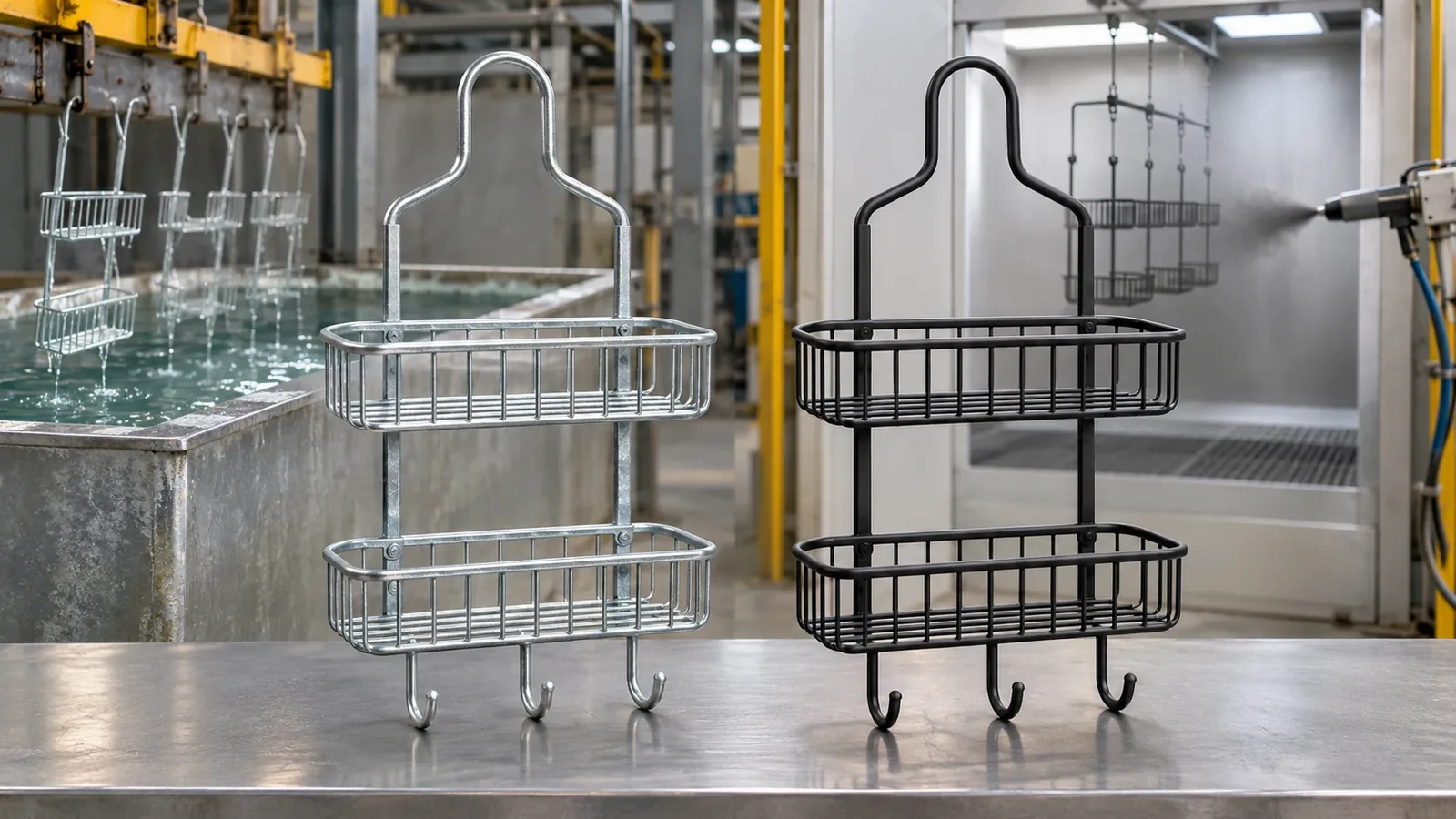
“Galvanized vs powder coated” is not a simple contest between two colors. Galvanizing applies a zinc-based metallic coating to steel; powder coating applies an organic coating material that is cured into a continuous film. The systems differ in what the coating is made of, how it protects the substrate, how it is applied, and what the buyer needs to verify. A third possibility also matters: zinc and an organic topcoat can be used together as a duplex system, so the two terms are not always mutually exclusive.
For bathroom and home-storage hardware buyers, the practical first step is to identify the substrate and the exact route behind each proposal. “Galvanized steel” might describe pre-coated sheet or wire, or zinc applied after fabrication. “Powder coated” might describe a resin and color family but says little by itself about pretreatment, coverage, cure, or the part’s exposure. Request the process description and product-specific evidence before comparing price or appearance. This is the core of a useful galvanized vs powder coated review: compare an identified system with an identified system.
Galvanized vs powder coated: what is being compared?
Galvanizing places zinc on steel. Depending on the method and component, zinc can form a metallic layer that acts as a barrier and can also provide sacrificial, or cathodic, protection to exposed steel under suitable conditions. Powder coating is an organic finishing system: dry powder is applied to a prepared surface and heated so the material flows and cures into a film. A conventional powder layer primarily acts as a barrier and provides the selected appearance and surface characteristics.
These descriptions concern the coating system, not a guaranteed service life. The outcome depends on the base metal, coating method, preparation, geometry, workmanship, exposure, cleaning, damage, and maintenance. A generic comparison cannot tell a buyer how a particular rack, basket, bracket, or fastener will perform in a specific bathroom. It can help the buyer ask the right questions and avoid treating two unlike proposals as if they were identical.
| Question de l'acheteur | Zinc-based galvanized coating | Powder coating |
|---|---|---|
| What is the coating? | A metallic zinc layer on steel | A cured organic coating film |
| What does the system contribute? | Barrier protection and, where the conditions permit, sacrificial protection of exposed steel | A barrier layer plus a chosen color and surface appearance |
| What process detail matters? | Whether the steel was pre-coated or the fabricated part was galvanized, and how edges or joints are handled | Substrate preparation, powder formulation, application coverage, cure and part geometry |
| Is the term enough to approve a sample? | No; identify the coating route and specification | No; identify the coating system and approval criteria |
The table gives a decision framework, not an engineering selection for every product. Zinc layers and organic coatings have different mechanisms. If a supplier describes a product as “galvanized powder coated,” ask whether it is a designed zinc-plus-organic stack, a pre-coated substrate with a later finish, or simply an informal description. The written specification should state the layer sequence clearly.
How zinc protection differs from a powder film
Zinc and steel have different electrochemical behavior. In appropriate conditions, zinc can corrode preferentially to protect exposed steel at a local defect. That does not mean a galvanized product is immune to corrosion, that any scratch is harmless, or that the zinc will protect every geometry indefinitely. Its effect depends on the coating, available zinc, defect size, environment, drainage, and the surrounding design.
Powder coating works differently. A cured film separates the metal surface from its environment. The barrier can be useful only where the coating is properly applied and remains sufficiently continuous for the use. A pinhole, cut edge, damaged corner, trapped moisture location, or poorly covered joint can change the local condition. This is not a reason to dismiss powder coating; it is a reason to define what areas matter and how the part will be inspected.
The mechanisms explain why the two systems can be combined. A zinc layer may supply one kind of protection while an organic topcoat adds another barrier and the desired finish. The American Galvanizers Association describes duplex systems as a zinc coating combined with paint or powder coating. Combining layers introduces its own requirements: compatibility, surface preparation, coating sequence, adhesion, cure conditions, and inspection criteria need to be defined by qualified parties for the actual system. A duplex label alone does not prove that those requirements were met.
Identify the galvanizing route before comparing a quote
The word “galvanized” can refer to more than one supply route. Steel sheet or wire may receive zinc coating before it is formed into a product. Alternatively, a fabricated component or assembly may be galvanized after fabrication, depending on its size, design, material and supplier capability. Those routes can leave different conditions at cut ends, welds, holes, bends, enclosed spaces and contact points.
For pre-coated sheet or wire, downstream cutting and joining can expose areas that were not coated in the original coil or wire surface. The buyer should ask how the product design and supplier process address those areas. For a fabricated-part galvanizing route, the buyer should ask which surfaces are included, how drainage and venting are handled where relevant, and what dimensional or cosmetic changes the process may introduce. These are route-specific questions, not universal defects.
The distinction also matters for procurement. A quote that says “galvanized steel basket” may be describing the base material rather than a post-fabrication treatment. Another quote may refer to a zinc finish applied to the completed assembly. Before comparing cost, obtain the substrate specification, the galvanizing route, the sequence relative to forming and welding, and the acceptance requirements. If the product is later powder coated, record whether powder goes over the zinc layer and what preparation is specified.
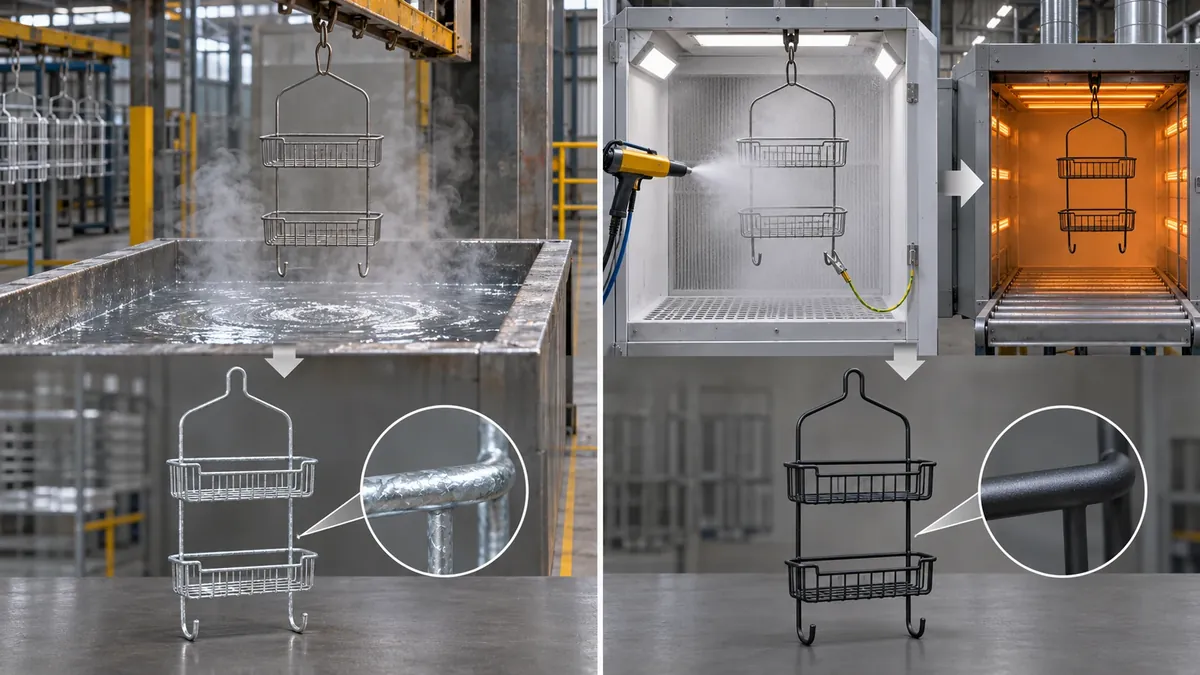
What a powder-coating description should include
“Powder coated” is not a complete specification. Ask for the coating family or approved product, color and gloss reference where relevant, substrate, pretreatment or surface-preparation route, coverage expectations, cure requirements, and the areas that will be judged visually. A supplier may not be able to disclose proprietary formulation details, but the buyer still needs enough controlled information to approve a defined system and repeat it on later orders.
Part geometry affects what can be coated and inspected. Wire intersections, basket corners, inside faces, narrow gaps, hooks, tube ends, holes, threaded features and assembled interfaces can present different coverage or masking conditions. A sample should represent the actual construction and finish, not just a flat panel. If the design changes after sample approval—such as a new wire spacing, weld location, edge, or assembly sequence—the buyer should decide whether the finish review must be repeated.
Do not assume that a uniform appearance proves the coating has the intended properties. Color, gloss and texture are visible characteristics. Adhesion, thickness, cure, chemical resistance and corrosion behavior require the specified test or process evidence. A visual inspection is useful for appearance and obvious damage, but it cannot certify hidden performance. Keep appearance approval and technical validation as separate decisions.
When buyers may consider each system
Selection should start with the product, exposure and acceptance needs—not a claim that one coating is always superior. A zinc-based route may be considered when the substrate and design require zinc protection and the selected process is compatible with the component. Powder coating may be considered when the project needs a specific color, surface appearance, or an organic barrier layer. A duplex system may be considered when there is a reason to combine a zinc layer and an organic finish and the supplier can define a compatible, validated sequence.
For a bathroom product, map the actual environment. A dry vanity cabinet, a ventilated guest bathroom, a frequently splashed shower area, and a humid coastal property do not necessarily impose the same conditions. Record water exposure, cleaning products, contact time, ventilation, installation location, handling and expected maintenance. Do not turn “bathroom use” into a single universal corrosion category.
Also separate coating choice from base-metal choice. The coating does not convert a steel substrate into stainless steel, and a coating name does not identify the steel grade. If material identity matters, specify and verify it separately. A stainless-versus-galvanized substrate comparison is a separate question from zinc-versus-powder coating.
A practical decision matrix for buyers
Before requesting samples, write down what the coating must do for the product. The matrix below turns a broad finish preference into reviewable inputs. It should be completed with the responsible technical and quality teams; it is not a substitute for their specification or acceptance authority.
| Decision area | Buyer records | Supplier or technical reviewer confirms |
|---|---|---|
| Substrate | Base material and any required grade evidence | Available material documentation for the supplied part |
| Route | Pre-coated stock, post-fabrication galvanizing, powder only, or a defined layer stack | Actual production sequence and any route limitations |
| Exposure | Location, splash or humidity, cleaning and handling | Whether the proposed system has relevant evidence for the stated conditions |
| Appearance | Reference sample, color, gloss, texture and visible faces | Sample method, variation limits and visual inspection points |
| Geometry | Welds, edges, recesses, holes, threads and contact areas | Coverage, masking, drainage or assembly considerations |
| Validation | Required test method, sample size, acceptance criteria and report owner | What testing or records are available and what they demonstrate |
| Contrôle des modifications | Approved drawing, finish revision and reference sample | How material or process changes will be notified and approved |
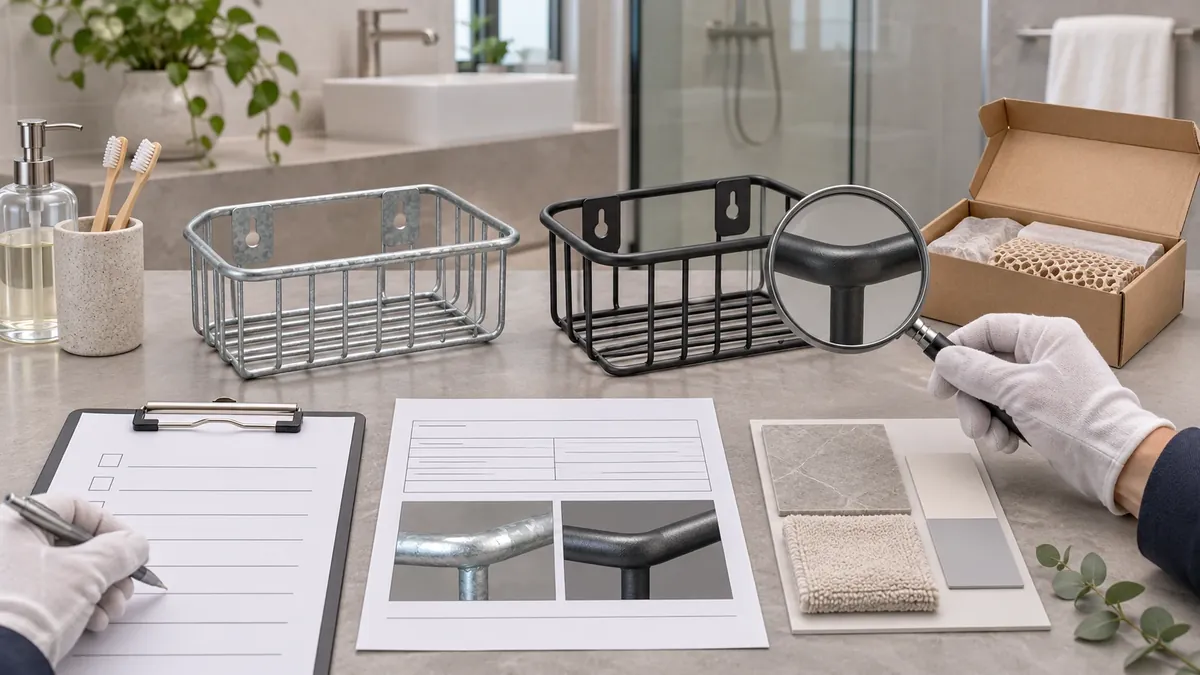
If a quotation leaves one of these fields open, mark it as an assumption rather than treating the item as included. Ask the supplier to identify exclusions, additional operations and any feature that needs engineering review. A buyer can then compare like-for-like scope instead of choosing a low price that may not include the same treatment or evidence.
How to review samples and production evidence
Start with sample identity. Label the sample with the product drawing revision, material or substrate designation, coating route, color reference, date and approving parties. A finish chip can help with color selection; it does not represent a complex wire product’s coverage, weld areas, inside corners or assembled interfaces. A product sample is more informative when it follows the intended production sequence.
Define visual inspection zones. For example, the buyer may distinguish front-facing surfaces, underside, mounting interfaces and hidden contact areas. Record acceptable appearance characteristics and examples of conditions that require review. Avoid vague requirements such as “perfect finish” without an agreed method. A supplier cannot reliably apply a subjective expectation that the two parties have never defined.
For technical evidence, ask what was tested, on which substrate and coating route, using what method, under what conditions, and against what acceptance criteria. A test on a flat panel may not represent a welded basket. A test report for one formulation does not automatically apply to another. Salt-spray hours, coating thickness or a supplier’s general brochure cannot be translated directly into a guaranteed product life without a validated basis for that conclusion.
When incoming goods arrive, compare identity, packaging, visible finish and quantity against the approved sample and documents. Where the plan calls for measurements or other checks, use the agreed method and equipment. Record defects with location and context. If a concern appears, quarantine or escalate according to the buyer’s quality process and obtain a technical disposition. Do not infer the coating mechanism from a photograph alone.
Can powder coating be applied over galvanized steel?
Yes, a zinc coating and a powder coating can be combined as a duplex concept. Whether a specific combination is suitable depends on the zinc route, the powder system, preparation, design and process controls. The coating supplier or qualified process owner should specify the preparation and compatibility requirements. The buyer should not invent a surface-treatment recipe from a generic article or assume that every powder can be applied directly over every galvanized surface.
The project specification should identify the full layer stack. For example, it can distinguish the steel substrate, zinc layer, preparation step, organic coating system and visual reference. It should also state which supplier owns each operation and which records are required. If several suppliers handle material, fabrication, galvanizing and powder coating, document transfer points and responsibilities to prevent assumptions from being lost between purchase orders.
The layered approach can affect thickness, dimensions, fit, threads and contact surfaces. Include the complete finish stack when checking clearances, holes, mating parts and assembly. If the component is installed with a tight tolerance, confirm that the combined layer thickness is considered in the design and inspection plan. Where the buyer needs a particular corrosion or adhesion result, define the test on representative samples and agree on the acceptance criteria before production.
Common comparison mistakes
Choosing by color or sample appearance alone
A dark finish can look similar across different coating systems. A metallic surface can also be produced by several different routes. Appearance is one approval dimension, not proof of substrate, coating chemistry, thickness or protection mechanism. Record the actual process and material separately from the visual sample.
Treating the systems as mutually exclusive
Some projects compare stand-alone zinc and powder systems; others may specify both as a layer stack. Ask whether the supplier means “either/or” or “zinc plus powder.” If a combined system is proposed, request the layer sequence and process owner. Do not infer a duplex design from the phrase “galvanized powder coated.”
Assuming a finish name guarantees performance
Neither “galvanized” nor “powder coated” defines every relevant characteristic. It does not automatically establish a corrosion class, coating thickness, chemical resistance, service life, compliance status, or suitability for a particular bathroom. The accepted evidence must match the product and application.
Ignoring fabrication sequence and exposed areas
Cutting, forming, welding and assembly can change the coating condition. Identify when coating occurs relative to fabrication and which areas are subsequently exposed, masked, touched up or inaccessible. A route that suits a flat sheet might not be equivalent for a welded assembly.
Comparing unbalanced quotations
One proposal might include a zinc layer and another a powder finish, but also differ in substrate, pretreatment, packaging or inspection. Build a scope comparison that lists included operations and exclusions. If the difference is unclear, ask for clarification before awarding the order.
Supplier questions to include in an RFQ
- What is the base metal and what documentation identifies it?
- Does “galvanized” mean pre-coated material or a post-fabrication zinc process?
- Is powder coating applied over bare steel or over a zinc layer?
- Which areas are treated, masked, assembled later or otherwise excluded?
- What sample will represent the actual product geometry and process sequence?
- How are appearance, coverage and visible defects reviewed?
- What product-specific test evidence is available, and what does it not establish?
- Who owns each coating stage and any required subcontracted operation?
- How will changes to coating material, source, process or appearance be approved?
- What care, cleaning or installation information should accompany the product?
These questions turn a finish label into an accountable proposal. They also help the buyer distinguish a confirmed supplier capability from a technical assumption. If a supplier cannot provide a particular test, it should state that limitation plainly rather than borrowing a result from an unrelated substrate, color or process.
Keep adjacent decisions on the right page
This article focuses on the coating-system distinction. If the question is whether galvanized sheet or galvannealed sheet is a better substrate for powder coating, that is a different comparison with its own manufacturing route and application constraints. If the question is how pre-galvanized wire behaves after cutting and welding, the relevant issue is the fabrication sequence and treatment of exposed areas. These related pages can share terminology without replacing the zinc-versus-organic-system explanation here.
For incoming wire and cut-end questions, review the relevant manufacturing information with the product supplier. For a product-specific coating and OEM discussion, a buyer can also review Koitor’s home-storage hardware manufacturing context. That page does not establish a particular finish for a project; the actual drawing, sample and specification remain controlling.
Foire aux questions
Is galvanized steel always better than powder-coated steel?
There is no universal winner. Zinc and powder coating protect through different mechanisms and answer different product requirements. Compare the base metal, route, exposure, appearance, geometry and accepted evidence for the actual product.
Does powder coating make steel corrosion-proof?
No. A coating is not a guarantee against corrosion. Coverage, preparation, damage, edges, joints, exposure and maintenance matter. A product-specific claim requires relevant evidence and defined conditions.
Does galvanized steel never rust?
No. Galvanizing provides a zinc-based coating whose behavior depends on its specification and environment. It does not establish immunity from corrosion under every condition or for every defect.
Are galvanizing and powder coating mutually exclusive?
No. A zinc layer and an organic powder coating can be combined in a duplex arrangement. The actual stack and compatible process must be specified and validated for the product.
Is a flat test panel enough to approve a wire basket?
A panel can help assess a coating attribute, but it may not reproduce the basket’s welds, edges, corners, recesses or assembly. Decide whether a representative product sample is needed for appearance and process review.
What should be written on the purchase specification?
Identify the substrate, coating route and sequence, appearance reference, relevant geometry, required evidence, acceptance criteria and change-control process. Name the operation owner where multiple suppliers are involved.
Sources and scope
- American Galvanizers Association: Protective Coatings — supports general context about zinc coatings and protective mechanisms.
- American Galvanizers Association: Duplex Systems — supports the possibility of combining galvanizing with an organic topcoat. It does not establish a product-specific preparation recipe or guaranteed lifetime.
This article is a buyer decision guide, not a coating specification, test report, standards review or guarantee of product performance. Koitor’s confirmed positioning is custom metal hardware manufacturing; the article does not claim that Koitor performs every galvanizing or powder-coating operation described. Confirm project-specific processes and claims with the responsible supplier and technical reviewer.
Collaborez avec Koitor Hardware
Define the substrate and finish stack
Share the product drawing or sample, intended use, substrate information, finish reference, quantity and packaging brief. Koitor Hardware is a family-owned custom metal hardware factory focused on bathroom and home-storage products. The team can review the manufacturing scope for an OEM discussion; coating specifications, technical evidence and acceptance remain tied to the actual project and responsible process owners.
Review a Metal Hardware Finish Brief
Share the substrate, proposed coating sequence, finish reference, product drawing, quantity and exposure conditions to clarify which sample and evidence should be reviewed.
Fabrication pour compte de tiers / Marque de distributeur
Transformez ce guide d'approvisionnement en cahier des charges
Indiquez-nous le produit souhaité, ses dimensions, sa finition, la quantité commandée et vos exigences en matière d'emballage. Votre équipe recevra une analyse pratique de la faisabilité de la fabrication avant l'établissement du devis.

 English
 Español
 Português
 Français
 Deutsch
 العربية