
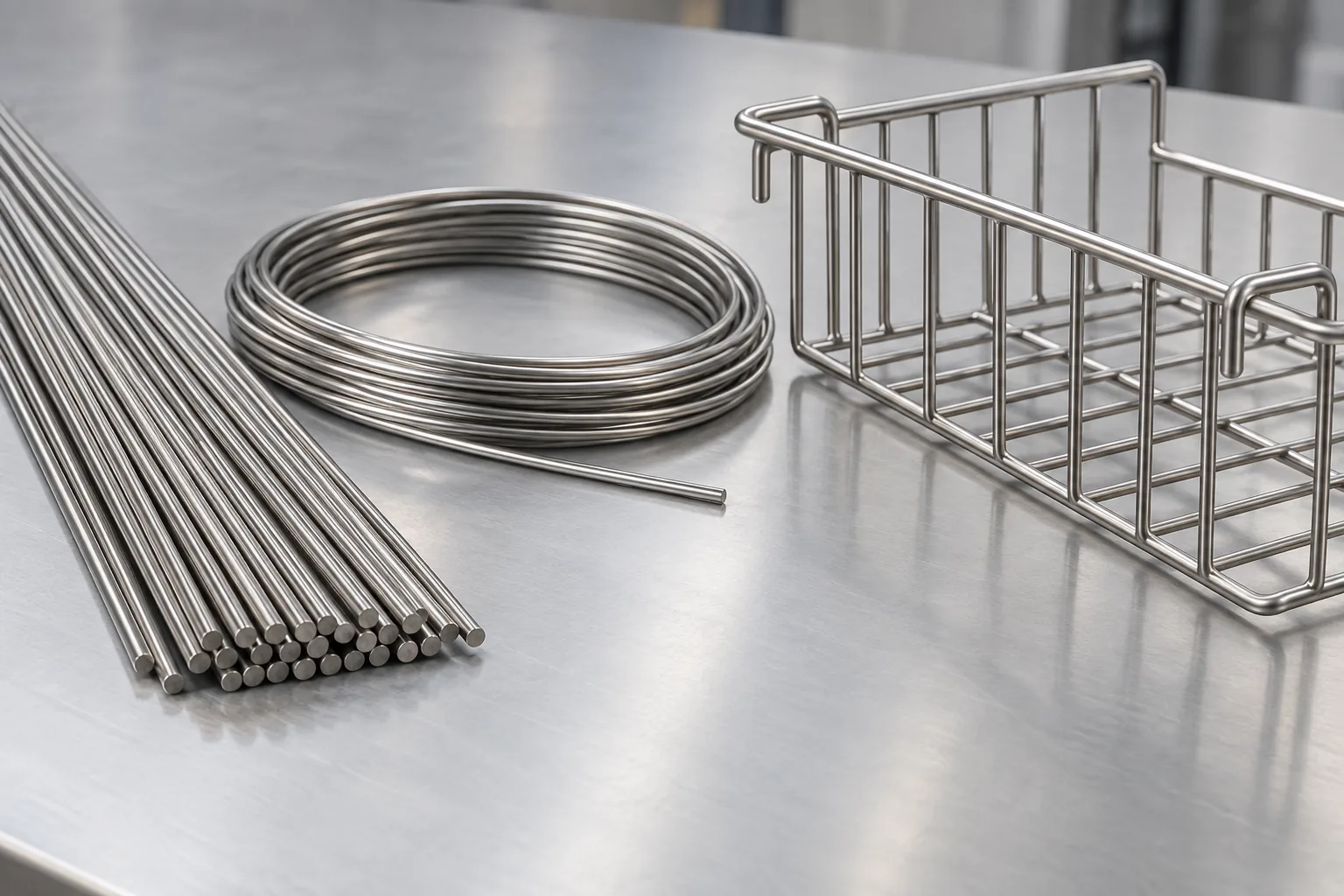
Wire straightening coil set should be reviewed before basket fabrication when incoming wire curvature or twist could affect rail alignment, bend locations, assembly fit or the finished basket’s visual symmetry. Buyers should define how a free sample is released and inspected, identify wire material and size, and agree how much straightness variation the drawing can tolerate. Do not treat a natural curve from a coil as proof of a defective lot—or assume a supplier’s straightener removes every forming effect without a representative trial.
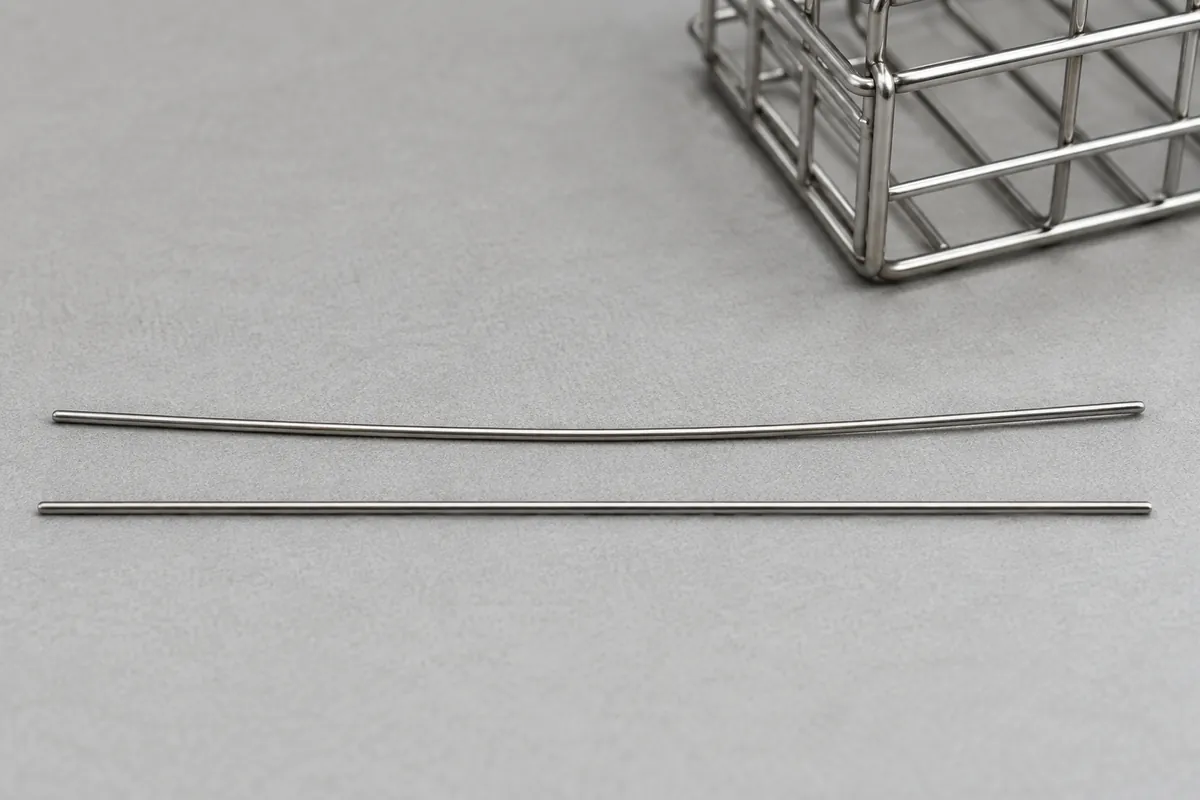
What does coil set look like in incoming wire?
Wire stored or supplied in coil form may retain a tendency to curve when released. A cut length can show a broad bow, a tighter arc, a twist or a combination. The observed shape depends on the wire, coil and handling history, straightening process and sample length. A flat tabletop check can be a useful first observation, but it does not by itself establish the material’s mechanical properties or prove how the wire will behave in a basket-forming operation.
The phrase wire straightening coil set describes two connected but distinct concerns: the incoming wire’s free-state shape and the process used to correct it for a downstream operation. A straight-looking short piece may still twist or drift over a longer length. Conversely, a modest free-state curve may be corrected during a controlled forming route without affecting the finished rail. The buyer should link the inspection to the part feature that matters, rather than impose a generic straightness claim without an application.
In a wire basket, a rail that enters bending or fixture assembly with inconsistent curvature can shift against a stop or create different spring-back behavior across pieces. That can influence the position of cross wires, corner fit or the visual line of a long member. These are potential manufacturing effects to validate on the project sample; they are not a diagnosis or proof that coil set caused a particular defect.
A useful first step is to release an agreed sample length using a documented method and compare it to a defined reference surface or fixture. State whether the check is made before straightening, after straightening or after forming. If the supplier’s process straightens wire inline, record the measurement point and representative production condition. A result without the process state is difficult to interpret or compare between suppliers.
Which material and incoming details belong on the RFQ?
Identify material grade and form, nominal wire diameter or section, supplier, coil or lot reference and any finish requirement. If the wire is stainless or coated, specify the approved material documentation and visible surface condition. Do not use color or magnet response alone as grade identification. The actual material and dimensional range should be confirmed in the purchase specification and tied to the finished basket drawing.
Describe the intended part and critical formed features. Mark long rails, perimeter wires, repeated bends, weld intersections and cosmetic faces. The same amount of initial curve may be insignificant on a short hidden crosspiece but important on a visible front rail. Identify the datum or fixture that controls the finished shape and state the final assembly dimension that the buyer is protecting.
Clarify whether incoming material arrives as a coil, straight cut length or pre-straightened stock. The packaging and payoff method can affect handling before the wire reaches the straightener. Ask the supplier who is responsible for decoiling, straightening, cutting and feeding, and whether the operation is performed internally or by another supplier. These are scope questions; they do not imply a particular machine is owned by Koitor.
If the same wire specification is used in multiple basket sizes, state which part family and feature define the acceptance sample. A design with long unsupported rails may be more sensitive to bow than a compact basket. Do not silently extend a short-part sample approval to a longer version. Record whether the sample covers one SKU, a range of lengths or a specific material and diameter combination.
How can a buyer compare straightening and forming routes?
A supplier may use a straightening unit, controlled feed rolls or another qualified process to correct coil curvature before cutting and forming. The process route should be described at the level needed for the buyer’s quality plan: what is controlled, how the wire is guided, how surface contact is protected and how output straightness is checked. When comparing suppliers, connect wire straightening coil set claims to a sample length, process stage and basket feature rather than an equipment description alone. Machine brand or roller count alone does not prove the finished basket meets its drawing.
Wire can be worked in more than one plane to correct curvature, but a correction that addresses one direction may leave another bow or twist. Supplier guidance from straightening-equipment makers commonly describes the need to manage direction and setup for the wire and application. Buyers should avoid prescribing a roller adjustment or straightener setting unless they own that process engineering requirement and have qualified it with the material and part.
Compare the finished outcome, not just the wire entering the machine. Ask how the process preserves the surface and whether straightened stock remains stable during cut-to-length, bending, forming, welding and handling. A straight length may spring back or move when released from a fixture. Thus, incoming straightness is one input to shape control, not a substitute for checking the final formed rail and assembled basket.
A trial can include the intended wire lot, a representative straight length, key bends and a small assembled basket section. Record the wire condition before and after straightening, the fixture used, the bend sequence and the final alignment. If a different supplier or wire diameter is later used, decide whether that change needs a new trial. Make no assumption that one straightening route is best for all gauges or products.
What sample checks reveal whether coil set matters?
Release a representative wire length without forcing it flat, and inspect it in a stated orientation on a clean reference surface or fixture. Observe broad bow, local kinks, twist and end behavior. If the acceptance depends on a measurement, specify the span, support points, release method and measuring instrument. A visual check may screen for obvious variation, but it cannot create a numeric requirement that the drawing never defined.
Feed the material through the intended straightening and cut process, then recheck a comparable length. Keep samples and records associated with the same lot and process state. If the product uses different straightened lengths, inspect a long piece and a representative short piece where both conditions matter. Avoid drawing conclusions from a hand-held photograph because perspective, gravity and handling can disguise a gentle curve.
Next, form the sample using production-intent stops and tools. Compare bend location, rail-to-rail alignment, end position and assembly fit to the approved drawing. For a basket, use the intended cross wires or frame members at least at one representative section. A material that appears straight before forming may still change behavior when bent; the final part is the buyer’s retrieval target.
Separate material condition from machine or operator setup during the review. If one rail is out of position, check lot identity, initial coil state, straightening condition, cut length, fixture contact and forming sequence before assigning cause. A corrective action should state which variable changed and what evidence supports the conclusion. Do not claim that coil set caused a defect solely because the incoming stock was coiled.
How should buyers write a practical acceptance plan?
State the free-state sample condition and the feature being protected. For example, a buyer might require an agreed length to be released without manual flattening and then checked at a defined span, while the final basket rail is checked against its datum. The actual tolerance should come from the product design, supplier capability and intended appearance. This article does not prescribe a universal straightness limit or test dimension.
Use a comparison table and retain the approved sample ID, wire grade, diameter, supplier lot, straightening route and drawing revision. If a visual standard is used, photograph the sample with a neutral background and identify the viewing orientation. A sample photo can support identification but should not replace a controlled dimension when the dimension is critical to fit or assembly.
Decide the inspection frequency and record format based on risk, volume and process stability. An initial first-article check can answer whether the route works for the design; repeat-lot incoming checks can verify that material and setup remain within the agreed plan. Do not claim a statistical capability index or defect rate unless it has actually been calculated from suitable, traceable production data.
Packaging and storage also belong in the route discussion. Long straight lengths can bend during transport or handling if poorly supported, and coils can be tangled or kinked during payoff. Identify how stock is protected, labeled and staged before fabrication. If damage is found, preserve the incoming condition and lot label before straightening or cutting so the parties can investigate without losing the evidence.
What change-control questions should close before repeat orders?
Identify changes to wire mill or grade, diameter, coating, coil format, payoff method, straightening setup, cutting, forming fixture or basket geometry that require notice. Not every change demands the same requalification. A change affecting only packaging may require a targeted incoming check, while a wire source or section change could affect spring-back and formed alignment. Agree the supplier’s notice and the buyer’s review route before a repeat order is released.
If a corrective action adjusts straightener setup, document the prior and new process conditions, the affected lot and the output comparison. Verify that the change did not introduce surface marks or change the bend response. A successful correction should be checked on the representative formed piece, not merely on wire exiting a straightening head.
Keep material certificates, purchase specifications, incoming records, sample approvals and forming inspection linked by lot and revision. If wire is purchased through a service center or subcontractor, state who holds the source record and who is responsible for notifying the buyer about a material substitution. Traceability is especially useful when a basket family includes multiple wire sizes or suppliers.
Koitor’s approved manufacturing context supports discussion of wire forming, metal fabrication and physical sample review, but it does not establish a specific straightener model or an equipment ownership claim. Confirm the actual route and quality records for a project. The buyer should make the acceptance decision against the drawing, sample and agreed process—not an assumed machine capability.
Incoming wire and formed-part comparison
| Stage | Buyer question | Evidence |
|---|---|---|
| Incoming coil/length | What free-state bow or twist is acceptable? | Lot identity, release method and agreed span check |
| After straightening | Did the route correct the relevant directions without surface damage? | Comparable sample and process state |
| After forming | Do bend position and rail alignment meet the drawing? | Production-intent fixture and first-article record |
| Assembled basket | Does the geometry fit together and look consistent? | Assembly check tied to sample ID and revision |
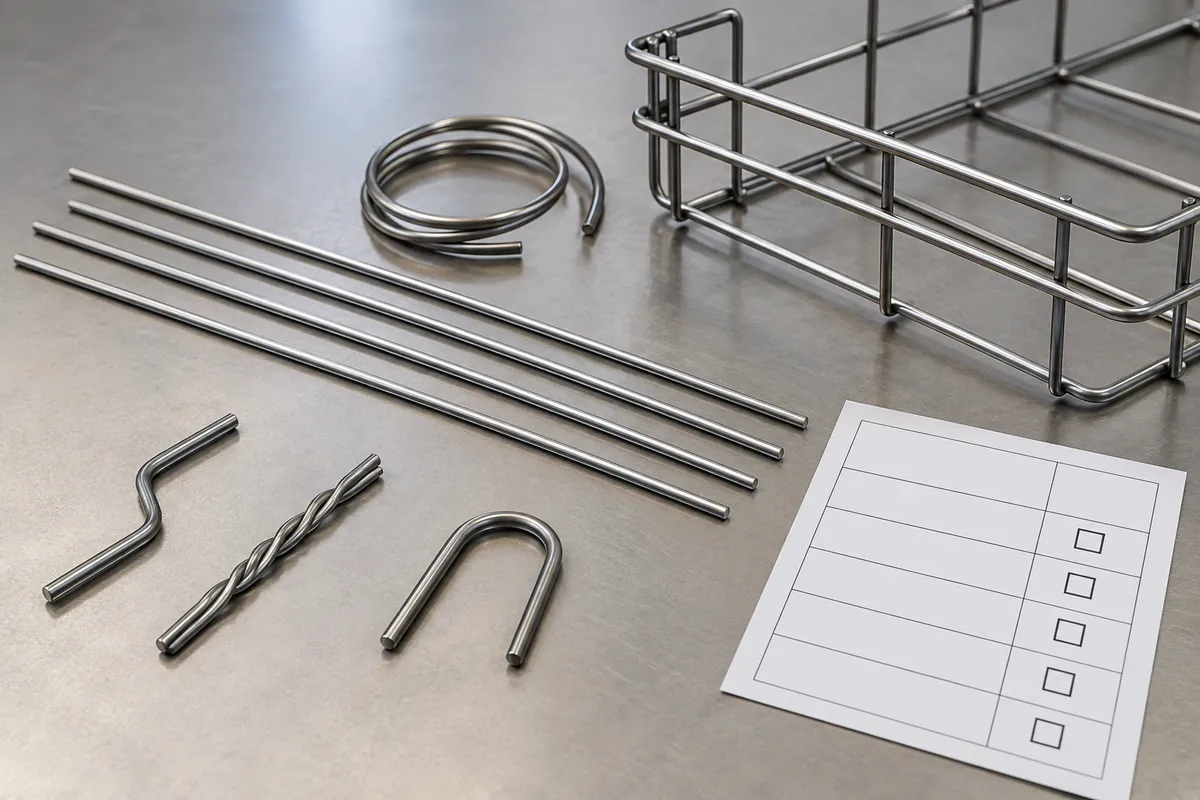
Buyer incoming and sample checklist
- Identify wire material, diameter/section, supplier and coil or lot reference.
- Define how a free length is released and where straightness/twist is checked.
- Separate before-straightening, after-straightening and after-forming observations.
- Trial the longest visible rail, critical bends and a representative basket assembly.
- Record surface condition, fixture, sample ID, drawing revision and open issues.
- Set change notice and resampling triggers for wire source, size and process changes.
Foire aux questions
Is any visible bow in coiled wire a defect?
Not automatically. The acceptance depends on the free-state method and the finished feature that the buyer needs to control.
Does straightening remove all spring-back from a basket rail?
No. Straightening affects incoming curvature, while bending and final geometry have their own material and process behavior. Validate the formed sample.
Can a supplier set a universal straightness tolerance?
A useful limit must relate to the part length, datums, forming route and assembly requirement. Agree the measuring span and method for the project.
Should a buyer inspect raw wire or finished baskets?
Both can answer different questions: raw wire helps screen input condition, while a production-intent formed sample verifies the application outcome.
Does this article confirm Koitor owns wire-straightening equipment?
No. It explains buyer questions and sample evidence. Confirm the actual project route and supplier capability before quoting.
For related wire and metal-basket context, see Koitor’s custom metal storage basket page or contact the team with the wire specification, drawing, target quantities and straightness acceptance question.
Collaborez avec Koitor Hardware
Review a Wire Basket Sample Plan
Share the wire material and size, basket drawing, target order volume and incoming/final checks so the production route and acceptance record can be discussed.
Fabrication pour compte de tiers / Marque de distributeur
Transformez ce guide d'approvisionnement en cahier des charges
Indiquez-nous le produit souhaité, ses dimensions, sa finition, la quantité commandée et vos exigences en matière d'emballage. Votre équipe recevra une analyse pratique de la faisabilité de la fabrication avant l'établissement du devis.
 English
  Español
  Português
  Français
  Deutsch
  العربية