

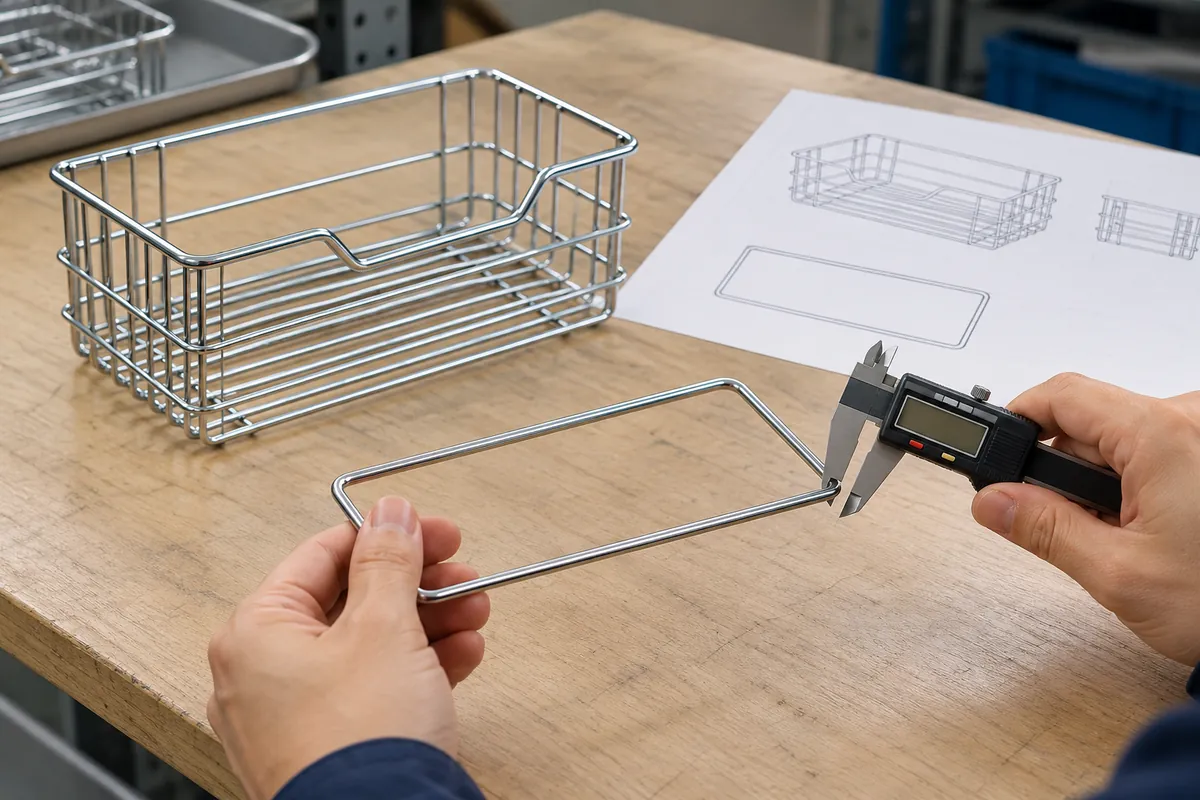
Wire butt welding upset flash dimensional allowance should connect the starting wire length, the joining route and the dimensions required after finishing. A buyer should agree the finished rim requirement first, then ask the supplier to explain how material consumed or displaced during the proposed butt-welding operation is accommodated. Flash removal is a separate finishing decision because it can change the joint’s local profile. Approve identified samples after joining and dressing rather than treating the cut-wire dimension as proof that a finished basket rim will fit.
Which basket joint does this question apply to?
This question applies to an end-to-end joint closing a wire rim or similar component when the supplier proposes a resistance butt-welding route. It does not describe an ordinary crossing between two basket wires. Identify the actual joint before discussing allowance, because different joining arrangements affect material and geometry differently.
For an importer developing a custom wire basket, the closure joint may be visually small but relevant to product size, finish, handling and assembly. A rim can fit a forming fixture before joining yet have a different perimeter or local profile afterward. If a buyer approves the initial component only, the approval misses the condition delivered in the finished product.
Ask the supplier to identify the joining method precisely. Flash butt welding and resistance upset butt welding are related processes but should not be treated as interchangeable labels. The proposed route determines which losses and movements the supplier needs to evaluate. Koitor’s approved resistance-welding capability does not establish that every specialized butt-welding machine or configuration is available; applicability requires project review.
The buyer’s useful decision is whether a drawing, allowance approach and sample plan establish a repeatable finished rim. It is usually unnecessary for a sourcing manager to prescribe an unverified machine cycle. It is necessary to distinguish a proposed manufacturing input from a finished-product acceptance dimension and to establish who owns each.
Keep the manufacturing drawing and the purchase specification connected. If the supplier works from a physical sample, identify its overall rim dimensions and the condition of the closure joint. A sample’s attractive polished surface cannot reveal the original cut length, the joining loss or the thickness left after dressing.
How should cut length and finished size be connected?
Start with the drawing’s finished datums and dimensions, then work backward through the proposed manufacturing stages with the supplier. Cut length is a process input. Finished width, depth, perimeter where relevant, corner geometry and local joint profile are product requirements. They are related, but they are not equivalent measurements.
TWI’s flash-butt-welding design guidance explains that matching cross sections support balanced end heating, that loss of length during flashing matters when finished dimensions are important, and that the parts need suitable clamping and support. It also identifies current shunting as a consideration for ring configurations. These general points justify a supplier feasibility discussion; they do not establish a wire-basket allowance, machine capability or acceptance tolerance.
A useful dimensional chain identifies the starting component, formed condition before closure, joined condition before dressing, and final condition after the intended surface route. The supplier should state where a dimension is measured, which features are held constant, and whether additional correction or sizing is proposed. If a drawing calls for a finished dimension after coating, the sample should represent that condition.
Do not automatically add the same allowance to every wire diameter or material. Geometry, material, process, fixture support and finishing route can change the practical relationship. Ask for the supplier’s basis: development samples, a qualified existing route or a new trial. If the supplier has not evaluated the combination, record the allowance as proposed and leave the production approval open.
Separate perimeter from local dimensions
A closed rim’s perimeter does not by itself establish its width, depth, squareness or corner shape. Two components can have similar total wire length and different envelopes. The joint can also introduce a local mismatch that an overall measurement misses. Specify the features that matter to basket assembly and handling, and avoid substituting a convenient measurement for the buyer’s actual requirement.
For a hypothetical rim that must meet a basket body, confirm the relationship between the rim and body datums. If the rim is a standalone subcomponent, identify whether approval occurs before attachment or in the complete assembly. The example is a planning framework, not a claim about a particular Koitor SKU.
What does flash removal change at the joint?
Flash removal addresses the excess material around a joined region; it does not independently establish joint integrity. A smooth-looking joint can still require examination against the product’s requirements, and a visible upset collar may be acceptable at one stage but unsuitable for the delivered product. Define the inspection stage and final profile explicitly.
Ask the supplier how the local excess will be removed or controlled and which surrounding surfaces could be affected. Grinding or dressing can alter contour, surface texture and the local material remaining. A requirement such as “make the joint invisible” can invite excessive removal unless it is tied to an approved profile and appropriate evidence.
Separate three decisions: whether the joining operation is suitable, whether the local finish is acceptable, and whether the complete rim meets its dimensions. One polished sample photograph cannot answer all three. The buyer should identify the relevant appearance zone, any hand-contact concern and the agreed method for assessing the actual joint.
| Stage or evidence | Buyer question answered | Limitation | Record to retain |
|---|---|---|---|
| Cut-wire measurement | Was the proposed starting length supplied? | Does not establish formed or joined dimensions | Component identity and cut-length record |
| Formed open rim | Does the pre-closure shape fit the planned route? | Closure can change its geometry | Drawing revision and forming condition |
| Joined undressed rim | What is the post-join size and upset profile? | Does not represent the delivered finish | Identified sample and joining stage |
| Dressed joint | Is the final local contour acceptable? | Appearance alone does not prove joint integrity | Finish criteria and suitable joint evidence |
| Finished assembled basket | Does the delivered configuration fit and function? | May conceal the origin of a dimensional error | Final inspection datums and approved sample |
Establish limits before cosmetic rework
Agree which surfaces may be dressed and how the final condition will be reviewed. The appropriate limit depends on material, joint geometry and the product’s function. Do not adopt a universal grind depth, remaining diameter or joint-strength value from an unrelated product. Where a quantified requirement is needed, assign it to the responsible technical party and validate the inspection method.
If a supplier proposes additional straightening or sizing after joining, include that operation in sample approval. It may change the geometry, local surface or production effort. A development sample corrected by hand can still be useful, but the buyer needs to know whether the same correction is part of the intended repeat-production route.

Which samples demonstrate a usable allowance?
Use identified samples that connect each important manufacturing stage to the finished result. The most useful evidence is a traceable comparison using the actual material, wire form, joint preparation, fixture arrangement and finishing route. A sample from a different rim or material may help feasibility discussion, but it cannot establish the new product’s final allowance.
Ask for the sample identity, drawing revision, material condition and measurements at agreed stages. For a development trial, the supplier can explain which starting inputs changed and what effect was observed. The buyer should avoid comparing a single measurement from one sample with a finished-product measurement from another without a clear link.
Representative selection matters. If consistency across a material lot, production run or setup is the concern, agree a plan that addresses that concern. There is no universal sample count in this guide. The plan should be proportionate to the product’s risk, design maturity and purchasing requirements, and it should describe what the results can and cannot establish.
Evaluate the local joint and the overall rim separately. Where integrity evidence is required, choose a suitable method with qualified personnel and relate its acceptance criteria to the product. For dimensions, define orientation, support and datums. For appearance, define the final surface condition and viewing criteria. Preserve these distinctions in the approval record.
Resolve conflicting dimensions methodically
If two parties disagree about finished size, first compare the drawing revision, sample identity, finish stage, datum and support. A measurement of an open rim or an undressed joint is not necessarily comparable to a delivered basket measurement. Clarify the measurement condition before changing the process allowance.
Record the discrepancy and its disposition. If the supplier changes the starting length, rerun the relevant comparison rather than assuming the rest of the dimensional chain remains unchanged. If only the dressing route changes, assess the local profile and any linked dimension. Focused trials help avoid making several changes at once and losing the basis of the approval.
What should an RFQ and repeat-order record contain?
An RFQ for wire butt welding upset flash dimensional allowance should define the finished requirement and ask the supplier to disclose its proposed manufacturing assumptions. This lets buyers compare quotations on the same delivered condition while leaving process development with the appropriate technical owner.
- Product and rim drawing revision or an identified physical reference sample.
- Known wire material, form, diameter and intended finish.
- Exact end-to-end closure location and its product function.
- Required finished dimensions, datums and assembly relationships.
- Proposed butt-welding route and whether its applicability is already evaluated.
- Starting-length allowance basis and development items still open.
- Flash-removal or dressing proposal and appearance-sensitive surfaces.
- Sample stages, measurement methods and required joint evidence.
- Acceptance authority and treatment of deviations or cosmetic rework.
- Changes requiring notice, new samples or renewed approval.
Compare commercial implications after the route is defined
Starting material, setup, clamping, dressing, inspection and possible correction all contribute to the practical cost. Ask which items are included in the quotation and which depend on the final specification. A lower starting-wire price does not establish the lowest cost for a finished acceptable rim. Conversely, a more elaborate route is not justified simply because it produces a smoother photograph.
For a small-batch development program, ask the supplier to distinguish one-time trial or tooling work from recurring production steps. Agree which evidence is needed before committing to further development. Do not infer savings, cycle time or yield from a generic process description; those figures require actual supplier and project evidence.
Keep the approved route usable for repeat orders
Record the approved inputs, samples and final criteria against the product revision. Potential changes include wire material or diameter, joining method, fixture, starting allowance, dressing operation and surface finish. The buyer and supplier should decide which changes affect the approval rather than requiring the same response to every routine adjustment.
Retain the supplier’s explanation of the allowance and the final sample record. If a future batch fails a dimension, the record helps identify whether the starting component, joining stage or final correction needs review. Without it, a familiar-looking basket can be produced through a changed route while the buyer assumes the original approval still applies.
Koitor Hardware is a family-owned custom metal hardware factory supporting bathroom and home storage products, drawing or sample development, resistance welding, grinding, polishing and assembly among its approved processes. A specialized butt-welding configuration and product-specific allowance must be confirmed during project review. Buyers can discuss fabrication sur mesure de paniers de rangement en métal and broader OEM home storage hardware requirements using an actual drawing or sample.
Foire aux questions
Is butt-weld flash the same as spot-weld expulsion?
No. Identify the process and joint before applying terminology. This guide addresses end-to-end wire closure and the local material profile associated with the proposed butt-welding route. A crossed-wire spot joint needs its own evaluation.
Can the supplier use one allowance for every basket rim?
That should not be assumed. Material, wire dimensions, forming geometry, joining route and finishing can affect the relationship. Ask for evidence supporting the proposed allowance on the actual configuration.
Does removing the flash prove the joint is acceptable?
No. Dressing establishes a surface condition. Joint integrity and finished dimensions need the appropriate evidence and agreed criteria. Review the sample after the intended final operations.
What if the supplier cannot perform the proposed butt weld?
Ask for an alternative design or joining proposal, then compare it against the same finished function, dimensions and appearance. Review any changed material, fixture, finish or acceptance evidence before approval.
What is the central purchasing decision?
For wire butt welding upset flash dimensional allowance, approve a documented relationship between the manufacturing inputs and the delivered rim. The buyer needs traceable sample evidence and a defined final condition, rather than an unsupported universal allowance.
Review Your Hardware Drawing and Sample Requirements
Send Koitor the drawing or physical sample, known material and finish, joint location and the approval evidence your buyer team needs. Our family-owned factory can discuss manufacturability and small-batch OEM options; specialized routes and results require project confirmation.
Fabrication pour compte de tiers / Marque de distributeur
Transformez ce guide d'approvisionnement en cahier des charges
Indiquez-nous le produit souhaité, ses dimensions, sa finition, la quantité commandée et vos exigences en matière d'emballage. Votre équipe recevra une analyse pratique de la faisabilité de la fabrication avant l'établissement du devis.

 English
 Español
 Português
 Français
 Deutsch
 العربية