
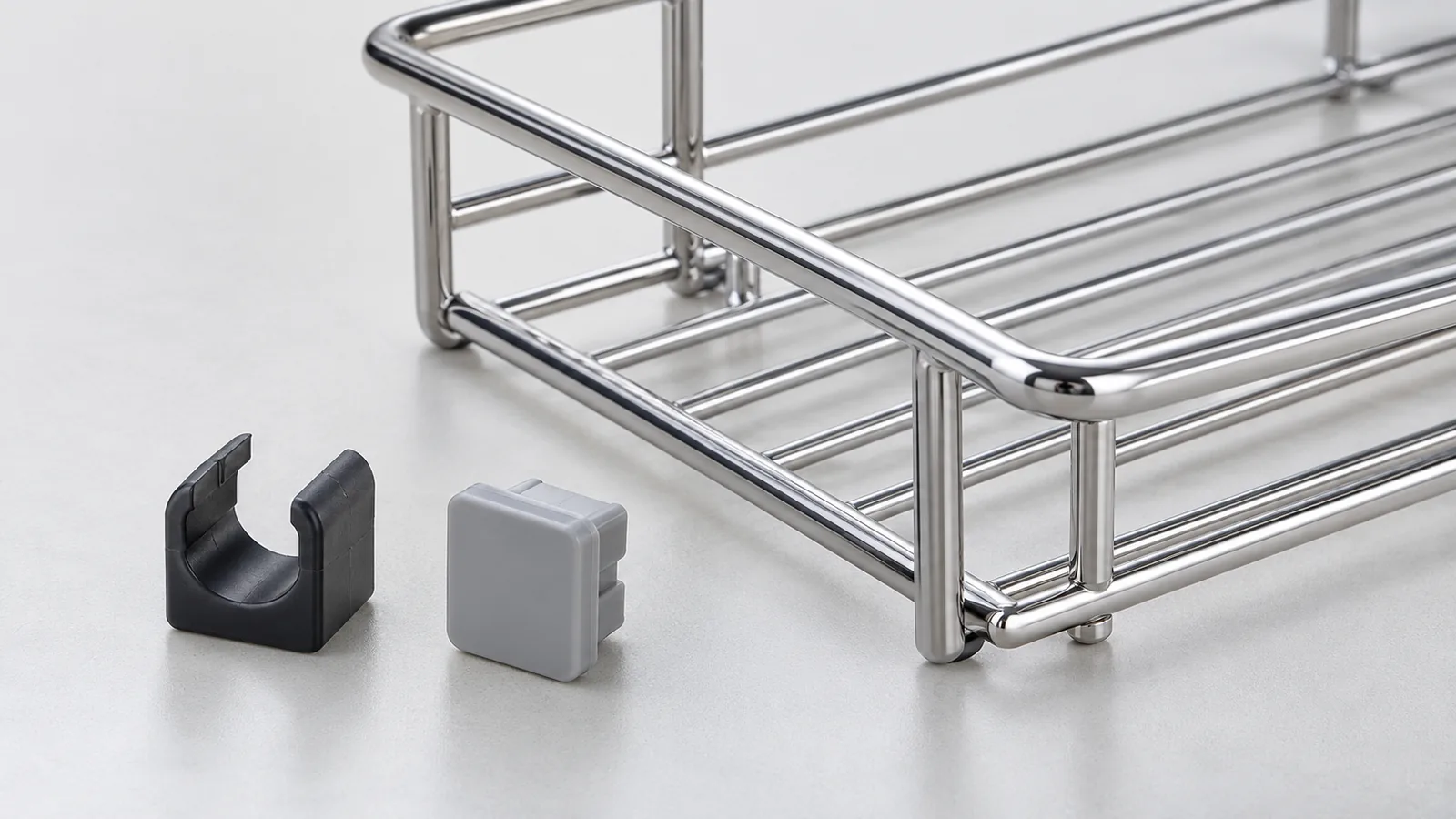
Buyers comparing plastic PBT versus PA66 moisture dimensional stability should not choose by resin name alone. For a purchased clip or cover used with a metal bathroom or home-storage rack, the decision depends on the exact grade, reinforcement, part geometry, conditioning, temperature and fit requirement. PBT grades are often selected where low moisture uptake and dimensional stability are useful, while PA66 properties are more sensitive to moisture conditioning; neither label by itself proves that a finished component will fit or last in a particular application. Ask the component supplier for grade-specific data and approve representative parts under defined conditions.
Why does moisture-related dimensional stability matter for rack clips and covers?
A clip can look correct when dry and still become difficult to assemble, loose, stressed or misaligned after storage and use conditions change. The practical concern is not abstract resin comparison: it is whether a bought-in plastic part keeps the dimensions and behavior needed at its interface with a metal wire, tube, bracket or cover.
Small dimensional changes may matter when a clip snaps over a wire, locates a shelf, hides a joint or retains an accessory. The effect depends on the design. Clearance, wall thickness, rib direction, snap features, molding variation and the metal part’s tolerance all influence fit. A material datasheet cannot evaluate that complete assembly.
The phrase plastic PBT versus PA66 moisture dimensional stability therefore describes a supplier-qualification question, not a universal winner. Start with the function of the component and identify which dimensions are critical. If the part is only a cosmetic cap, appearance and retention may dominate. If it carries load or keeps an assembly from shifting, the interface and retention condition need closer review.
What do PBT and PA66 supplier data actually tell a buyer?
PBT and PA66 are different polymer families, and published data should be read grade by grade. BASF describes its Ultradur PBT portfolio as including grades with low moisture absorption and dimensional stability, while its technical materials also distinguish grades and conditions, including hydrolysis-resistant products for particular requirements. BASF’s Ultramid PA materials show moisture behavior that varies by grade and relative humidity. These manufacturer references explain why buyers should request the exact commercial grade and its test conditions rather than copy a generic family-level value into a specification.
Useful evidence includes the grade designation, whether the compound is unfilled or reinforced, the test method, specimen preparation, conditioning, temperature, humidity and the property being reported. A reported equilibrium moisture value, dimensional change, tensile property or heat-deflection value is not interchangeable with another measure. Values from different methods or conditioning states should not be compared as though they describe the same service condition. For example, BASF’s Ultradur PBT portfolio describes low water absorption and dimensional stability among portfolio characteristics; its Ultramid polyamide portfolio spans multiple PA families and grades. These are manufacturer portfolio references, not proof that an unspecified clip uses one of those grades or will meet a particular assembly requirement.
For a purchased component, request the supplier’s technical data sheet and confirm that the offered grade matches the sample and production part. If the supplier proposes an equivalent grade, ask for the exact grade name and a written change declaration. “PBT” or “PA66” alone is not a complete material specification.
How should buyers compare the alternatives without overgeneralizing?
Use a decision table that separates the material-family tendency from the evidence needed for the actual part.
| Buyer question | PBT route: evidence to request | PA66 route: evidence to request | What remains project-specific |
|---|---|---|---|
| How does moisture affect the selected grade? | Exact grade data, method and conditioning state | Exact grade data across relevant conditioning states | Actual exposure and acceptance dimensions |
| Is the part reinforced? | Filler type and content, if applicable, plus grade sheet | Filler type and content, if applicable, plus grade sheet | Flow direction, geometry and local stiffness |
| Will it fit the rack interface? | Dimensioned sample measured at agreed points | Dimensioned sample measured at agreed points | Metal tolerance, snap geometry and assembly force |
| Is the sample representative? | Supplier lot/grade identification and sample-to-production confirmation | Supplier lot/grade identification and sample-to-production confirmation | Process and supplier change control |
| Does the data prove bathroom service life? | No; it supports a material comparison only | No; it supports a material comparison only | Cleaning, temperature, loading, design and field conditions |
A family-level statement such as “PBT absorbs less moisture than PA66” can be a useful screening clue, but it is not a substitute for grade-specific documentation. Reinforcement, additives and product design can change the relevant properties. Similarly, a data-sheet result under one conditioning protocol does not automatically predict dimensions after a different environment or service history.
Do not select a resin solely because one number appears lower. First define the allowable dimensional range and what constitutes acceptable assembly: a clip that is too tight can be difficult to fit or create stress; one that is too loose may move or fail to retain the intended position. Those outcomes depend on geometry and tolerances, so they need sample-level verification.
What should be checked on a representative sample?
Review samples as components in the intended metal assembly, not as loose plastic pieces. Record the part identification, supplier, proposed grade and sample revision. Check critical dimensions using a method suitable for the feature and agree when measurements are taken after conditioning. A visual check can identify obvious flash, short shots, cracks, warpage or inconsistent appearance, but it cannot establish resin identity or prove hidden material properties.
The assembly review should include the intended wire or tube size, insertion direction, retention feature, contact area and any cosmetic gap that matters. Compare multiple samples when available. Note whether installation requires unusual force, whether the clip rocks or shifts, and whether removal damages the component. These are observations for that design, not universal acceptance limits.
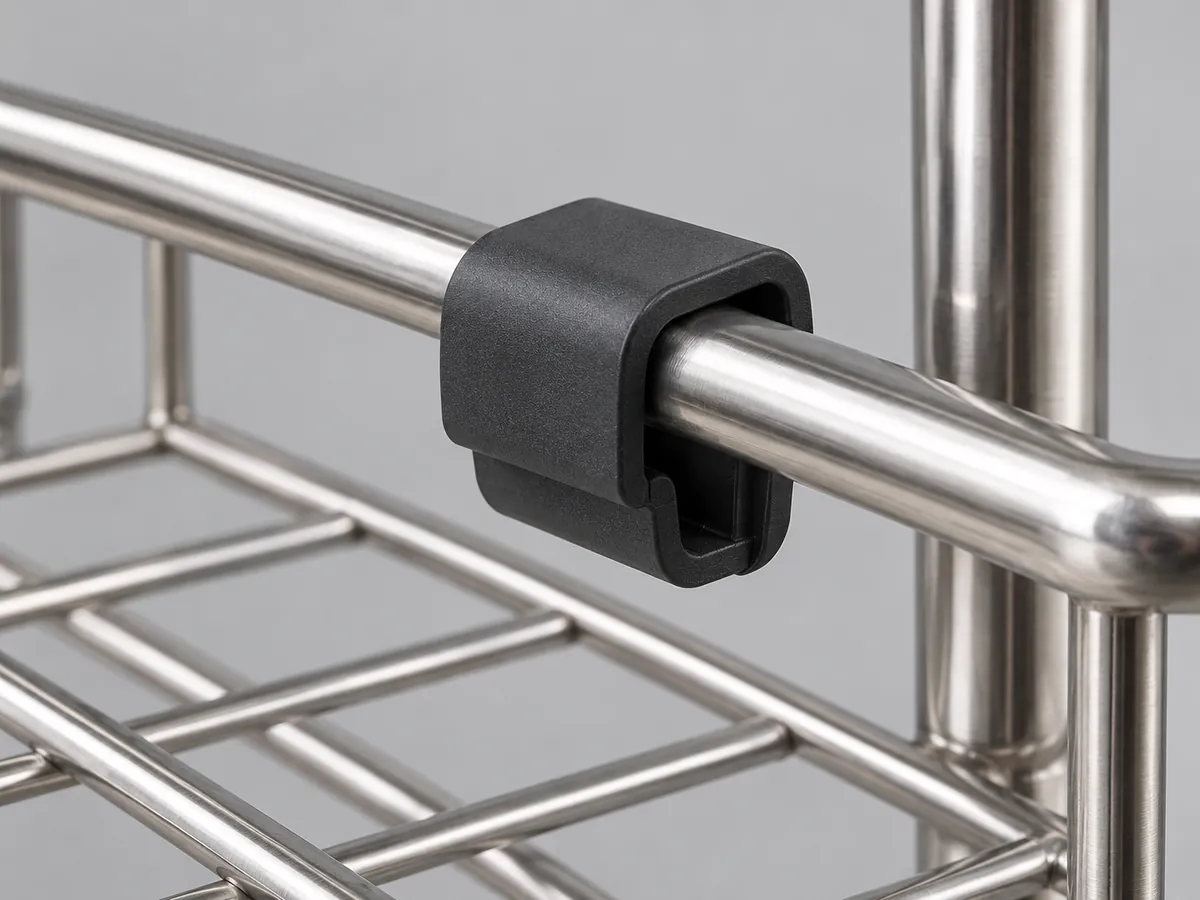
If moisture conditioning matters to the application, agree a representative conditioning method with the component supplier before testing. Record the method, duration, temperature and humidity, and measure the same critical points before and after. Do not invent a conditioning period or claim that an informal soak represents every bathroom environment. Where performance is safety-critical or a formal compliance claim is needed, use an appropriate qualified testing plan rather than treating an article checklist as a test standard.
How can buyers keep sample approval meaningful for production?
A sample is useful only when its identity and route are traceable. Ask the supplier to state the material grade and whether the sample is made with the intended production resin, tooling and process. A hand-finished prototype or an unidentified sample may help assess shape, but it cannot prove production consistency.
Define which changes require buyer notification or reapproval. These may include resin grade, filler content, supplier, mold or cavity, key dimensions, colorant, geometry, or the metal interface. The list should be tailored to the component. Keep an approved reference sample or dimension record where practical, and link it to the drawing revision and purchase specification.
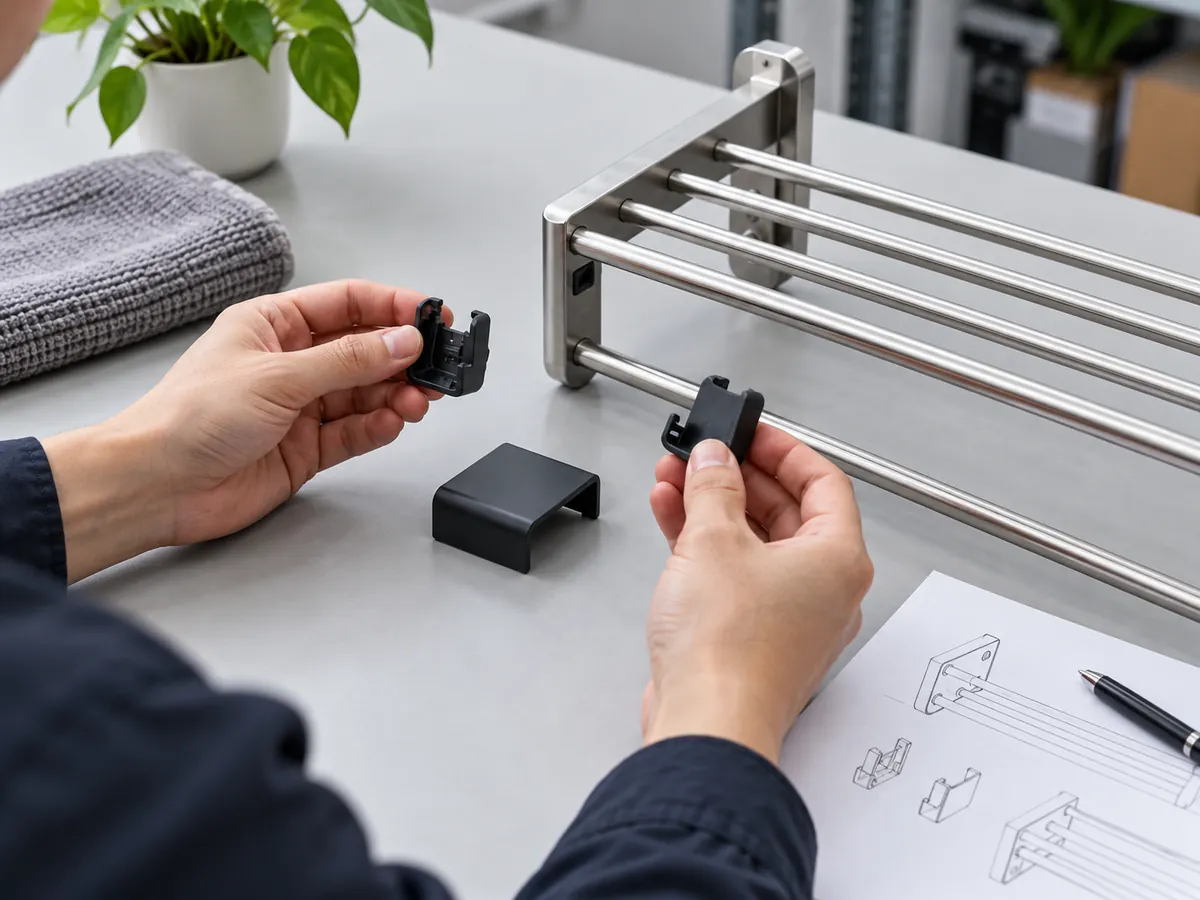
For plastic PBT versus PA66 moisture dimensional stability, the buyer’s approval record should capture what was actually evaluated: sample identity, measured features, conditioning state, assembly observations and any open risks. It should not imply that the entire product has passed a durability test when only a fit review occurred.
What belongs in the RFQ for a purchased plastic clip or cover?
A concise RFQ can prevent the material label from hiding important differences. Include the part drawing or a controlled sample, intended function, mating metal dimensions, critical-to-fit features, finish or appearance needs, environment, expected assembly method and order quantity. Request the exact grade and data sheet, and state whether substitutions require approval.
Separate supplier declarations from buyer acceptance criteria. For example, the supplier can identify a proposed grade and provide its published data; the buyer defines the critical dimensions, sample evaluation and change-control requirements. If the supplier cannot disclose proprietary formulation details, agree what material identification and consistency evidence can be provided without requiring confidential recipe disclosure.
Koitor’s documented scope is custom metal bathroom and home-storage hardware, not plastic resin manufacture. Where a product uses a purchased plastic component, buyers should confirm which supplier owns that part and who is responsible for material documentation. Koitor can discuss the metal product interface and the information needed for an OEM review, but this does not establish that Koitor molds PBT or PA66 components.
What should buyers include in the RFQ and approval checklist?
A useful RFQ connects the polymer component to the assembled product. Include the relevant metal dimensions and drawing revision, expected fit or retention function, cosmetic surfaces, intended cleaning and exposure conditions, and the way the part is assembled or replaced. If the clip is supplied as part of a finished rack, identify which party controls the polymer component and who must notify the buyer of changes. This avoids treating a component data sheet as if it were a complete product specification.
Where the buyer cannot prescribe a grade, ask the supplier to propose one and state what evidence accompanies the proposal. The buyer can then compare candidates against the same intended function and acceptance points. Avoid mixing an initial sample approval with a separate durability or regulatory claim; each needs a defined purpose and evidence.
Which sourcing mistakes create avoidable fit problems?
- Approving by family name only. “PA66” or “PBT” does not identify the exact grade, reinforcement or conditioning state.
- Comparing unlike data. Values measured by different methods or at different humidity and temperature conditions do not make a direct comparison.
- Checking only a loose component. The mating wire, tube or bracket dimensions are part of the fit system.
- Treating a prototype as production proof. Confirm the sample’s grade, tooling and process before relying on it.
- Changing material without rechecking the interface. A change can affect stiffness, shrinkage, dimensions, appearance or assembly behavior; its effect depends on the grade and design.
- Claiming service life from one datasheet. A material property is not a guarantee for a complete rack under unknown cleaning, loading and environmental conditions.
These controls are practical sourcing guidance, not a declaration that one family always fails or that a particular component will change by a fixed amount.
Buyer checklist before approving the component
- Identify the component function and the metal feature it mates with.
- Specify the exact proposed grade, including reinforcement where applicable.
- Obtain the current technical data sheet and preserve its test conditions.
- Agree critical dimensions, measurement points and fit observations.
- Confirm sample identity and whether it represents the planned production route.
- Define conditioning requirements only when they reflect the intended application.
- Record changes that require notification or reapproval.
- Clarify whether the plastic part is bought-in and which supplier provides its evidence.
- Keep material evidence separate from finished-product claims or guarantees.
Foire aux questions
Is PBT always more dimensionally stable than PA66?
No universal rule should replace grade- and condition-specific evidence. Published PBT data often highlights low moisture absorption, while PA66 data shows moisture-related behavior that depends on grade and conditioning. The buyer still needs the offered grade, test conditions and finished-part fit evidence.
Can a supplier’s resin datasheet prove that a clip will fit?
No. It describes specified material properties under stated conditions. Fit also depends on component geometry, molding variation, mating metal dimensions and the agreed acceptance method.
Should buyers require a moisture test for every plastic accessory?
Not automatically. The need depends on the component’s function, exposure, fit sensitivity and consequences of dimensional change. Define the question first, then agree a representative method with the supplier or qualified test provider.
Does an approved sample guarantee mass-production consistency?
No. The sample establishes a reference only for the identified material, revision and process conditions. Buyers should define change control and appropriate production verification separately.
Who should provide the polymer grade information?
The supplier responsible for the plastic component should identify the offered grade and provide available technical documentation. For a hardware assembly, clarify responsibility among the component supplier, assembler and brand owner.
Collaborez avec Koitor Hardware
Review a Metal Rack Interface Before Approving a Purchased Plastic Part
Share the drawing or sample, mating metal dimensions, intended function and the supplier’s proposed material information. Koitor can discuss the metal hardware interface and OEM review inputs; plastic molding capability is not implied. See the home-storage hardware OEM overview for the metal-product scope.
Fabrication pour compte de tiers / Marque de distributeur
Transformez ce guide d'approvisionnement en cahier des charges
Indiquez-nous le produit souhaité, ses dimensions, sa finition, la quantité commandée et vos exigences en matière d'emballage. Votre équipe recevra une analyse pratique de la faisabilité de la fabrication avant l'établissement du devis.
 English
 Español
 Português
 Français
 Deutsch
 العربية