

For a US buyer checking US antidumping boltless steel shelving China orders, the starting point is the specific written scope—not the broad description “metal shelving,” a supplier’s product name or an HTS number alone. In September 2026, the USITC made affirmative five-year review determinations, and Commerce published continuation of the existing antidumping and countervailing duty orders, effective September 29, 2026. That confirms the orders remain in place; it does not decide whether a particular SKU is covered or state the importer’s current cash-deposit rate. Buyers should compare their exact product and package configuration with the order text, then have a customs professional confirm scope, classification and entry-specific requirements.
The search expression “US antidumping boltless steel shelving China” describes the buyer’s research topic, not a legal product category or a conclusion about coverage.
Scope note: This is a sourcing and document-preparation guide checked against official USITC and Federal Register records on October 23, 2026. It is not legal advice, customs classification, a scope ruling, a duty calculation or a guarantee that any product is included or excluded. Recheck the official record and obtain advice for the actual entry.
What did the 2026 sunset review change?
The 2026 five-year review did not create a universal duty on steel racks. The USITC said revoking the existing orders on boltless steel shelving units prepackaged for sale from China would likely lead to continuation or recurrence of material injury. Commerce then published a notice continuing the existing AD and CVD orders. The notice says the continuation is effective September 29, 2026.
The buyer-relevant distinction is between the review outcome and an entry decision. A sunset review determines whether an order will be revoked or remain in place; it is not an individual ruling on a buyer’s SKU. Coverage, applicable order instructions, exporter/producer information, entry date and cash-deposit treatment are separate questions. Do not copy a rate from an old quotation or assume one rate applies to every exporter and shipment.
The USITC’s September 15, 2026 determination summarizes its injury finding. The controlling continuation notice is the Commerce Federal Register notice for the China boltless shelving orders. Use these as dated records and look for later instructions before shipment.
Which product configuration is described in the order?
The notice describes boltless steel shelving units prepackaged for sale, with or without decks. It defines the minimum relevant package around the steel vertical supports—such as uprights or posts—and horizontal supports—such as beams or braces—needed to assemble a completed shelving unit for the end user. Add-on kits are also included in the written scope.
“Boltless” refers to frames assembled primarily without nuts, bolts or screws, for example by fitting tabs, rivets or similar connectors into slots or holes. The order says incidental use of screws or bolts for accessories, wall anchors, tie-bars or shelf supports does not by itself remove otherwise described shelving from scope. Some covered units may arrive partially assembled, such as welded end frames packaged with the remaining required components.
For that reason, do not send a marketing photo alone as the package record. Record the contents of the actual sales unit, whether enough uprights and horizontal supports ship together for a complete shelf, whether it is an extension kit, and which items are shipped separately under the commercial transaction. Keep carton-level and SKU-level records consistent with the goods actually ordered and entered. A packaging description helps the professional compare facts with the order; it does not itself decide legal scope, and it should never be altered or selectively documented to avoid a trade measure.
The order also lists exclusions, including wall-mounted shelving that does not stand on or transfer load to the floor; a specifically described type of wire shelving with wire decks and supports plus collars and sleeves; bulk-packed parts or components; and made-to-order shelving systems. These are descriptions to compare against—not shortcuts to self-classify a product from one photograph or one packaging label.
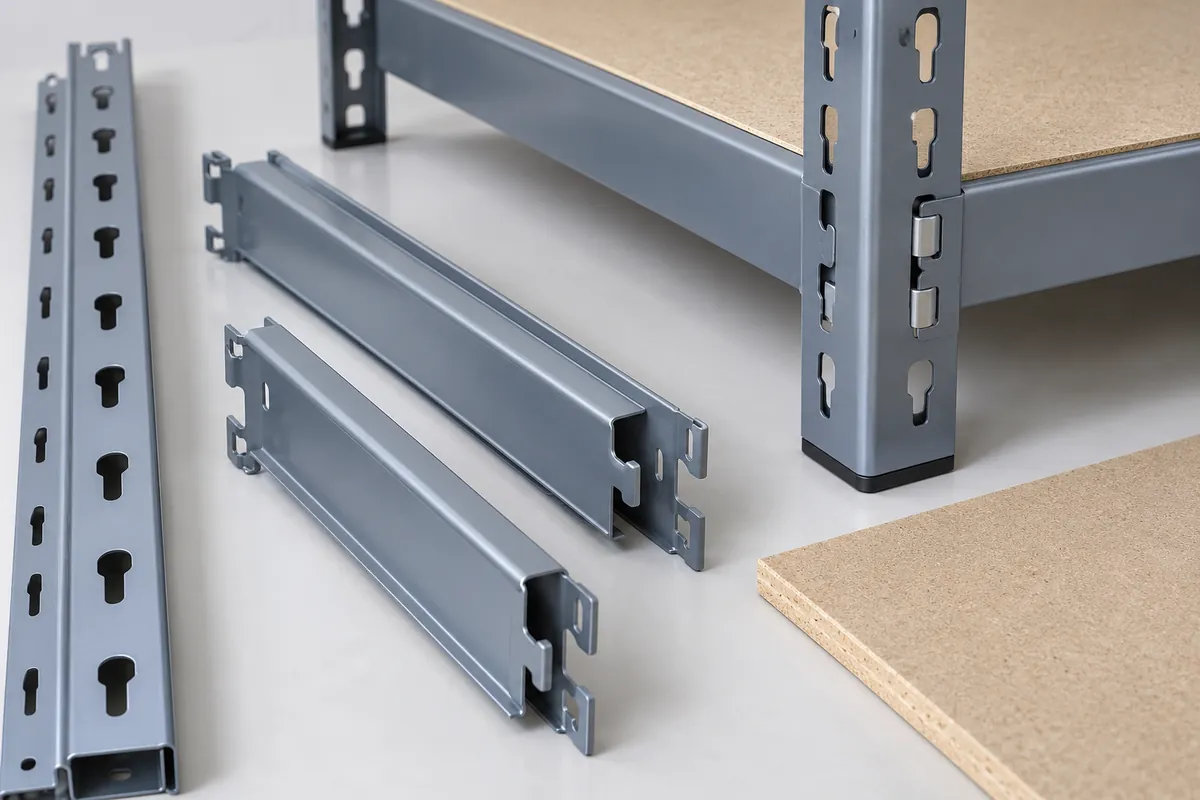
This image is a generic educational illustration, not a Koitor catalogue product and not a legal determination that any pictured configuration is covered.
What evidence should an importer assemble before asking about scope?
Build a revision-controlled SKU file that lets a broker or trade counsel compare the imported goods with the written order. Ask the supplier for product facts; keep the supplier’s description separate from the importer’s legal conclusion.
| Evidence to collect | Useful detail | Pourquoi est-ce important ? |
|---|---|---|
| Product identity | SKU, model, sales description and drawing revision | Prevents a generic “rack” label from substituting for the actual article |
| Complete package contents | Uprights, beams, braces, decks, connectors, accessories and quantities | Helps assess whether the package contains the components described for assembly |
| Assembly method | Slot/tab, rivet, bolt, screw, welded subassembly or a combination | “Boltless” is defined by the primary frame connection, while incidental fasteners may remain |
| Packaging and sales unit | Retail box or other unit, package-level BOM, whether components ship together or separately | The order is specifically for shelving units prepackaged for sale; package facts should be documented accurately |
| Origin and production | Country-of-origin support and relevant production records | Supplier location alone does not establish the customs origin of the imported merchandise |
| Entry information | Planned entry date, importer, producer/exporter and broker’s proposed classification | Current order instructions and entry facts must be checked for that shipment |
Useful attachments include the assembly drawing, bill of materials, photographs of each component and the final retail package, assembly instructions, purchase order, commercial invoice description and origin documents available for the SKU. Label each file with the same model and revision. If the design or package changes, update the file rather than reusing an old scope review.
Do HTS numbers decide whether shelving is covered?
No. The Federal Register notice lists several HTSUS statistical subheadings where subject shelving may enter, but explicitly states those headings are for convenience and customs purposes; the written scope description is dispositive. A tariff heading can help a broker find the right customs questions, but a heading alone does not answer whether the product meets the order’s description.
Equally, a product’s marketing name is not decisive. “Storage rack,” “garage shelf,” “boltless shelf,” “wire rack” and similar terms may be used inconsistently across suppliers. Compare the imported configuration to the full order language, including its definition, inclusions, exclusions and package requirements. If the comparison remains unclear, ask the broker or counsel whether a formal scope inquiry or ruling is appropriate before relying on a classification assumption.
How should a buyer distinguish order status, scope and cash deposits?
Treat these as three separate workstreams. Order status asks whether the orders remain active. Scope asks whether the exact merchandise is described by the order. Cash-deposit or duty treatment asks what current official instructions apply to a particular entry, exporter/producer and date. Evidence for one workstream does not settle the others.
| Question | What the official notice can establish | What still needs entry-specific review |
|---|---|---|
| Did the 2026 reviews end the orders? | Commerce published continuation after affirmative Commerce and ITC review determinations | Check later official instructions or amendments |
| Is this SKU covered? | The written scope, definitions and exclusions provide the comparison framework | Full product, package, origin and transaction facts; obtain a broker/counsel assessment |
| What rate or deposit applies? | The notice says CBP will continue collecting at rates in effect at entry for subject merchandise | Current instructions, applicable exporter/producer treatment and actual entry details |
| Can the supplier quote the landed cost? | The notice does not calculate a buyer’s total landed cost | Confirm duty treatment with the importer’s customs adviser and calculate other costs separately |
Do not describe an order continuation as a final rate announcement for a named product. Do not promise a customer that a product is exempt merely because its sales listing uses a different name, it has a different finish, or a supplier ships a component separately. Packaging changes should be accurately disclosed and reviewed; they are not a compliance strategy to evade an order.
What should buyers ask the supplier and customs broker?
Send the broker a concise, factual package and request a written explanation of assumptions. Ask the supplier to confirm only facts it can substantiate: the model and revision, material and component list, assembly method, what is packed together for each sales unit, manufacturing location and origin documents. Koitor Hardware can discuss documented construction or material facts for its own quoted metal storage hardware, but does not determine US trade-remedy coverage or rates.
Questions for the broker or trade counsel include:
- Does the complete configuration appear to match the order’s defined product, including its prepackaged-for-sale element?
- Do any stated exclusions plausibly apply to the actual product, and what evidence supports that reading?
- Which classification and current Commerce/CBP instructions apply to the planned entry?
- Are exporter- or producer-specific instructions relevant to the proposed supplier and date?
- Is a formal scope inquiry warranted before issuing a customer quotation or placing a shipment?
- What records should the importer retain if the SKU, package or supply chain changes?
For product-development context, buyers can review Koitor’s home-storage hardware OEM manufacturing page. Product construction information can support a review, but the importer and its customs professional remain responsible for legal and customs decisions.
What should be on the pre-shipment checklist?
Before confirming an order or shipment, make sure the buyer’s file contains:
- [ ] Final SKU, assembly drawing and revision-controlled bill of materials.
- [ ] A clear list of everything packed in each retail or sales unit.
- [ ] Photos of uprights, beams, connectors, decks, accessories and the package configuration.
- [ ] A description of how the frame connects and which parts are preassembled.
- [ ] Origin information and supplier evidence for the actual merchandise.
- [ ] Broker-confirmed classification rationale and current order/scope review.
- [ ] Entry-specific instructions checked for exporter/producer and planned date.
- [ ] A documented escalation path if the scope comparison is uncertain.
- [ ] A change-control trigger requiring review after any material, design, package, origin or supplier change.
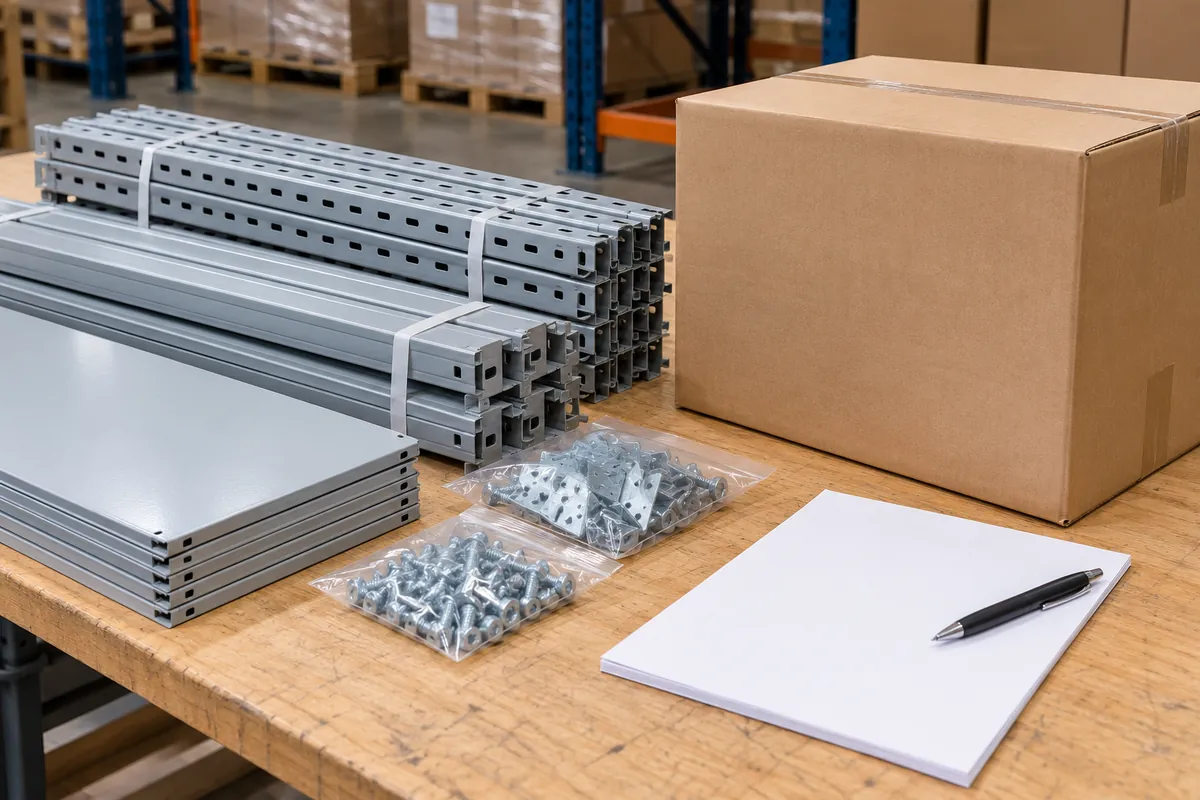
The blank sheet and generic parts in this image are illustrative only. It is not an official customs document, broker ruling or determination of AD/CVD coverage.
Does the 2026 continuation mean every Chinese steel rack has an AD/CVD deposit?
No. The notice continues the orders for merchandise within their written scope; it does not declare that every steel rack, bathroom organizer or storage product from China is covered. Match the exact goods and entry facts to the current official order and seek professional advice.
Does “boltless” mean a product cannot contain any screw?
Not necessarily. The order describes the primary frame assembly as boltless and says incidental fasteners for certain accessories, anchors, tie-bars or supports do not remove otherwise covered shelving from scope. Review the precise product design and complete notice rather than relying on the word alone.
Are bulk-packed components automatically the same as a complete shelf?
The notice lists bulk-packed parts or components among exclusions, while also defining covered packages and including add-on kits. A buyer should document how the exact goods are sold and imported and obtain a case-specific interpretation; changing packaging or splitting an order does not itself establish an exclusion.
Can the HTSUS number or product photo confirm coverage?
No. The notice says its tariff subheadings are provided for convenience and that the written scope controls. Photos help document geometry, but the complete product description, package, origin and entry details may also matter.
What did the 2026 sunset review establish?
The official records state that Commerce and the USITC made affirmative determinations and Commerce continued the existing AD and CVD orders, effective September 29, 2026. That is an order-status result, not a product-specific scope ruling or an individual importer’s rate calculation.
The practical takeaway is to treat the 2026 continuation as a reason to check the exact boltless shelving configuration—not as a blanket tariff statement. A buyer searching “US antidumping boltless steel shelving China” should keep product, package and origin evidence together, then ask a customs professional to confirm the current order and entry treatment before relying on a landed-cost assumption.
Prepare a Clear Product Configuration File
Share a revision-controlled drawing, package bill of materials and documented construction questions for a product-development discussion. Confirm trade-remedy scope and entry treatment with your customs professional.
Fabrication pour compte de tiers / Marque de distributeur
Transformez ce guide d'approvisionnement en cahier des charges
Indiquez-nous le produit souhaité, ses dimensions, sa finition, la quantité commandée et vos exigences en matière d'emballage. Votre équipe recevra une analyse pratique de la faisabilité de la fabrication avant l'établissement du devis.

 English
 Español
 Português
 Français
 Deutsch
 العربية