
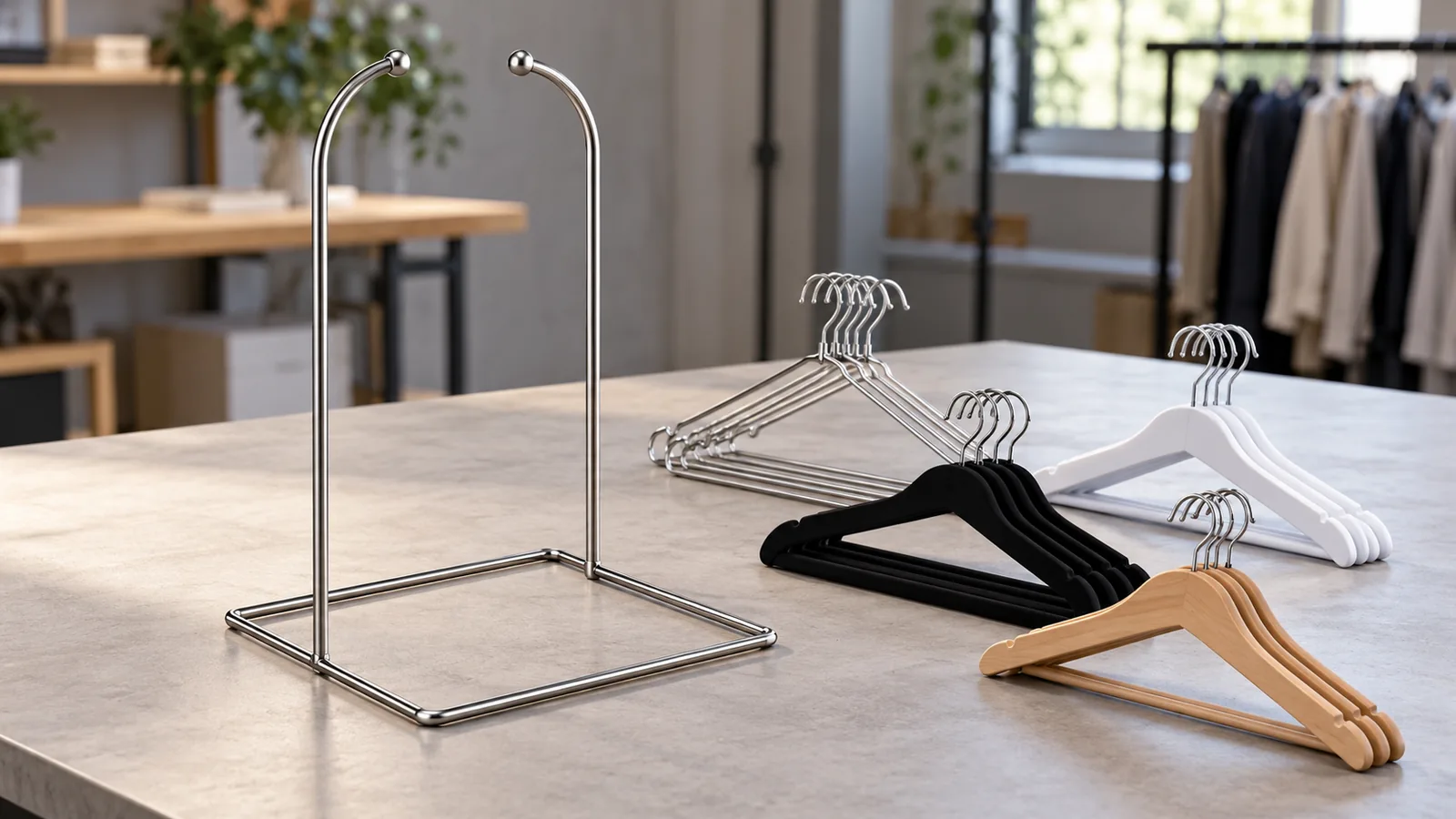
A metal hanger stacker rack should be specified against the actual hangers a buyer expects customers to store and retrieve. “Fits all hangers” is not a useful release criterion: wire, velvet-covered, molded-plastic and wooden hangers can differ in hook shape, shoulder width, thickness, clips and surface finish. For a compact freestanding home or laundry model, importers should define a representative hanger set, check loading and removal one hanger at a time and in a small group, and record the intended stack height and base footprint. Approve those interactions on a production-representative sample before publishing compatibility, capacity or stability claims. This guide concerns compact household stackers for empty hangers, not tall garment-store collection fixtures.
Loose empty hangers can occupy a basket, shelf or floor area and become difficult to separate when several styles are mixed. A compact stacker attempts to hold a group of empty hangers in a defined orientation so that they can be stored together and removed as needed. The product decision is therefore not only whether the frame can hold hangers. A buyer also needs to know which hanger types fit, how the first and last hangers are loaded, whether the user can retrieve one without dragging several others along, and whether the stand remains acceptably steady in its intended location.
Search results reveal two different product contexts. Compact countertop or shelf-size household products are presented for laundry rooms and closets, while tall upright units are marketed for garment stores, stockrooms or checkout areas. Their dimensions, intended user motions and packaging needs differ. Do not combine them under one vague “hanger organizer” specification. This article focuses on the compact household form. If a buyer is developing a retail backroom fixture, its working height, transport function, batch handling and floor footprint need a separate review.
The buyer question for a metal hanger stacker rack should be concrete: which hanger references, storage location and retrieval actions must the sample support? An online listing can help a team identify product forms, but its stated fit or capacity does not prove the fit of another design. For example, Target’s compact steel stacker listing notes that the number of hangers depends on their size and thickness. A tall retail hanger stacker listing describes a different upright format and distinguishes hanger styles. These are examples of how products are described, not performance evidence for a proposed OEM item.
Which reference hangers should buyers define?
Start with the buyer’s assortment rather than an abstract universal hanger. List the hanger constructions likely to be used: thin wire, coated or velvet-covered slim hangers, molded plastic, wood, and clip or trouser hangers if the intended customer uses them. The list should identify actual representative models or physical samples. “Plastic hanger” alone may hide a large shoulder profile, a thick neck, a swivel hook or protruding clips that change how it sits on the frame.
For each reference, capture the dimensions that affect contact and movement. Useful measurements may include overall shoulder width, body thickness at the support region, hook wire diameter, inside hook opening, hook orientation, neck or throat width, and any clip projection. The exact critical measurements depend on the proposed stacker geometry; a drawing should mark the points buyers and factories will use consistently. Include a photograph of the hanger hanging naturally and another view showing the hook and neck. Record the model, material and source so a later replacement sample is not mistaken for the approved reference.
A practical matrix can separate fit from retrieval:
| Hanger reference | Geometry to record | Sample action | Acceptance question |
|---|---|---|---|
| Thin wire | Hook diameter, hook opening, shoulder outline | Load and remove singles and a small group | Does the hook catch, cross or slide out of the intended path? |
| Velvet-covered slim | Coating thickness, shoulder width, hook-to-body transition | Check adjacent hangers and removal angle | Does the coating snag or create friction that changes retrieval? |
| Molded plastic | Neck thickness, shoulder width, hook rotation, notches | Test the largest intended profile | Does the hanger clear the uprights and neighboring shoulders? |
| Wooden or clip style | Body thickness, hook projection, clip envelope | Load the buyer’s actual model separately | Do the larger body or clips collide with the frame or base? |
Do not assume that the “largest” hanger is the only important reference. A slim hanger may slip through a wide opening or sit at an unexpected angle, while a broad hanger may interfere with a rail or reduce usable stack height. A mixed assortment can expose interactions that never appear when the stacker is loaded with one uniform type. Select boundary cases and representative everyday models, then identify which combinations are intended to work together. If some types are incompatible, specify a separate configuration or state the limitation accurately.
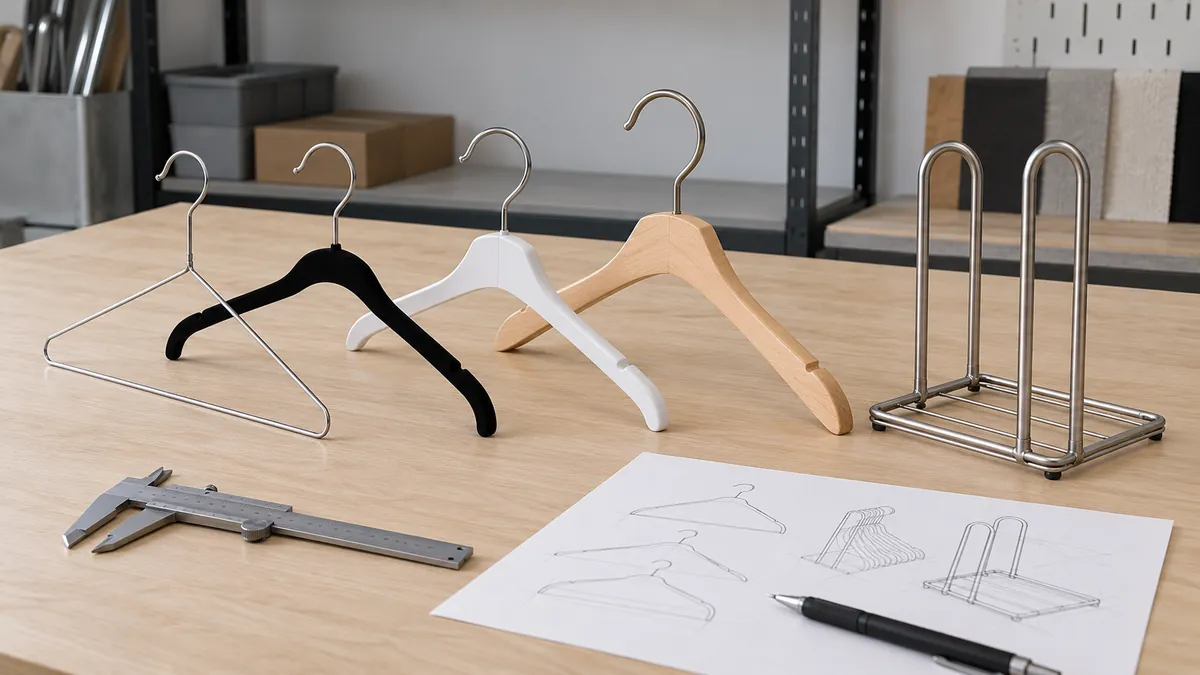
How should the frame geometry be specified?
Define outside dimensions and functional clearances separately. The overall height, width and depth help establish whether the product fits a shelf, counter or cabinet, but they do not explain how hangers engage with it. A buyer should identify the distance between supports, the shape and spacing of contact rails, the open path through which hooks enter or leave, and any cross-member that could obstruct a hanger body. Dimension the design from stable drawing datums and make clear whether measurements refer to bare metal or the finished surface.
Next, check the location envelope. Measure the intended storage space, including shelf depth, nearby wall or cabinet sides, door movement, and the clearance required to lift a hanger out. A unit can fit on a shelf but be frustrating if a cabinet shelf above prevents removal, if a rail is too close to a wall, or if the product must be tilted past a lip. Confirm the space needed for the user’s hand and the hanger’s movement path. A photograph of a product beside a ruler rarely captures that path.
Stack height also needs a defined use condition. Identify whether the buyer expects hangers to be placed onto the frame from above, slid onto an accessible side, or loaded in another sequence. Check the lowest and highest intended hanger positions and whether the structure leaves enough room to grasp a hanger at the bottom. A nominal count cannot replace a stated usable height and a repeatable loading arrangement. If the product is meant to hold several hanger shapes, record the tested combination and order rather than multiplying the count from a single thin-wire example.
A drawing and sample approval record should answer:
- What are the overall width, depth and height, and which surfaces set each dimension?
- What is the clear opening between supports and the usable vertical stack zone?
- Which crossbars, joints, caps or feet intrude into the hanger path?
- What is the specified base footprint and the location of each support point?
- Which hanger models were used for fit review, including the buyer’s largest and slimmest cases?
- Which surface, shelf and nearby obstructions were used when checking insertion and retrieval?
A dimension change can alter several of these interactions at once. Moving uprights outward may increase clearance for a shoulder but change the footprint or the angle at which hangers sit. Raising the stacker may provide more storage height but make retrieval less convenient in a low cabinet. Treat each design revision as a new fit question and update the drawing, sample record and related product copy together.
How should buyers test loading, retrieval and stability?
Use a short, repeatable sample protocol. First inspect the unloaded unit: confirm the dimensions, weld locations, frame alignment, edge condition, feet or contact pads, finish and any assembly joints against the approved drawing. This is a visual and dimensional check, not proof of load capacity or long-term durability. Record deviations rather than silently bending or adjusting the sample, because a hand-corrected sample may not represent the production process.
Then load the named hanger references. Try single hangers, a small group of the same type, and the mixed combinations that the buyer expects to support. Observe whether hooks enter without forcing, whether shoulders cross the rails, whether clips strike the frame, and whether one hanger pulls another along when removed. Repeat the action from the positions a user is likely to reach, including lower and upper positions. Note any required lifting angle, twisting motion or need to hold the stand with the other hand. “Easy to retrieve” should be tied to an observed action and an agreed acceptance statement.
Check the base on the intended surface. A stacker placed on a firm, level laundry counter may behave differently from one on a narrow shelf, a slightly uneven cabinet board or a surface with a raised edge. Record the surface and product orientation. Observe rocking, sliding, lifting of a support point or movement during the defined loading and removal actions. Do not label the base “non-slip” or “tip-proof” from a brief demonstration. If a buyer needs a stability criterion, define the method, surface, loading pattern and pass condition before testing, and use suitable technical review rather than an informal visual judgment.
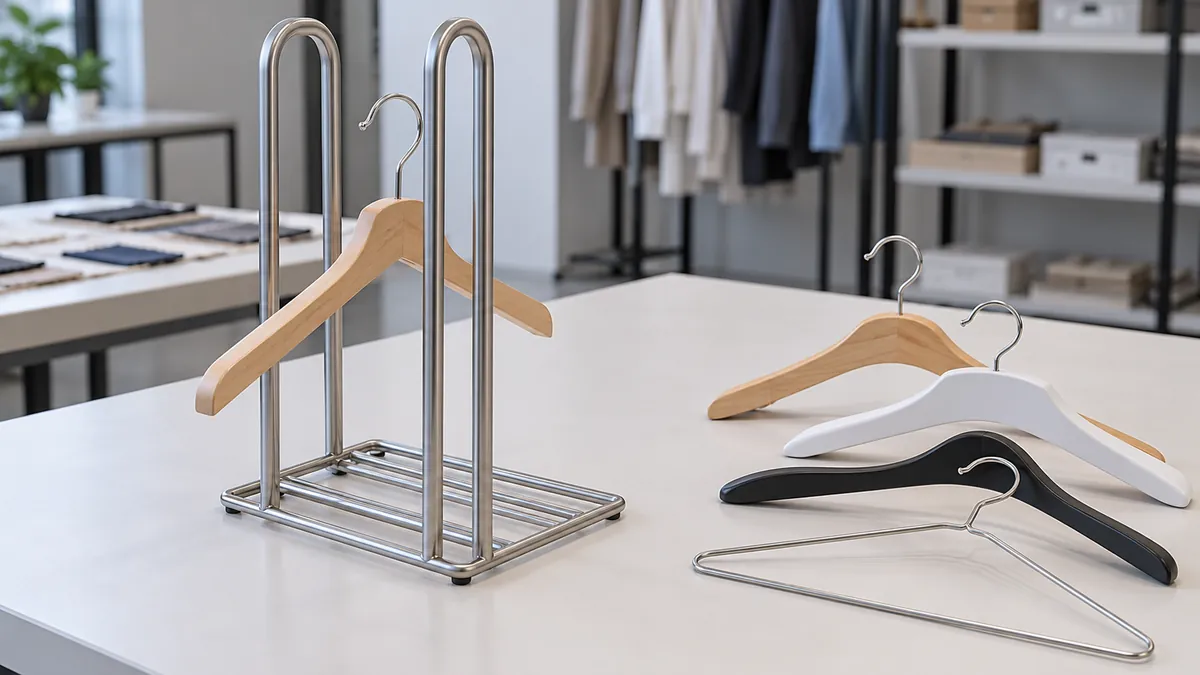
The approval record should identify who performed the evaluation, the sample revision, hanger references, loading sequence, surface, observed interference and decision. Include a short video or annotated photos when hand motions or collision points are difficult to communicate in text. Keep the approved physical sample or a traceable reference set when practical. That makes later production inspections and product-copy review more meaningful than a generic “sample approved” note.
How do material, joints and finish affect the decision?
A compact hanger stacker may use formed rod or wire, tube, sheet details or a combination, depending on the selected structure. The final design and process should be confirmed with the manufacturer from the drawing and sample; this article does not assert that Koitor currently offers this product. For any proposed construction, identify which parts carry contact, which joints keep the frame aligned, and which surfaces will rub against hangers during repeated use. These are the places where geometry, forming, welding, finishing and assembly tolerances can affect the buyer-visible fit.
The buyer should state the required appearance and environment rather than assume a generic “metal” specification is complete. If a coated finish is selected, review color, gloss or texture, coverage at edges and joints, and any masking or contact surfaces that need to remain clear. Check that the finished dimensions still allow the intended hanger path. A coating or protective sleeve at the contact area can change clearance and friction; a polished edge can look different from a coated one. The sample should represent the specified finished condition, because a bare-metal prototype may not show final fit.
For welded constructions, review alignment, visible joint condition, sharp edges and finish consistency on the sample. A clean-looking joint does not establish a rated capacity, and a particular weld method cannot be selected from appearance alone. The joint design, material, section, access and product use matter. Ask the manufacturing partner to identify any drawing features that need adjustment for forming, fixture access, joining, grinding or finishing, then approve those changes before production. Avoid adding decorative crossbars or reinforcements unless they support a stated structural, fit or assembly requirement; extra metal can also block the retrieval path or add packing complexity.
Packaging is part of product approval. A narrow upright frame can rub against its own base or against other parts during shipment. Review how the finish is protected, how components are immobilized, whether assembly hardware is identified, and how the retail or master carton preserves the product’s orientation. If the unit is shipped disassembled, confirm the assembly sequence, fasteners, tool requirements and instructions on a production-representative pack. Check the packed sample, not only the assembled product.
Which mistakes create avoidable fit claims?
The first mistake is approving a sample with only one convenient hanger. A sample loaded with identical slim wire hangers says little about a range that includes thick plastic shoulders, velvet coatings or clips. The second is recording a single capacity number without naming hanger types and arrangement. Listings from different product classes may publish different approximate counts because hanger dimensions and storage geometry vary. Do not copy such a number into another product’s packaging.
Another mistake is measuring overall dimensions while ignoring use clearance. Buyers sometimes verify that a unit fits on a shelf but never try to place or remove a hanger beneath an upper cabinet. A fifth or sixth rail, an added crossbar or a changed foot position can also affect the user path even when the outside dimensions stay similar. Include the critical functional clearance in the drawing and repeat the actual movement at sample approval.
A third mistake is evaluating stability on the wrong surface or in the wrong condition. A stacker may be shown on a broad level tabletop, while the planned retail use is a narrow shelf near an edge. State the surface and loading sequence relevant to the intended market. If stability is an important safety or performance claim, define an appropriate test with the responsible technical party; do not infer it from a single photo.
Finally, teams can separate product, packaging and copy decisions too late. If the sample review excludes the carton, a finish can be scratched before sale. If the marketing team writes “works with every hanger” before a mixed reference set is tested, a minor limitation becomes a return or claim risk. Link the approved configuration to the SKU, drawing revision, sample record, packaging and product description.
How can an OEM partner support development?
A custom metal hardware manufacturer can review a buyer’s drawing or physical references, discuss whether the proposed geometry is practical to form and join, and develop a sample for fit review. For an adjacent storage item such as a hanger stacker, the buyer should treat this as a product-development conversation—not evidence that a particular factory already makes an identical SKU. Koitor’s approved positioning supports custom bathroom and home-storage hardware, drawing/sample development, metal forming and joining, finishing, assembly and packaging preparation; it does not establish a current hanger-stacker model or tested performance.
A useful first RFQ package contains the target storage location, overall envelope, intended hanger list, critical interface dimensions, finish requirements, expected order range, packaging concept and any required product-copy claims. Attach dimensioned drawings where available, photos showing the hanger hook and shoulder profiles, and physical samples if geometry is difficult to convey. Ask the factory to identify assumptions and unresolved questions. If a design change is proposed, ask what fit, finish, cost or packaging consequence it addresses and request that the revision be recorded.
Small-batch sample development can help a buyer evaluate a new assortment before deciding whether to scale it, subject to product complexity, materials and order details. Confirm commercial terms, MOQ, sample timing and production lead time directly for the specific design; do not infer them from a generic article. Koitor’s home-storage OEM overview describes the relevant general category, and the custom kitchen rack manufacturing page provides additional context for custom metal rack discussions. For a project-specific drawing or sample discussion, use the Koitor contact page.
Buyer checklist before requesting a quotation
- Name the exact product scope: compact freestanding household hanger stacker, not a tall store fixture.
- Provide the storage location’s usable width, depth, height, access opening and nearby obstructions.
- List hanger references by material or construction and attach representative models, measurements or physical samples.
- Identify the largest shoulder/body profile, smallest hook, coating thickness and any protruding clips that may affect fit.
- Mark the stacker opening, support spacing, usable stack height, base footprint, contact points and critical clearances on the drawing.
- Define loading order and the single-hanger and mixed-hanger removal actions expected to work.
- Record the surface and location used to observe rocking or sliding; state that this is not a rated test unless a method has been agreed.
- Specify material, finish, color, edge/joint expectations, assembly and packaging requirements.
- State which fit or capacity claims are planned for product listings, and require evidence tied to the approved sample and hanger set.
- Identify sample revision, approval owner, reference hangers, packed configuration and production-change notification needs.
Foire aux questions
Does a metal hanger stacker rack fit every hanger type?
Not automatically. Hook openings, shoulder width, body thickness, clips and surface coatings vary. Buyers should name the hanger references, evaluate the largest and smallest relevant geometries, and check mixed sets. If a design is only approved for selected hanger types, say so clearly.
Can an importer specify a hanger capacity before sampling?
A preliminary target can help size the product, but a published number should be linked to a defined hanger type, arrangement and approval method. A count achieved with thin wire hangers should not be transferred to thicker molded, coated or wooden models without verification.
Should household and retail hanger stackers use the same design?
They may share a broad purpose, but the use conditions are different. Compact household units are constrained by shelf or counter space and hand clearance; taller store fixtures may need a different working height, base and handling approach. Define the product class before comparing dimensions or suppliers.
What should change control cover after sample approval?
Record changes to hanger references, support spacing, height, base, joints, finish, feet, assembly and package. Recheck affected fit or retrieval actions when a change can alter the approved interface, and update the drawing and product claim together.
A buyer gains the most reliable decision by treating the stacker as an interface product: the frame must work with specific hangers, a specific place and a specific retrieval action. Approve those boundaries on a representative finished and packed sample, then keep the compatibility statement no broader than the evidence.
Discuss a Hanger Stacker Drawing or Sample
Share the target hanger references, storage envelope, drawing or physical sample, finish and packaging requirements with Koitor Hardware to discuss the metal part and sample-development questions. Fit and capacity claims still require buyer-defined checks.
Fabrication pour compte de tiers / Marque de distributeur
Transformez ce guide d'approvisionnement en cahier des charges
Indiquez-nous le produit souhaité, ses dimensions, sa finition, la quantité commandée et vos exigences en matière d'emballage. Votre équipe recevra une analyse pratique de la faisabilité de la fabrication avant l'établissement du devis.


 English
 Español
 Português
 Français
 Deutsch
 العربية